



Acapulco Diary
Ed Keck
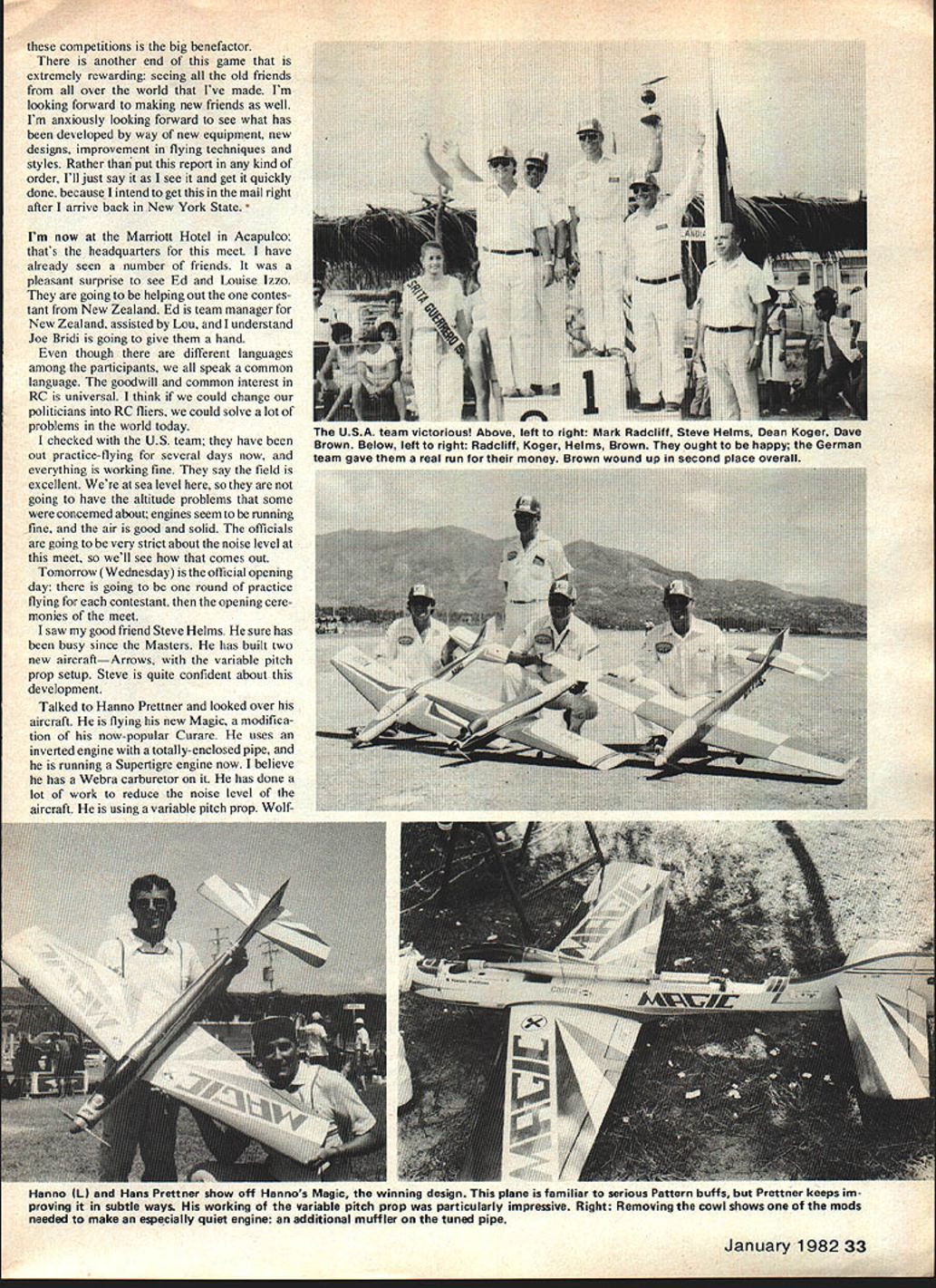
Here is the early word from the 12th RC Aerobatics World Championships in Acapulco, Mexico. Our reporter dictated this "diary" during the event to give a feeling of the competition as it was happening. Hanno Prettner took top honors once more, and the U.S. team placed very well.
Arrival and opening impressions
I thought I'd get a head start on this article on the plane headed for Acapulco. As I'm sitting here, I'm pondering the very first World Championships and our U.S. team at that time: Bob Dunham from the West Coast, Ed Kazmirski from the Midwest, and Harold DeBolt from the East Coast. The first championship meet was held in Switzerland over 20 years ago (1960). We selected a team in the U.S. at that time with one member from the East, one from the West, and one from the Midwestern states.
As RC modelers, we have a great deal to be grateful for to all contestants worldwide. They have certainly advanced the state of the art for radio-control aircraft as we know them today. Tremendous strides—in radio equipment, engines, aircraft, sound control, and propeller design—have come through the dedication of competitors who demand the utmost in reliability and performance. The fun flier at the local field who may never attend one of these competitions is the big benefactor.
There is another rewarding part of this event: seeing old friends from all over the world and making new ones. I'm anxious to see the new equipment, designs, and improvements in flying techniques and style. Rather than put this report in strict order, I'll say it as I see it and get it quickly done because I intend to put this in the mail right after I arrive back in New York State.
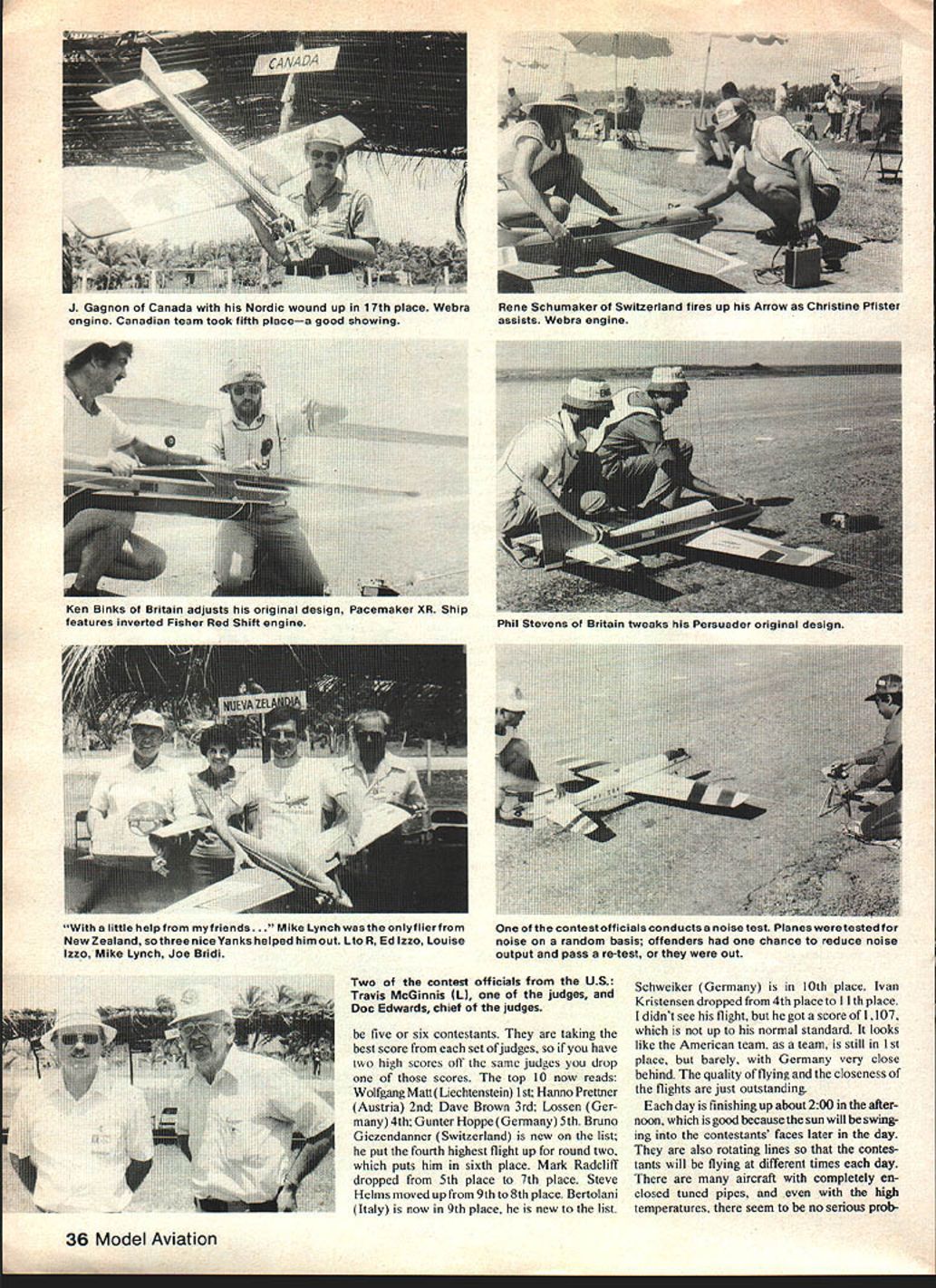
I'm now at the Marriott Hotel in Acapulco; that's headquarters for this meet. I have already seen a number of friends. It was a pleasant surprise to see Ed and Louise Izzo. They are going to help the one contestant from New Zealand—Ed is team manager for New Zealand, assisted by Lou, and I understand Joe Bridi is going to give them a hand.
Even though there are different languages among the participants, we all speak a common language: goodwill and the common interest in RC. I think if we could change our politicians into RC fliers, we could solve a lot of problems in the world today.
I checked with the U.S. team; they have been practice-flying for several days and everything is working fine. The field is excellent. We're at sea level here, so altitude problems some feared are not showing up; engines seem to be running fine, and the air is good and solid. The officials are going to be very strict about the noise level at this meet, so we'll see how that comes out. Tomorrow (Wednesday) is the official opening day: one round of practice flying for each contestant, then the opening ceremonies.
People and equipment
- Steve Helms has built two new aircraft—Arrows—with a variable-pitch prop setup. He is confident about this development.
- Hanno Prettner is flying his new Magic, a modification of his popular Curare. He uses an inverted engine with a totally enclosed tuned pipe, running a Super Tigre engine with a Webra Dynamicx carburetor. He has done a lot of work to reduce noise and is using a variable-pitch prop.
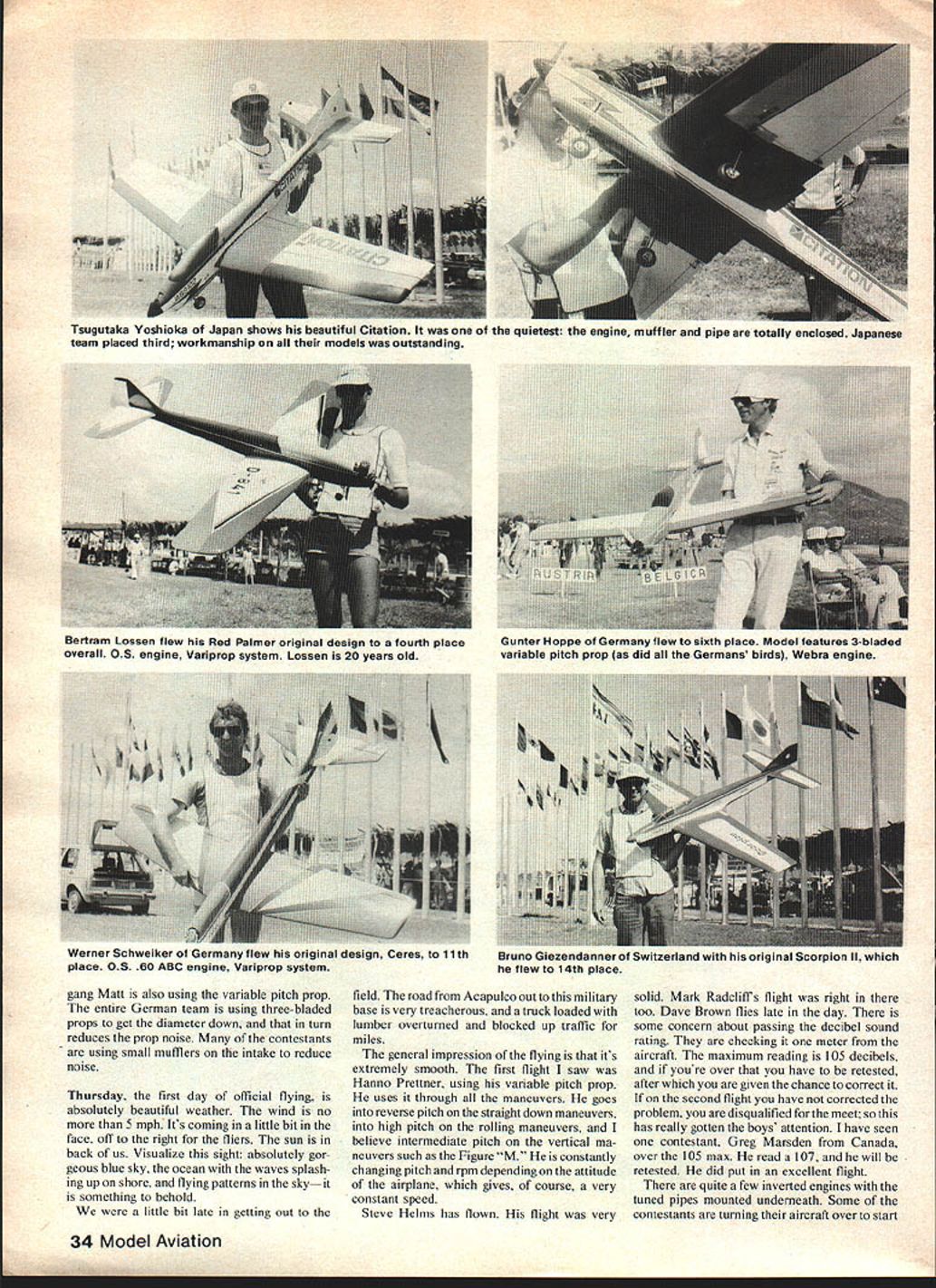
- Wolfgang Matt is also using a variable-pitch prop. The entire German team is using three-bladed props to reduce diameter and prop noise. Many contestants are using small mufflers on the intake to reduce noise.
Noise rules and starting details
Officials are checking decibel ratings on the field. The maximum reading is 105 dB; if you're over that you must be retested. After a retest you are given the chance to correct the problem; if not corrected on the second test you are disqualified for the meet. I saw Greg Marsden (Canada) record 107 dB and be retested—he still put in an excellent flight.
There are quite a few inverted engines with tuned pipes mounted underneath. Some contestants turn their aircraft over to start them; Yoshioka (Japan) did this and his engine quit—apparently out of fuel—late in the flight. That engine quit on the last maneuver will cost him dearly despite an otherwise excellent flight. Hanno Prettner starts his aircraft from an upright position; his installation runs very consistently. He uses a tuned pipe plus a mini-muffler ducted out the bottom of the aircraft, making his one of the quietest here. Yoshioka's aircraft is also very quiet.
Day 1 — Official flying (Thursday)
Weather: absolutely beautiful. Wind no more than 5 mph, a little into the face and off to the right for the fliers. Sun at the contestants' backs. Picture: blue sky, the ocean with waves splashing on shore, and flying patterns in the sky—something to behold.
We were a bit late getting to the field due to road troubles: the road from Acapulco out to the military base is treacherous and a truck loaded with lumber overturned, blocking traffic for miles.
My general impression: flying here is extremely smooth. The first flight I saw was Hanno Prettner using his variable-pitch prop through all maneuvers—reverse pitch on straight-down maneuvers, high pitch on rolling maneuvers, and intermediate pitch on verticals such as the Figure "M." He constantly changes pitch and rpm depending on the attitude of the airplane, which yields very constant speed.
Steve Helms flew a very solid flight. Mark Radcliff's flight was also strong. Dave Brown flies late in the day.
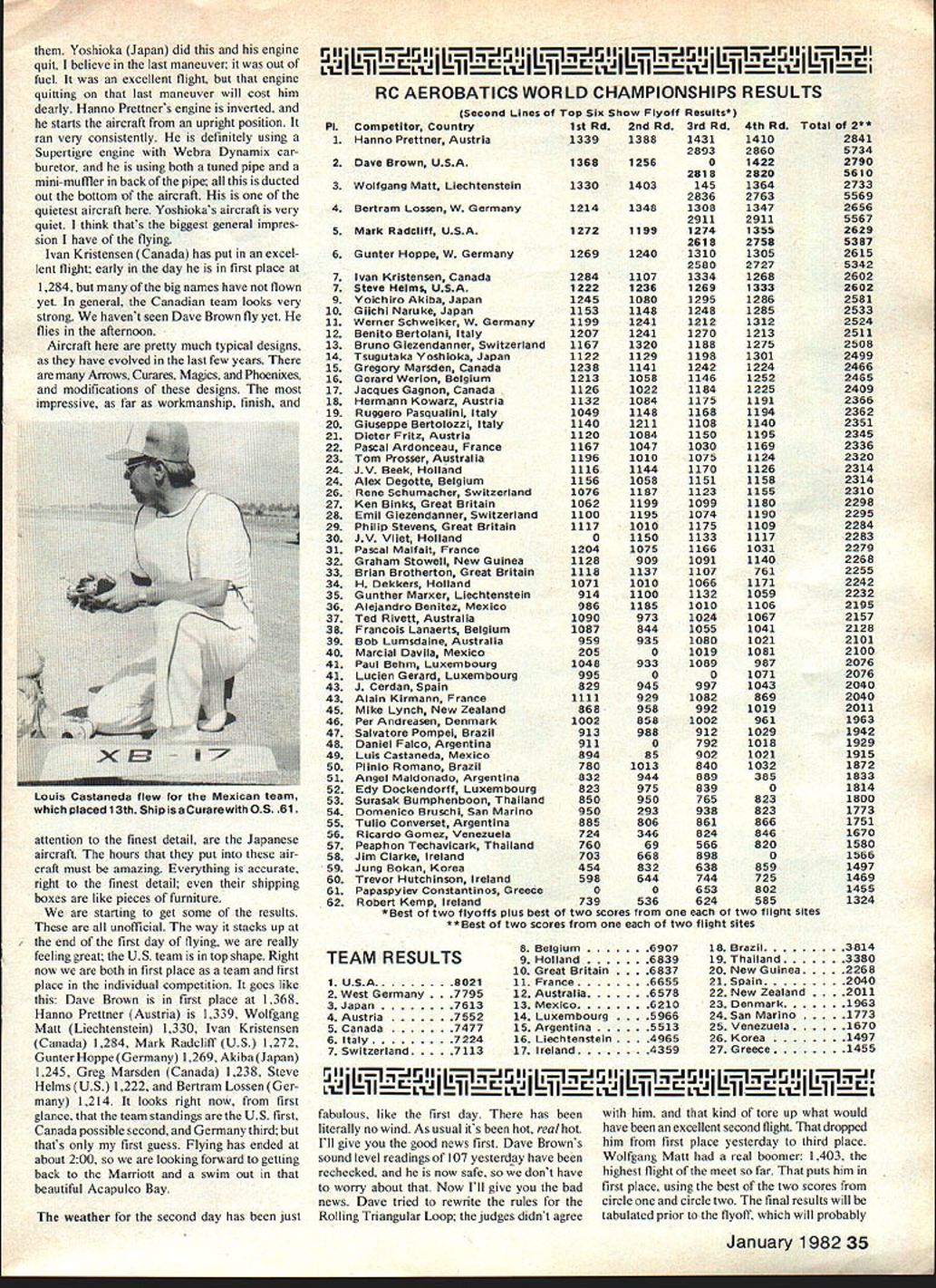
After the first day of flying, unofficial standings looked like this:
After Day 1 (Unofficial, top scores)
- Dave Brown (U.S.) — 1,368
- Hanno Prettner (Austria) — 1,339
- Wolfgang Matt (Liechtenstein) — 1,330
- Ivan Kristensen (Canada) — 1,284
- Mark Radcliff (U.S.) — 1,272
- Gunter Hoppe (Germany) — 1,269
- Akiba (Japan) — 1,245
- Greg Marsden (Canada) — 1,238
- Steve Helms (U.S.) — 1,222
- Bertram Lossen (Germany) — 1,214
Team impressions (early, unofficial): U.S. first, Canada possible second, Germany third. Flying ended about 2:00 p.m., so contestants were looking forward to returning to the Marriott and a swim in Acapulco Bay.
Day 2
Weather again fabulous: virtually no wind, but very hot. Good news: Dave Brown's 107 dB reading from yesterday was rechecked and he is now safe. Bad news: Dave tried to reinterpret the Rolling Triangular Loop and the judges did not agree with his execution, which cost him what would have been an excellent second flight and dropped him from first to third overall on the combined scores.
Wolfgang Matt had a tremendous flight—1,403—the highest flight of the meet so far. Scores are being combined by taking the best score from each set of judges, and if you have two high scores from the same judges you drop one. Final results will be tabulated prior to the flyoff, which will probably be tomorrow; there may be five or six contestants in the flyoff.
After Day 2 (Unofficial, top standings observed)
- Wolfgang Matt (Liechtenstein) — 1st (best flight 1,403)
- Hanno Prettner (Austria) — 2nd
- Dave Brown (U.S.) — 3rd
- Dossen (Germany) — 4th
- Gunter Hoppe (Germany) — 5th
- Bruno Giezendanner (Switzerland) — 6th
- Mark Radcliff (U.S.) — 7th
- Steve Helms (U.S.) — 8th
- Bertolani (Italy) — 9th
- Schweiker (Germany) — 10th
Ivan Kristensen (Canada) dropped from 4th to 11th after a lower-than-usual score of 1,107 in round two. The American team still held first place as a team, but narrowly, with Germany very close behind. The quality of flying and the closeness of scores are outstanding.
Each day finishes around 2:00 p.m. to avoid the sun swinging into the contestants' faces; contest lines are rotated so pilots fly at different times each day. Many aircraft now have completely enclosed tuned pipes, and despite the high temperatures there have been no serious problems.
Opening ceremonies and field
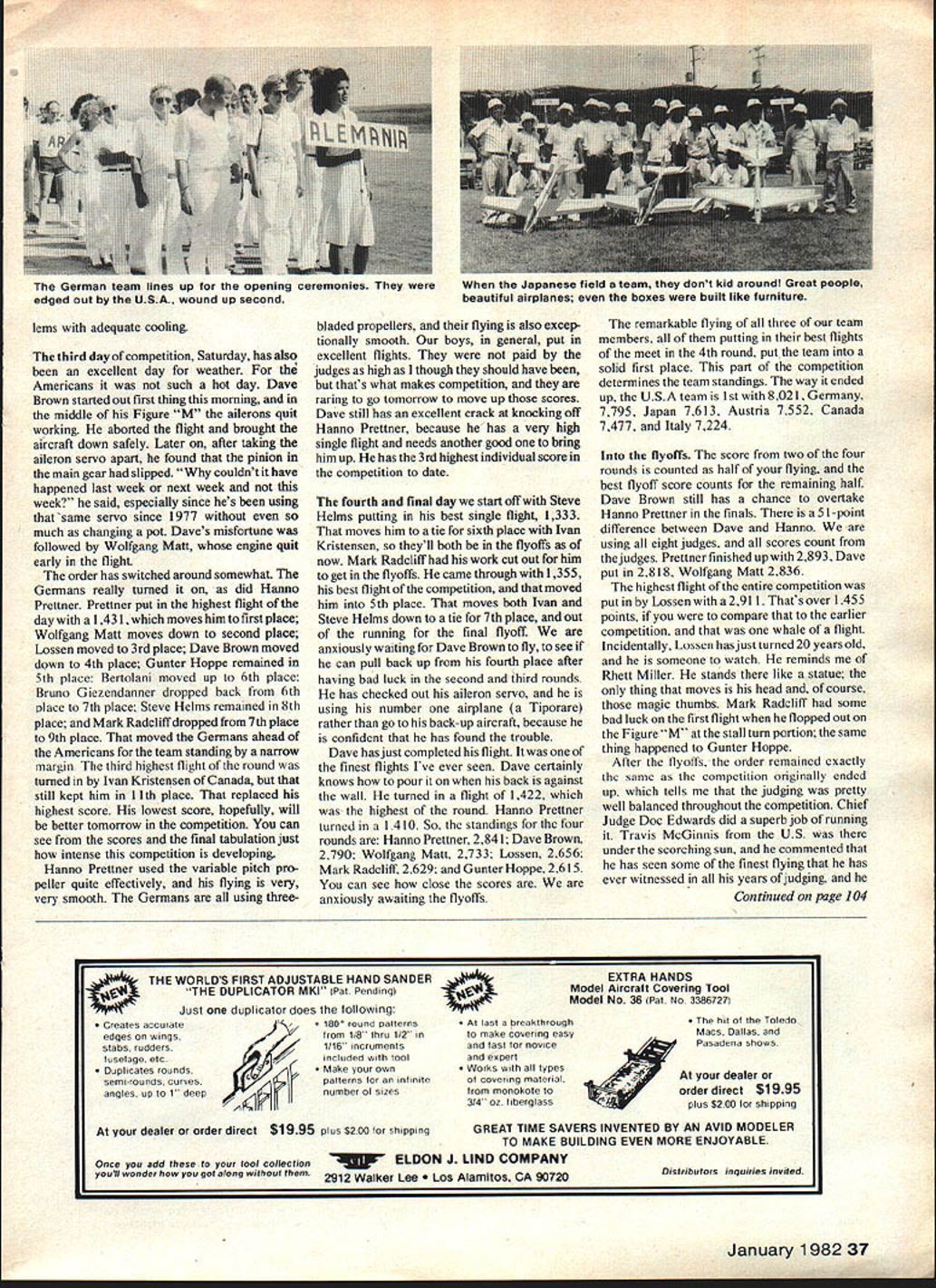
At opening ceremonies the teams lined up behind a young Mexican lady carrying a sign designating each team's country. Lots of spectators and well-wishers watched from the fabulous flying field. Ignore the mountains in the background—this is sea level.
Aircraft at the meet are variations of recent, evolved designs: many Arrows, Curarees, Magics, Phoenixes, and modifications thereof. The most impressive workmanship, finish, and attention to detail come from the Japanese entries—the hours they put into their aircraft must be amazing. Everything is accurate down to the finest detail; even their shipping boxes are like pieces of furniture.
Other observations
- Hanno Prettner uses an inverted engine, enclosed tuned pipe, mini-muffler and variable-pitch prop to achieve a very quiet, consistent installation.
- Some pilots mount tuned pipes underneath inverted engines and start aircraft inverted; others start upright. Installation and starting technique vary and can affect reliability.
- Ivan Kristensen (Canada) put in an excellent early flight (1,284) but had a lower second round. The Canadian team overall looks strong.
- Noise reduction is a major focus: three‑bladed props, smaller diameters, intake mufflers and enclosed pipes are widely used.
Closing, banquet and thanks
Betty and Sue Stream helped with tabulating; their sunny dispositions and competence reassured everyone in this important job. The banquet was disappointing—started late and was disrupted when they cleared the dance floor to go out to the beach, so I left early. I later heard a bomb-scare rumor that fouled up the banquet.
The Mexican hosts have put forward a hard effort; their desire to please and do a super job is to be respected. The memories of Acapulco will stick with us all—the beauty of the country and the superb flying field are something to behold.
Transcribed from original scans by AI. Minor OCR errors may remain.

