
Across State Lines
Joseph H. Decker
I was introduced to gasoline-powered model airplanes during my sophomore year of high school. I had been building and flying hand-launched gliders for years, and had grown a little tired of them when I first heard about miniature gasoline engines. I was really fascinated by the thought of so much power in such a small package.
John Fedora, one of the leading model airplane enthusiasts in the St. Louis area, had just opened a new model airplane store in the 2200 block of Madison Avenue. It was in the window of this store that I first saw a model gasoline engine.
This engine was manufactured by Brown, and it was a beauty. The Brown engine was the most popular model power plant at the time, and like all other miniature engines, it had a distributor, points, and condenser. There were no glow plugs in those days; an onboard battery, along with the coil and condenser, was needed to supply the high voltage required to fire the conventional spark plug.
As soon as I heard that engine run, I made up my mind that I wanted one, and I would build a large airplane to carry it. The engine cost about eight dollars new, and Mr. Fedora said he would sell me a used one for four dollars and throw in a used coil, a new condenser and gas tank, along with a new timer.
I couldn't wait to get home. I went right up to my room and began looking through back issues of model airplane magazines, searching for working plans of models that were large enough to carry the Brown engine with which I had just fallen in love.
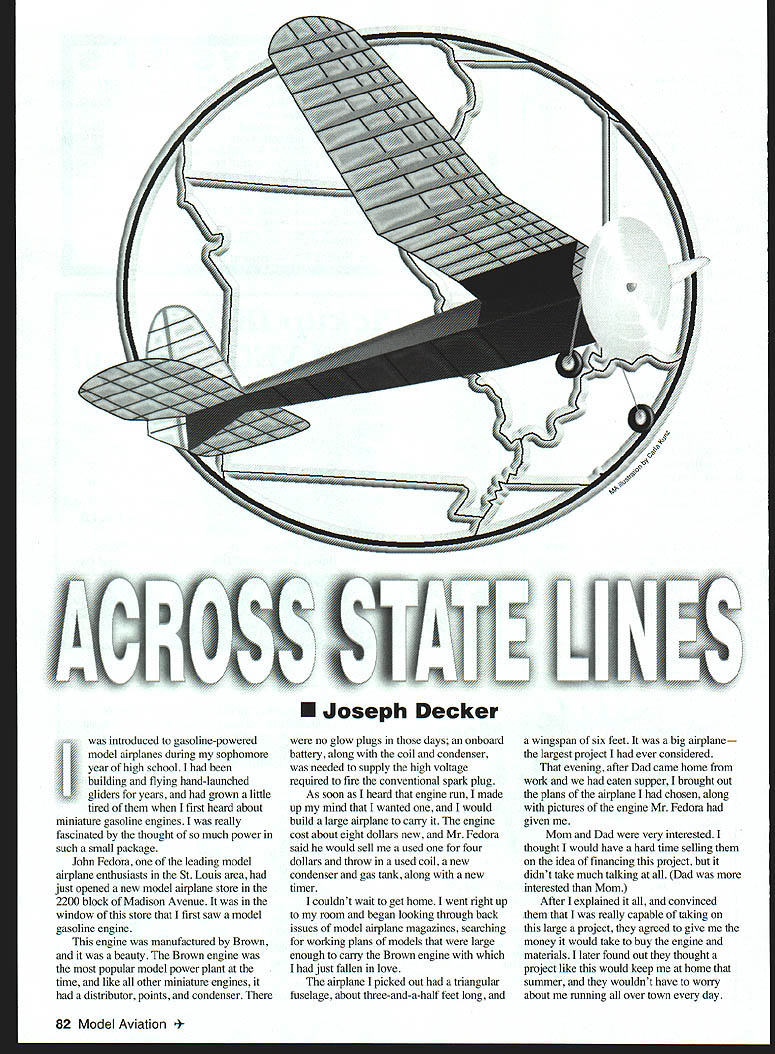
The airplane I picked out had a triangular fuselage, about three-and-a-half feet long, and a wingspan of six feet. It was a big airplane—the largest project I had ever considered.
That evening, after Dad came home from work and we had eaten supper, I brought out the plans of the airplane I had chosen, along with pictures of the engine Mr. Fedora had given me. Mom and Dad were very interested. I thought I would have a hard time selling them on the idea of financing this project, but it didn't take much talking at all. Dad was more interested than Mom.
After I explained it all and convinced them that I was really capable of taking on such a large project, they agreed to give me the money it would take to buy the engine and materials. I later found out they thought a project like this would keep me at home that summer, and they wouldn't have to worry about me running all over town every day.
I started redrawing the plans full size — a big job — and it took several days. I drew on back wallpaper; it made very good drafting paper because it was cheap and plentiful. The fuselage was the complicated part. It began as a triangular-shaped affair about four feet long and looked a lot like the body of a glider. When the finished fuselage was completed, I mounted the engine, gas tank and other components and test-ran the engine before setting the fuselage aside to begin building the wing and tail assembly.
The wingspan was six feet and the wing had a polyhedral design. It was the first time I had built a large polyhedral wing. When I finished building and covering it, I covered the fuselage with blue rice paper and the wings with red. It was a thing of beauty and I was satisfied with the papering job. Rice paper is hard to apply and this certainly showed my lack of experience.
One evening Dad came home from work and the airplane was sitting in the middle of the backyard. I was sitting back on the steps admiring it when I heard the truck pull into the driveway and the door slam. I expected Dad to come back the way he had left, but he had gone around to the front door. I started to get up and call him when I saw him standing in the doorway with a big smile on his face. As Dad picked up the airplane I could tell he was pleased with the job I had done. He assured me the papering job wasn't bad and we went in to eat the evening meal with Mom waiting for us. It's strange how moments like that stick in the memory years after they occur.
After supper Dad took the airplane out to the school yard to see how well it would glide. Again I was surprised — it glided better than I expected. I don't remember what the glide ratio must have been, but it had at least 10:1. Dad wanted to fire the engine up and launch, which was tempting, but I knew the glide would be short because the engine run would be only five or six seconds and could barely keep it airborne. So we decided to wait until the next night to test-fly at the farmer's field the club had permission to use.
The next day we went very slowly. Dad did get off work a little early and, after a fast meal on the way, we tried to start the engine. Engines are a rule-exception; even with coil, condenser and points everything adjusted just right, some engines simply won't start. Ours finally did start and I adjusted the needle valve until the engine began to purr. After I disconnected the starter batteries, I hand-launched the airplane. It immediately pointed its nose straight up and climbed at a fast rate until the engine shut off at about 100 feet. I made a rather sloppy recovery before it started a long, graceful glide. There was nothing wrong with the glide pattern — it was a slow, lazy descent, describing lazy 8s in the still, warm air. However, something had to be done about the power-off range.
Bill Williams, a friend I had met at Fedora's shop, and I took the airplane out the next day and worked out power-off recovery problems. Bill took his airplanes along and we spent the whole day out there—we had some great flights. Bill told me about a contest that was coming up the next weekend in Missouri, and he talked me into entering.
The contest was on a Sunday. My Dad and I had the car packed and ready to go, so after the 6 a.m. Mass we took off. We met all the other guys from the club there. The club members stayed together in a little group and helped each other as much as we could. As they say, a good time was had by all.
My turn came up in early afternoon. We had a hard time starting the engine until Fedora's brother put a shot of some secret concoction John was using into the tank. Then the engine took off with a whine that indicated it was running at peak rpm.
Hand-launching was not allowed in the contest, so I held the airplane as level as I could, realizing that with only one wheel I was at a disadvantage, and when everything seemed right, I threw it loose.
The airplane jumped ahead about six or eight feet and pointed its nose straight up as it did on all the other flights. This time, however, the timer stuck, and failed to stop the motor in 20 seconds as it should have. Twenty-one seconds into the contest I was disqualified, and that was just the beginning of my problems.
The engine kept running until the airplane was almost out of sight, stopping only because it ran out of gas. Then the airplane leveled off and began its long glide.
Everyone was moaning and groaning at my bad luck and saying I would never see the airplane again. Dad put the gear back in the car while I kept an eye on the airplane. Then we took off in the direction of that speck in the sky that represented a good amount of money for those days, and almost two months of hard work.
We followed the airplane on the back roads of Missouri until we didn't know where we were. The last time I saw the airplane before it went out of sight, it was headed west, across the river. By this time it had been at least a half-hour since I launched the airplane, so we decided to give it up for lost, and head for home.
We rode around for another half hour before we found our way back to Route 66, and another 15 minutes to Old Chain of Rocks Bridge. When we were about halfway across it, a car passed us with the wing of a model airplane sticking out of the rear window. I turned around in the seat to get a better look, and told Dad that it looked like my airplane.
With a lot of insistence from me, he turned around and we followed the car. We never did catch up, but we were sure it was headed for the contest site we had just left.
That's exactly where we went. We pulled up alongside of it, and I got out of the car to get a better look at the wing. Sure enough, it was my airplane. I couldn't believe my eyes. I just stood there for a few seconds, and then asked the car's driver where he got that airplane.
He smiled and said, "Are you Joe Decker?" I had my name and address glued to the side of the airplane. When I assured him I was, he told me this story.
He and his wife were sitting on the front porch of their home in Mitchell, Illinois reading an article in the Post-Dispatch about the contest, when my airplane made a perfect three-point landing in their front yard. They saw my name and address on the airplane, and told his wife that it must have flown from the contest in Missouri, so they put the airplane in the car and headed for the contest.
At the contest the gentleman and his wife met a reporter and photographer from the Post-Dispatch who came up and introduced themselves. The reporter asked a bunch of questions and then told me my airplane had made an interstate flight, "and that's news."
The next day there was an article in the Post-Dispatch. It said that I had made an interstate flight, and told about the kind man and his wife retrieving the airplane and bringing it back to the field.
My Dad and I were thankful for the gentleman and his wife who brought the airplane back. I felt pretty good about my first contest, even though I was disqualified. I later tore the paper covering off the airplane and redid it in the same color; it really looked a lot better.
My mother kept that Post-Dispatch article for a long time. I don't know whatever happened to it, but I would surely like to see it again. I suppose it's lost forever—even in the minds of everyone who was there that day, so very long ago.
Joseph H. Decker 2313 Hodges Granite City, IL 62040
Transcribed from original scans by AI. Minor OCR errors may remain.

