
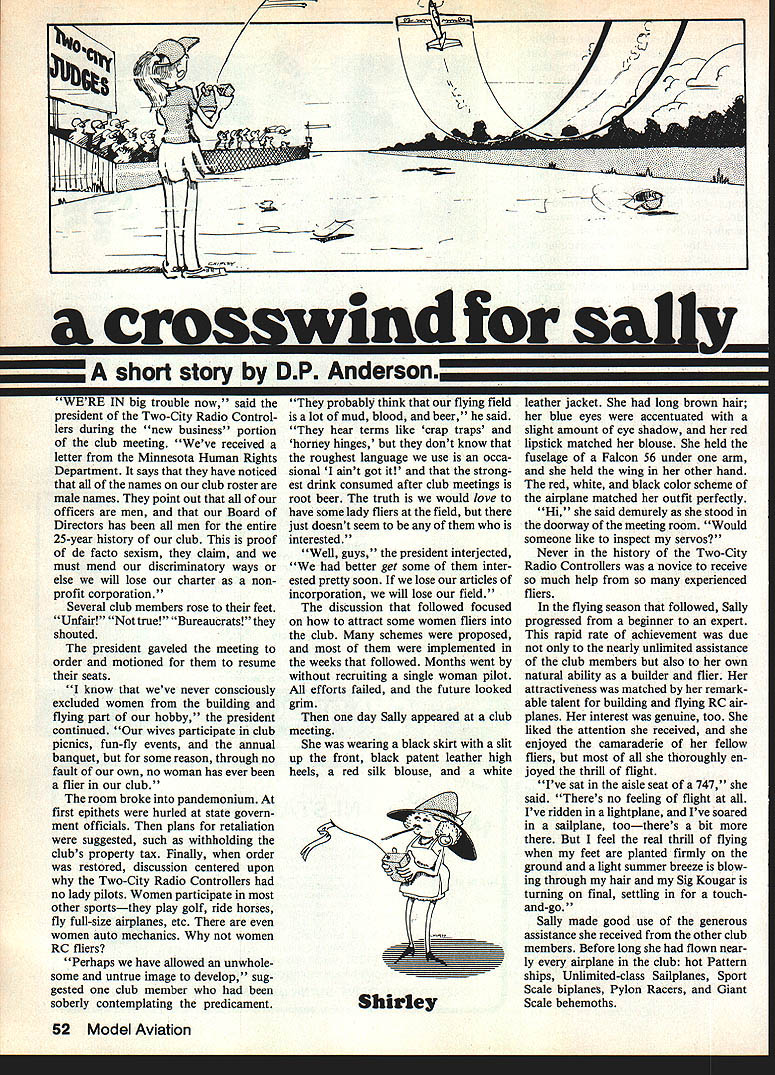
A Crosswind for Sally
A short story by D.P. Anderson.
The Problem
"We're in big trouble now," said the president of the Two-City Radio Controllers during the "new business" portion of the club meeting. "We've received a letter from the Minnesota Human Rights Department. It says that they have noticed that all of the names on our club roster are male names. They point out that all of our officers are men, and that our Board of Directors has been all men for the entire 25-year history of our club. This is proof of de facto sexism, they claim, and we must mend our discriminatory ways or else we will lose our charter as a non-profit corporation."
Several club members rose to their feet. "Unfair!" "Not true!" "Bureaucrats!" they shouted.
The president gaveled the meeting to order and motioned for them to resume their seats. "I know that we've never consciously excluded women from the building and flying part of our hobby," the president continued. "Our wives participate in club picnics, fun-fly events, and the annual banquet, but for some reason, through no fault of our own, no woman has ever been a flier in our club."
The room broke into pandemonium. At first epithets were hurled at state government officials. Then plans for retaliation were suggested, such as withholding the club's property tax. Finally, when order was restored, discussion centered upon why the Two-City Radio Controllers had no lady pilots. Women participate in most other sports—they play golf, ride horses, fly full-size airplanes, etc. There are even women auto mechanics. Why not women RC fliers?
"Perhaps we have allowed an unwholesome and untrue image to develop," suggested one club member who had been soberly contemplating the predicament. "They probably think that our flying field is a lot of mud, blood, and beer," he said. "They hear terms like 'crap traps' and 'horny hinges,' but they don't know that the roughest language we use is an occasional 'I ain't got it!' and that the strongest drink consumed after club meetings is root beer. The truth is we would love to have some lady fliers at the field, but there just doesn't seem to be any of them who is interested."
"Well, guys," the president interjected, "we had better get some of them interested pretty soon. If we lose our articles of incorporation, we will lose our field."
Discussion followed, focused on how to attract women fliers into the club. Many schemes were proposed, and most of them were implemented in the weeks that followed. Months went by without recruiting a single woman pilot. All efforts failed, and the future looked grim.
Sally Arrives
Then one day Sally appeared at a club meeting.
She was wearing a black skirt with a slit up the front, black patent-leather high heels, a red silk blouse, and a white leather jacket. She had long brown hair; her blue eyes were accentuated with a slight amount of eye shadow, and her red lipstick matched her blouse. She held the fuselage of a Falcon .56 under one arm, and she held the wing in her other hand. The red, white, and black color scheme of the airplane matched her outfit perfectly.
"Hi," she said demurely as she stood in the doorway of the meeting room. "Would someone like to inspect my servos?"
Never in the history of the Two-City Radio Controllers was a novice to receive so much help from so many experienced fliers.
Rising Star
In the flying season that followed, Sally progressed from a beginner to an expert. This rapid rate of achievement was due not only to the nearly unlimited assistance of the club members but also to her own natural ability as a builder and flier. Her attractiveness was matched by her remarkable talent for building and flying RC airplanes. Her interest was genuine, too. She liked the attention she received, and she enjoyed the camaraderie of her fellow fliers, but most of all she thoroughly enjoyed the thrill of flight.
"I've sat in the aisle seat of a 747," she said. "There's no feeling of flight at all. I've ridden in a lightplane, and I've soared in a sailplane, too—there's a bit more there. But I feel the real thrill of flying when my feet are planted firmly on the ground and a light summer breeze is blowing through my hair and my Sig Cougar is turning on final, settling in for a touch-and-go."
Sally made good use of the generous assistance she received from the other club members. Before long she had flown nearly every airplane in the club: hot Pattern ships, Unlimited-class sailplanes, Sport Scale biplanes, Pylon Racers, and Giant Scale behemoths. The more airplanes she learned to fly, the better she became at flying any one of them. Like a bunch of suitors, club members tried to woo her interest in their favorite types of airplane. Some of them even switched models so that they could teach her to fly their airplanes.
After experimenting with a variety of RC airplanes, Sally finally decided to concentrate her efforts on Pattern. As the date of the club's big annual contest drew closer, Sally was observed practicing certain aerobatic maneuvers more and more frequently. Speculation arose as to whether she was going to enter the contest.
Contest Day
Dawn broke on the first day of the Two-City Radio Controllers Annual Open Pattern and Sport Scale Contest. It was the beginning of a warm August day with light winds and a clear blue sky. As usual, Sally was the center of attention.
She was wearing a white tennis skirt and a yellow golf shirt with white tennis shoes and yellow socks. Her hair was pulled back into a ponytail, which poked through the expansion space in the back of her Two-City Radio Controllers cap.
Her field box was covered with yellow-and-white vinyl. It had large black calligraphic letters spelling SALLY across the side. Her airplane was a Dirty Birdy epoxy-painted white with yellow lace and jonquil air-brushed onto the wings and stabilizer. A yellow stripe ran down the top of the fuselage and up the fin. Beneath it her name was calligraphically recorded across the fuselage in black letters. Yellow-and-white lace ribbons on her transmitter antenna revealed her frequency to be 72.960 MHz.
"If I were to change frequencies, I would have to buy a whole new wardrobe," she explained.
When her name was called for Round 1, she picked up her airplane and transmitter and carried them to the ready box. She required no caller because she had memorized the Pattern maneuver sequence. Not having to talk to a caller while flying left more time available to concentrate on flying, she had discovered.
Sally engaged the onboard glow driver and started the Supertigre engine with one flip of the prop. The sun glinted off the shiny-smooth epoxy wings and polished tuned pipe as Sally's airplane taxied into takeoff position. Sally stood beside the judges seated in folding chairs near the edge of the runway. Shouts of "Go for it, Sally!" and "Show 'em how it's done!" were heard from the spectator area, as all eyes focused upon Sally and her airplane. But Sally tuned all that out. Her concentration was devoted solely to her airplane.
"Takeoff—starting now," she announced to the judges. She advanced the throttle slowly and held a slight amount of right rudder as the airplane accelerated slowly at first, then faster. It lifted into the air after passing by the judges' position and transitioned into a steady wings-level climb. Sally flicked the retract switch with her left forefinger, and the landing gear snapped up.
Sally listened to the engine and observed the effect of wind drift as she flew the plane around the field in preparation for entering the first maneuver. A slight crosswind meant that compensating rudder had to be used in most maneuvers, she noted to herself.
"Double stall turn—starting now," Sally announced as the plane approached the center of the field. As the plane passed before the judges, it arched straight up and began to slow. Sally reduced the throttle to a fast idle. Full left rudder rotated the plane in place, and it dropped straight down with a slight wiggle of its tail. Sally continued to hold a little left rudder to prevent the plane from drifting with the crosswind as it passed the judges again and pulled up into the second stall turn, rotated in place, and dropped with another tiny wiggle, leveling out at the extreme of each heading and altitude as the entry.
"Complete," she said. Applause burst forth from the spectators.
The remaining maneuvers of the Advanced Pattern were equally successful, receiving eights, nines, and tens from the judges. After a well-flared and boundless touchdown in front of the judges, Sally received a standing ovation of cheers and applause.
Sally's final standing in the contest did not go unnoticed by other fliers in Minnesota. Attendance at contests and fun-fly events increased dramatically afterward. People came to watch Sally fly, and they discovered that they, too, enjoyed flying more when they were flying with her.
A New Generation
Sally did not go unnoticed by women spectators, either. When asked by other women why she enjoyed Pattern flying, she responded, "It combines the grace and beauty of figure skating with the excitement of grand prix racing. I wish more women would try it."
Indeed, more women did try it. Because of Sally's example, more women joined the Two-City Radio Controllers. There was Julie, Alice, Lucrey, Heidi, and Shirley, among others:
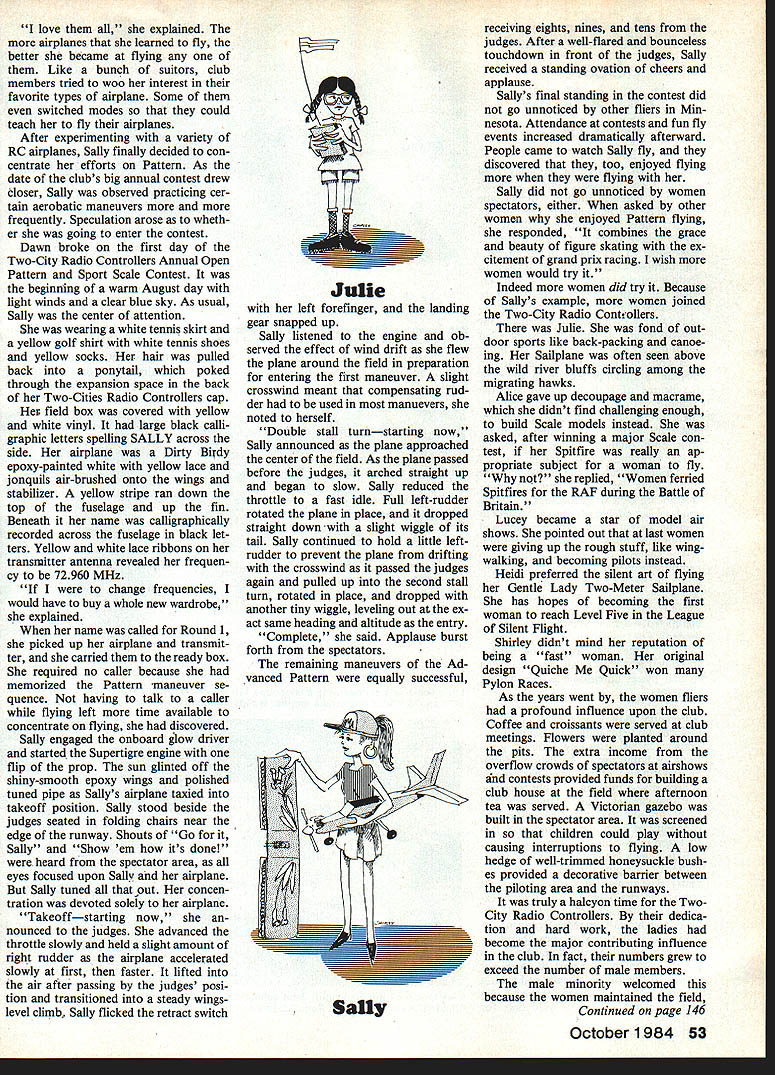
- Julie loved outdoor sports like backpacking and canoeing. Her sailplane was often seen above the wild river hawks circling among the migrating flocks.
- Alice gave up decoupage and macramé, which she didn't find challenging enough, to build Scale models instead. After winning a major Scale contest, she was asked if her Spitfire was really an appropriate subject for a woman to fly. "Why not?" she replied. "Women ferried Spitfires for the RAF during the Battle of Britain."
- Lucrey became a star of model air shows. She pointed out that at last women were giving up the rough stuff, like wing-walking, and becoming pilots instead.
- Heidi preferred the silent art of flying her Gentle Lady two-meter sailplane. She had hopes of becoming the first woman to reach Level Five in the League of Silent Flight.
- Shirley didn't mind her reputation of being a "fast" woman. Her original design, "Quiche Me Quick," won many Pylon Races.
As the years went by, the women fliers had a profound influence upon the club. Coffee and croissants were served at club meetings. Flowers were planted around the pits. The extra income from the overflow crowds at fun days and contests was used for building a clubhouse at the field where afternoon tea was served. A Victorian gazebo was built in the spectator area; it was screened so that children could play without causing interruptions to flying. A low hedge of well-trimmed honeysuckle bushes provided a decorative barrier between the piloting area and the runways.
It was truly a halcyon time for the Two-City Radio Controllers. By their dedication and hard work, the ladies had become the major contributing influence in the club. In fact, their numbers grew to exceed the number of male members. The male minority welcomed this because the women maintained the field, ran the business affairs of the club, and were effective in keeping the club treasury filled with money. The men devoted all of their time to building and flying, and left the work to the women—a dream come true for the men.
The Ironic Letter
One day a letter arrived.
"We're in big trouble now," said President Sally during the "new business" portion of the club meeting. "We've received a letter from the Minnesota Human Rights Department. It says that they have noticed that the names on the club roster are all female names. They point out that the officers and the Board of Directors have been women for the entire history of the club. This is proof of de facto sexism. We must mend our discriminatory ways or else we will lose our charter as a non-profit corporation."
Several club members rose to their feet. "Unfair! Not true!" "Bureaucrats!" they shouted. The president gaveled the meeting to order and motioned for them to resume their seats.
"You know we've never consciously excluded men from building and flying as part of the hobby," the president continued. "Husbands participate in club picnics, fun-fly events, and the annual banquet. For some reason, through no fault of their own, no man has ever been as involved in the running of the club."
The room broke into pandemonium. Again, first epithets were hurled at government officials and plans for retaliation were suggested. Finally, order was restored and discussion centered upon the club's lack of male representation in official positions. The irony was not lost on anyone. The club had come full circle.
The Two-City Radio Controllers had changed—and in the change they had found a larger, livelier, and more welcoming club. The rest, as they say, was up to the members to sort out.
Transcribed from original scans by AI. Minor OCR errors may remain.

