
Aerial Photography from RC Sailplane
By Robert H. Lodge
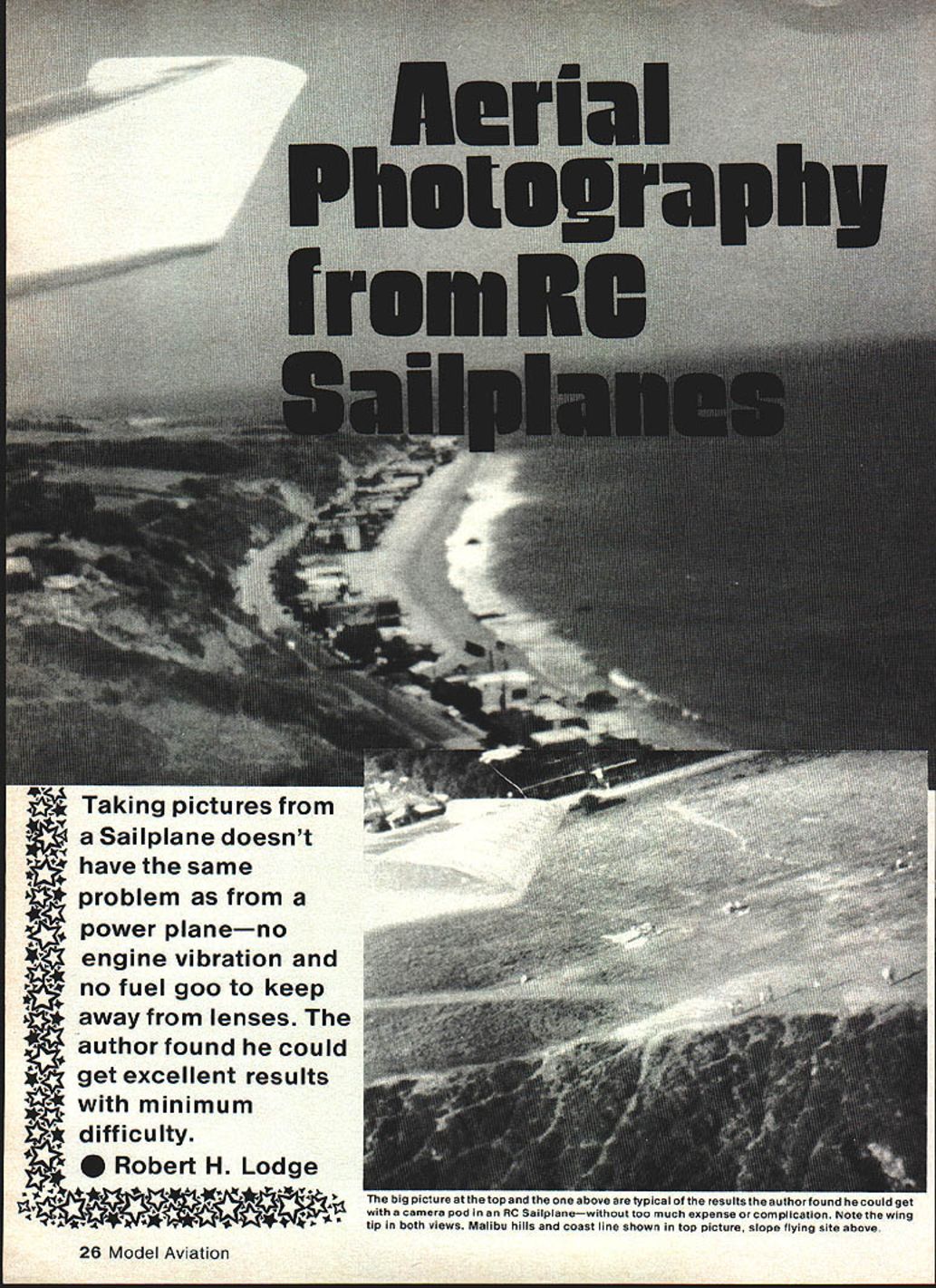
Taking pictures from a sailplane avoids the problems of engine vibration and fuel residue that plague power planes. With a lightweight camera and a simple mechanical pod, excellent results can be obtained with minimal difficulty.
Camera selection and requirements
I wanted a minimum shutter speed of 1/250 to stop motion. The camera had to be lightweight, small, and inexpensive — after all, who wants to risk a $250–$300 camera in thermals? This narrowed the choices to 110 or 16mm formats.
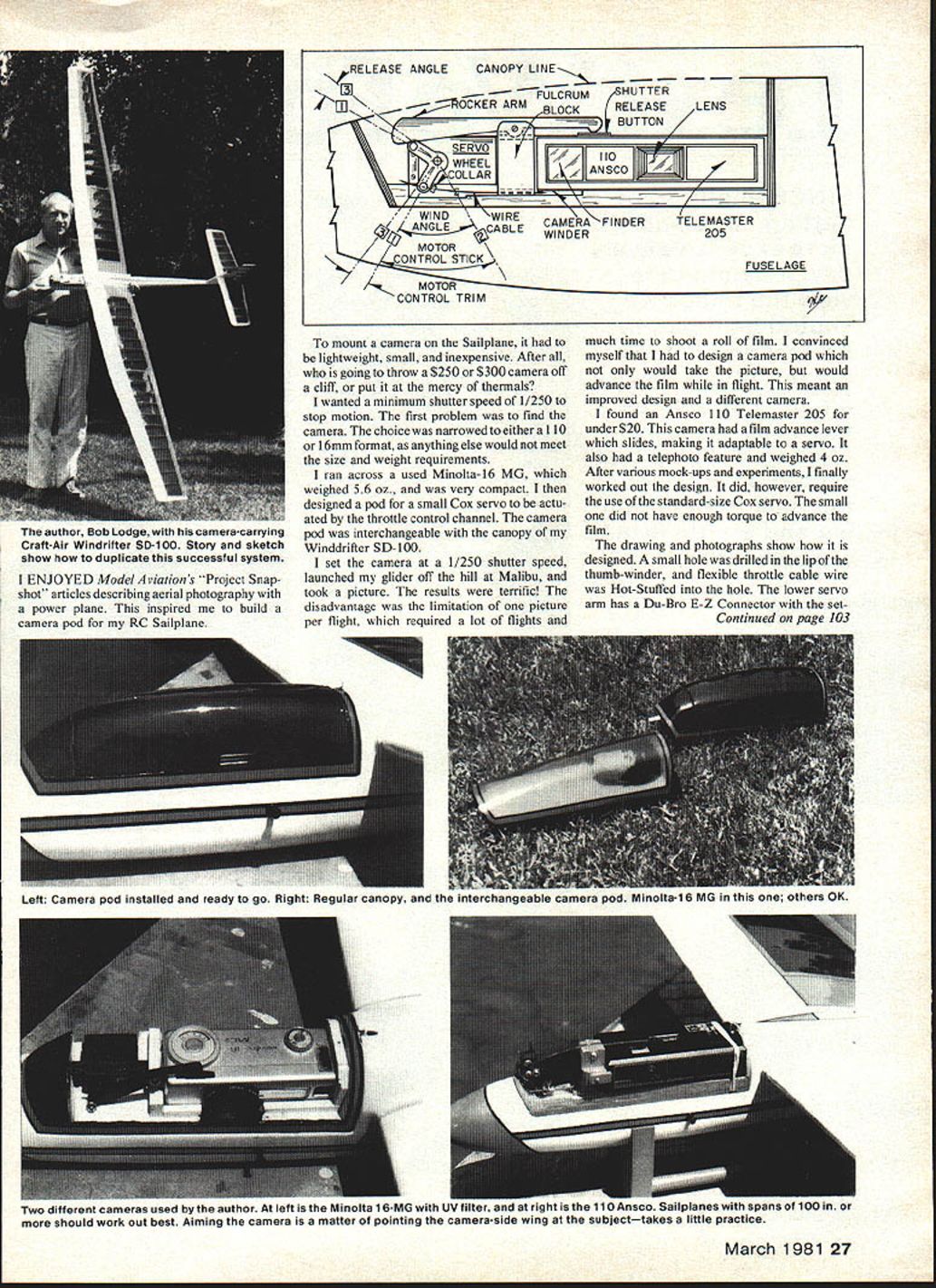
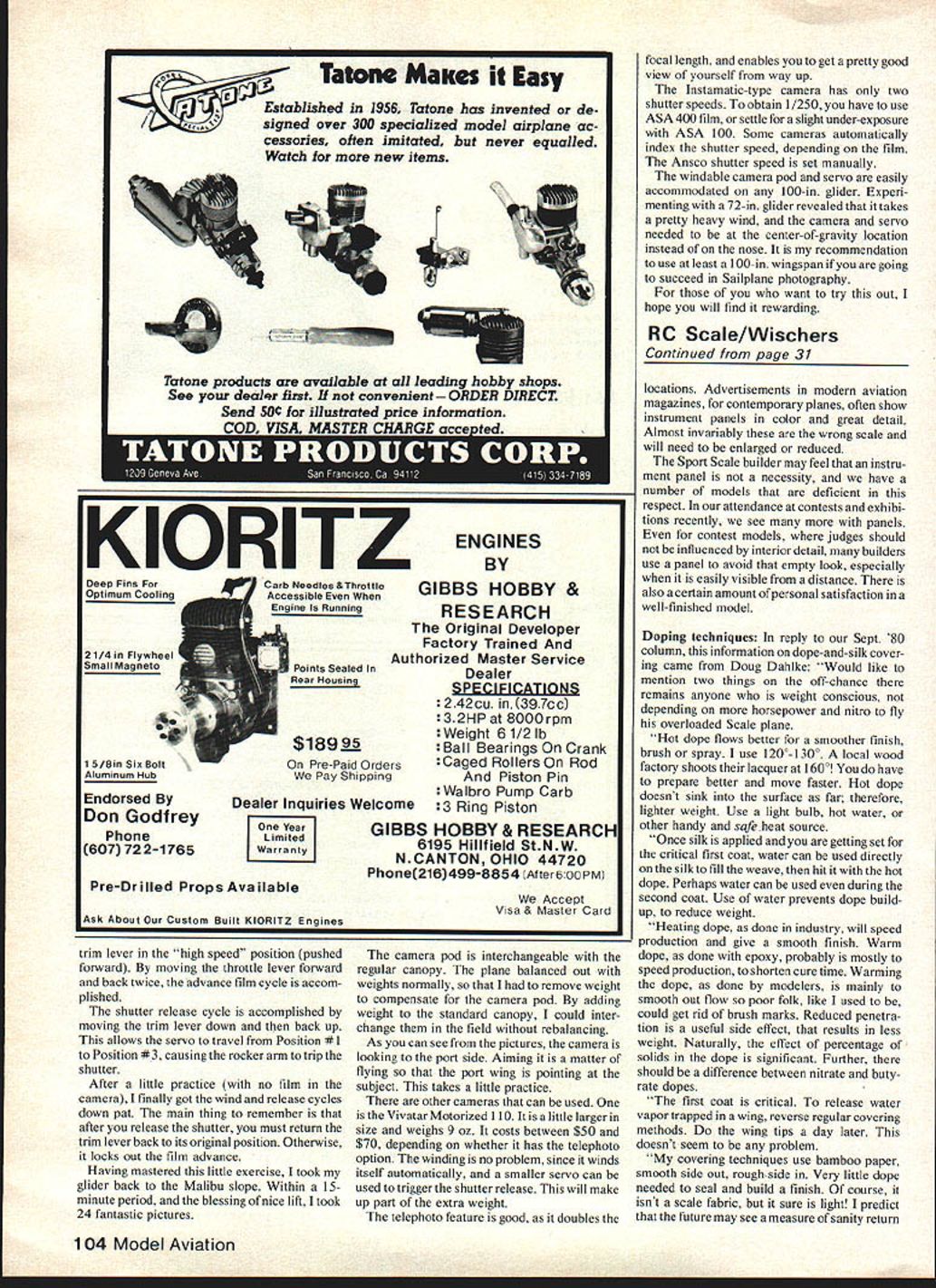
I found a used Minolta-16 MG that weighed 5.6 oz and was very compact. I designed a pod to mount it, actuated by a small Cox servo tied to the throttle control channel. The pod was interchangeable with the canopy of my Winddrifter SD-100.
First flight test
I set the camera to 1/250, launched the glider at Malibu, and took a picture. The results were terrific, but I was limited to one picture per flight. Shooting a roll of film would require many flights, so I decided to design a camera pod that would both release the shutter and advance the film in flight.
Designing a film-advance pod
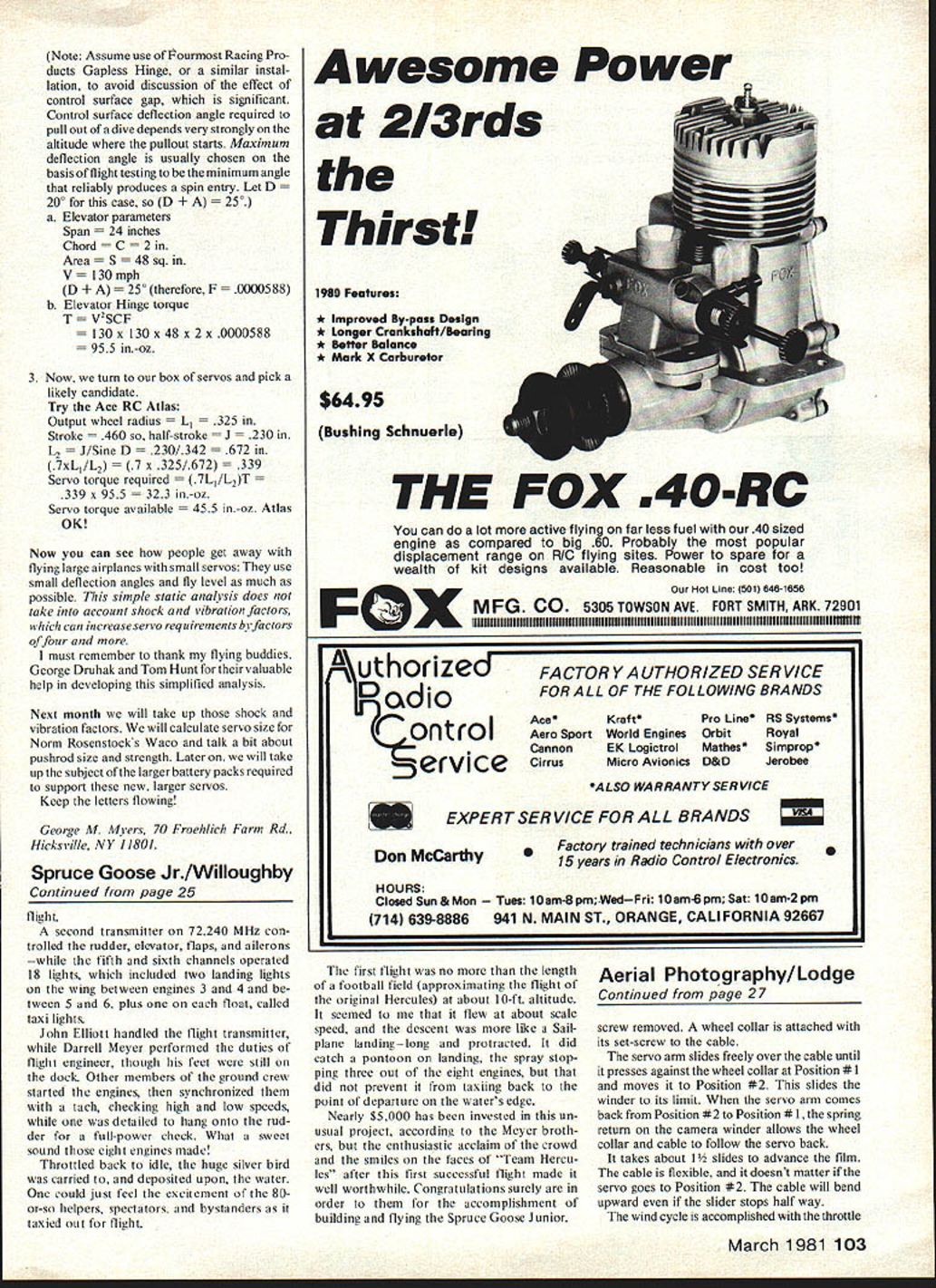
I found an Ansco 110 Telemaster 205 for under $20. It had a sliding film-advance lever that could be adapted to a servo, a telephoto feature, and weighed 4 oz. After mock-ups and experiments I arrived at a working design, but it required the standard-size Cox servo — the smaller servo lacked the torque to advance the film.
Key design features:
- A small hole was drilled in the lip of the thumb-winder and flexible throttle cable wire was hot-stuffed into the hole.
- The lower servo arm uses a Du-Bro E-Z Connector set.
- The set-screw was removed; a wheel collar is attached to the cable with its set-screw.
- The servo arm slides freely over the cable until it presses against the wheel collar at Position #1 and moves it to Position #2, which slides the winder to its limit.
- When the servo arm returns from Position #2 to Position #1, the spring returns the camera winder and allows the wheel collar and cable to follow the servo back.
It takes about 1½ slides to advance the film. Because the cable is flexible, it will bend even if the servo stops partway, so the servo does not have to reach Position #2 fully to complete the action.
Operating the pod (wind and shutter cycles)
- Wind (film-advance) cycle:
- Put the throttle trim lever in the high-speed (forward) position.
- Move the throttle lever forward and back twice to accomplish the film-advance cycle.
- Shutter-release cycle:
- Move the trim lever down and then back up.
- This moves the servo from Position #1 to Position #3, causing the rocker arm to trip the shutter.
Practice with no film in the camera until the wind and release cycles are smooth. After releasing the shutter, always return the trim lever to its original position; otherwise the film advance will be locked out.
Flight results
After practicing, I returned to the Malibu slope. In a 15-minute period with good lift, I took 24 outstanding pictures.
Mounting and balancing
The camera pod is interchangeable with the regular canopy. The plane balanced normally with weights in place, so I had to remove weight when using the camera pod. By adding weight to the standard canopy I could swap them in the field without rebalancing.
Aiming the camera is done by flying so that the port wing points at the subject; the camera is mounted looking to port. This takes some practice.
Other camera options
- Vivitar Motorized 110: Larger and heavier (about 9 oz), costs $50–$70 depending on telephoto option. Its motorized winding eliminates the need for film-advance servo torque; a smaller servo can be used to trigger the shutter. The telephoto doubles focal length, useful for getting a view of yourself from altitude.
- Instamatic-type cameras: Usually only two shutter speeds. To obtain effective 1/250 shutter speed you may need ASA 400 film, or accept slight underexposure with ASA 100. Some cameras index shutter speed automatically depending on film; the Ansco shutter speed is set manually.
Glider size recommendation
The windable camera pod and servo are easily accommodated on any 100-inch glider. On a 72-inch glider you need stronger wind, and the camera and servo may need to be at the center-of-gravity location instead of on the nose. I recommend at least a 100-inch wingspan for successful sailplane photography.
For those who want to try this, I hope you find it rewarding.
Transcribed from original scans by AI. Minor OCR errors may remain.

