
Aerial Photography from Sailplanes
By David Garwood
Aerial photography from sailplanes? Sure, why not? Sailplanes can easily lift cameras as payload, and compared to engine-powered RC model airplanes, sailplanes have the advantages of no motor vibration to spoil photo sharpness and no burned-fuel residue to foul a camera lens. Sailplanes can fly slowly and smoothly, contributing to the steadiness needed to produce detailed aerial photographs.
During three flying seasons I’ve taken dozens of photos from two sailplane camera platforms, and I’ve learned a bit along the way. This article shares that experience and helps RC sailplane pilots who want to take their own aerial photos.
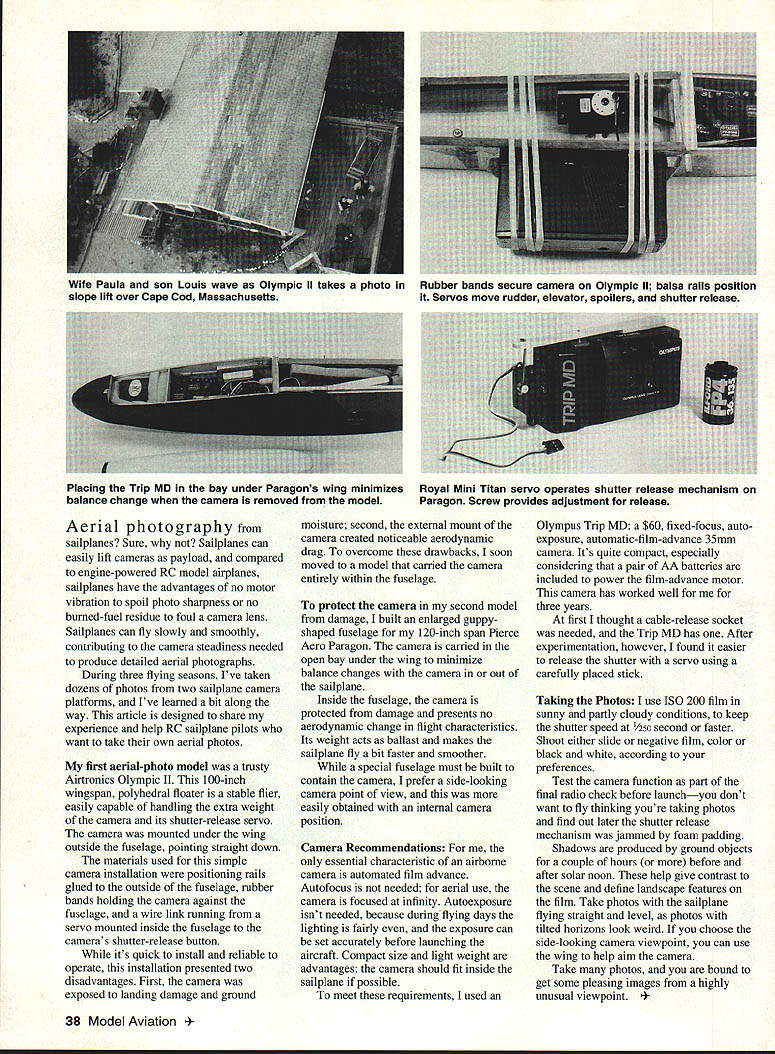
My first aerial-photo model was a trusty Airtronics Olympic II. This 100-inch wingspan, polyhedral floater is a stable flier, easily capable of handling the extra weight of a camera and its shutter-release servo. The camera was mounted under the wing outside the fuselage, pointing straight down. Materials used for this simple installation were positioning rails glued to the outside of the fuselage, rubber bands holding the camera against the fuselage, and a wire link running from a servo mounted inside the fuselage to the camera’s shutter-release button.
This external installation was quick to install and reliable, but it presented two disadvantages:
- The camera was exposed to landing damage and ground moisture.
- The external mount created noticeable aerodynamic drag.
To overcome these drawbacks, I moved to a model that carried the camera entirely within the fuselage. To protect the camera in my second model I built an enlarged guppy-shaped fuselage for my 120-inch span Pierce Aero Paragon. The camera is carried in the open bay under the wing to minimize balance changes when the camera is in or out of the sailplane.
Inside the fuselage the camera is protected from damage and presents no aerodynamic change in flight characteristics. Its weight acts as ballast and makes the sailplane fly a bit faster and smoother. While a special fuselage must be built to contain the camera, I prefer a side-looking camera point of view, and this is more easily obtained with an internal camera position.
Camera Recommendations
For me, the only essential characteristic of an airborne camera is automatic film advance. Other considerations:
- Autofocus is not needed; for aerial use the camera is focused at infinity.
- Autoexposure isn't needed, because lighting on flying days is fairly even and exposure can be set accurately before launch.
- Compact size and light weight are advantages; the camera should fit inside the sailplane if possible.
I used an Olympus Trip MD: a low-cost, fixed-focus, auto-exposure, automatic-film-advance 35mm camera. It’s compact and runs on a pair of AA batteries that power the film-advance motor. This camera worked well for me for three years.
At first I thought a cable-release socket was needed (the Trip MD has one). After experimentation I found it easier to release the shutter with a servo using a carefully placed stick.
Taking the Photos
Film and exposure:
- I use ISO 200 film in sunny and partly cloudy conditions to keep the shutter speed at 1/250 second or faster.
- Shoot slide or negative film, color or black-and-white, according to your preferences.
Practical tips:
- Test the camera function as part of the final radio check before launch—you don't want to fly thinking you’re taking photos and later find the shutter-release mechanism was jammed by foam padding.
- Shadows produced by ground objects a couple of hours before and after solar noon help give contrast to the scene and define landscape features.
- Take photos with the sailplane flying straight and level; tilted horizons look odd.
- If you choose a side-looking viewpoint, use the wing to help aim the camera.
- Take many photos; you’re bound to get some pleasing images from this highly unusual viewpoint.
Transcribed from original scans by AI. Minor OCR errors may remain.

