
An Aerie: For the Key City Bald Eagles
Stephen E. Kanyusik
When this club lost its flying field, members weren't shy about getting the public involved. Working hand in hand with the local community, these RCers found a fabulous answer to the problem of where to fly.
You read about it in the daily newspapers. You see it on television. People living near airports are complaining about the air traffic and noise levels and are demanding changes.
In most circumstances the airports were there first, and over the years residential development has crowded in around them. It can be extremely irritating for all factions. Resolving the inevitable differences can cause tempers to run high. It can also involve a great deal of expense for the community.
With changing demographics, modelers today are becoming increasingly embroiled in similar disputes. Noise, of course, is the biggest culprit, though other ecological factors sometimes enter the picture too. "I just can't stand the noise" is the comment most often heard from the public.
Losing the Field
The Key City Bald Eagles of Mankato, MN, recently faced the loss of its flying site and the challenge of successfully locating and developing a new field.
The Bald Eagles' flying site had been on a relatively isolated farm. The few nearby residents enjoyed the club's summer flying activities. Club members had leveled, cultivated, and mowed the field to create a nice, compact flying area. But when the farm was sold to a professional who wanted to escape to the peace and quiet of country living, this flying paradise came to an end.
I can sympathize with the gentleman, as I lived in the Los Angeles area working for General Dynamics. After six years of the California routine — two cigars through the interchange, six lanes of moving metal and concrete flat-tops — I was ready to get to the boonies and moved back to Minnesota. After the California-dreaming phase I settled on the outskirts of town. Trees, woods, and open space became life until the kids left home.
Mobilizing the Club and Community
The new owner was considerate enough to give the club a year to find another flying site. Members didn't waste time mobilizing themselves for the upcoming search. A specific amount of time was allocated at club meetings for discussing and evaluating the ongoing search.
Since members represent a broad cross section of the community, outlets and possibilities to explore became a community effort. Some members who were salesmen crisscrossed the countryside talking with landowners and farmers; others took family drives through the country exploring new territory — which, of course, got whole families involved in the process.
A small show was staged to make the community aware of the club's need for a new flying site — and to spark new interest in RC flying. We made a sign informing the public of our need, which gave us many leads that we followed up.
The Key City Bald Eagles group is heavily into public involvement (see my article, "Involve the Community," Model Aviation, July 1987). When a field is lost, no outsider can be of assistance. The search for a new site must be spearheaded by local people dealing with local government, institutions, and one another. To gain acceptance by and assistance from the community, the club has to become an integral part of that community. If you've made yourself welcome to stay in the community, you won't have to work your way back in when an emergency strikes. The Key City Bald Eagles made themselves a welcome part of the community, and it paid off.
Finding the Gustafson Farm
Our club's new flying field was ultimately located through a club member who owns a farm service business. He didn't limit talk about the Bald Eagles' plight to club meetings, but mentioned it to people he met in the workaday world. One such individual was John Gustafson.
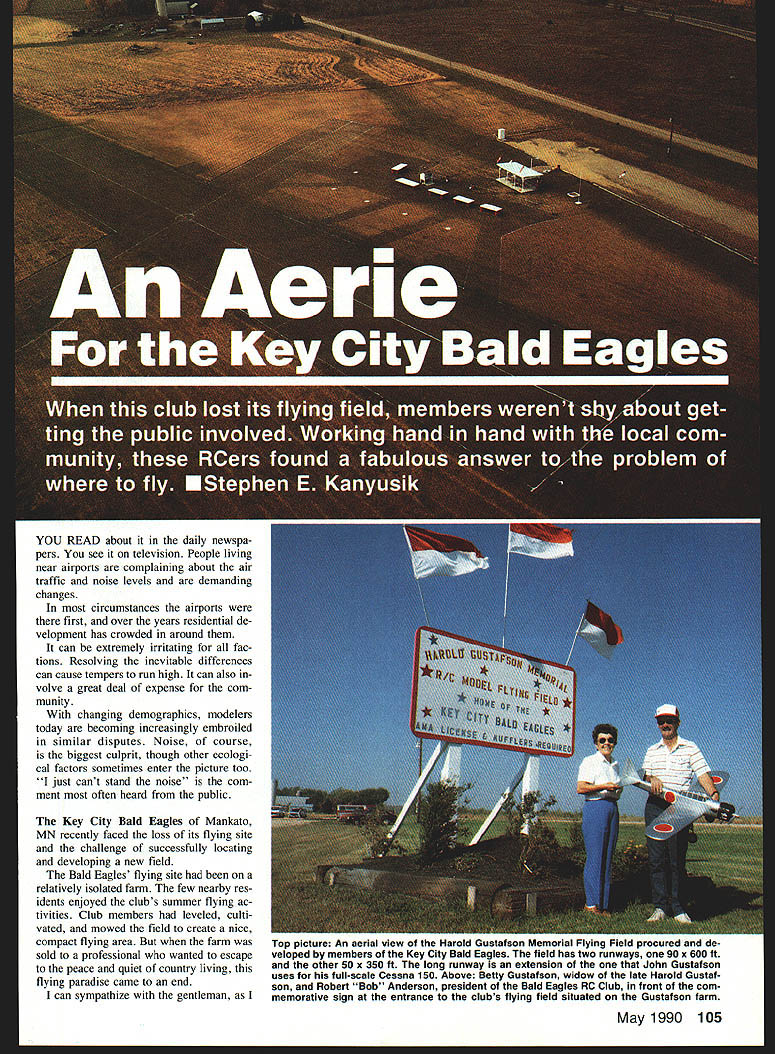
When he learned of our club's situation, John told us that his father, the late Harold Gustafson, had been an aviation enthusiast. He had built an airstrip on his farm for John's Cessna 170 and had also enjoyed watching model airplanes fly. John also thought it would be nice to see the miniature planes flying from the Cessna's airstrip.
It wasn't long before the Bald Eagles were invited to set up their flying field at the Gustafson farm.
Developing the New Field
Members set to work immediately by:
- cutting down trees
- leveling land
- planting grass
- putting in culverts for drainage
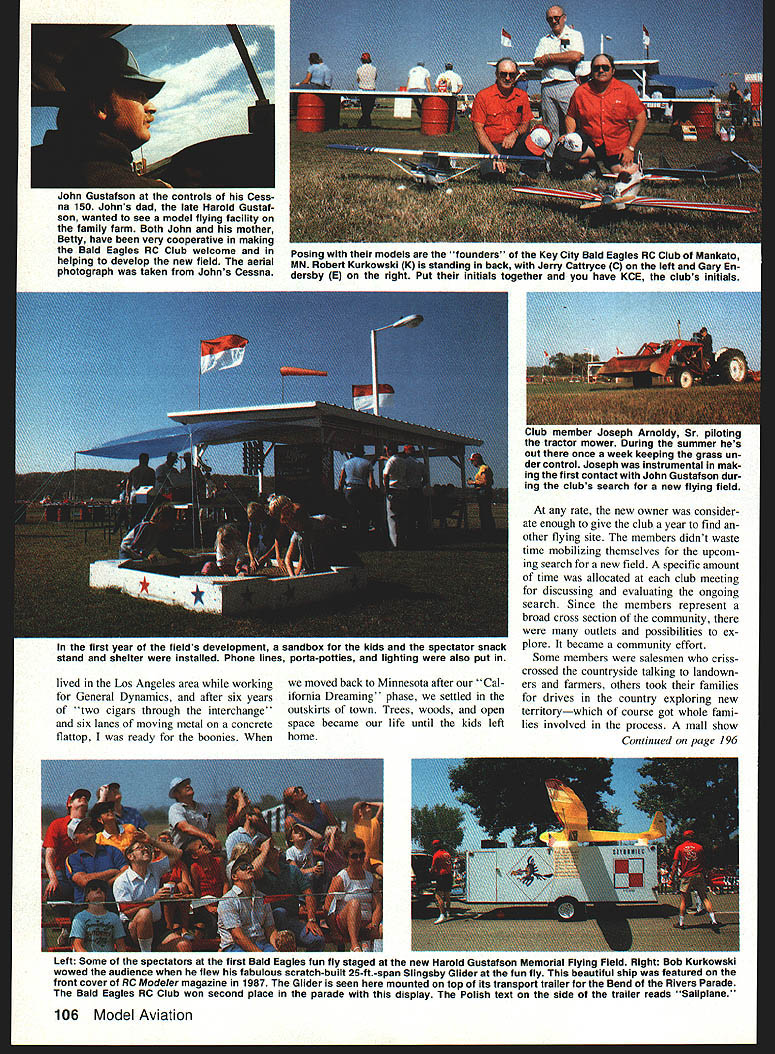
All this initial work was done in the fall so that other work could continue in the spring, when members came out in force to level gopher holes, remove frost-pitched rocks, and repair other winter damage. A porta-potty was set up, and phone lines were brought in — an important safety factor in any public facility. Later in the summer a shelter was built.
Of course, as soon as weather permitted, development activities were interspersed with flying sessions.
Dedication and Community Benefit
In September 1989 the Harold Gustafson Memorial Flying Field was officially dedicated with a fun fly. Harold's widow, Betty, had shared his love of aviation, and she and John Gustafson, who carry on with the farm and other business ventures, were very proud to see the airstrip used as an RC flying field.
A farm airstrip was converted into an active RC flying field, benefiting not only the club but also the community as a whole. The Key City Bald Eagles of Mankato can take pride in their flying facility. They can be just as proud of their cooperative efforts in securing and developing this ideal site.
"The Bald Eagles join me in saying 'Thanks, Harold!'" I think the people of Mankato agree.
Transcribed from original scans by AI. Minor OCR errors may remain.

