
Aerocats and Aero Design East
By Chuck Snyder
It seems that there is always something new and different to challenge us in this hobby and to stimulate a deeper interest. Such was the case when I had the opportunity to join a group of university engineering students in an international design/fly competition for radio control (RC) models: Aero Design East, held April 12–14 at Titusville, Florida.
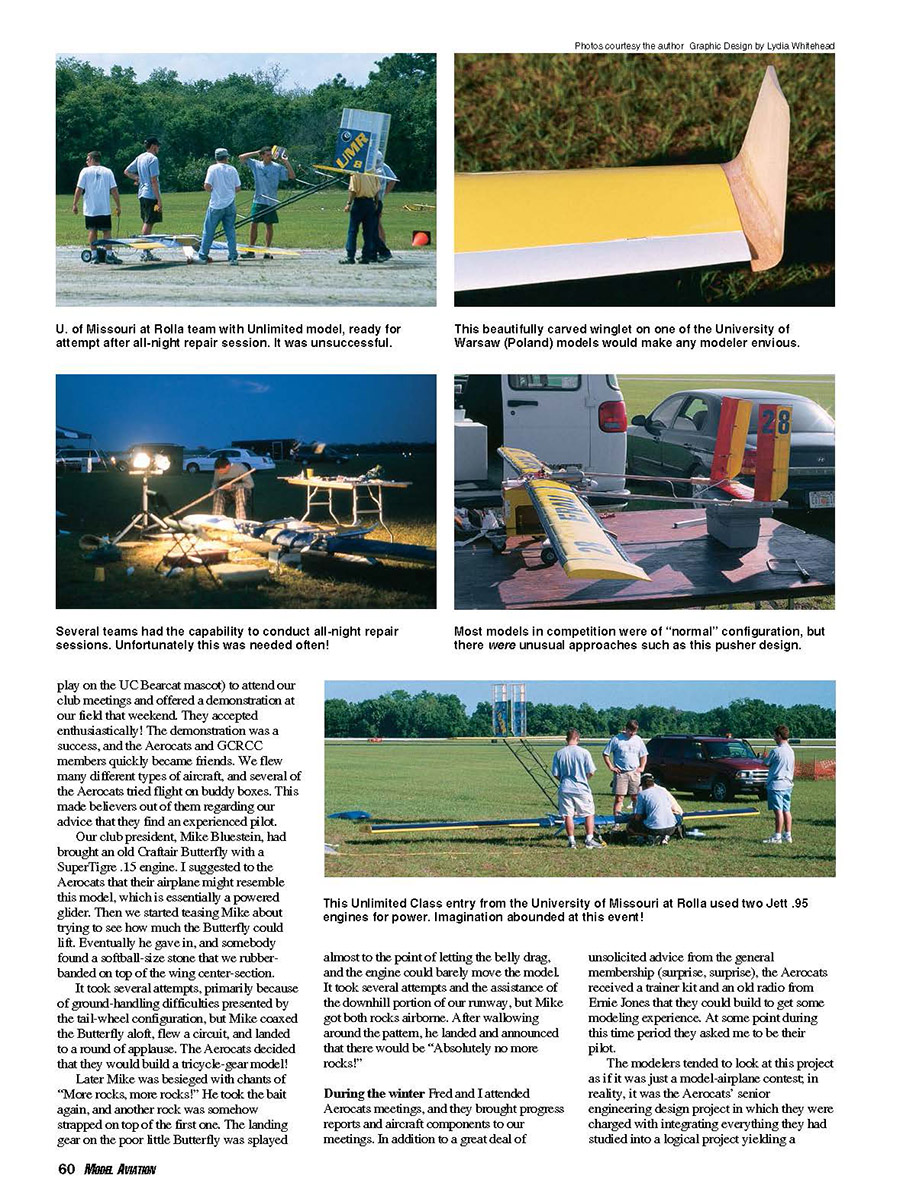
I had seen articles in the modeling press regarding the Aero Design competition sponsored by the Society of Automotive Engineers (SAE), and I knew it was a contest for college engineering students to build RC models with the greatest payload capacity. Aeronautical engineering students at the University of Cincinnati (UC) contacted our club—the Greater Cincinnati Radio Control Club (GCRCC)—through our web site. The students had minimal experience with RC and were looking for advice and information. Our webmaster forwarded the request and suggested that some of the engineers in the club might want to get involved. Fred Murrell and I quickly volunteered; he is a mechanical engineer and had built an Aero Design entry when he attended UC, and I'm a chemical engineer.
Fred and I attended one of the students' meetings. We were introduced to the team and their faculty advisors, and we told them about our club. We hit it off immediately and began a rewarding relationship. I learned the contest's general rules and the aircraft-design constraints.
Competition rules and constraints
- Maximum total projected area: 1,200 square inches.
- Engines allowed: stock K&B or O.S. Max .61.
- Aircraft must be airborne within a 200-foot takeoff zone.
- Aircraft must land with all wheels on the ground within 400 feet (rollout beyond that is permitted).
- Specified cargo hold volume: 300 cubic inches.
- Propeller must turn at the same rpm as the crankshaft (no reduction units).
- Direct participation limited to SAE members; any AMA member may serve as pilot.
- Competition includes a formal written report, an oral presentation with questioning, and flying the model.
We invited the Aerocats (the team name is a play on the UC Bearcat mascot) to attend our club meetings and offered a demonstration at our field that weekend. They accepted enthusiastically. The demonstration was a success, and the Aerocats and GCRCC members quickly became friends. We flew many different types of aircraft, and several of the Aerocats tried flight on buddy boxes. This made believers out of them regarding our advice that they find an experienced pilot.
Our club president, Mike Bluestein, had brought an old Craftair Butterfly with a SuperTigre .15 engine. I suggested to the Aerocats that their airplane might resemble this model, which is essentially a powered glider. Then we started teasing Mike about seeing how much the Butterfly could lift. Eventually he gave in, and somebody found a softball-size stone that we rubber-banded on top of the wing center section. It took several attempts—primarily because of ground-handling difficulties presented by the tail-wheel configuration—but Mike coaxed the Butterfly aloft, flew a circuit, and landed to a round of applause. The Aerocats decided that they would build a tricycle-gear model!
Later Mike was besieged with chants of "More rocks, more rocks!" He took the bait again, and another rock was somehow strapped on top of the first one. The landing gear on the poor little Butterfly was splayed almost to the point of letting the belly drag, and the engine could barely move the model. It took several attempts and the assistance of the downhill portion of our runway, but Mike got both rocks airborne. After wallowing around the pattern, he landed and announced that there would be "absolutely no more rocks!"
The team and the project
During the winter Fred and I attended Aerocats meetings; they brought progress reports and aircraft components to our meetings. In addition to a great deal of unsolicited advice from the general membership, the Aerocats received a trainer kit and an old radio from Ernie Jones that they could build to get some modeling experience. At some point during this time they asked me to be their pilot.
The modelers tended to look at this project as if it was just a model-airplane contest; in reality, it was the Aerocats' senior engineering design project in which they were charged with integrating everything they had studied into a logical project yielding a "product" that would achieve certain goals. Being able to predict the aircraft's performance was a major portion of the project. Every aspect of the design had to be evaluated and appropriate calculations completed. The team had access to computer-aided design and drawing programs and plenty of computing power.
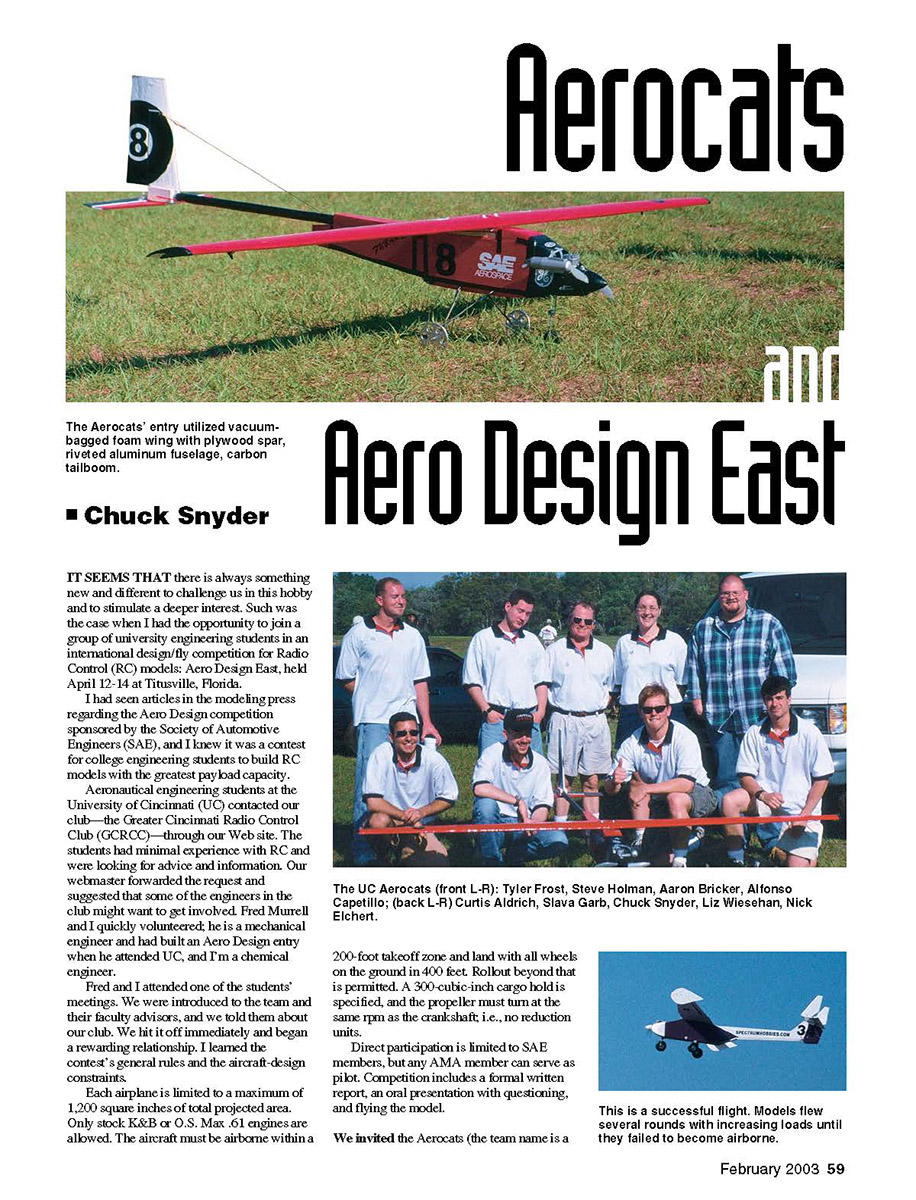
Several of the Aerocats had had summer jobs or co-op experience at full-scale aircraft manufacturers, so their airplane resembled a "miniature" full-scale aircraft rather than a big model. The fuselage was aluminum with a carbon-fiber tailboom, and the wings were vacuum-bagged fiberglass and carbon over foam.
The team decided that maximizing lift would be its top priority; other major considerations were engine thrust, structural integrity, and weight reduction. After reviewing video of a previous competition, they decided on a conventional high-wing aircraft.
Aerodynamic and structural design
The airfoil had to provide high lift at low airspeeds. Consequently they selected the Selig S1223 airfoil, developed specifically for this competition. It is a highly undercambered section of approximately 15% maximum thickness and achieves a lift coefficient greater than 2.0 (by comparison, the classic Clark Y has a maximum coefficient of about 1.6).
The Aerocats evaluated tradeoffs between wingspan, taper ratio, area, aspect ratio, induced drag, strength, and weight. The result:
- Wing span: 110 inches.
- Aspect ratio: 12.5.
- Wing area: 968 square inches.
- Total planform area (wing + stabilizer + fuselage): 1,194 square inches.
This airfoil has pitching characteristics that require a great deal of down force from the stabilizer to control the aircraft. The Aerocats selected a low-drag, lifting airfoil for the stabilizer, but they mounted it inverted to get the required down force. I saw several other airplanes at the contest using the same airfoil with their stabilizers installed "upside down."
Structural integrity was the second priority. The airplane was designed for 2.5 g with a 1.5 safety factor. The fuselage and tailboom were designed to withstand simultaneous maximum deflection of the elevator and rudder. The wing was analyzed as an I-beam with a birch plywood shear web and carbon-fiber caps.
- Calculated shear web thickness: 3/32 inch at the root tapering to 1/32 inch at the tip; for ease of construction the team used a constant-thickness web.
- Carbon-fiber caps: two layers of cloth with constant thickness of 0.018 inch; width varied from 3/4 inch at the root to 1/2 inch at the tip.
- The model used some extra material "just in case."
There was excellent data available for the aerodynamic and structural parts of the design, but engine thrust was another story. The Aerocats selected the O.S. .61 FX, but did not have horsepower or torque curves for the engine. I found several magazine engine-review articles with curves for similar engines; these provided the basis for design estimates.
The computerized calculations confirmed what experienced modelers intuitively know: the propeller should have a large diameter and low pitch. Unfortunately, there are no commercially available propellers with the optimum diameter and pitch. The design proceeded with an optimistic assumption of thrust because budget and constraints didn't allow for the purchase of a dynamometer. When I learned that they "couldn't get" any actual thrust data, I invited the team to meet me at the field and asked that they bring their collection of propellers, a short length of rope, and a fish scale. I brought one of my airplanes with an older O.S. .61 and a tachometer.
We set the model on a picnic table and tied the scale to the tail—an improvised dynamometer. Within an hour we had data on several propellers. Propellers in the 12 x 6 to 14 x 4 range produced similar thrust readings, but no usable propeller allowed the engine to come close to its calculated horsepower peak at about 16,000 rpm. This information was included in the project report with the comment that "tested props were never able to obtain [the calculated performance]."
The design work predicted an airplane capable of getting airborne in 200 feet at a gross weight of 40.0 pounds and a stall speed of 49 feet per second (33 mph). The takeoff distance turns out to be the limiting factor in this competition. The formula to calculate it considers tire friction, headwind, all drag components, rotation time, propeller thrust as a function of aircraft velocity, and a safety factor.
However, the calculation had been made using the theoretical propeller static thrust before the actual data had been collected and was never revised.
Prototype testing and repairs
All of this design work was a major portion of the project, and model construction had taken lower priority. Finally, approximately 10 days before the competition the prototype was ready for its maiden voyage. The weather was excellent on the last weekend of March, and the Aerocats arrived at our field and set up the airplane. Many of the modelers felt that there was too much decalage (angle difference between wing and stabilizer), but we deferred to the engineers' calculations.
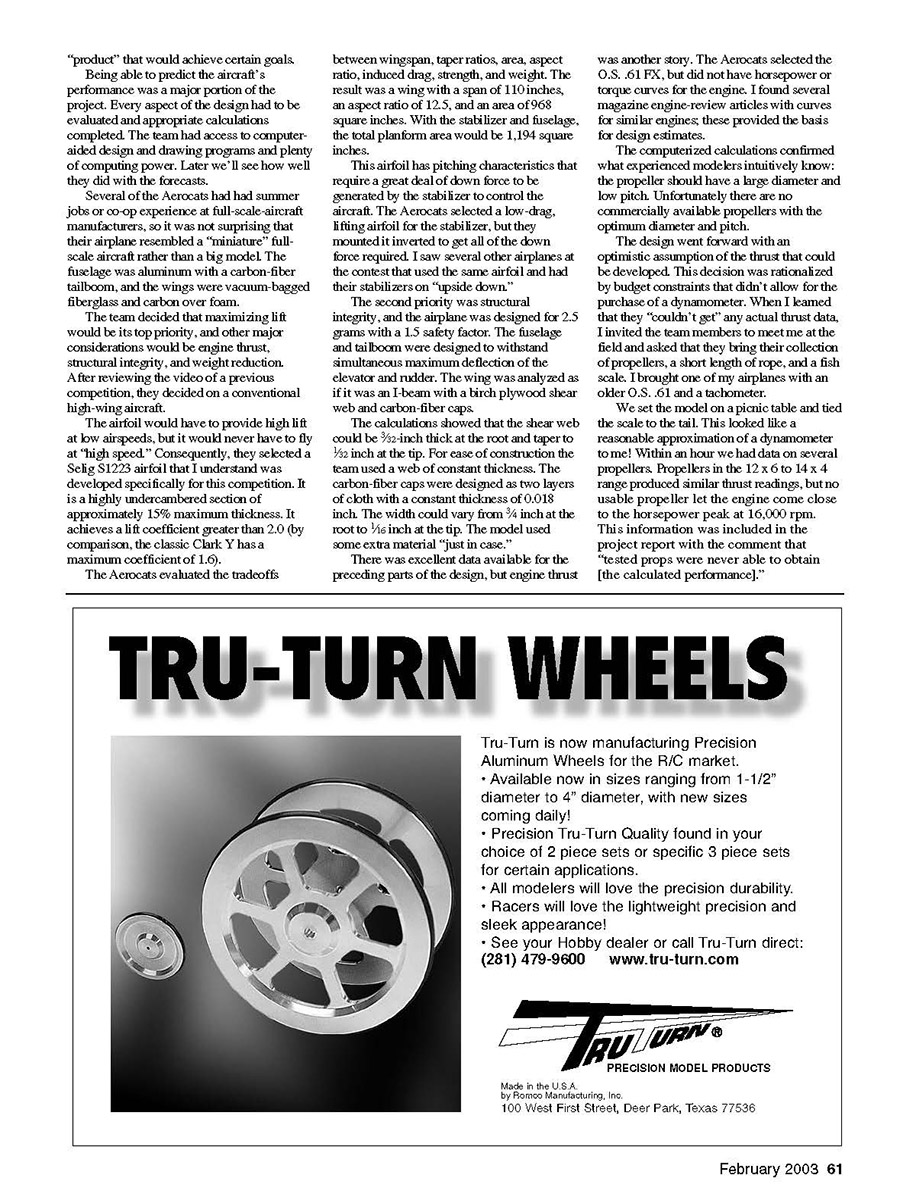
The model didn't fly on its first attempt, but the crash was minor enough that repairs were made the same day. The stabilizer was reinstalled at a typical model-airplane incidence, then it flew successfully. Aerocats jumped and cheered, and the GCRCC members shouted, clapped, and patted backs. The magnitude of the excitement was greater than what I've seen for any first flight!
The airplane flew very well, and after minor trim adjustments we began adding weight. I botched the landing on a flight with 16.0 pounds of cargo. The model flipped over when it went off the side of the runway and the forward fuselage was destroyed, but the Aerocats said they would build another—or maybe two! Everyone went home with big smiles that afternoon.
Working in shifts for 20-hour days, the Aerocats built two new fuselages. They also had two wings, and they chose to mate the better (but unflown) wing to one of the fuselages. The Aerocats, their airplane, and "their pet chemical engineer" headed for Titusville for the competition.
The competition at Titusville
When we arrived at the flying site—a taxiway at the municipal airport—46 teams were setting up. It was an international event; there were teams from Europe, Central and South America, and Canada. What followed was one of the best model-airplane contests I've ever attended. The SAE administration and judging were outstanding. They even provided an excellent pilot for teams that did not have their own.
The camaraderie and offers of help between the teams were similar to what is seen at AMA contests, and good sportsmanship predominated. Most of these airplanes would be pushed until they failed; teams rejoiced in each other's successes and sympathized when the inevitable crashes occurred.
I checked out the other airplanes while the Aerocats set up. Most were conventional, but there were many novel ideas such as lifting-body fuselages, slotted airfoils, and spoilers for roll control. There was some outstanding craftsmanship; I especially admired the two entries from the University of Warsaw (Poland), which placed first and third. The Aerocats were working on a card table with a small collection of hand tools, but several teams had trailers complete with generators, power tools, and floodlights.
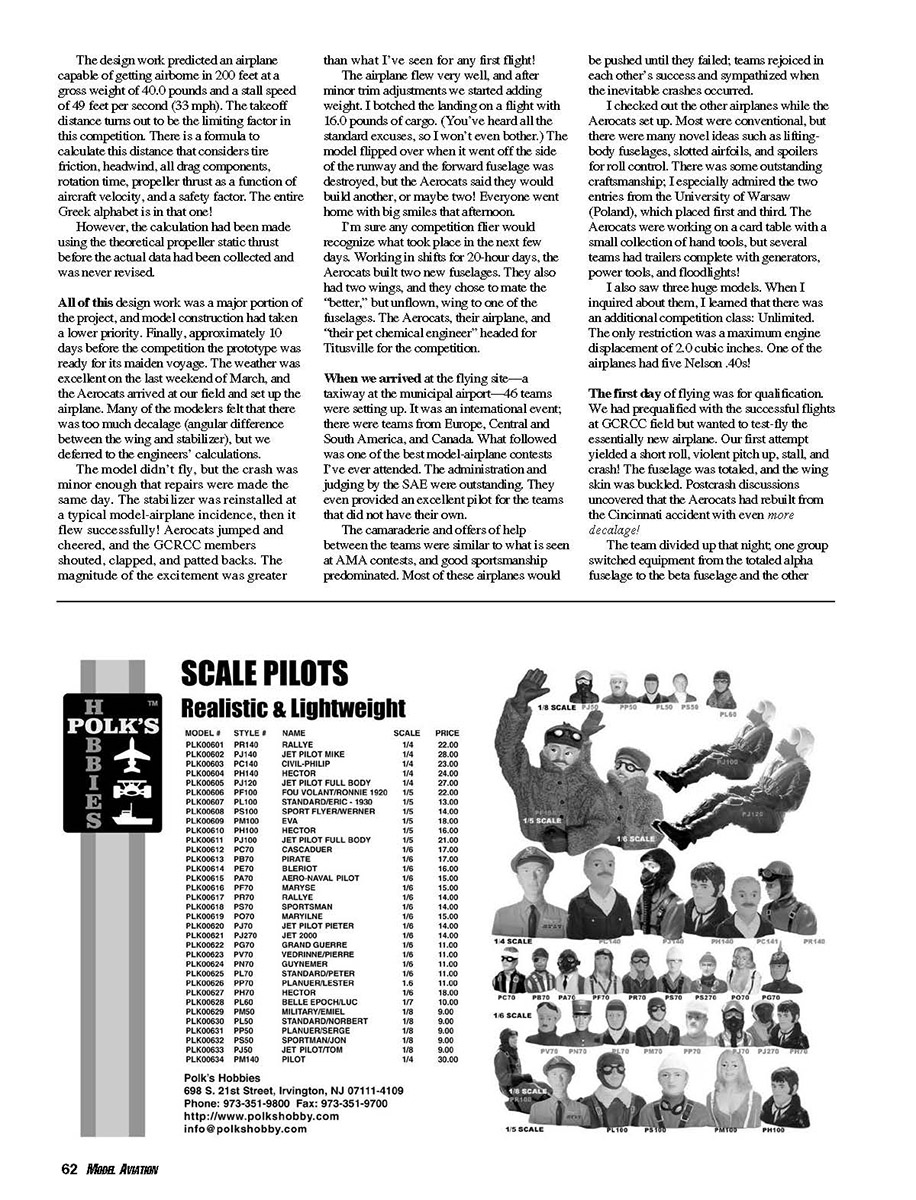
I also saw three huge models. When I inquired about them, I learned there was an additional competition class: Unlimited. The only restriction was a maximum engine displacement of 2.0 cubic inches. One of the airplanes had five Nelson .40s!
The first day of flying was for qualification. We had prequalified with the successful flights at the GCRCC field but wanted to test-fly the essentially new airplane. Our first attempt at Titusville yielded a short roll, violent pitch up, stall, and crash. The fuselage was totaled, and the wing skin was buckled. Postcrash discussions uncovered that the Aerocats had rebuilt from the Cincinnati accident with even more decalage.
The team divided that night; one group switched equipment from the totaled alpha fuselage to the beta fuselage and the other made the oral presentation. The old wing was also put back in service.
The father of one of the Aerocats was able to attend the contest. Steve Frost is a corporate pilot who knows how an airplane ought to look. He and I walked into the motel room where the first group was having a lively discussion about wing and stabilizer incidence. Clearly there wasn't a consensus, and the Aerocats were about to vote.
"If you are going to vote," I announced, "Steve and I get to vote, and we are going to age-weight the voting!" There wasn't a vote, but the stabilizer was installed properly.
We were not the only team to crash. Takeoff and departure stalls were common; I saw a couple of airframes break up in midair. The Unlimited airplane with the Nelson .40s managed a few feet of straight-ahead flight, and one of the other Unlimiteds crashed in front of us. Neither looked controllable to me.
The oral presentations were made at the local community college. I intended to listen to several in hopes of learning some teams' secrets, but only team members and associates were permitted to hear the presentations. The Aerocats did a great job and tied for the highest oral-presentation score.
Surprisingly, the questioning was not focused on technical aspects but on the project-management side of the experience. This made sense after I talked to the event organizer, who told me that most teams do not complete their airplanes.
Flying rounds and payloads
The next morning began the official competition. The Aerocats were excited because they were in fifth place based on the written and oral presentations. Their only shortfall turned out to be stability. Although my engineering background didn't provide experience with those calculations, as a modeler I was painfully aware that they deserved the low score.
When our turn to fly came, another short roll, pitch up, stall, and crash occurred. We had moved the center of gravity farther back than it was in Cincinnati. Fortunately the damage was reparable, and the Aerocats again did a great job effecting repairs with power tools lent by another team.
We were ready to fly again by late afternoon. It flew, but the flight didn't count because the takeoff roll exceeded the 200-foot limit. Even though we had a trimmed and flyable airplane, my self-image as a pilot was low.
For the next attempt I decided to stand at the 200-foot marker so I could better judge when to rotate. I had been checking scores and knew we could make a good showing if we could duplicate the weight we lifted in Cincinnati, but competition was over for the day.
Sunday started beautifully, but Lady Luck was still not with us. A propeller/spinner combination did not allow the propeller nut to tighten properly. They don't give points for shaft runs, and we were running out of scheduled rounds. The spinner was discarded, and the propeller was attached with a plain hex nut.
Then the discussion revolved around picking a payload we knew we could lift or "going for broke" with what the calculations said the airplane could lift. I don't recall the exact decision method, but they loaded the model with a little more than we had lifted back home.
We finally had a successful takeoff and circuit of the field. I flew a second circuit to settle down, then landed the model to the cheers of the Aerocats and the other teams. I think the payload was roughly 18.0 pounds. That got the team on the board, in 12th or 14th place, and I began to feel like a human being again.
There was time for one more round, and the Aerocats put 20.3 pounds in the cargo bay. What a flight! Video cameras recorded a couple of snaps right after takeoff with the right wingtip almost dragging the ground. The big, counterbalanced rudder overcame the snaps, and after a long, slow climb I gently turned crosswind for a really big pattern. The airplane flew fine as speed built and landed to the applause of everyone on the flightline.
Results and reflections
The contest ended with the Aerocats being one of only five teams to lift more than 20.0 pounds. The winners from the University of Warsaw lifted 25.0 pounds. The scoring is not directly related to the amount lifted, but rather to the ratio of actual to forecast. As a result, the Aerocats finished in 10th place because they had predicted a maximum of 28.0 pounds.
How did the other predictions come out? The team was right on the estimate of 11.5 pounds for the model's empty weight. The airplane survived, so it must have been strong enough, but we'll never know how overbuilt it was. I had overheard claims of airplanes that weighed as little as 6.0 pounds.
And what about the "real world" propeller thrust we had measured? Theoretically the airplane should not have been able to fly on that last flight. I guess it is a good thing they didn't tell me that ahead of time!
This was a fantastic performance for a first-time team, and the students were rightfully proud of their accomplishment. The association between the Aerocats and the GCRCC was fun and rewarding for everybody involved. All of the Aerocats were seniors, and they started their careers in aeronautical and aerospace engineering after graduation. I'm sure the overall modeling experience was positive for them, and several will probably take up our hobby when they have time. If you get a chance to participate in a similar opportunity, jump on it!
P.S.: None of the Unlimited airplanes had successful flights. It made me wish I had brought my Mok 1.8; we could have stuck it on the front of the Aerocats' airplane and won that event. -AA
Chuck Snyder 10759 Moss Hill Ln. Cincinnati, OH 45249
Transcribed from original scans by AI. Minor OCR errors may remain.

