
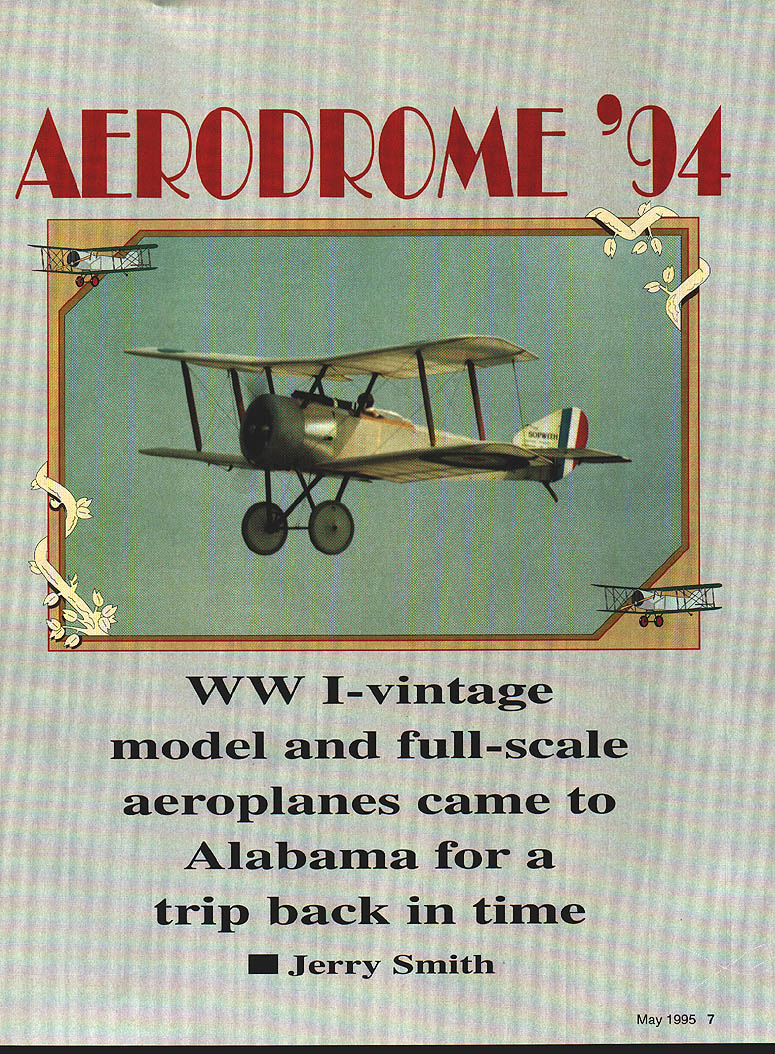
AERODROME '94
By Jerry Smith
Aerodrome ’94 was held August 20–22 at the Gadsden Municipal Airport in Gadsden, Alabama. This was the second event of its kind (Aerodrome ’92 was held at Guntersville, Alabama, home of Ryder’s Replica Fighter Museum). The Gadsden airport provided more space and better accommodations for the large crowd expected to attend.
Event overview
When I walked onto the field I was overwhelmed by a feeling of nostalgia, as if it were sometime during World War I. That feeling was reinforced when a gentleman dressed in an authentic WWI uniform rode by in a 1914 Model T Army ambulance.
Some 50 or more replicas were parked wingtip-to-wingtip along the runway. Many of the owner/pilots were on hand to talk about their airplanes. The types on display and flying included Fokkers, Nieuports, Sopwiths, Albatroses, and many more. The airplanes were shuffled in and out of the flightline for frequent exercises, with as many as 12 in the air at one time.
Full-scale replicas
Authenticity and modern adaptations
- Most replicas were full-size or near–full-size and carefully built to depict original aircraft that would be far too rare or valuable to risk flying today.
- The main deviations from absolute authenticity were the substitution of more modern, reliable engines (Continental, Warner, Lycoming, Ranger) and the addition of brakes and tailwheels for better ground handling.
- Some builders hid modern engines under false housings to mimic the appearance of original rotary engines.
Highlights
- The highlight of the day was watching a Fokker Dr.I with a rotary-style engine being propped. After priming a few cylinders and a few hard pulls on the huge wooden prop, the engine started in a cloud of smoke. The smell of castor oil was everywhere; the bottom of the Fokker was drenched in oil after landing — not unlike cleaning two-stroke model engines.
Air-to-air photography
I rode in a J-3 Cub for air-to-air photography and captured a good shot of Roy McCaldin (Tucson, AZ) flying his 70% scale D.H.4. Roy built that replica from microfilm copies of original plans obtained from the Smithsonian.
Unmanned aircraft (RC)
Organization and schedule
- The RC contingent was headed by Hank Ilczsch (Seekonk, MA).
- RC pilots were allotted a one-hour slot in the morning and a one-hour slot in the evening. Weather prevented Saturday evening and Sunday morning RC flights, but several fine WWI RC models were flown and displayed during better weather windows.
Notable RC models and builders
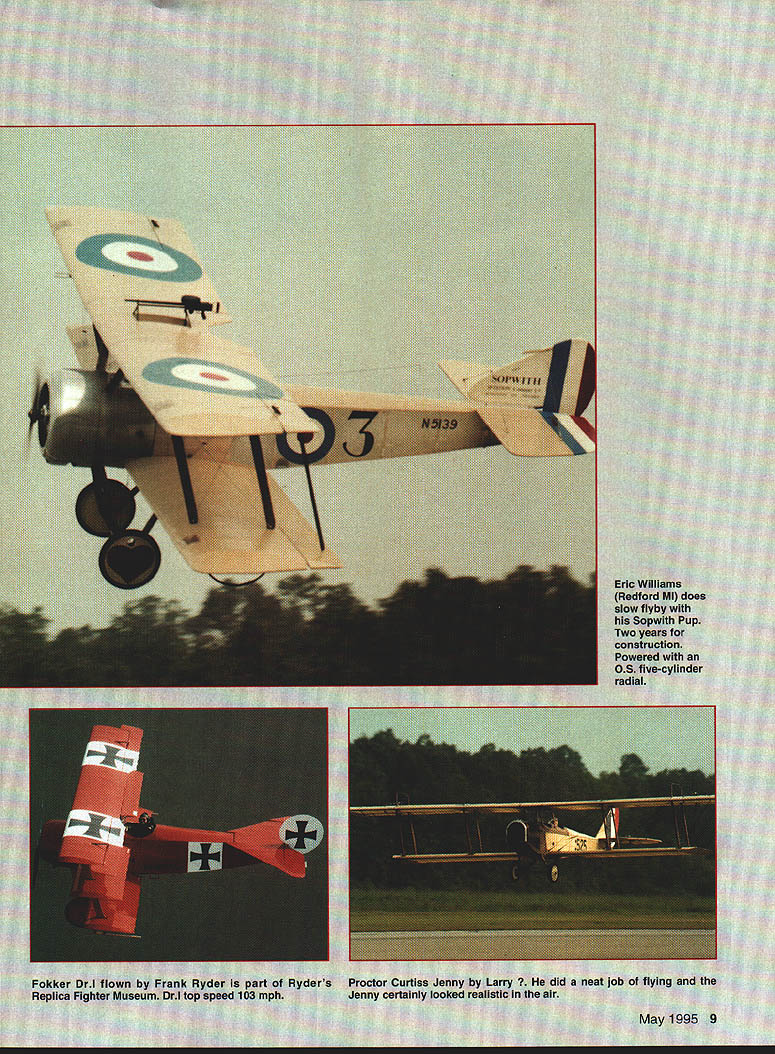
- Eric Williams (Redford, MI) — Sopwith Pup
- Started from a Balsa USA kit with many scale modifications.
- Power: O.S. five-cylinder radial.
- Weight: 30 pounds.
- Covering: Coverite Super Shrink.
- Took two years to build; workmanship and flight realism were excellent.
- Dick Parshall (Holcomb, NY) — Airco/De Havilland D.H.2 (displayed, did not fly)
- A purist scale builder; all fittings were hand-made, including rigging turnbuckles.
- Power: Quadra 35; pusher configuration requiring a special driveshaft.
- Weight: 21 pounds; still needs a dummy engine and additional detail.
- The full-size D.H.2 was an early true Allied fighter; its Lewis .303 machine gun was mounted in front with no propeller to shoot through, giving it a distinct advantage over Eindeckers.
Notable full-scale and large-scale pilots and aircraft
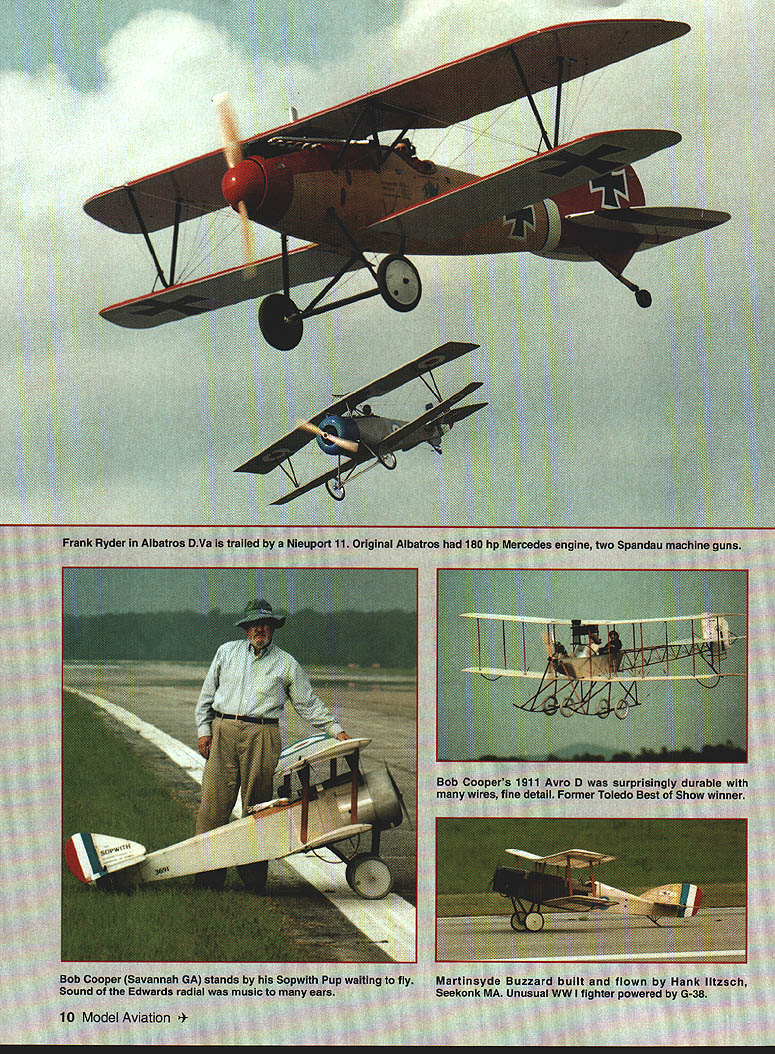
- Bob Cooper (Savannah, GA)
- Displayed and flew a 1/4-scale 1911 Avro D and a Sopwith Pup.
- The Avro used wing warping and, despite looking fragile, performed well; each flight ended with engine failure and a forced landing.
- The Sopwith Pup was fitted with an Edwards five-cylinder radial and showed realistic performance. Pilot Doss Steed (Hartwell, GA) handled it with smooth touch-and-goes. Bob Cooper is a lute maker by trade and a meticulous scale builder.
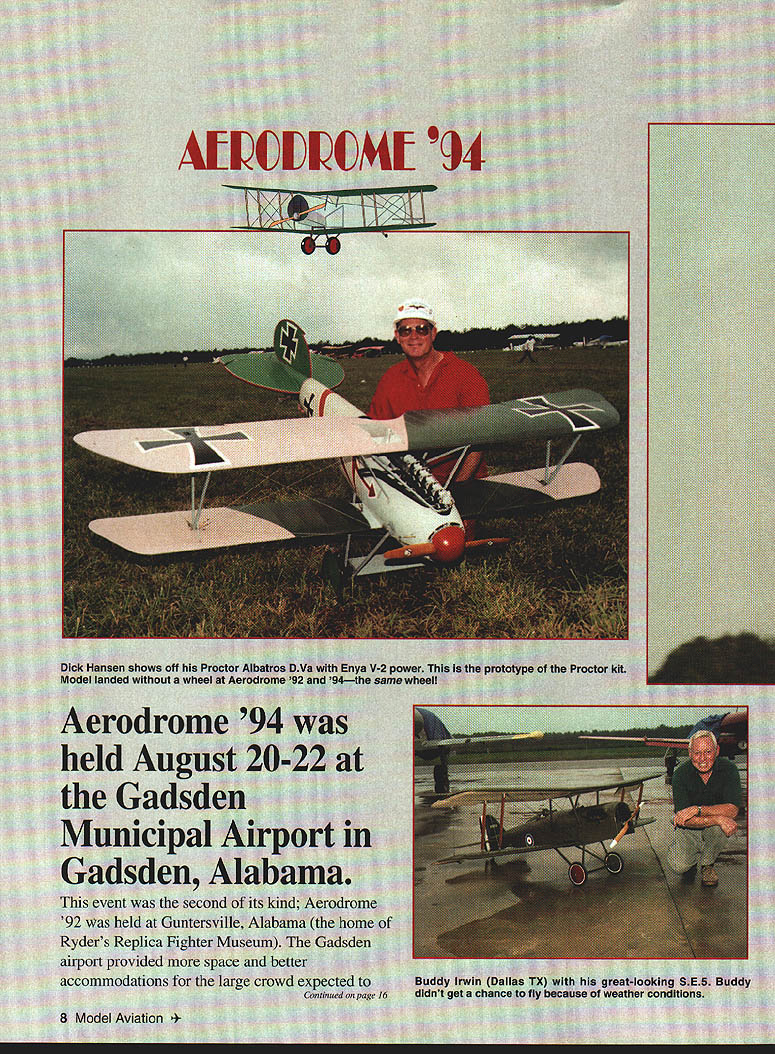
- Dick Hansen (Portland, OR; Hansen Scale Aviation Videos)
- Flew a 1/4-scale Proctor Albatros D.Va (the prototype for Proctor’s kit).
- On Sunday evening takeoff the Albatros lost its left wheel — the same wheel had failed at Aerodrome ’92. Dick landed without damage.
- Buddy Irwin (Dallas, TX)
- Displayed a scratch-built S.E.5 powered by a 1-20 four-stroke (I did not see it fly).
- Note: The difference between the S.E.5 and S.E.5a is that the S.E.5’s exhaust stack does not run by the cockpit, and the radiator configuration is different.
Organizations and museum
If you are a WWI fighter-plane buff, consider joining The First Warplanes — an organization dedicated to the preservation and restoration of WWI replica aircraft. The movement has enjoyed wide support and international interest.
If you travel through central Alabama, visit Ryder’s Replica Fighter Museum (Guntersville, AL). The museum features:
- Seven spotless hangars displaying nearly 40 WWI aircraft
- A fine art collection related to the era
- A collection of vintage engines and propellers
- An extensive aviation reference library and archives
- A large array of artifacts and memorabilia
- Beautiful large-scale unmanned aircraft, including a series of 15-footers hanging from the beams
- A 32-foot Zeppelin nearing completion
I have visited the museum several times; it’s fascinating. Building replicas and preserving the WWI fighter era is likely how future generations will remember this important time in aviation.
Frank Ryder is the driving force behind the Aerodrome events. Through his efforts it will most likely become a popular national event — look for it again in August 1995.
Contact
The First Warplanes / Ryder’s Replica Fighter Museum Box 366 Guntersville, AL 35976 (205) 582-4309
Transcribed from original scans by AI. Minor OCR errors may remain.

