
Aerolympics II
By John Worth
Overview
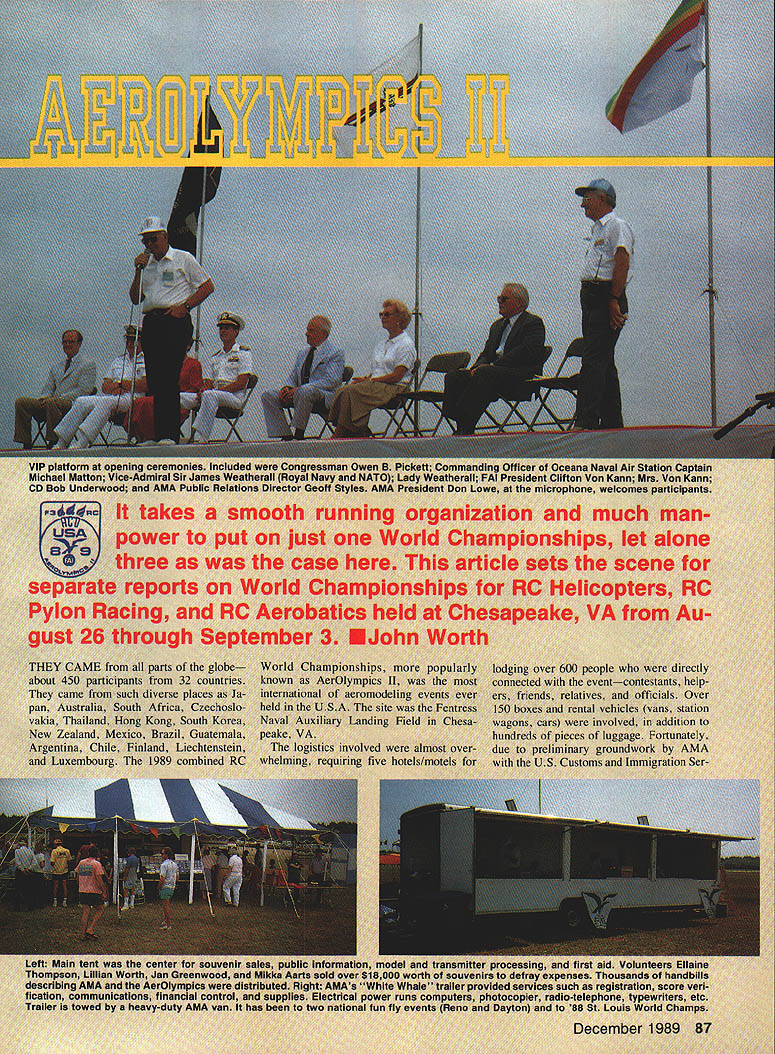
It takes a smooth-running organization and much manpower to put on just one World Championships, let alone three as was the case here. This article sets the scene for separate reports on World Championships for RC Helicopters, RC Pylon Racing, and RC Aerobatics held at Chesapeake, VA from August 26 through September 3.
They came from all parts of the globe—about 450 participants from 32 countries. The 1989 combined RC World Championships, more popularly known as AerOlympics II, was the most international aeromodeling event ever held in the U.S.A. The site was the Fentress Naval Auxiliary Landing Field in Chesapeake, VA.
Participants
- Approximately 450 participants
- Representing 32 countries, including:
- Japan, Australia, South Africa, Czechoslovakia, Thailand, Hong Kong, South Korea, New Zealand
- Mexico, Brazil, Guatemala, Argentina, Chile, Finland, Liechtenstein, Luxembourg
Logistics and Accommodation
The logistics involved were almost overwhelming. Organizers required five hotels and motels to lodge over 600 people directly connected with the event—contestants, helpers, friends, relatives, and officials. Over 150 boxes and numerous rental vehicles (vans, station wagons, cars) were involved, in addition to hundreds of pieces of luggage.
Fortunately, due to preliminary groundwork by the AMA with the U.S. Customs and Immigration Service, model boxes and luggage moved in and out of the country with a minimum of problems.
The closing banquet was the topper. Though at first it had appeared that there would be room for only 500 people, in the end 600 were accommodated. It was a grand affair, with flags decorating every wall of the ballroom where the banquet was held.
Headquarters and Navy Support
The Holiday Inn at Chesapeake, VA was the headquarters hotel. The friendly staff did a superb job accommodating needs from the initial welcoming party through team manager meetings, various evening social events, a mini-trade show, and the big banquet.
U.S. Navy officials at Fentress (site of the 1988 Nationals) also did a superb job supporting airfield activity without compromising their basic mission of providing for practice landings and jet takeoffs from nearby Oceana Naval Air Station. Full-scale flight operations were scheduled during early morning or late-night hours so that the AerOlympics could operate without interference roughly from 9 a.m. to 7 p.m.
In order to use the Fentress site, the AMA had to make a number of accommodations. Restrictions were imposed on where tents and aircraft could go. A field inspection and cleanup was conducted every evening to make sure nothing was left on runways or taxiways that might end up in a jet engine. Vehicle movement and parking were tightly controlled.
Field Operations and Facilities
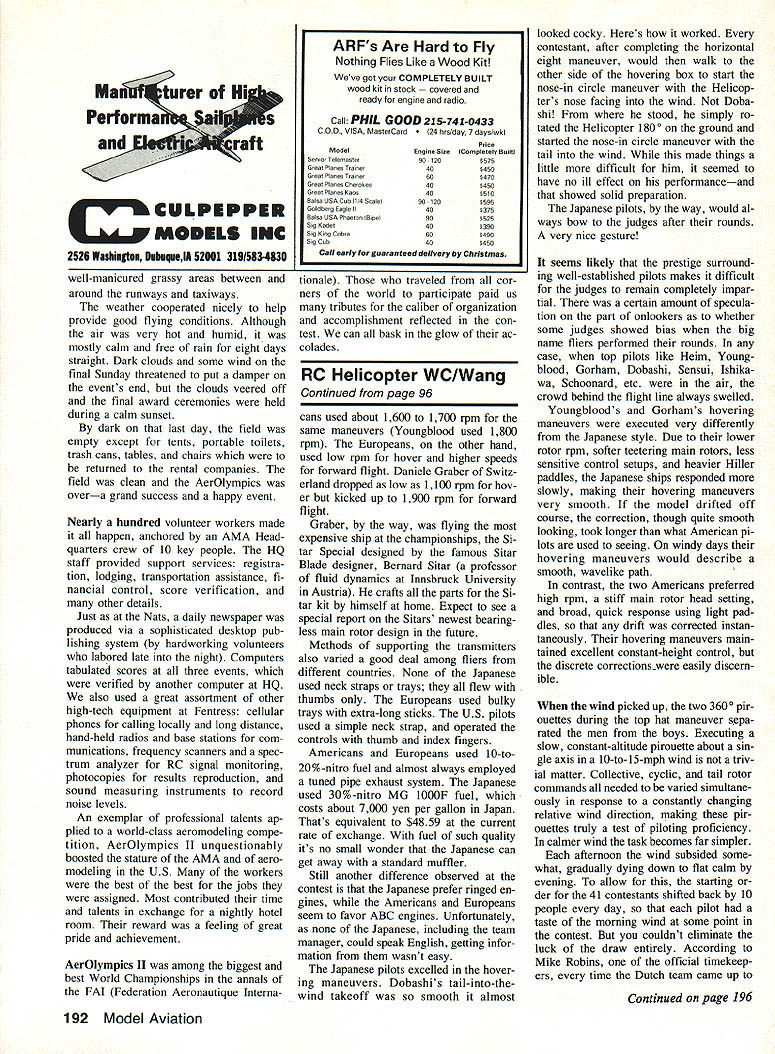
Despite the restrictions, Fentress was a terrific site for the combined world championships. Physical separation and control of RC frequencies enabled Helicopters, Pylon Racers, and Aerobatics to operate with only minor compromises. The site is attractive, with well-manicured grassy areas between and around the runways and taxiways.
Weather and Closing
The weather cooperated nicely to provide good flying conditions. Although the air was very hot and humid, it was mostly calm and dry for eight days straight. Dark clouds and some wind on the final Sunday threatened to put a damper on the event's end, but the clouds veered off and the final award ceremonies were held during a calm sunset.
By dark on that last day the field was empty except for tents, portable toilets, trash cans, tables, and chairs that were to be returned to the rental companies. The field was clean and the AerOlympics was over—a grand success and a happy event.
Technology and Scoring
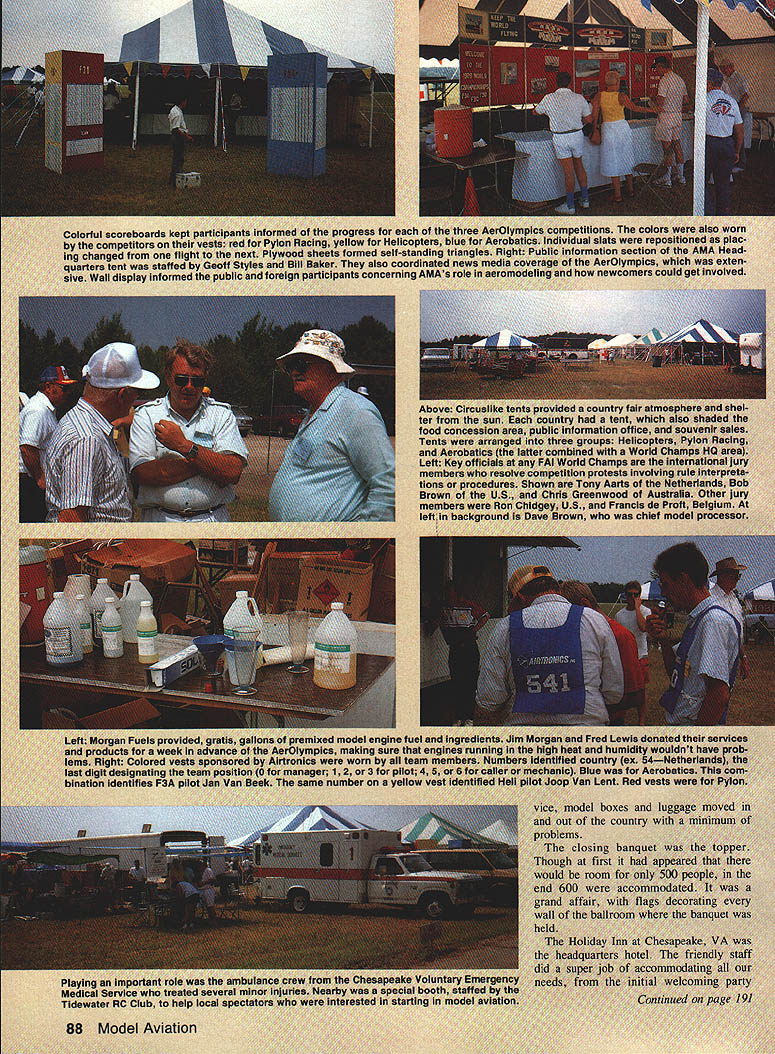
A daily newspaper was produced via a sophisticated desktop-publishing system by volunteers who labored late into the night. Computers tabulated scores at all three events, which were verified by another computer at HQ.
Other equipment used at Fentress included:
- Cellular phones for local and long-distance calls
- Hand-held radios and base stations for communications
- Frequency scanners and a spectrum analyzer for RC signal monitoring
- Photocopy equipment for reproducing results
- Sound measuring instruments to record noise levels
Volunteers and Organization
Nearly a hundred volunteer workers made it all happen, anchored by an AMA Headquarters crew of 10 key people. The HQ staff provided support services: registration, lodging, transportation assistance, financial control, score verification, and many other details.
Most volunteers contributed their time and talents in exchange for a nightly hotel room. Their reward was a feeling of great pride and achievement.
Legacy and Conclusion
AerOlympics II was among the biggest and best World Championships in the annals of the FAI (Federation Aeronautique Internationale). Those who traveled from all corners of the world to participate paid many tributes for the caliber of organization and accomplishment reflected in the contest. The event unquestionably boosted the stature of the AMA and of aeromodeling in the U.S., and organizers and volunteers can bask in the glow of their accolades.
Transcribed from original scans by AI. Minor OCR errors may remain.

