
Aeronautica Collector
Richard Seely
If you're a serious scale builder or just someone interested in collecting aviation memorabilia, this man is someone you're going to want to get to know.
- Chris Weinreich
What do you do if you need an interior photo of the cockpit of a World War II B-26 Martin Marauder? Or what if you want a different, but authentic, design and color scheme that will set your P-47 apart from the rest of the models on the field? Where would you go to get a schematic for the landing gear of a Fokker F.VIIb-3m, a list of fighter planes used by the Japanese Air Force in China during 1937, a history of Boeing Aircraft, or an eyewitness account of the 1939 Wakefield contest?
The answer to all these questions, and literally thousands of others, is Mr. Richard Seely of Olympia, WA. Richard is one of the top dealers and collectors of aviation literature, documentation, and photographs in the country. (His complete address and phone number appear at the end of this article.)
A collector for 35 years and a dealer for 20, Richard's inventory includes over 3,500 books, 25,000 magazines, and 35,000 slides and pictures of airplanes, airships, and aviation history. His customers include museums, libraries, private collectors, and modelers in the United States and around the world. He has lent and sold materials to the Smithsonian Air and Space Museum, and he recently filled an order for a modeler in Finland.
Seely notes that museums and libraries make up a different category of clientele than individual modelers. The former come to him when they need to fill out a collection or replace materials that have been lost or stolen. Modelers, on the other hand, are usually in search of something special or obscure—especially something that no one else has—and have been known to spend up to $400 to get proper and accurate documentation for their models.
Bookcases line two rooms in Seely's home where his private collection is kept. Models, pictures, and aviation memorabilia rest on shelves, hang from the walls, and spill over onto the copy machine and his desk. Part of his collection has even been relocated to the attic for lack of room to display it.
His dealership is run from a one-bedroom apartment down the street. Magazines are stored on wall shelves and in freestanding stacks in the middle of the floor of one room. Books are stored in another room, arranged in the order in which they appear on his current list. The walk-in closet is packed full of vintage plastic kits that he picked up in a deal from another collector.
"I don't normally deal in kits," he explained, "but I got a good buy, bought them and put them on the list. They've been selling steadily."
During an interview a modeler dropped by to show off a recently completed R/C Wildcat. Seely had supplied him with copies of the drawings and text from the original Grumman maintenance/repair manual. The finished model was truly magnificent.
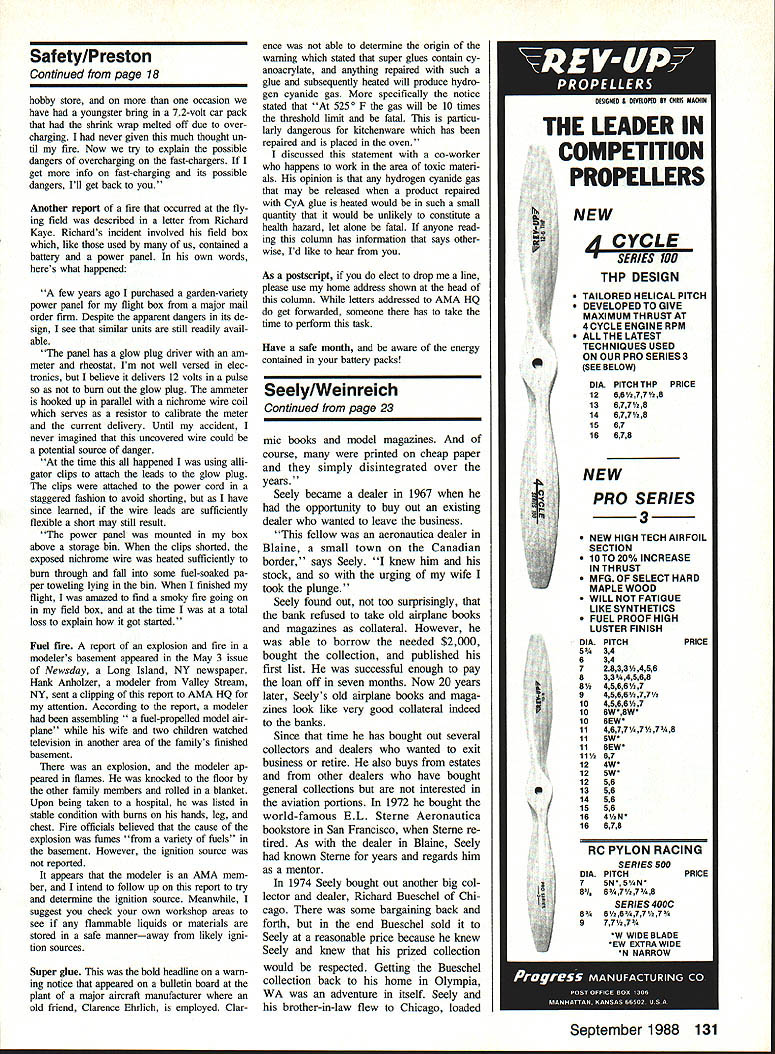
Modelers, especially those interested in antique nostalgia events, come to Seely looking for plans, construction articles, and features from the 1930s, '40s and '50s. Seely's list of model magazines includes:
- Aeromodeller
- American Modeler
- Flying Aces
- Model Airplane News
- Model Aviation
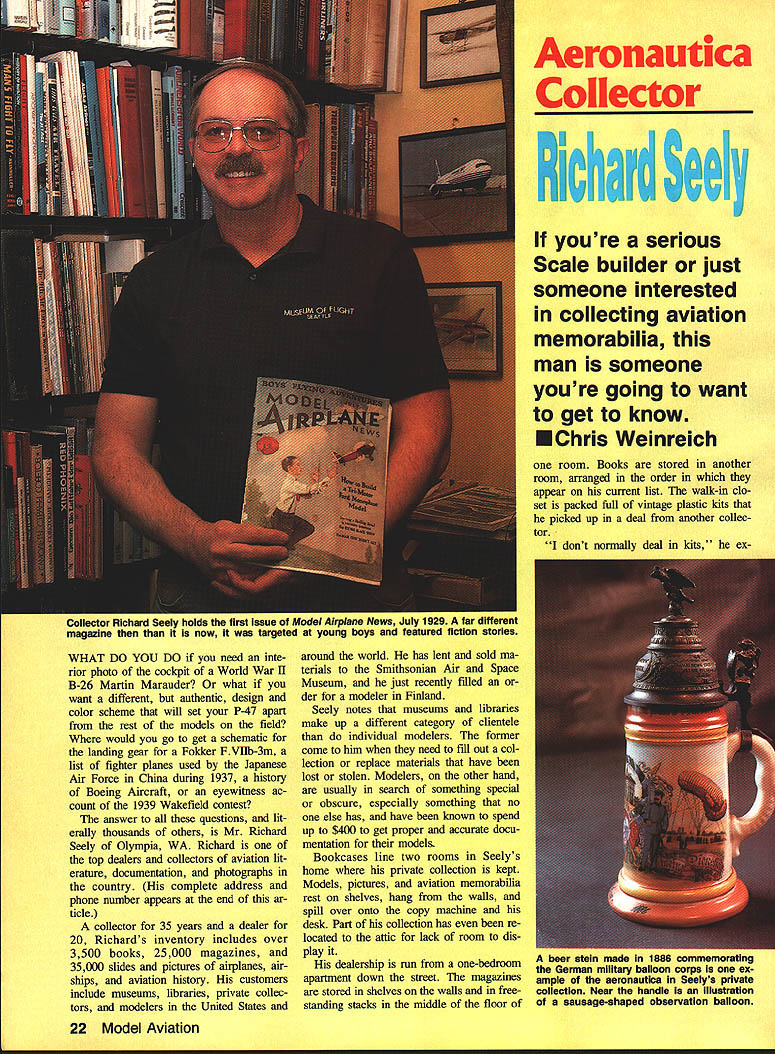
Among Seely's prizes is Volume 1, Number 1 of Model Airplane News, published July 1929 by Bernarr Macfadden. The first issue of MAN is a far cry from the exclusively R/C, adult-oriented publication it is today; it was aimed at boys and contained fiction stories, construction articles, and other features directed at younger readers. Seely notes that pre-World War II model magazines are rather scarce, and his price list reflects that: he sells some early issues for $12–$15 per issue, whereas issues from the mid-1940s sell for $5–$10, and 1950s issues for $3–$5.
"A lot of the pre-World War II magazines went into paper drives," he explains. "Johnny went off to war, his mother cleaned up his room and got rid of the whole collection—comic books and model magazines. And of course, many were printed on cheap paper and they simply disintegrated over the years."
Seely became a dealer in 1967 when he had the opportunity to buy out an existing dealer who wanted to leave the business.
"This fellow was an aeronautica dealer in Blaine, a small town on the Canadian border," says Seely. "I knew him and his stock, and so with the urging of my wife I took the plunge."
Seely found out, not too surprisingly, that the bank refused to take old airplane books and magazines as collateral. However, he was able to borrow the needed $2,000, bought the collection, and published his first list. He was successful enough to pay the loan off in seven months. Now, 20 years later, Seely's old airplane books and magazines look like very good collateral indeed to the banks.
Since that time he has bought out several collectors and dealers who wanted to exit the business or retire. He also buys from estates and from other dealers who have purchased general collections but are not interested in the aviation portions. In 1972 he bought the world-famous E.L. Sterne Aeronautica bookstore in San Francisco when Sterne retired. As with the dealer in Blaine, Seely had known Sterne for years and regards him as a mentor.
In 1974 Seely bought out another big collector and dealer, Richard Buscheid of Chicago. There was some bargaining back and forth, but in the end Buscheid sold it to Seely at a reasonable price because he knew Seely and knew that his prized collection would be respected. Getting the Buscheid collection back to Olympia was an adventure in itself. Seely and his brother-in-law flew to Chicago, loaded the boxes into the biggest rental truck they could find, and headed west.
"The collection was so big it just barely fit into the truck," Seely remembers. "This was the middle of the 1974 gas shortage, so we crossed Minnesota, North Dakota, and Montana, trying to make it from one gas station to the next. We only actually ran out of gas once, and fortunately were able to get help almost immediately."
In 1980 he bought a magazine collection sight unseen from a man in Connecticut. It was delivered to his driveway in 231 boxes, each weighing about 70 lb.
"The truck driver felt sorry for me," he says, "and helped me move them into the garage. I moved a chair down there and every night after work I would sort through them."
After he buys a collection, he catalogs it, then consults "want lists" that libraries, museums, and private collectors have sent him. After he fills those orders, he publishes his own list.
Most of his regular customers are selective and have standing orders for specific materials or subjects, such as information on World War I British Sopwith airplanes, French airliners, or aircraft of the 1930s. Seely appears to enjoy a high level of mutual trust with his regular customers. For instance, he is friends with Walter J. Boyne, the former director of the Smithsonian Air and Space Museum and a noted aviation author. Boyne and Seely regularly exchange books, articles, and pictures with each other and keep a kind of running tab.
"Sometimes I owe him and sometimes he owes me," Seely said. "This is more than just a business. I get to know the people I deal with; I keep relations with them personal, and always will."
Seely himself is a private collector and has his personal want list. High on the list are the 1923 and 1926 volumes of Jane's All the World's Aircraft. He owns the rest of the volumes, dating back to the original edition published in 1909 as All the World's Aircraft and Airships.
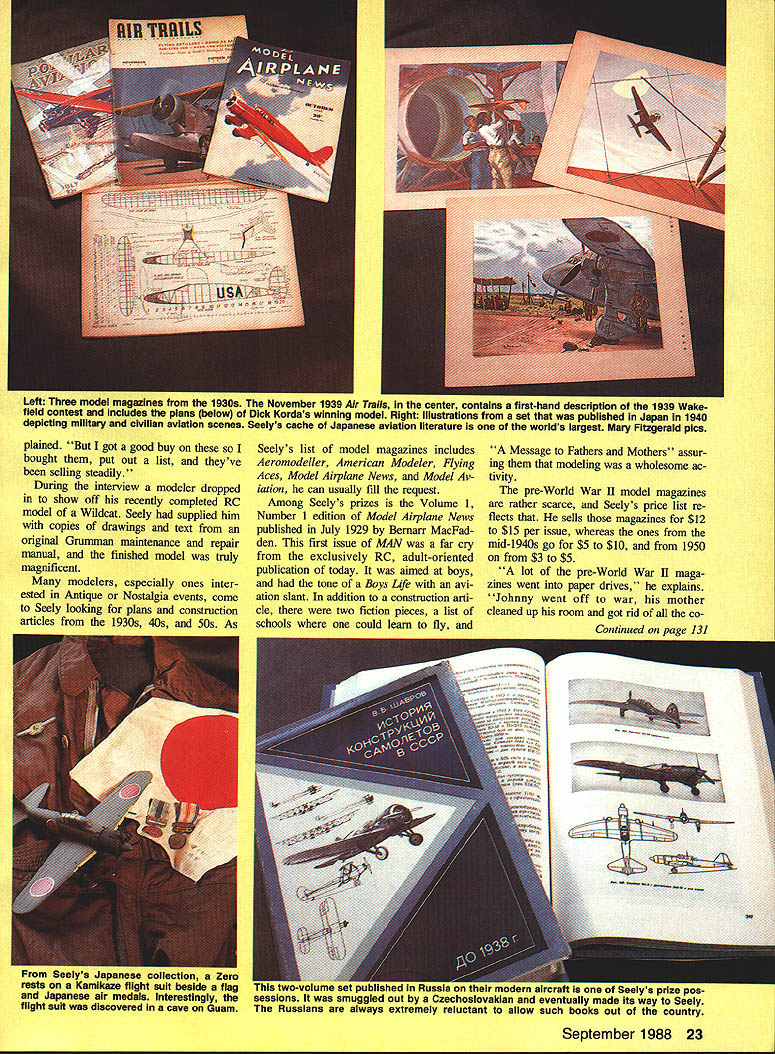
One of the rarest books in his collection is The History of Ballooning by Gaston Tissandier, published in France in 1887. Only 25 were printed, and Seely has the only copy in private hands.
Seely's personal interest in airlines and airliners lies behind his extensive collection of books on those subjects. He belongs to the World Airline Historical Society and the American Aviation Historical Society, which has a strong emphasis on airliners.
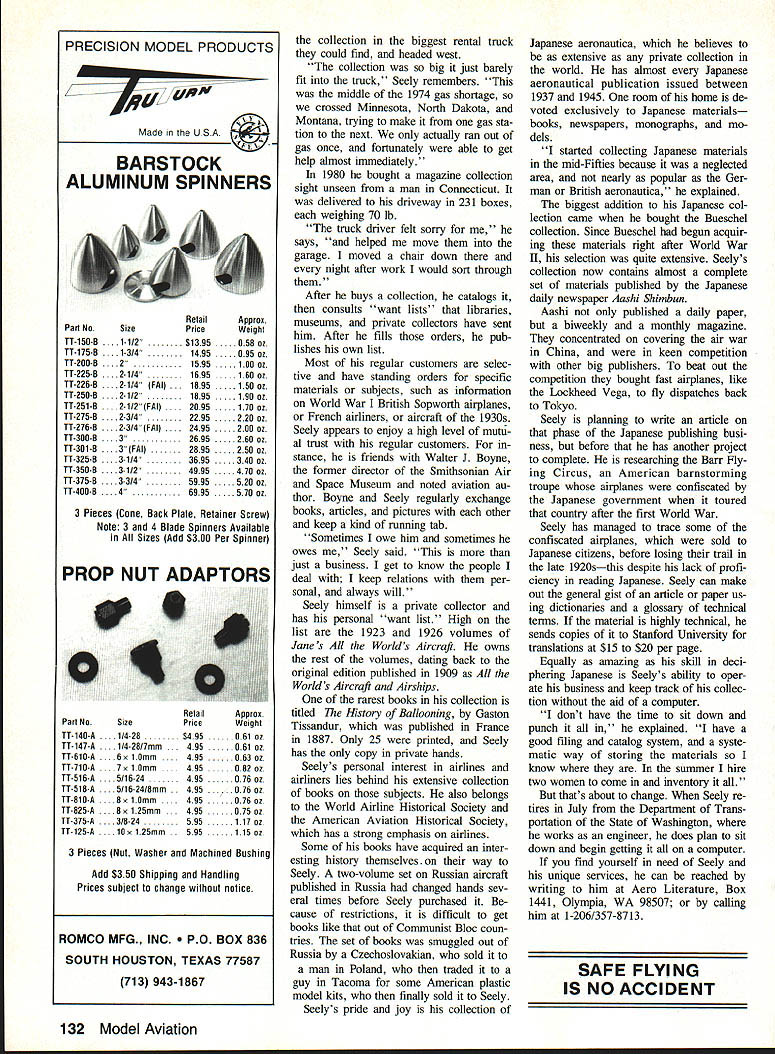
Some of his books have acquired an interesting history on their way to Seely. A two-volume set on Russian aircraft published in Russia had changed hands several times before Seely purchased it. Because of restrictions, it is difficult to get books like that out of Communist Bloc countries. The set was smuggled out of Russia by a Czechoslovakian, who sold it to a man in Poland, who then traded it to a fellow in Tacoma for some American plastic model kits, who then finally sold it to Seely.
Seely's pride and joy is his collection of Japanese aeronautica, which he believes to be as extensive as any private collection in the world. He has almost every Japanese aeronautical publication issued between 1937 and 1945. One room of his home is devoted exclusively to Japanese materials—books, newspapers, monographs, and models.
"I started collecting Japanese materials in the mid-Fifties because it was a neglected area, and not nearly as popular as the German or British aeronautica," he explained.
The biggest addition to his Japanese collection came when he bought the Bueschel collection. Since Bueschel had begun acquiring these materials right after World War II, his selection was quite extensive. Seely's collection now contains almost a complete set of materials published by the Japanese daily newspaper Asahi Shimbun.
Asahi not only published a daily paper, but a biweekly and a monthly magazine. They concentrated on covering the war in China and were in keen competition with other big publishers. To beat out the competition they bought fast airplanes, like the Lockheed Vega, to fly dispatches back to Tokyo.
Seely is planning to write an article on that phase of the Japanese publishing business, but before that he has another project to complete. He is researching the Barr Flying Circus, an American barnstorming troupe whose airplanes were confiscated by the Japanese after the first World War.
Seely has managed to trace some of the confiscated airplanes, which were sold to Japanese citizens, before losing their trail in the late 1920s—this despite his lack of proficiency in reading Japanese. Seely can make out the general gist of an article or paper using dictionaries and a glossary of technical terms. If the material is highly technical, he sends copies of it to Stanford University for translation at $15 to $20 per page.
Equally as amazing as his skill in deciphering Japanese is Seely's ability to operate his business and keep track of his collection without the aid of a computer.
"I don't have the time to sit down and learn it all," he explained. "I have a good filing and catalog system, and a systematic way of storing the materials so I know where they are. In the summer I hire two women to come in and inventory it all."
But that's about to change. When Seely retires in July from the Department of Transportation of the State of Washington, where he works as an engineer, he does plan to sit down and begin getting it all onto a computer.
If you find yourself in need of Seely and his unique services, he can be reached by writing to:
- Aero Literature, Box 1441, Olympia, WA 98507
- Phone: 1-206-357-8713
Transcribed from original scans by AI. Minor OCR errors may remain.

