
AEROSCALE '82
THE SEVENTH RC Scale World Championships, known as AeroScale '82, was by far the most successful competition in the history of the event. Forty-three entrants represented 14 nations, and for the first time the Stand-Off Scale models outnumbered those in the F4C (Precision) class in a world competition. Quality of the airplanes, as well as of their flight, was very similar in the two classes. When all were assembled in the display and work hangar at Reno-Stead Airport, it was often only possible to tell them apart by their label cards. As in the U.S., the two classes have almost completely blended into one—an opinion shared by members of the official jury and the judges.
While it had been generally conceded that most contestants in past World Championships were repeat appearances, the 1982 meet brought 18 new modelers out of 25 total in the Stand-Off class, and nine new faces among the 18 total in F4C. This turnover indicates strong growth in RC Scale and, from our viewpoint, permitted the making of many new friends.
Winner and highest scores
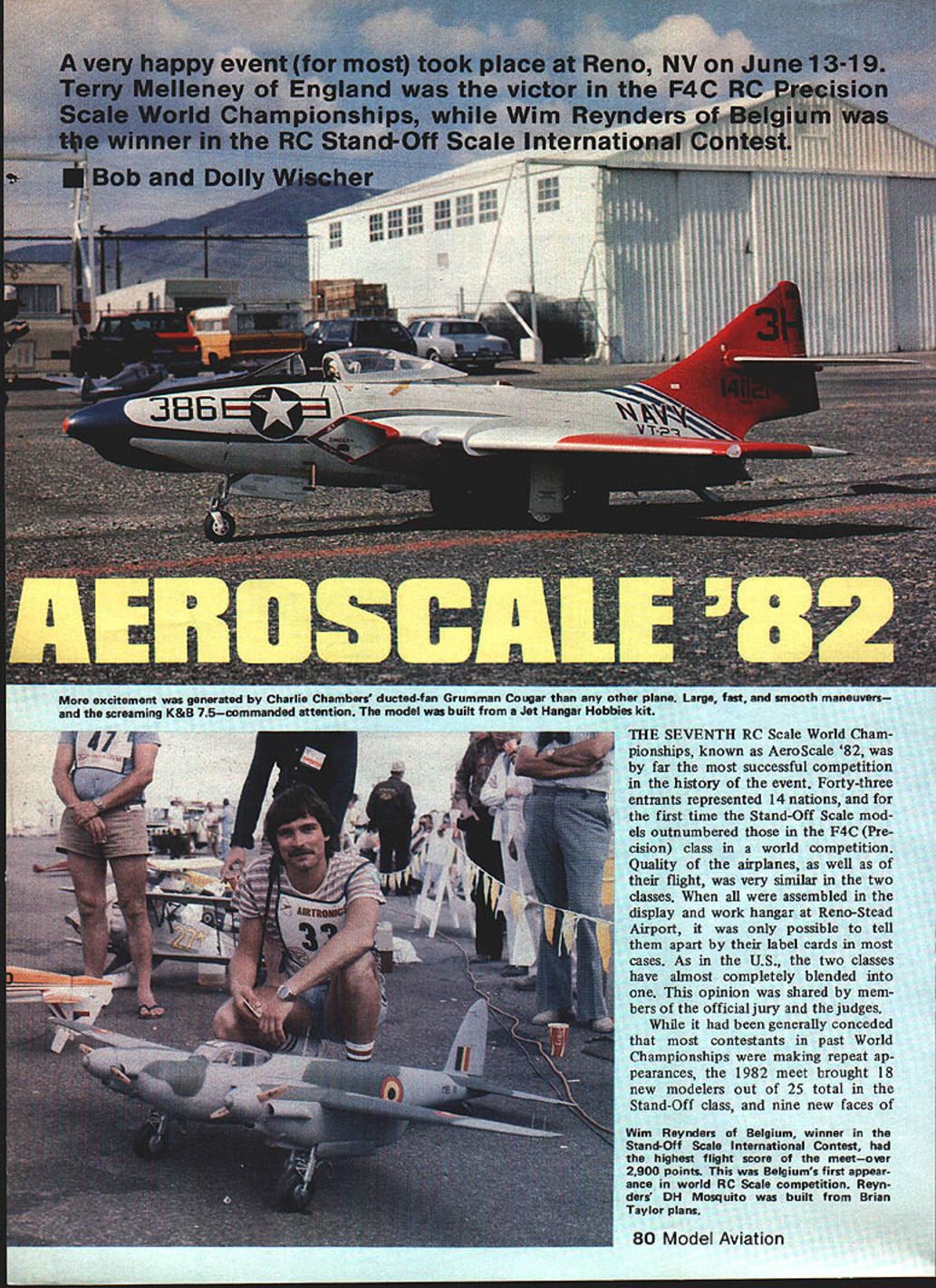
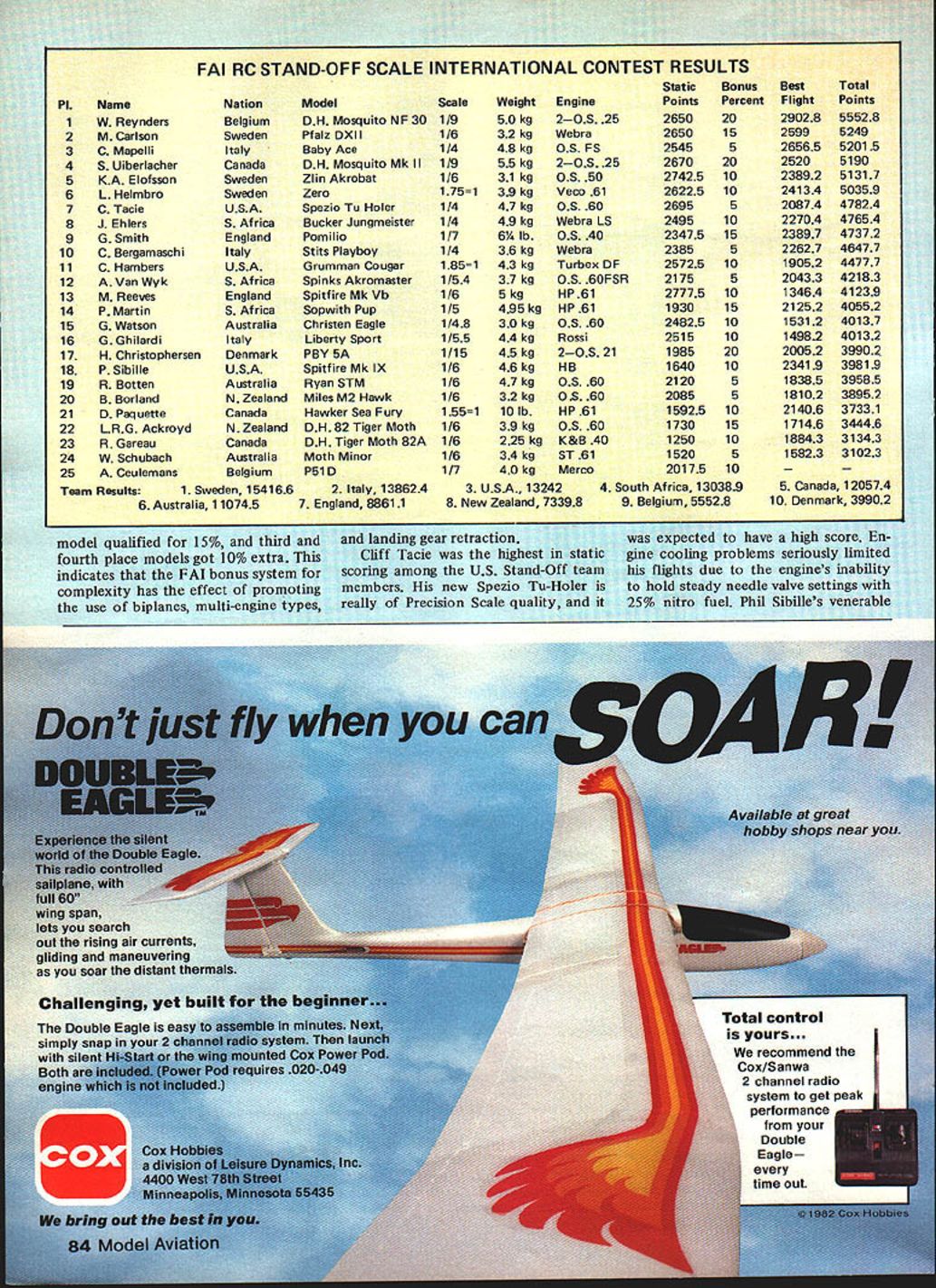
Wim Reynders of Belgium, winner in the Stand-Off Scale International Contest, recorded the highest flight score of the meet—over 2,900 points. This was Belgium's first appearance in world RC Scale competition. Reynders' de Havilland Mosquito was built from Brian Taylor plans.
Location and weather
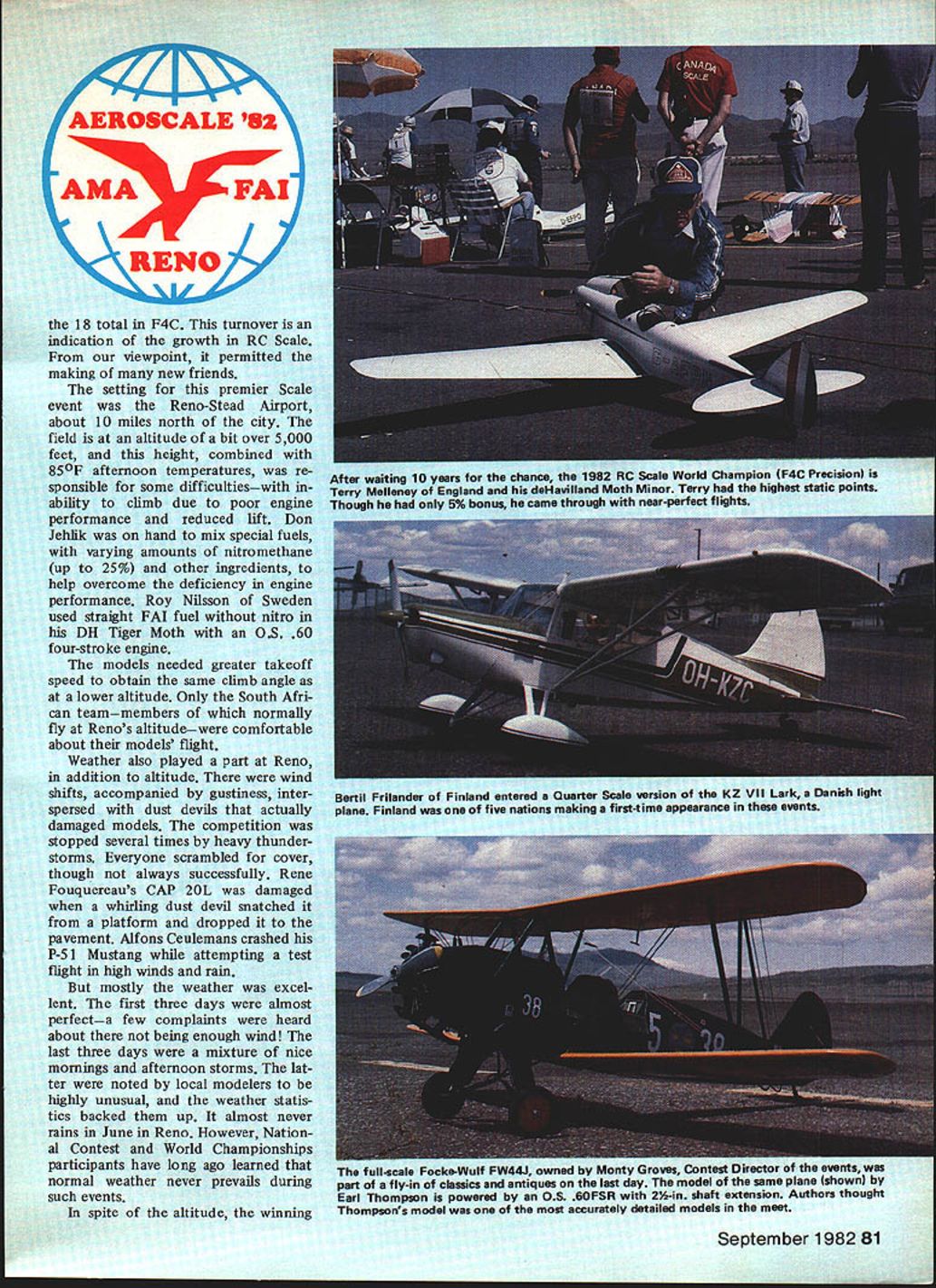
The setting for this premier scale event was Reno-Stead Airport, about 10 miles north of Reno. The field is at an altitude of a bit over 5,000 feet, and this height, combined with 85°F afternoon temperatures, was responsible for some difficulties—poor engine performance and reduced lift made climbs harder to obtain. Don Jehlik mixed special fuels with varying amounts of nitromethane (up to 25%) and other ingredients to help overcome the deficiency in engine performance. Roy Nilsson of Sweden used straight FAI fuel without nitro in his de Havilland Tiger Moth powered by an O.S. .60 four-stroke.
Models needed a greater takeoff speed to obtain the same climb angle as at lower altitude. Only the South African team—whose members normally fly at Reno’s altitude—were fully comfortable about their models’ flight characteristics.
Weather also played a part beyond altitude. There were wind shifts with gustiness and dust devils that actually damaged models. The competition was stopped several times by heavy thunderstorms; everyone scrambled for cover, though not always successfully. Rene Fouquereau’s CAP 20L was damaged when a whirling dust devil snatched it from a platform and dropped it to the pavement. Alfons Ceulemans crashed his P-51 Mustang while attempting a test flight in high winds and rain.
But mostly the weather was excellent. The first three days were almost perfect—a few complaints were heard about there not being enough wind. The last three days were a mixture of nice mornings and afternoon storms. The latter were highly unusual for Reno in June; it almost never rains then. National Contest and World Championships participants have long since learned that normal weather seldom prevails during such events.
Competition summary and incidents
Despite the altitude, several top contenders were hard-hit by performance issues. Reeves' ill-fated Stand-Off Spitfire stalled at the top of a loop and demolished itself on the pavement. Mick Reeves went on with his F4C Spitfire to secure second place; only a missed spot landing kept him from becoming the first contestant in RC Scale to win the World Championships twice. Other victims of altitude were Walter Scherbach's de Havilland Moth Minor—which stalled out of a loop—Gianni Ghilardi's Liberty Sport—which had insufficient altitude to complete a three-turn spin—and Charlie Chambers' Grumman Cougar ducted-fan model, which lifted a bit early on takeoff and snap-rolled into the runway. Both the Moth Minor and the Cougar were repaired and flown successfully afterwards, a real test of perseverance by their modelers.
Stand-Off Scale
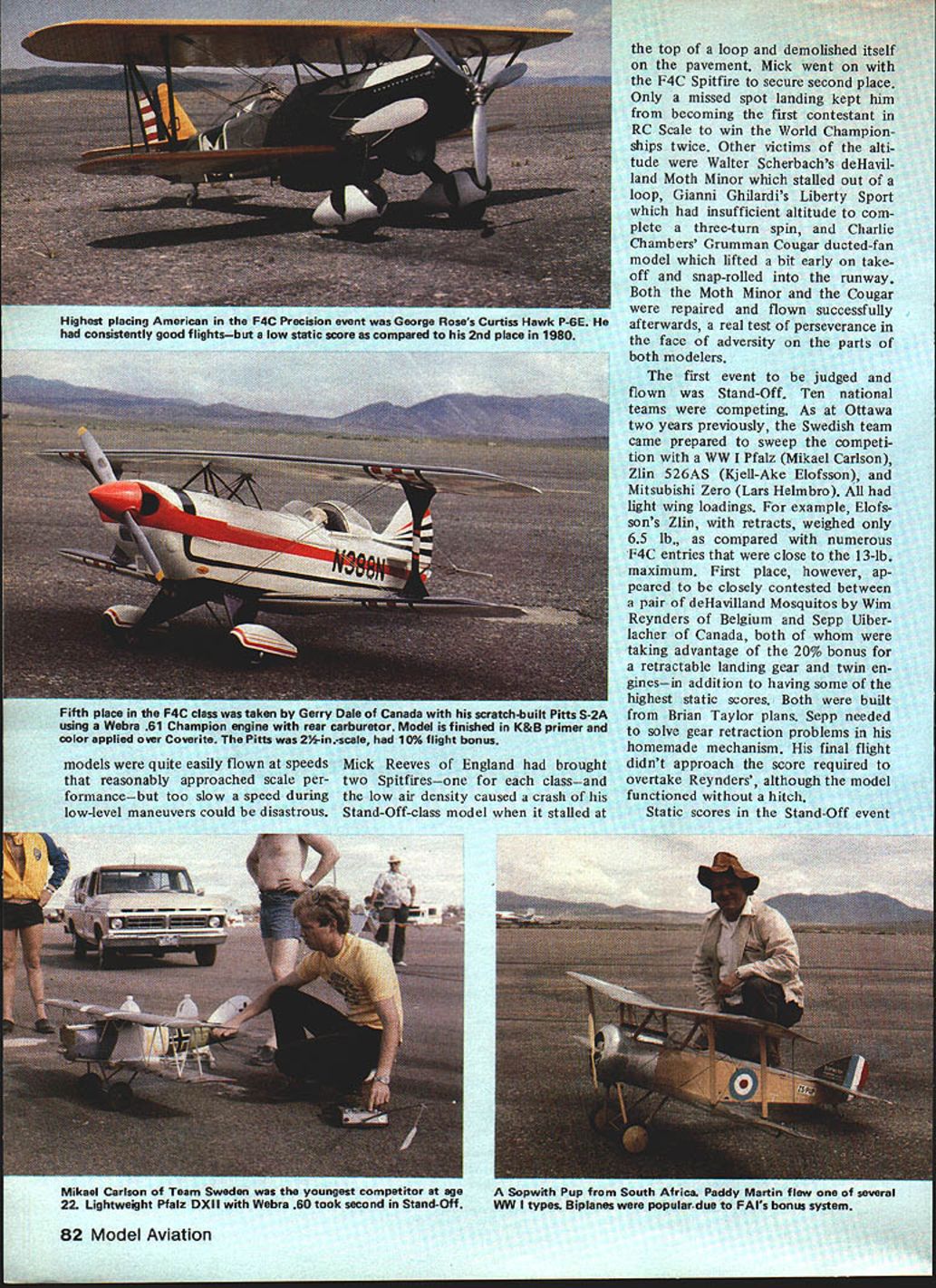
The first event to be judged and flown was Stand-Off. Ten national teams competed. As at Ottawa two years previously, the Swedish team came prepared to sweep the competition with a WWI Pfalz (Mikael Carlson), Zlin 526AS (Kjell-Åke Elofsson), and Mitsubishi Zero (Lars Helm). All had light wing loadings; for example, Elofsson's Zlin, with retracts, weighed only 6.5 lb., compared with numerous F4C entries that were close to the 13-lb. maximum.
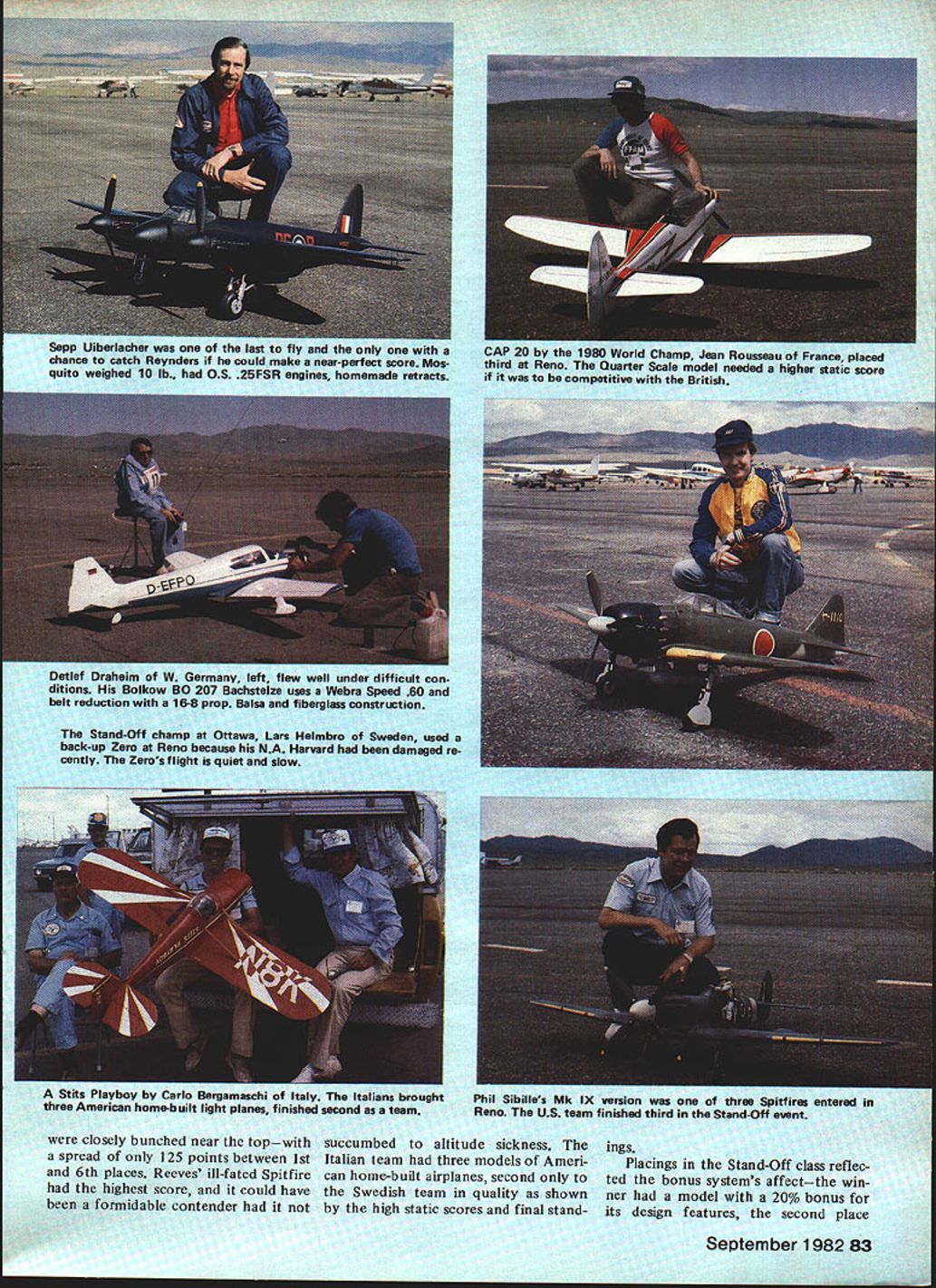
First place, however, was closely contested between a pair of de Havilland Mosquitos by Wim Reynders of Belgium and Sepp Uiberlacher of Canada. Both benefited from the 20% bonus for a retractable landing gear and twin engines and had some of the highest static scores. Both were built from Brian Taylor plans. Sepp needed to solve gear retraction problems in his homemade mechanism; his final flight did not approach the score required to overtake Reynders', although the model functioned without a hitch.
Static scores in the Stand-Off event were quite high and the top results were closely bunched—a spread of only 125 points separated 1st and 6th places. Reeves' ill-fated Spitfire had the highest static score and could have been a formidable contender had it not succumbed to altitude-related performance problems. The Italian team presented three models of American home-built airplanes and ranked second only to the Swedish team in quality, as shown by high static scores and final standings.
Placings in the Stand-Off class reflected the effect of the bonus system—the winner had a model with a 20% bonus for its design features; the second-place model qualified for 15%; and third and fourth place models received a 10% bonus. This indicates that the FAI bonus system for complexity promotes the use of biplanes, multi-engine types, and retractable landing gear.
Highlights among U.S. Stand-Off team members:
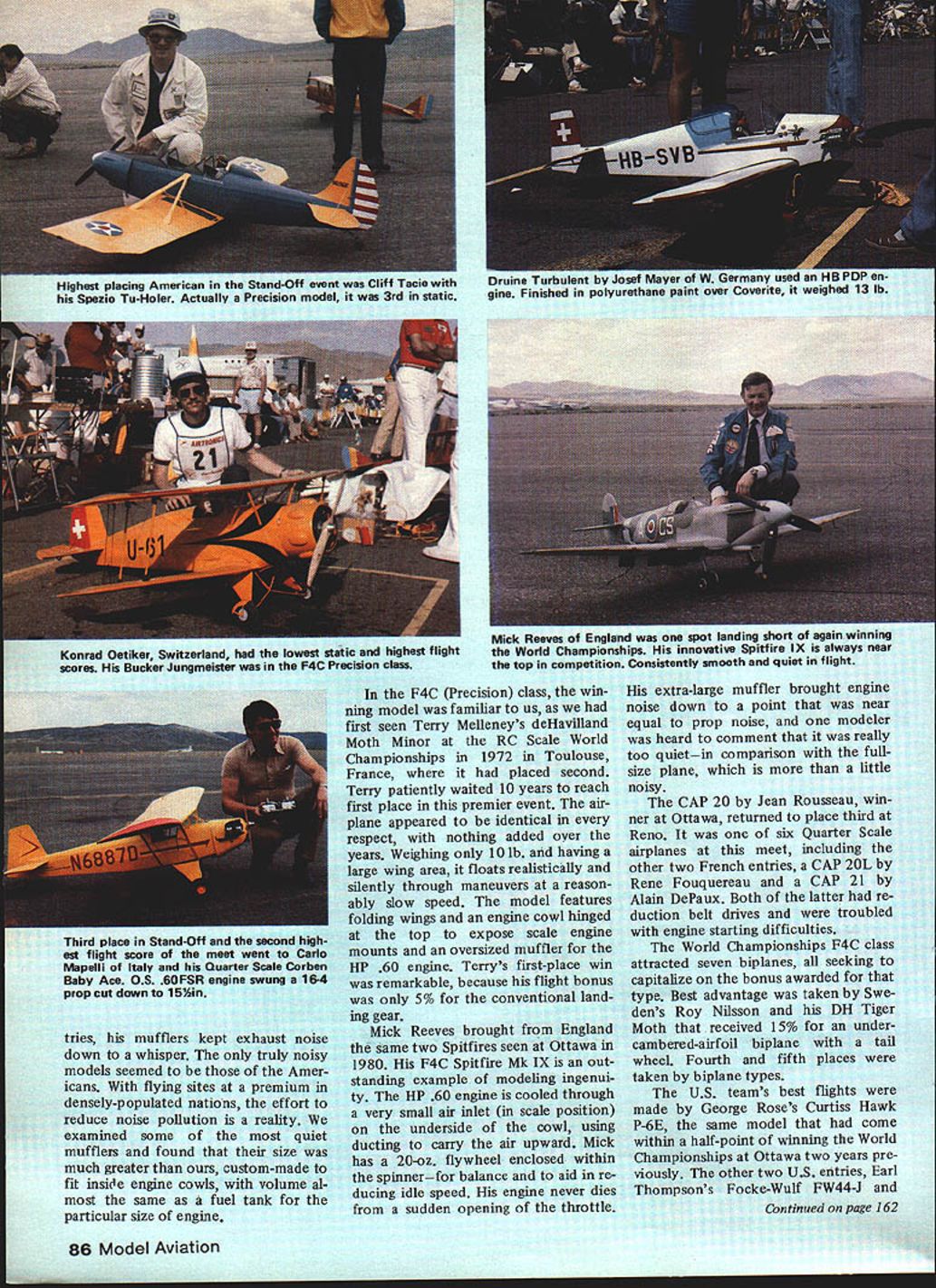
- Cliff Tacie was the highest in static scoring for the U.S. His new Spezio Tu Holer is essentially of Precision Scale quality and was expected to have a high score. Engine cooling problems, however, limited his flights because the engine could not hold steady needle valve settings with 25% nitro fuel.
- Phil Sibille's venerable Spitfire, used in the 1981 Nats qualifications, was the most consistent of the U.S. entries in flight scoring, but its low static score prevented a high overall placement.
- Charlie Chambers' Grumman Cougar was the sentimental favorite as the first ducted-fan model to appear in international competition. Damaged on its first flight attempt, an all-night repair and an early morning test flight in cool air proved that a ducted-fan model could be flown at high altitude. Cheers greeted its first successful takeoff. The K&B 7.5 engine with Turbax ducted-fan unit turned the same 23,000 rpm as at lower altitude using 25% nitro fuel, but thrust was reduced. Charlie's new Cougar weighs two pounds less than his 1981 Nationals model yet retains features such as Rhom retracts, dive brakes, flaps, and navigation lights.
An unusual Consolidated PBY-5A Catalina by Herb Christensen of Denmark was small for a twin at 1/5 scale and used a pair of O.S. .21 engines. It had homemade retracts and retractable wingtip floats, and it was the only tricycle-geared model in the meet. Like many European entrants, he used Rhom retracts, dive brakes, flaps, and navigation lights. In practice, his mufflers kept exhaust noise down to a whisper.
With flying sites at a premium in densely populated nations, the effort to reduce noise pollution is real. Some of the quietest mufflers examined were much larger and custom-made to fit inside engine cowls, with internal volume almost the same as a fuel tank for the particular engine size. The only truly noisy models seemed to be those of the Americans.
F4C (Precision) class
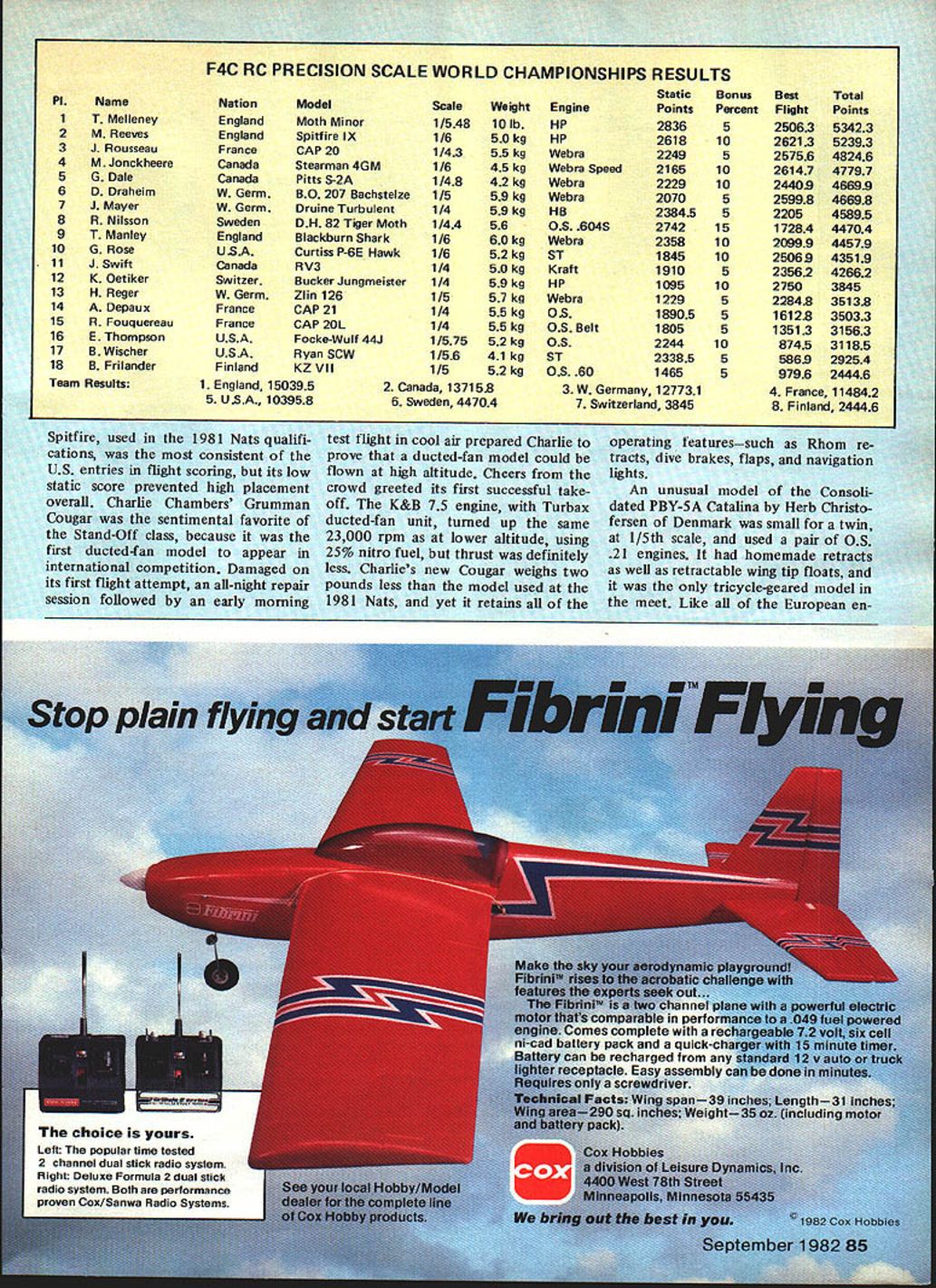
The winning F4C model was familiar: Terry Melleney's de Havilland Moth Minor, which had placed second at the 1972 World Championships in Toulouse, France. Terry patiently waited 10 years to reach first place in this premier event. The airplane appeared identical in every respect to the 1972 version—nothing added over the years. Weighing only 10 lb. and having a large wing area, it floats realistically and silently through maneuvers at a reasonably slow speed. The model features folding wings and an engine cowl hinged at the top to expose scale engine mounts and an oversized muffler for the HP .60 engine. Terry's first-place win was notable because his flight bonus was only 5% for conventional landing gear.
Mick Reeves brought from England the same two Spitfires seen at Ottawa in 1980. His F4C Spitfire Mk IX is an outstanding example of modeling ingenuity. The HP .60 engine is cooled through a very small, scale-position air inlet on the underside of the cowl, with ducting carrying the air upward. Mick has a 20-oz. flywheel enclosed within the spinner—for balance and to aid in reducing idle speed. His engine never dies from a sudden opening of the throttle. His extra-large muffler brought engine noise down to near prop noise; one modeler commented that it was really too quiet compared with the full-size plane.
The CAP 20 by Jean Rousseau, winner at Ottawa, returned to place third at Reno. It was one of six Quarter Scale airplanes at the meet, including two other French entries: a CAP 20L by Rene Fouquereau and a CAP 21 by Alain DePaux. Both of the latter had reduction belt drives and experienced engine starting difficulties.
The F4C World Championships attracted seven biplanes, all seeking to capitalize on the bonus awarded for that type. Best advantage was taken by Sweden's Roy Nilsson and his de Havilland Tiger Moth, which received a 15% bonus for an undercambered-airfoil biplane with a tail wheel. Fourth and fifth places were also taken by biplane types.
The U.S. team's best flights were made by George Rose's Curtiss Hawk P-6E, the same model that had come within a half-point of winning the World Championships at Ottawa two years previously. Other U.S. entries included Earl Thompson's Focke-Wulf FW44J.
Weights were carefully checked: scales accurate to 1/1,000 of a gram were used to measure each model. Two planes of the German team were found to be over the 6 kg maximum and had to remove unnecessary items (such as lighting-system batteries) to reduce weight.
Static scores in Stand-Off were tightly grouped near the top; in F4C there was a wider spread—a 500-point difference between first and sixth places.
German team and notable designs
For sheer ingenuity and design quality, the German team was outstanding:
- Detlef Draheim's 1/5-scale Bolkow BO 207 Bachstelze used a belt-reduction drive adapted from a Maximizer. The reduction ratio was changed to 1.8:1 so that the Webra Speed .60 could swing a 16x8 prop. Detlef made his own oil-and-air shock struts and used a separate servo to trim the stabilizer leading edge in place of elevator trim.
- Josef Mayer's 1/3-scale Druine Turbulent was another inconspicuous model that received a high static score. His wheel brakes were operated individually or in combination depending on rudder position.
Full-scale activity at Reno-Stead
Two full-scale airplanes being developed at Reno-Stead Airport were present: the LearFan (an advanced-technology project using two turbines to drive a single carbon-fiber prop) and the OMAC (a canard design using a conventional engine). Both were given test flights while we were present and added interest and excitement to the Reno experience.
Organization, officials, and recognition
The Reno RC Club, headed by Phil Abbinnanti, deserves credit for many operational tasks necessary for a successful international contest, along with the Hill Country Flyers, headed by Ken Wardrip. Other key figures included Betty and Suzi Stream from California.
The international jury consisted of:
- Dennis Thumpston (chairman), England
- Helmuth Ziegler, Switzerland
- John Grigg, U.S.A.
Judges for the Stand-Off event:
- Roy Yates (chief), England
- Carl Mueller, Canada
- Whitey Pritchard, U.S.A.
- Pat Ray, U.S.A.
- Steve Gray, Canada
Judges for the F4C World Championships:
- Tony Arts (chief), Netherlands
- George Buso, U.S.A.
- Eric Coates, England
- Andy Sheber, U.S.A.
- Paul Jones, Canada
Contest Director for Aeroscale '82 was Monty Groves, with Contest Manager Patricia Groves assisting. Ken and Barbara Wardrip operated a faultless computer scoring system and were highly praised. The contest administration team, including several AMA HQ staff members, produced a smoothly functioning contest despite many behind-the-scenes problems. Handling many of these problems was the Underwood team—Bob, Rae, and Cathy—who received a standing ovation at the closing banquet for their hospitality.
Highlighting the Scale World Championships were simple but dramatic opening and awards ceremonies on the field, featuring flag raisings and the playing of national anthems. Adding a spectacular backdrop to the finale were full-scale antique aircraft flown in for the occasion, including a Ford Tri-Motor and two biplanes with Swedish markings, which were also represented in the contest by their model counterparts.
Conclusion
Overall, the weather was good despite some problem periods, contest management was highly praised, the food was plentiful, and lodging was excellent. AeroScale '82 was a great World Championships, and the winners were considered the most deserving. Not much more could be asked or expected.
Transcribed from original scans by AI. Minor OCR errors may remain.

