
Ailerons and Gliders
Here's a well reasoned—and demonstrated—proof that differential control enhances the quality of sailplane flight.
Charles W. Bentson
A LARGE SOARING bird or a full-scale sailplane is a majestic sight, rolling smoothly into banked turns and circling in perfect coordination. Modelers are inspired to emulate soaring flight, but often find the model glider painfully sluggish in response and awkward in turning.
My 20-plus years of piloting full-scale gliders have made me very particular about control response and, when flying a model, I expect the same smooth response and perfect coordination between rudder and aileron that I would from the big ship.
Ailerons are essential for instant response. I like my model to fly with me, not a few seconds behind. The stick on my transmitter should have the same feel as the stick on the large glider so that I feel like I'm actually in the aircraft. The ailerons, however, must be provided with the right amount of differential if they are to produce the desired response.
Aileron differential is usually overlooked in models, and is certainly not emphasized the way it should be. It is especially important in slow-flying models with long wings, but it probably could be argued that fast pattern ships that spend half their lives flying upside-down are better off without aileron differential. A glider without differential will show a reluctance to roll into a bank because the induced drag of the downward moving aileron tends to pull that wing tip back, producing adverse yaw. The rudder of the glider is unable to overcome the adverse yaw for an awkward moment and then the turn proceeds sluggishly. Not very inspiring!
To avoid the worst effects of adverse yaw, upward aileron movement should be at least twice as much as the downward movement. If there is no downward movement at all, you will be surprised how briskly the model rolls! The gap at the bottom of the wing can be reduced to a minimum if no downward movement is allowed for, resulting in a cleaner wing. It works well to have the hinge line at the top surface of the wing so the covering can be continued from the wing right over the aileron, sealing the aileron gap.
If you have a model glider equipped with ailerons with no differential, and you want to demonstrate the effect of differential, just rig the trailing edges of both ailerons up a bit. Then, when one is slightly below the trailing edge, the other will be at the top of its travel. Effect on performance is hardly noticeable, but what an improvement in response!
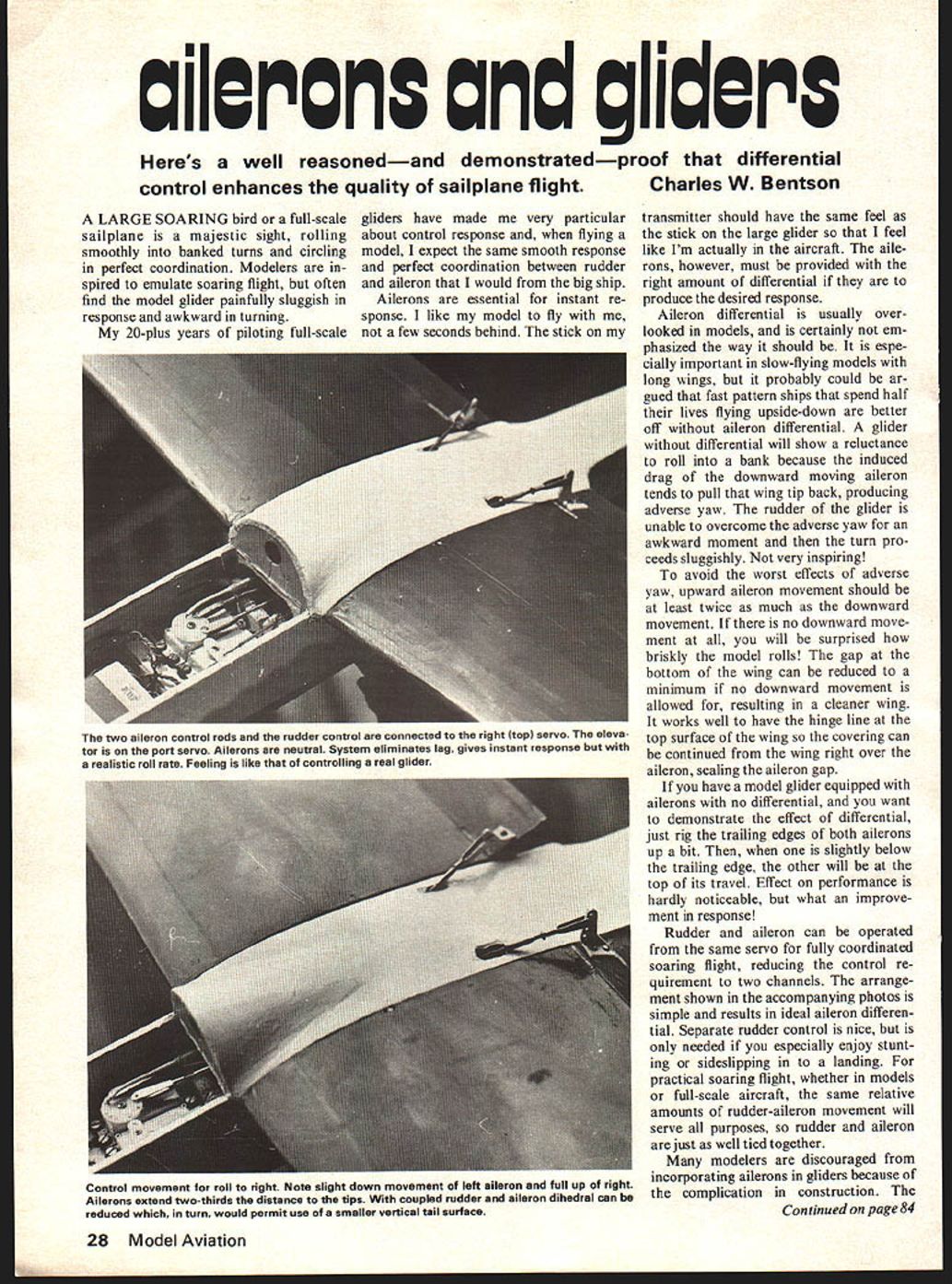
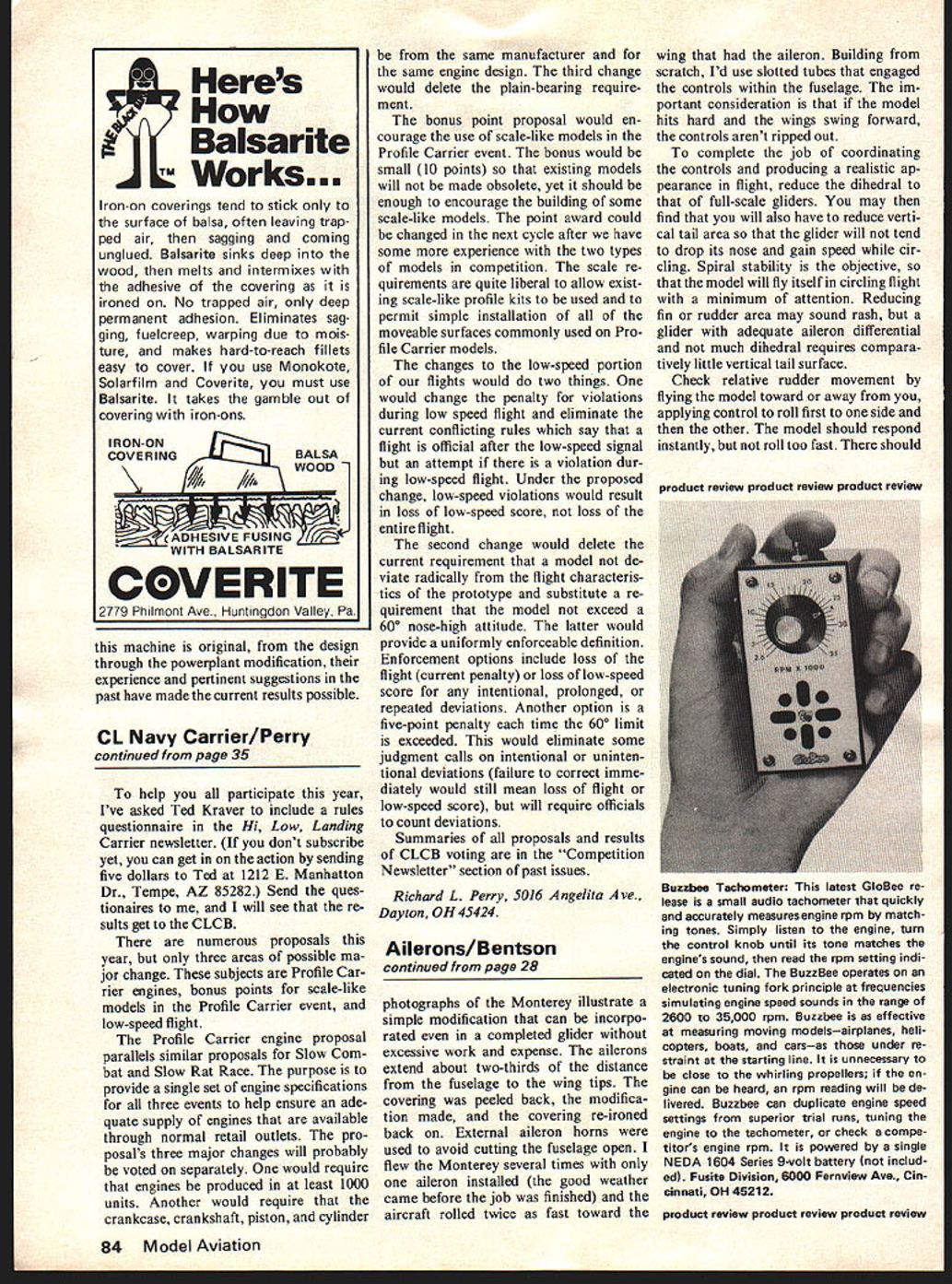
Rudder and aileron can be operated from the same servo for fully coordinated soaring flight, reducing the control requirement to two channels. The arrangement shown in the accompanying photos is simple and results in ideal aileron differential. Separate rudder control is nice, but is only needed if you especially enjoy stunting or sideslipping in to a landing. For practical soaring flight, whether in models or full-scale aircraft, the same relative amounts of rudder-aileron movement will serve all purposes, so rudder and aileron are just as well tied together.
Many modelers are discouraged from incorporating ailerons in gliders because of the complication in construction. The
Ailerons/Bentson continued from page 28
Photographs of the Monterey illustrate a simple modification that can be incorporated even in a completed glider without excessive work and expense. The ailerons extend about two-thirds of the distance from the fuselage to the wing tips. The covering was peeled back, the modification made, and the covering re-ironed back on. External aileron horns were used to avoid cutting the fuselage open. I flew the Monterey several times with only one aileron installed (the good weather came before the job was finished) and the aircraft rolled twice as fast toward the wing that had the aileron. Building from scratch, I'd use slotted tubes that engaged the controls within the fuselage. The important consideration is that if the model hits hard and the wings swing forward, the controls aren't ripped out.
To complete the job of coordinating the controls and producing a realistic appearance in flight, reduce the dihedral to that of full-scale gliders. You may then find that you will also have to reduce vertical tail area so that the glider will not tend to drop its nose and gain speed while circling. Spiral stability is the objective, so that the model will fly itself in circling flight with a minimum of attention. Reducing fin or rudder area may sound rash, but a glider with adequate aileron differential and not much dihedral requires comparatively little vertical tail surface.
Check relative rudder movement by flying the model toward or away from you, applying control to roll first to one side and then the other. The model should respond instantly, but not roll too fast. There should be no slipping or skidding. Remember that a full-scale glider at minimum sinking speed requires from four to six seconds to roll from a 45-degree bank to the opposite 45-degree bank. Faster rates of roll detract from realism and efficiency and serve no good purpose. Immediate response, but not fast response, should be the objective for realistic, pleasurable flight. Sailplanes are meant to be graceful.
Please write to me at Box 707, APO NY 09021 if you have questions or comments.
Transcribed from original scans by AI. Minor OCR errors may remain.

