
AMA Headquarters Hosts International Aeromodeling Meeting
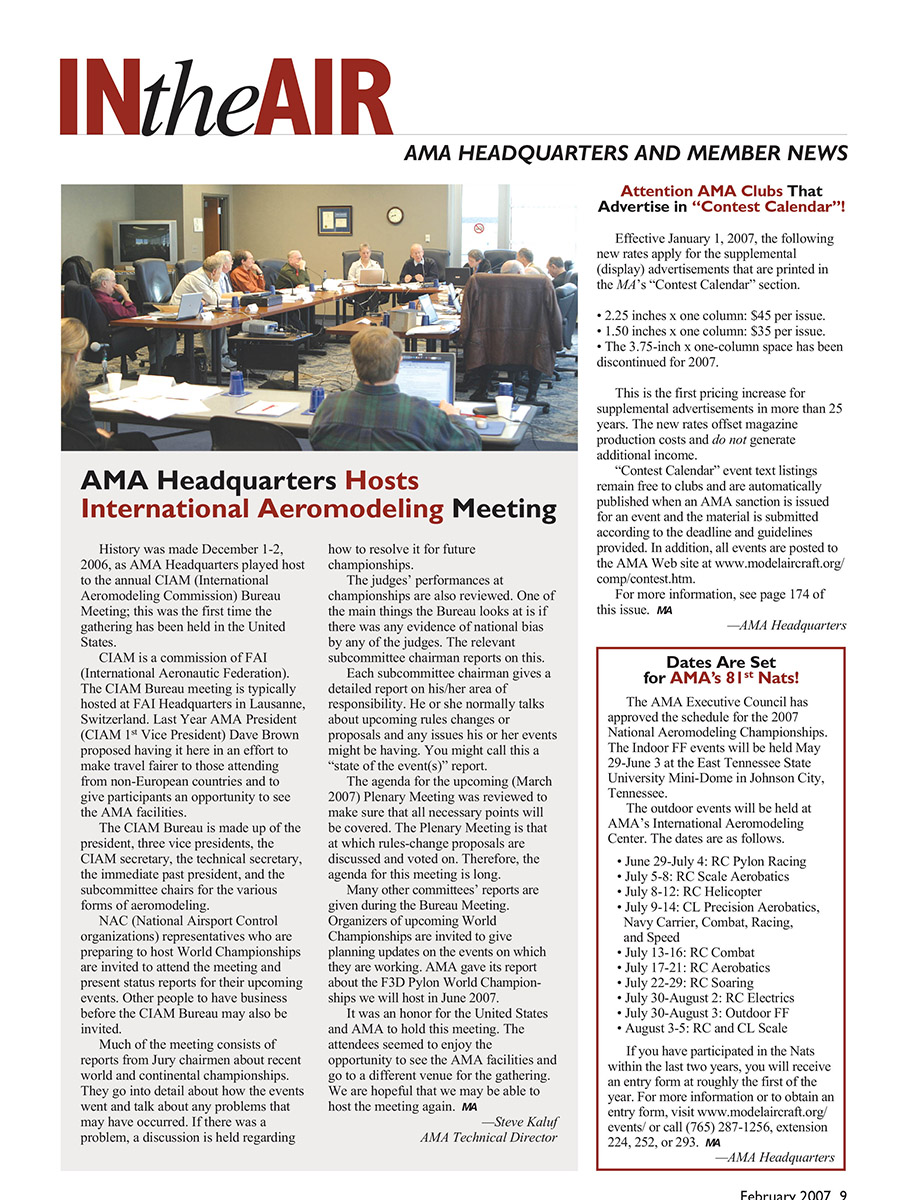
History was made December 1–2, 2006, as AMA Headquarters played host to the annual CIAM (International Aeromodelling Commission) Bureau Meeting; this was the first time the gathering has been held in the United States.
CIAM is a commission of the FAI (Fédération Aéronautique Internationale). The CIAM Bureau meeting is typically hosted at FAI Headquarters in Lausanne, Switzerland. Last year, AMA President (CIAM 1st Vice President) Dave Brown proposed having it here in an effort to make travel fairer to those attending from non-European countries and to give participants an opportunity to see the AMA facilities.
The CIAM Bureau is made up of the president, three vice presidents, the CIAM secretary, the technical secretary, the immediate past president, and the subcommittee chairs for the various forms of aeromodelling.
NAC (National Airsport Control) representatives who are preparing to host World Championships are invited to attend the meeting and present status reports for their upcoming events. Other people who have business before the CIAM Bureau may also be invited.
Much of the meeting consists of reports from jury chairmen about recent world and continental championships. They go into detail about how the events went and talk about any problems that may have occurred. If there was a problem, a discussion is held regarding how to resolve it for future championships.
The judges’ performances at championships are also reviewed. One of the main things the Bureau looks at is whether there was any evidence of national bias by any of the judges. The relevant subcommittee chairman reports on this.
Each subcommittee chairman gives a detailed report on his or her area of responsibility. He or she normally talks about upcoming rules changes or proposals and any issues his or her events might be having. You might call this a “state of the event(s)” report.
The agenda for the upcoming (March 2007) Plenary Meeting was reviewed to make sure that all necessary points will be covered. The Plenary Meeting is the meeting at which rules-change proposals are discussed and voted on. Therefore, the agenda for this meeting is long.
Many other committees’ reports are given during the Bureau Meeting. Organizers of upcoming World Championships are invited to give planning updates on the events on which they are working. AMA gave its report about the F3D Pylon World Championships we will host in June 2007.
It was an honor for the United States and AMA to hold this meeting. The attendees seemed to enjoy the opportunity to see the AMA facilities and go to a different venue for the gathering. We are hopeful that we may be able to host the meeting again.
MA — Steve Kaluf AMA Technical Director
A Great Elementary Hobby Day
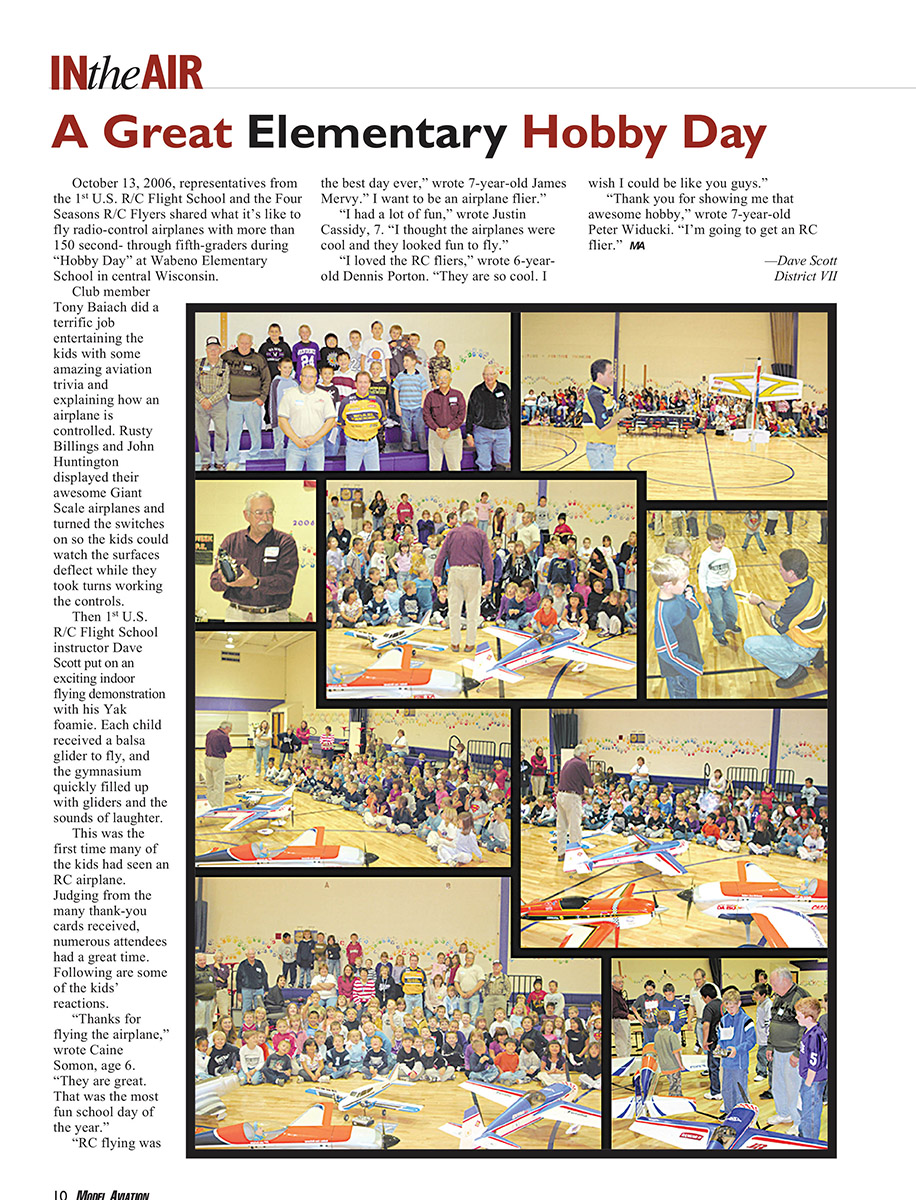
On October 13, 2006, representatives from the 1st U.S. R/C Flight School and the Four Seasons R/C Flyers shared what it's like to fly radio-control airplanes with more than 150 second- through fifth-graders during "Hobby Day" at Wabeno Elementary School in central Wisconsin.
Club member Tony Baiach did a terrific job entertaining the kids with some amazing aviation trivia and explaining how an airplane is controlled. Rusty Billings and John Huntington displayed their awesome giant-scale airplanes and turned the switches on so the kids could watch the surfaces deflect while they took turns working the controls.
Then 1st U.S. R/C Flight School instructor Dave Scott put on an exciting indoor flying demonstration with his Yak foamie. Each child received a balsa glider to fly, and the gymnasium quickly filled up with gliders and the sounds of laughter.
This was the first time many of the kids had seen an RC airplane. Judging from the many thank-you cards received, numerous attendees had a great time. Following are some of the kids' reactions.
"Thanks for flying the airplane," wrote Caine Somon, age 6. "They are great. That was the most fun school day of the year."
"RC flying was the best day ever," wrote James Mervy, age 7. "I want to be an airplane flier."
"I had a lot of fun," wrote Justin Cassidy, 7. "I thought the airplanes were cool and they looked fun to fly."
"I loved the RC fliers," wrote Dennis Porton, age 6. "They are so cool. I wish I could be like you guys."
"Thank you for showing me that awesome hobby," wrote Peter Widucki, 7. "I'm going to get an RC flier."
MA — Dave Scott District VII
An ARFer’s Tremendous Success
“Today’s” modelers are different from the traditional, dyed-in-the-wool builder/modelers. They weren’t lucky enough to have hobby shops on Main Street, and their fathers weren’t the major influence in their love of aviation. That’s how many traditional modelers got their start, right?
The modelers of today are sometimes harshly labeled “lazy” because they choose to spend their pastime flying. They fly ARFs, they use e-mail, and they use electric motors instead of glow engines.
Arguments have been made about the good and bad aspects of these rising trends in our hobby. What is encouraging is that the enthusiasm for the hobby has remained unchanged.
We recently received a letter from Daniel J. Ayala (BIGDANO), who could be classified as “today’s” modeler. He flies ARFs and he surfs the Internet for his information about the hobby. Gasp!
What is most apparent about Daniel is that his eagerness to get involved and learn more about the hobby is the same spirit that has influenced countless generations before us. That spirit deserves recognition and support and, as his letter proves, lives on in the modeler of today.
He wrote:
“I’ve been flying for less than a year. I received my Megatech Airstrike RTF model in the middle of December 2005 as a birthday present from my wife. I’ve never been as excited about RC as when I put that thing together and anticipated the maiden flight.
“I did all kinds of research online and found RCGroups (an amazing wealth of information). I immediately created an account and started searching the forums and posting newbie questions. It was great, and believe it or not, my maiden flight was a success.
“I then began the modification process and turned the Airstrike into a really powerful model with a brushless motor and good electronics. I eventually graduated to a Hobbico SuperStar EP ARF with ailerons. From the SuperStar I went to the Great Planes Super Sportster ARF just two months later. By then I needed a bigger place to fly these ‘bigger’ ARFs, so I started researching the nearby clubs.
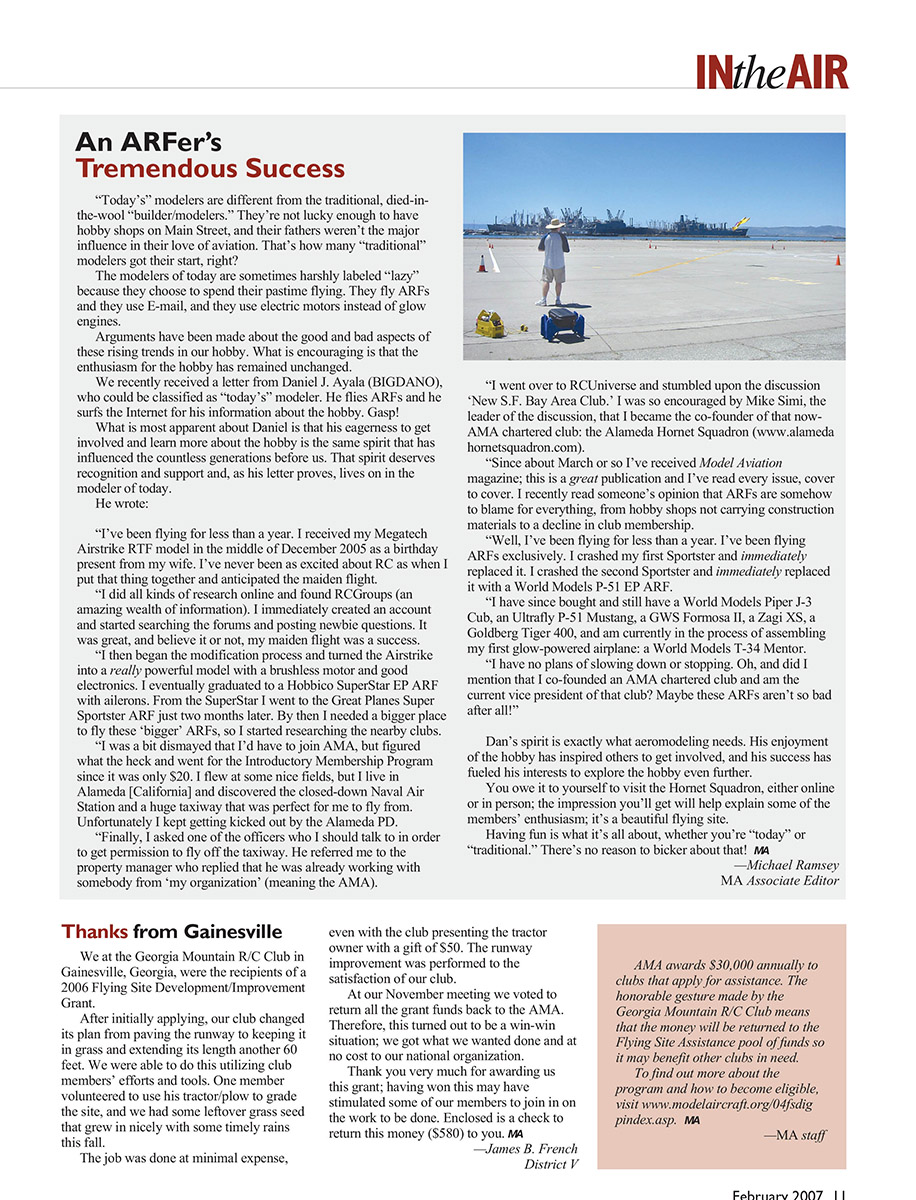
“I was a bit dismayed that I’d have to join AMA, but figured what the heck and went for the Introductory Membership Program since it was only $20. I flew at some nice fields, but I live in Alameda, California, and discovered the closed-down Naval Air Station and a huge taxiway that was perfect for me to fly from. Unfortunately I kept getting kicked out by the Alameda PD.
“Finally, I asked one of the officers who I should talk to in order to get permission to fly off the taxiway. He referred me to the property manager who replied that he was already working with somebody from ‘my organization’ (meaning the AMA).
“I went over to RCUniverse and stumbled upon the discussion ‘New S.F. Bay Area Club.’ I was so encouraged by Mike Simi, the leader of the discussion, that I became the co-founder of that now-AMA chartered club: the Alameda Hornet Squadron (www.alamedahornetsquadron.com).
“Since about March or so I’ve received Model Aviation magazine; this is a great publication and I’ve read every issue, cover to cover. I recently read someone’s opinion that ARFs are somehow to blame for everything, from hobby shops not carrying construction materials to a decline in club membership.
“Well, I’ve been flying for less than a year. I’ve been flying ARFs exclusively. I crashed my first Sportster and immediately replaced it, I crashed the second Sportster and immediately replaced it with a World Models P-51 EP ARF.
“I have since bought and still have a World Models Piper J-3 Cub, an Ultrafly P-51 Mustang, a GWS Formosa II, a Zagi XS, a Goldberg Tiger 400, and am currently in the process of assembling my first glow-powered airplane: a World Models T-34 Mentor.
“I have no plans of slowing down or stopping. Oh, and did I mention that I co-founded an AMA chartered club and am the current vice president of that club? Maybe these ARFs aren’t so bad after all!”
Dan’s spirit is exactly what aeromodelling needs. His enjoyment of the hobby has inspired others to get involved, and his success has fueled his interests to explore the hobby even further.
You owe it to yourself to visit the Hornet Squadron, either online or in person; the impression you’ll get will help explain some of the members’ enthusiasm — it’s a beautiful flying site.
Having fun is what it’s all about, whether you’re “today” or “traditional.” There’s no reason to bicker about that!
MA — Michael Ramsey MA Associate Editor
Frequently Asked Questions About AMA's Programs Department
Q: What are this department's responsibilities within AMA? A: The Programs Department has several functions, which are as follows.
- Representing the Academy at modeling/aviation trade shows.
- Overseeing the AMA Leader Club Program, Hobby Shop Pilot Program, Air Show Team Program, NRHSA (National Retail Hobby Stores Association) National Pilot Program, and Mall Show Program.
- Representing AMA at public forums and presentations.
- Acting as a liaison to the Federal Aviation Administration.
- Acting as a liaison to other federal agencies (such as the Department of Defense, the Department of Homeland Security, and the Federal Bureau of Investigation).
- Acting as a liaison to state agencies (such as the State Police and State Antiterrorism Task Forces).
- Acting as a liaison to full-scale aviation organizations (such as the Experimental Aircraft Association [EAA], the Aircraft Owners and Pilots Association, the local EAA Chapter 226, and the Delaware County Airport Authority in Muncie).
Q: What trade shows does AMA own or run? A: AMA owns and presents one show each year, which the Programs Department runs: the AMA Convention held in Ontario, California, in January.
Q: Does AMA provide clubs with financial assistance? A: Yes, through the Flying Site Development/Improvement Grant Program, administered by the Programs Department. You can find details at www.modelaircraft.org/04fsdigindex.asp.
Q: Does AMA assist clubs in finding and maintaining flying sites? A: Yes. The Academy has many resources available to help clubs and has two Flying Site Assistance coordinators whose full responsibility is to assist clubs with these tasks. Coordinators are Joe Beshar in Districts I–VII and Wes De Cou in Districts VIII–XI.
Q: Does AMA sanction club fields? A: No, AMA does not sanction, approve, or validate club fields. The Academy does charter clubs, and the safe operation of a club's site is its responsibility. All flying activities should be governed by the AMA Safety Code and recommendations found in the AMA Membership Manual. MA
Welcome, AMA Life Members!
- Ronald E. Hill (Okeechobee, FL)
- Craig Blackman (Tucson, AZ)
- Mike McGraw (Pasadena, TX)
- Tom Clark (Kissimmee, FL)
- Kenneth Kear (Mesa, AZ)
- Scott Walowsky (San Antonio, TX)
- Glen Singleton (Ingram, TX)
- Robert Larson (Deep River, CT)
- Thomas Johnson (Gladstone, MI)
- Charles Yates (Jamestown, NC)
- Joe Thornton (Springboro, OH)
- Denver Whitaker (Choctaw, OK)
- Roger Nienberg (Ottawa, OH)
- Dennis Valliant (Cedar Crest, NM)
- Andrew Schmettz (Broken Arrow, OK)
- Dennis Kirk (Arcadia, FL)
For information about becoming a Life Member, contact AMA Headquarters at (800) 435-9262. — AMA Membership Department
25 Years Ago in MA: February 1982
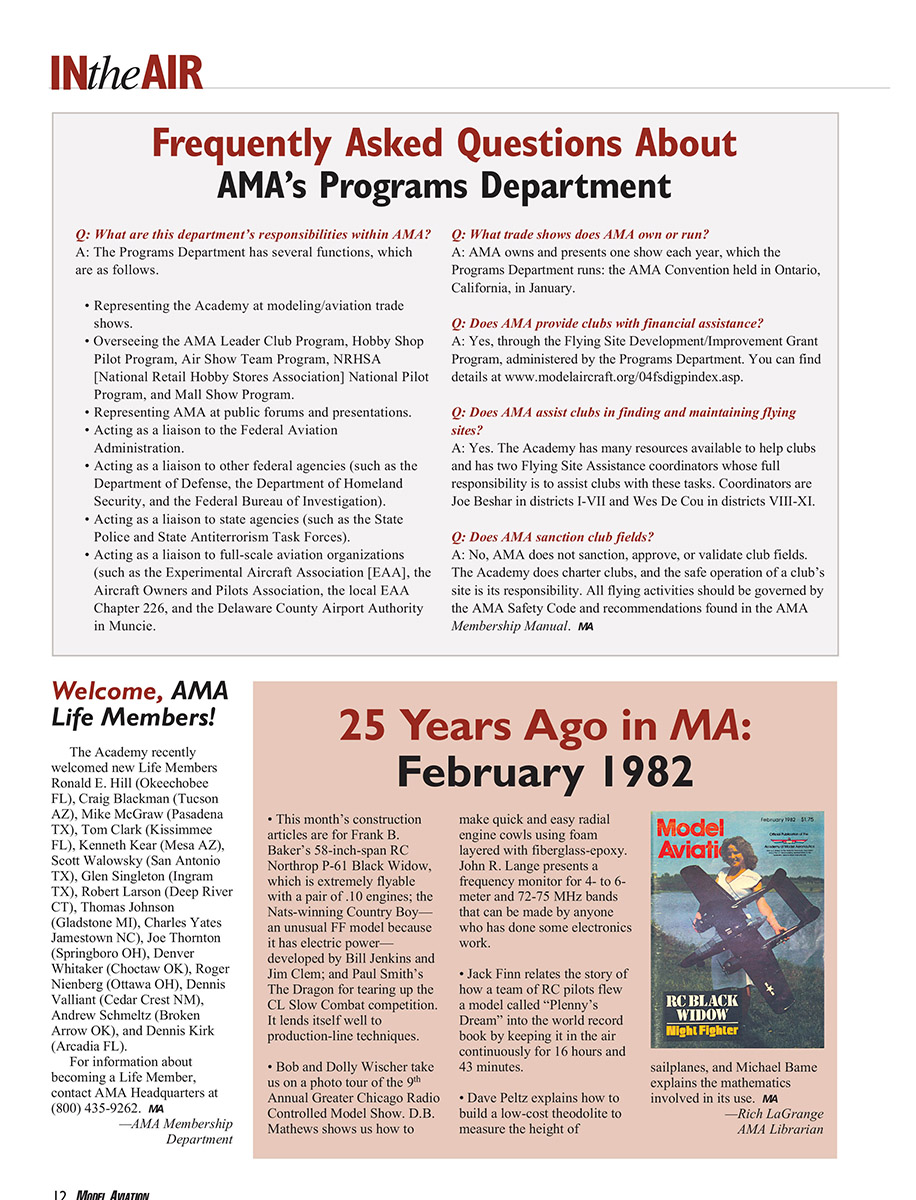
- This month's construction articles are for Frank B. Baker's 58-inch-span RC Northrop P-61 Black Widow, which is extremely flyable with a pair of .10 engines; the Nats-winning Country Boy—an unusual FF model because it has electric power—developed by Bill Jenkins and Jim Clem; and Paul Smith's The Dragon for tearing up the CL Slow Combat competition. It lends itself well to production-line techniques.
- Bob and Dolly Wischer take us on a photo tour of the 9th Annual Greater Chicago Radio Controlled Model Show. D.B. Mathews shows us how to make quick and easy radial engine cowls using foam layered with fiberglass-epoxy. John R. Lange presents a frequency monitor for 4- to 6-meter and 72–75 MHz bands that can be made by anyone who has done some electronics work.
- Jack Finn relates the story of how a team of RC pilots flew a model called "Plenny's Dream" into the world record book by keeping it in the air continuously for 16 hours and 43 minutes.
- Dave Peltz explains how to build a low-cost theodolite to measure the height of sailplanes, and Michael Bame explains the mathematics involved in its use.
MA — Rich LaGrange AMA Librarian
Transcribed from original scans by AI. Minor OCR errors may remain.

