
Air Academy Weekend
By Bob Underwood
An EAA–AMA joint youth program introduced 45 young people to both full‑size homebuilts and model aviation. The pilot Air Academy Weekend combined lectures, hands‑on building, and flying demonstrations to show how modeling and full‑scale aviation complement one another.
Background
For years both modelers and full‑scale aviators have noted that while membership in the AMA and EAA has grown, youth involvement has lagged. Under the leadership of EAA education director Charles (Chuck) Larsen, a youth program was launched that incorporates both full‑scale and modeling activities. The first pilot program of a four‑event series was held in Frederick, MD, January 29–31, 1988.
Friday: Volunteer briefing
- Date/place: Friday evening, January 29, classroom at the Aviation School, Frederick Community College (Frederick Airport).
- Attendance: about 45 volunteers and interested parties.
- Host: Chuck Larsen explained the program structure and each volunteer’s responsibilities.
- Presentation: a video greeting from EAA officials Paul and Tom Poberezny describing the program goals.
- Notes from introductions: volunteers each stood and shared background information. About 15% were members of both EAA and AMA, confirming how interests often cross between organizations.
Other volunteers and representatives present included Lance Zellers (coordinator for enrollments and housing), Phil Woodruff (FAA education director), and representatives from aviation insurer Avemco.
Saturday: Full day of activities
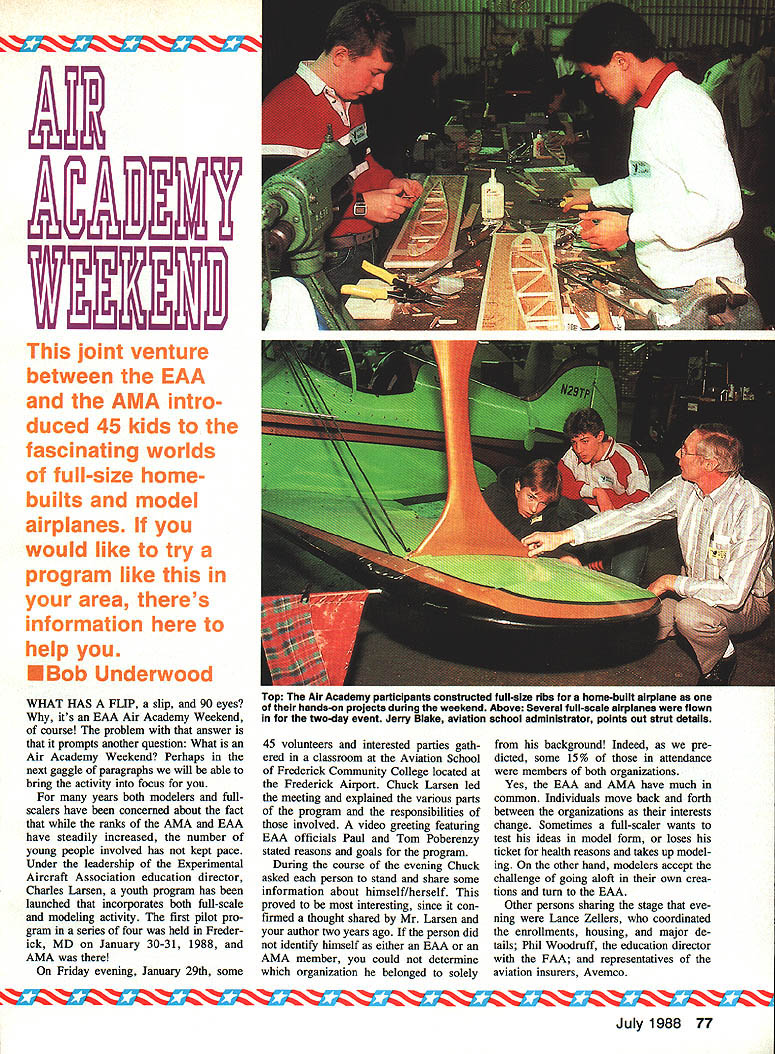
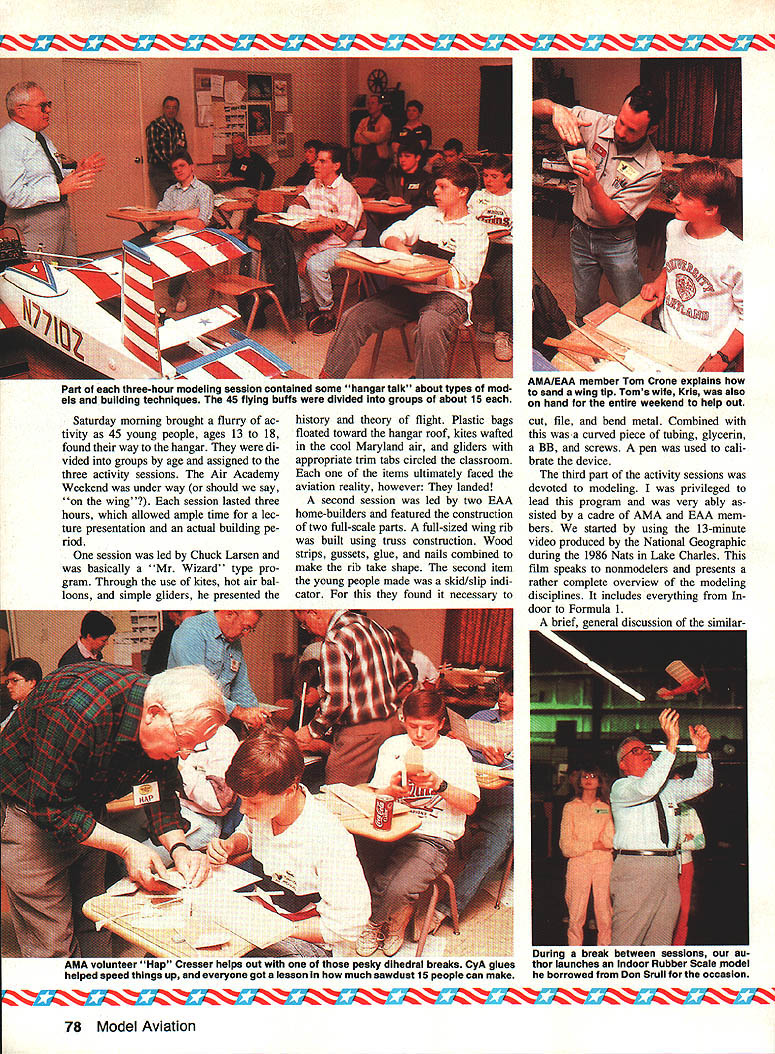
Forty‑five youth participants (ages 13–18) were divided into groups of about 15 and rotated through three three‑hour activity sessions: history/theory of flight, full‑scale construction, and modeling. Each session combined lecture material with hands‑on building.
#### 1. History and theory of flight (led by Chuck Larsen)
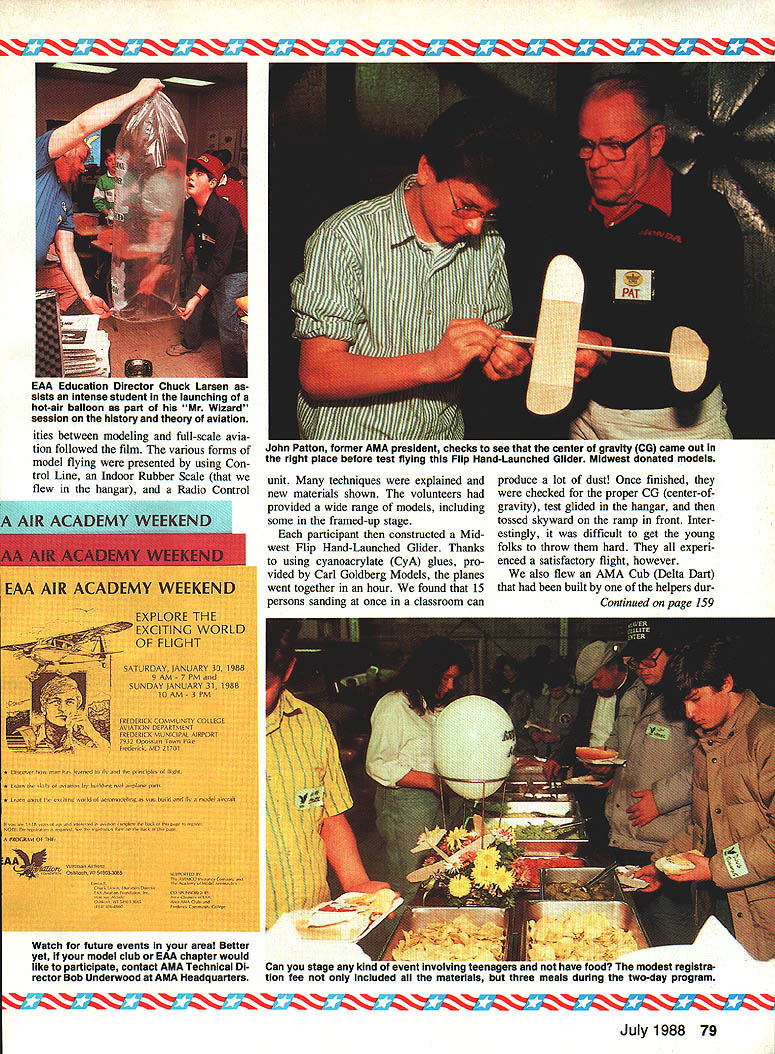
- Demonstrations and simple experiments: kites, hot‑air balloons, simple gliders and plastic‑bag lift.
- Hands‑on elements showed principles of lift, stability and trim; gliders with trim tabs were flown in the hangar and classroom.
#### 2. Full‑scale construction (led by EAA home‑builders)
- Projects:
- Construction of a full‑size wing rib using truss construction (wood strips, gussets, glue and nails).
- Fabrication of a skid/slip indicator (assembled from a curved piece of tubing, glycerin, a BB, brass screws; a pen was used for calibration).
- Helpers: Tom Crone explained sanding and finishing; his wife Kris assisted with cutting, filing and metal work.
#### 3. Modeling session (led by the author with AMA/EAA volunteers)
- Opening: a 13‑minute National Geographic video from the 1986 Nats at Lake Charles that provides an overview of modeling disciplines (Free Flight, Control Line, Indoor Rubber Scale, Radio Control, Formula 1, etc.).
- Hands‑on build: each participant constructed a Midwest Flip hand‑launched glider. Cyanoacrylate (CyA) glues, provided by Carl Goldberg Models, sped assembly so most planes were completed in about an hour.
- Instruction topics: dihedral breaks, control linkages, finishing, center‑of‑gravity checks and test glides.
- Demonstrations: Indoor rubber‑scale flying in the hangar; an AMA Cub (Delta Dart) built by a helper was also flown.
- Note: sanding fifteen models at once produces a lot of sawdust!
Between sessions participants gravitated to an AMA display room where they examined models, repaired or modified their builds (one Flip was modified into a Stealth‑type aircraft using scrap balsa), and traded tips with volunteers. Each model participant received a “goody bundle” containing AMA material, a copy of Model Aviation, and an AMA Cub kit to build at home.
Meals and evening program
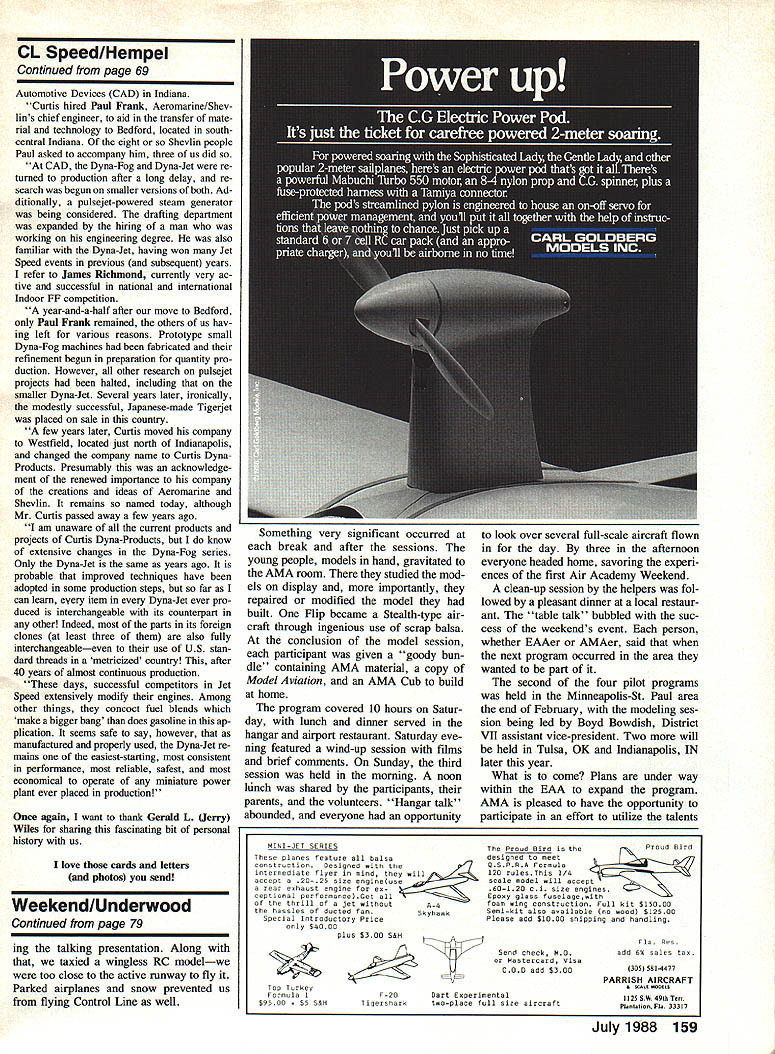
- Saturday included lunch and dinner served in the hangar/airport restaurant.
- Saturday evening featured a wrap‑up session with films and brief comments from volunteers.
- Helpers held a clean‑up session followed by a group dinner to discuss the weekend’s successes.
Sunday: Final session and wrap‑up
- A final activity session was held Sunday morning.
- Noon: lunch shared by participants, volunteers and parents; extensive “hangar talk” and viewing of several full‑scale aircraft that had flown in for the day.
- By 3:00 PM participants departed, reflecting on and savoring the weekend’s experiences.
Results and follow‑up
- The pilot in Frederick was judged a success; volunteers from both EAA and AMA expressed enthusiasm for repeating the program.
- The second pilot program took place in the Minneapolis–St. Paul area at the end of February, with the modeling session led by Boyd Bowdish (District VII assistant vice‑president). Two additional pilots were planned for Tulsa, OK and Indianapolis, IN later in the year.
Acknowledgments and contributors
- EAA education director: Charles (Chuck) Larsen
- Volunteer coordinators and helpers: Lance Zellers, Tom and Kris Crone, Boyd Bowdish (at the Minneapolis–St. Paul pilot)
- Sponsors and suppliers: Carl Goldberg Models (CyA glue), Avemco (insurance representatives)
- Special thanks to Don Strull for lending an indoor rubber‑scale model for demonstrations
Plans are under way within the EAA to expand the Air Academy Weekend format; AMA is pleased to participate and to help develop young people’s talents in both modeling and full‑scale aviation.
Transcribed from original scans by AI. Minor OCR errors may remain.

