
The Air Force Museum
Text and pictures by James M. Mills
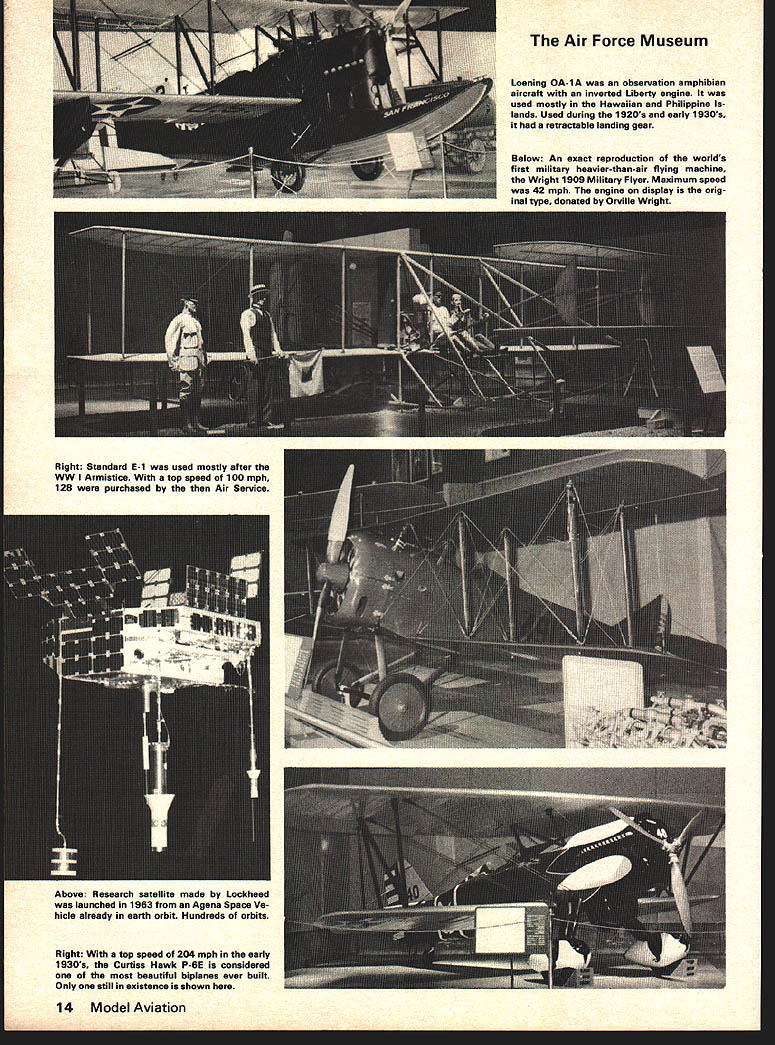
THERE IS an added attraction this year for those planning to attend the 1976 AMA National competition to be held at Wright Field, Dayton, Ohio. Many of the outdoor meets will be flown adjacent to the Air Force Museum — the oldest and largest military museum in the world. The restored or authentically reproduced aircraft gathered in the Museum and in the outdoor aircraft park are not just interesting display pieces, but are real planes. And while it is true that the collection is predominately military, the whole spectrum of aeronautics is represented here from the earliest balloons to the missiles lined up like silent sentinels at the Museum entrance.
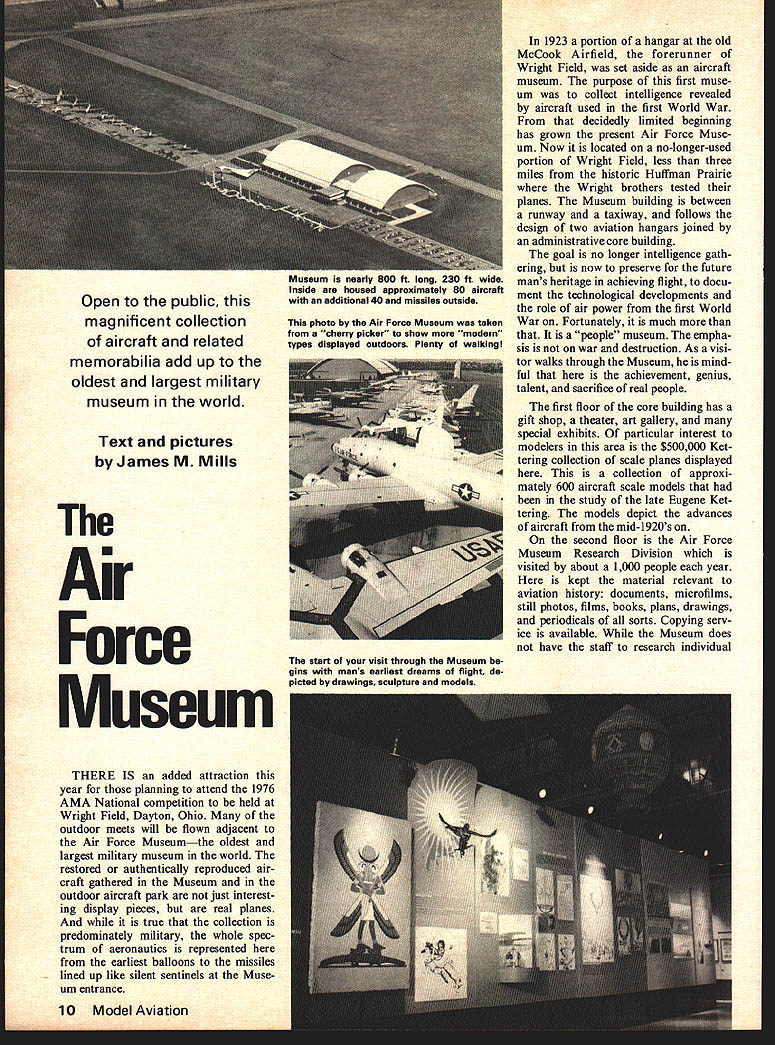
In 1923 a portion of a hangar at the old McCook Airfield, the forerunner of Wright Field, was set aside as an aircraft museum. The purpose of this first museum was to collect intelligence revealed by aircraft used in the First World War. From that decidedly limited beginning has grown the present Air Force Museum. Now it is located on a no-longer-used portion of Wright Field, less than three miles from the historic Huffman Prairie where the Wright brothers tested their planes. The Museum building is between a runway and a taxiway, and follows the design of two aviation hangars joined by an administrative core building.
The goal is no longer intelligence gathering, but is now to preserve for the future man's heritage in achieving flight, to document the technological developments and the role of air power from the First World War on. Fortunately, it is much more than that. It is a "people" museum. The emphasis is not on war and destruction. As a visitor walks through the Museum, he is mindful that here is the achievement, genius, talent, and sacrifice of real people.
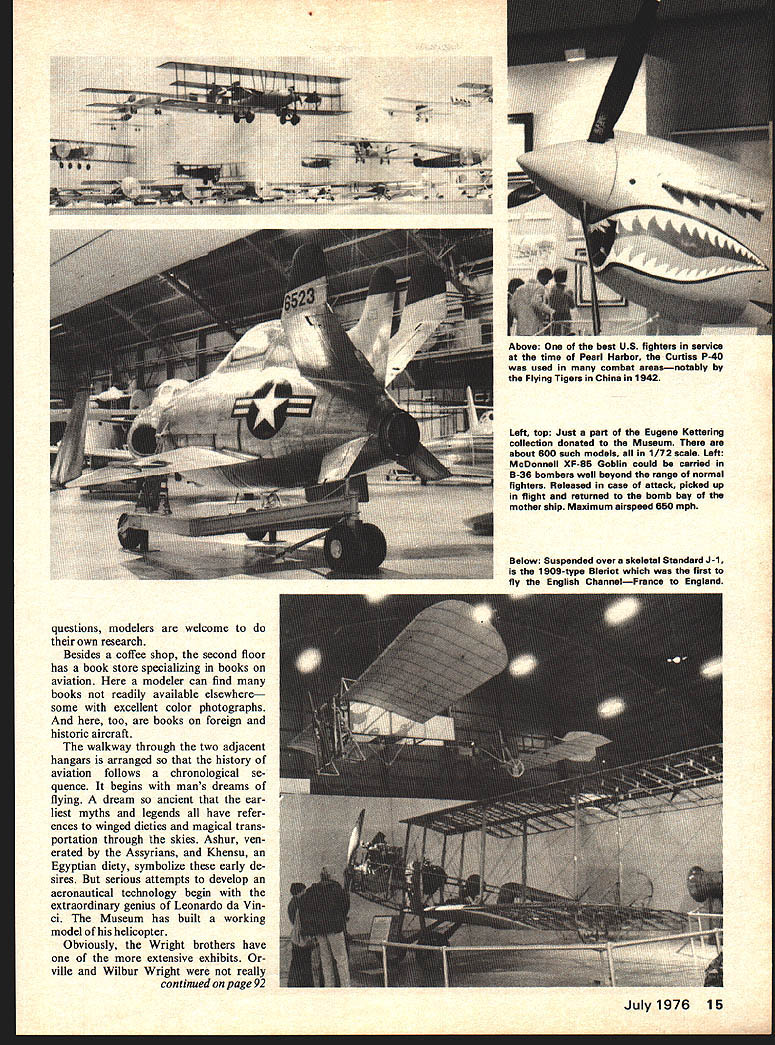
The first floor of the core building has a gift shop, a theater, an art gallery, and many special exhibits. Of particular interest to modelers in this area is the $500,000 Kettering collection of scale planes displayed here. This is a collection of approximately 600 aircraft scale models that had been in the study of the late Eugene Kettering. The models depict the advances of aircraft from the mid-1920's on.
On the second floor is the Air Force Museum Research Division which is visited by about a 1,000 people each year. Here is kept the material relevant to aviation history: documents, microfilms, still photos, films, books, plans, drawings, and periodicals of all sorts. Copying service is available. While the Museum does not have the staff to research individual requests. The Museum building is nearly 800 ft long and 230 ft wide. Inside are housed approximately 80 aircraft. Open to the public, this, with an additional 40 missiles outside, is a magnificent collection. There is an added attraction this year if you are planning to attend the 1976 AMA National competition held at Wright Field, Dayton, Ohio. Outdoor meets will be flown adjacent to the Air Force Museum.
The 1923 portion of the hangar of old McCook Field, the forerunner of Wright Field, was set aside as an aircraft museum. The purpose of the first museum — to collect intelligence revealed by aircraft used in the First World War — was decidedly limited. The beginning has grown into the present Air Force Museum. Now located in the no-longer-used portion of Wright Field, less than three miles from the historic Huffman Prairie where the Wright brothers tested planes, the Museum building, sited between runway and taxiway, follows the design of two aviation hangars joined by an administrative core building. The goal is no longer intelligence gathering but to preserve for the future man's heritage of achieving flight, to document technological developments, and to record the role of air power since the First World War. No continuing article text appears on this page — it contains only photographs and their captions. No continuing primary-article text appears on this page — it contains only photographs and their captions. questions, modelers are welcome to do their own research.
Besides a coffee shop, the second floor has a book store specializing in books on aviation. Here a modeler can find many books not readily available elsewhere—some with excellent color photographs. And here, too, are books on foreign and historic aircraft.
The walkway through the two adjacent hangars is arranged so that the history of aviation follows a chronological sequence. It begins with man's dreams of flying. A dream so ancient that the earliest myths and legends all have references to winged deities and magical transportation through the skies. Ashur, venerated by the Assyrians, and Khensu, an Egyptian deity, symbolize these early desires. But serious attempts to develop an aeronautical technology begin with the extraordinary genius of Leonardo da Vinci. The Museum has built a working model of his helicopter.
Obviously, the Wright brothers have one of the more extensive exhibits. Orville and Wilbur Wright were not really the "lucky" tinkerers that they are often made out to be. When the brothers became interested in flying, they assembled and studied all the scientific knowledge then available. They experimented with kites and gliders. When they found that the gliders did not perform as they expected, the Wrights concluded that the Lilienthal calculations on airfoil lift and drag commonly accepted were erroneous. Consequently they constructed in 1901, a wind tunnel that produced winds from 25 to 35 miles per hour. More than 200 airfoil sections were tested by the Wright brothers before they were confident that they had assembled the first reliable tables of air pressure on curved surfaces. And so, armed with more accurate information, the Wrights came up with a flyable plane. A replica of this wind tunnel was reconstructed by the Museum under the supervision of Orville Wright. It is part of the Wright brothers' exhibit.
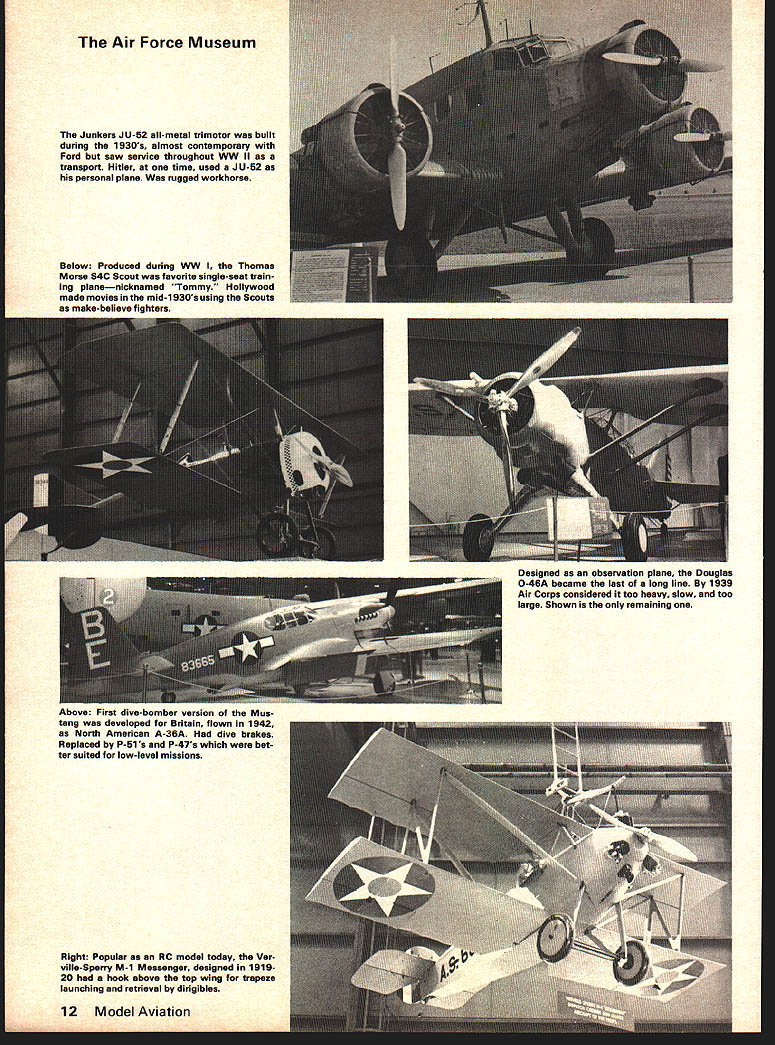
If aviation has a "romantic period," it has to be the first World War and the years following. Certainly the collection of planes from the first World War is one of the most popular with visitors. When the United States declared war in April, 1917, the Signal Corps' Aviation Section only had 250 airplanes—not one of which was combat worthy! Despite a tremendous effort, American industry was not able to produce one American-designed plane in time to see actual combat. The Americans used the British-designed de Havilland DH4s. Most were built in Dayton by the Dayton-Wright Company. The first aerial victory was in April, 1918. It had taken a while to get "going," but the final seven months saw 756 airplanes and 76 balloons shot down. America had a new kind of hero! We had 31 aces with Captain Eddie Rickenbacker the most famous.
After the war came the barnstorming, the daredevils, the country fairs with wing walkers and mock dog fights. But beneath the flamboyance and excitement, there was a struggle going on between those who saw the significance of the airplane and those who saw it only as an exotic toy. Men of vision, notably Brig. Gen. "Billy" Mitchell, attempted to promote the military future of the plane.
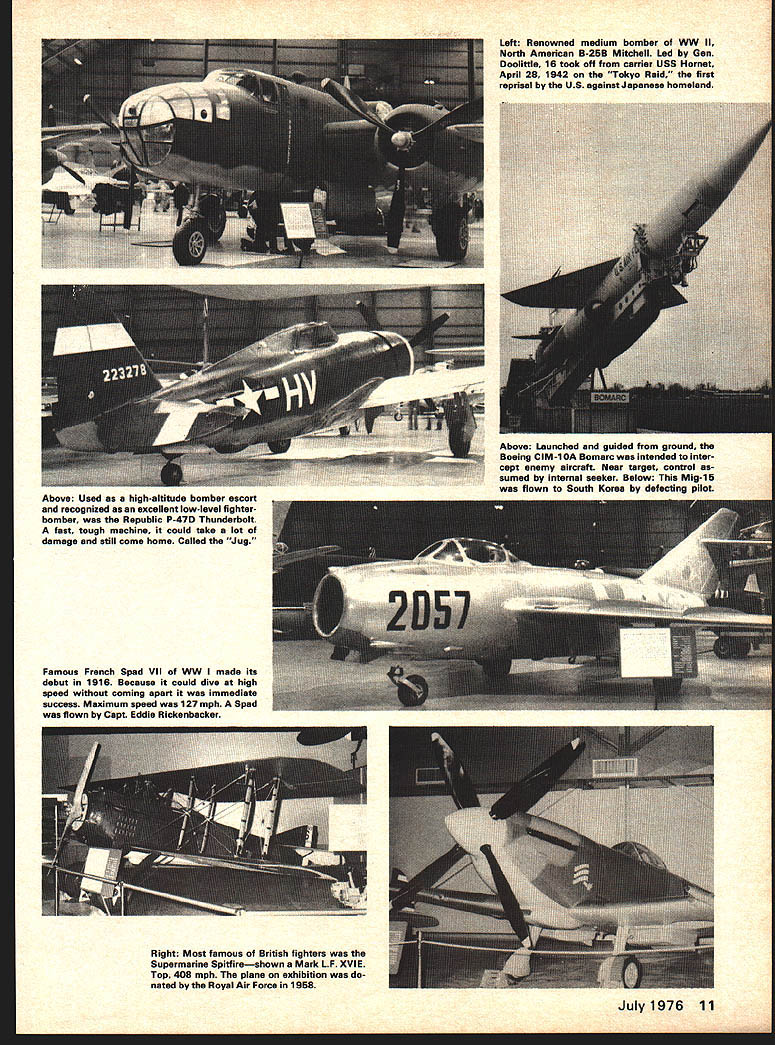
The second World War ended this dispute explosively. Air power — especially American air power — was a decisive factor in the Allied victory. Many of the best known planes of America and the other nations are here in the Air Force Museum. The arrangement is not only chronological but according to the theater of operation as well. For many visitors this part of the Museum is nostalgia tinged with sadness.
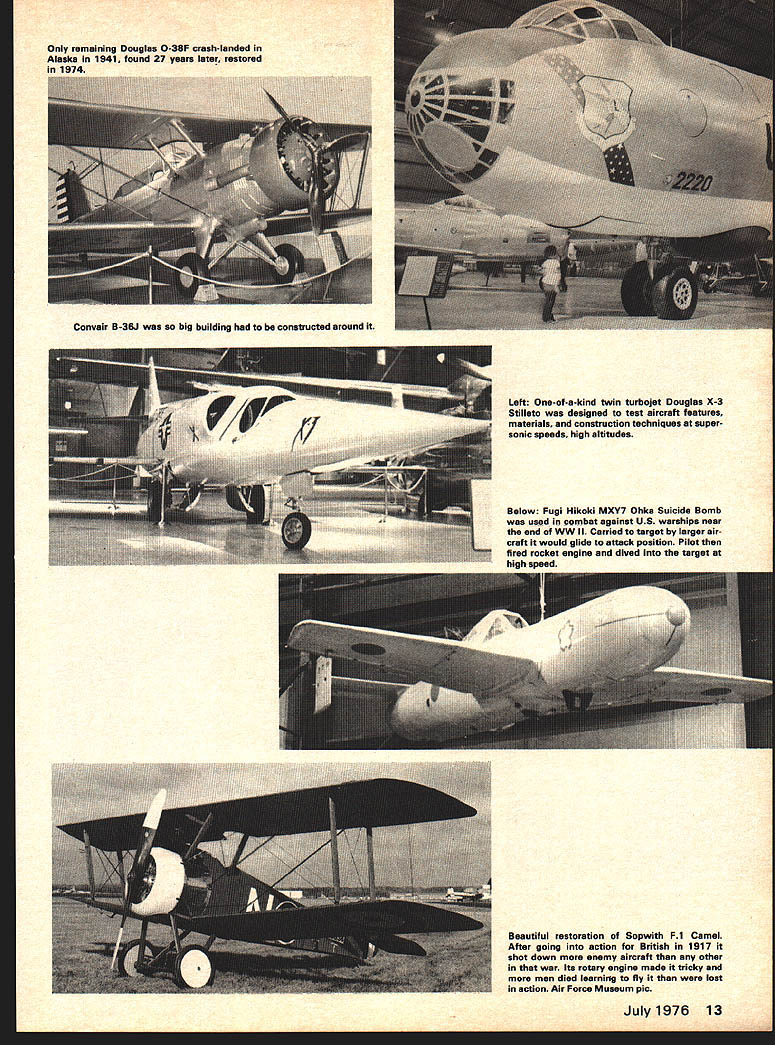
America's first jet, the XP-59A, made its initial flight in October, 1942. To confuse possible enemy spies it had a wooden propeller on the nose. A version of this plane is on display, but without its propeller! The Museum area devoted to the jet age and space is almost as popular as the antique planes.
The Air Force Museum is a must-see for anyone who is going to be in Dayton, Ohio. It is a comfortable Museum to visit. There is parking for 500 cars, a picnic area, and, inside the core building, are clean, well-marked restrooms. There is an elevator and restrooms for the handicapped. For those who need them, there are baby strollers and wheelchairs available. There is no admission charge or parking fee. Visiting hours weekdays are from 9:00 a.m. to 5:00 p.m. and from 10:00 a.m. to 6:00 p.m. on Saturdays and Sundays.
Transcribed from original scans by AI. Minor OCR errors may remain.

