
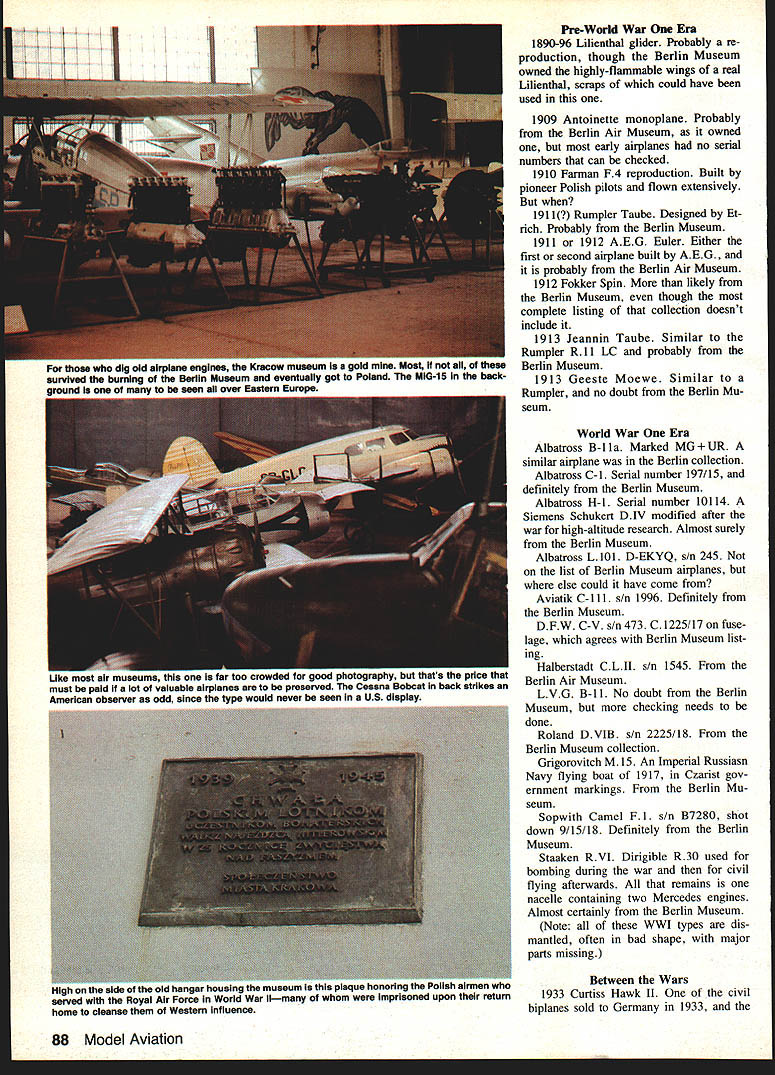
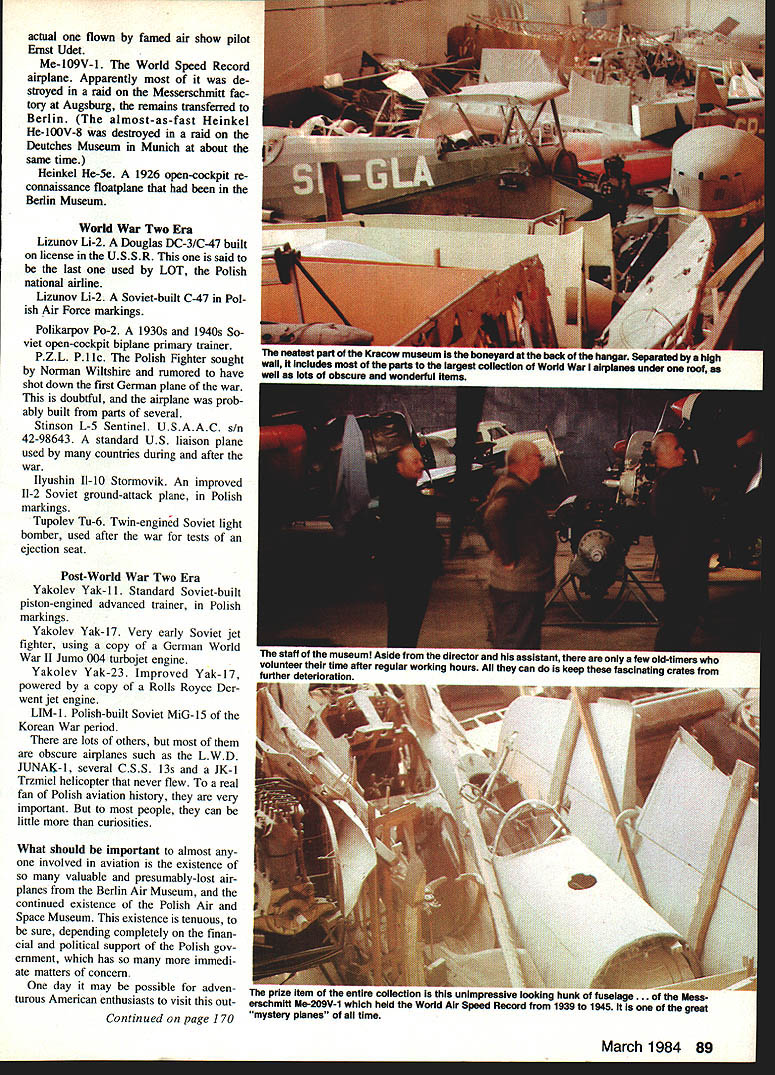

The Air & Space Museum of Poland
Museums are supposed to be centers of knowledge and enlightenment, not of mystery. They're places to go for answers, not for questions. A visit to one should result in a feeling of having learned, rather than having been puzzled.
Generally, that's the way museums are, whether they be of natural history, fine arts, or the aeronautical variety. But there's one air museum that runs completely counter to the flow: the Air and Space Museum of Poland, known locally (by the very few who are aware of its existence) as the Museum Lotnictwa i Astronautyki.
First of all, hardly any so-called aviation experts know that there is such a museum and that its collection of airplanes and engines ranks with the best. Second, getting there is a big pain, even in times of normalcy in that down-trodden land. When you get there, not even the few members of the museum staff can tell you, with any certainty, exactly how the most interesting displays got there.
Location and access
Take the matter of location. With the overwhelming exception of the National Air & Space Museum, smack in the tourist center of Washington, DC, few air museums are near large numbers of people. Let's face it: Dayton, OH; Pensacola, FL; and Hales Corners, WI are places few would go on purpose if it weren't for their having major aviation museums.
Krakow, Poland? Aside from being the site of one of the oldest universities in the world, it doesn't have all that much to offer. Anyway, the museum isn't even in the city, but several miles out, on the route to the huge Lenin Steel Works at Nowa Huta — not exactly one of the great tourist attractions, is it?
Still, if you're in the neighborhood, it's certainly worth a visit. Don't expect large, obvious signs directing you to the museum; they just don't do things that way in Eastern Europe. The place is off the main road, and any possible view of it is blocked by woods. There is a sign, but it's about the size of a loaf of bread and, of course, written in the peculiar Polish brand of lettering. If the general look of things is any indication, it may have fallen down by now.
There was a sign. By following the road, not much more than a driveway, past a cement pipe factory, it was possible to arrive at the edge of an old airfield. It actually dates back to just prior to World War I, and reportedly the airfield has been used by five different countries during periods of occupation.
The museum office was marked clearly enough, but it is so small and gloomy that a "vacant" sign would have been appropriate. It wasn't vacant and, in fact, was presided over by Museum Director Mr. Markowski. Assisting him, at least a few years ago, was one full-time aide and some old cronies from the World War II RAF Polish Squadrons who come in after regular work to help out.
The museum collection is housed in an old hangar, on the outside of which is a bronze plaque commemorating the Poles who fought for their country and ours in the 1939–45 war. It was a nice touch, but an unpolished plaque, high up on a dingy hangar on a disused airfield, doesn't offer the promise of much in the way of important and interesting old airplanes within.
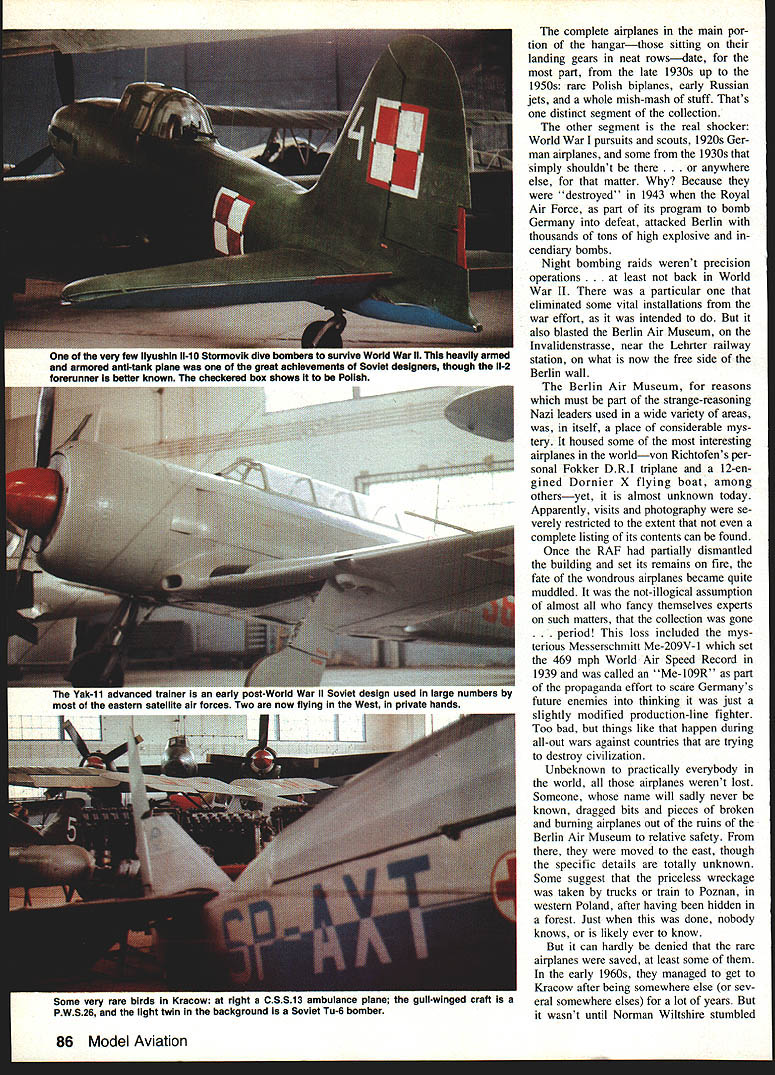
It was, therefore, a genuine shock to enter the hangar and look around at rows of unusual (and frequently unknown) airplanes dating back to the earliest days of flight. Lots of struts and wires and open cowlings. Lots of peculiar shapes and funny color schemes and unfamiliar markings.
The airplanes that first caught my eye were obviously different and worth a methodical inspection. But it was the unassembled ones piled into a walled-off area at the back of the hangar that turn this plain old building into something truly unique. It is those airplanes, so desperately in need of restoration, that give the Polish Air and Space Museum its air of mystery.
The complete airplanes in the main portion of the hangar—those sitting on their landing gear in neat rows—date, for the most part, from the late 1930s up to the 1950s: rare Polish biplanes, early Russian jets, and a whole mish‑mash of stuff. That's one distinct segment of the collection.
The other segment is the real shocker: World War I pursuits and scouts, 1920s German airplanes, and some from the 1930s that simply shouldn't be there ... or anywhere else, for that matter. Why? Because they were "destroyed" in 1943 when the Royal Air Force, as part of its program to bomb Germany into defeat, attacked Berlin with thousands of tons of high explosive and incendiary bombs.
Night bombing raids weren't precision operations—at least not back in World War II. There was a particular one that eliminated some vital installations from the war effort, as it was intended to do. But it also blasted the Berlin Air Museum, on the Invalidenstrasse, near the Lehrter railway station, on what is now the free side of the Berlin Wall.
The Berlin Air Museum, for reasons which must be part of the strange reasoning used by Nazi leaders in a wide variety of areas, was, in itself, a place of considerable mystery. It housed some of the most interesting airplanes in the world—von Richthofen's personal Fokker D.R.I triplane and a 12‑engined Dornier X flying boat, among others—yet it is almost unknown today. Apparently visits and photography were severely restricted to the extent that not even a complete listing of its contents can be found.
Once the RAF had partially dismantled the building and set its remains on fire, the fate of the wondrous airplanes became quite muddled. It was the not‑illogical assumption of almost all who fancy themselves experts on such matters that the collection was gone ... period! This loss included the mysterious Messerschmitt Me‑209V‑1 which set the 469 mph World Air Speed Record in 1939 and was called a "Me‑109R" as part of the propaganda effort to scare Germany's future enemies into thinking it was just a slightly modified production‑line fighter. Too bad, but things like that happen during all‑out wars against countries that are trying to destroy civilization.
Unbeknownst to practically everybody in the world, all those airplanes weren't lost. Someone, whose name will sadly never be known, dragged bits and pieces of broken and burning airplanes out of the ruins of the Berlin Air Museum to relative safety. From there, they were moved to the east, though the specific details are totally unknown. Some suggest that the priceless wreckage was taken by trucks or train to Poznan, in western Poland, after having been hidden in a forest. Just when this was done, nobody knows, or is likely ever to know.
But it can hardly be denied that the rare airplanes were saved, at least some of them. In the early 1960s they managed to get to Krakow after being somewhere else (several somewheres) for a lot of years. But it wasn't until Norman Wiltshire stumbled upon the remains in 1967, searching for a single airplane, that anyone found out the vaguest details of what occurred.
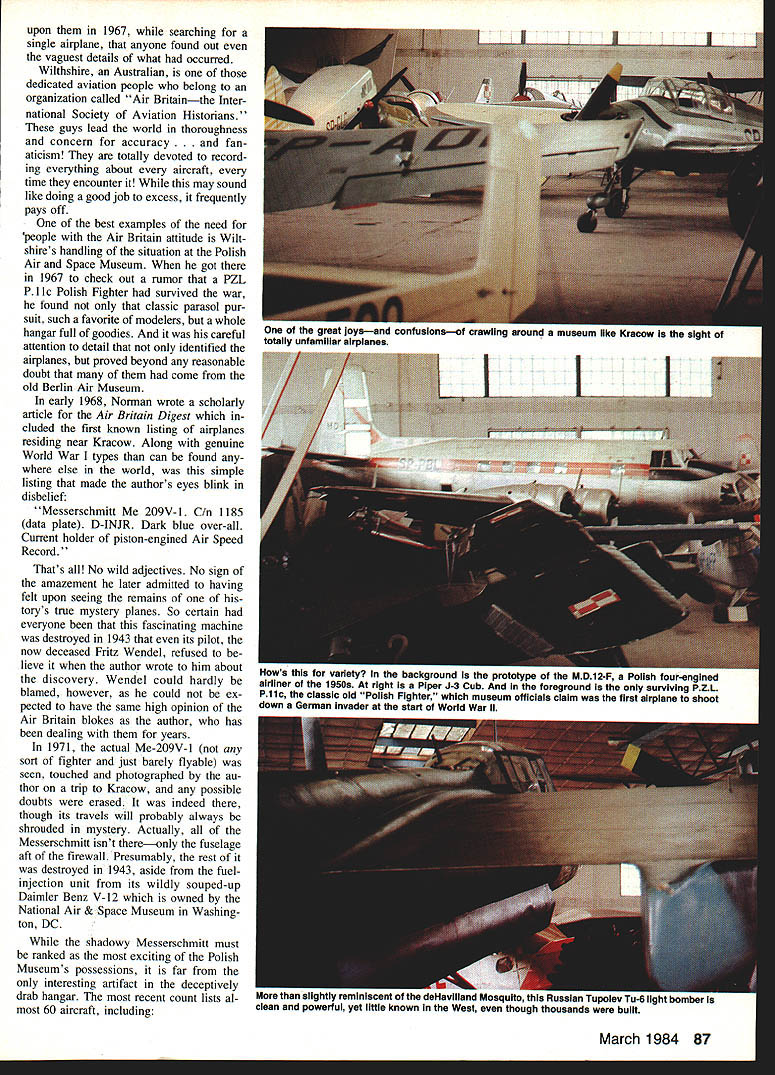
Wiltshire, an Australian dedicated to aviation, belonged to an organization called Air Britain—the International Society of Aviation Historians. These guys lead the world in thoroughness, concern for accuracy, and fanaticism totally devoted to recording everything about aircraft. This attitude may sound like excessive zeal, but frequently it pays off. The best example of this is Wiltshire's handling of the situation when the Polish Air and Space Museum, in 1967, checked out a rumor that a PZL P.11c Polish fighter had survived the war.
This classic parasol pursuit is a favorite of modelers. The whole hangar was full of goodies. With careful attention to detail, the identified airplanes proved beyond reasonable doubt to have come from the old Berlin Air Museum. Early in 1968 Norman wrote a scholarly article in Air Britain Digest which included the first known listing of airplanes residing near Krakow. Along with genuine World War I types can be found examples not seen elsewhere in the world. The simple listing made the author's eyes blink in disbelief: Messerschmitt Me‑209V‑1 C/n 1185 data plate D‑INJR; dark blue overall; current holder of the piston‑engined World Air Speed Record.
That's all! No wild adjectives. No sign of the amazement he later admitted to having felt upon seeing the remains of one of history's true mystery planes. So certain had everyone been that this fascinating machine was destroyed in 1943 that even its pilot, the now‑deceased Fritz Wendel, refused to believe it when the author wrote to him about the discovery. Wendel could hardly be blamed, however, as he could be expected to have the same high opinion of the Air Britain blokes as the author, who has been talking with them for years.
In 1971, the actual Me‑209V‑1 (not any sort of fighter and just barely flyable) was seen, touched and photographed by the author on a trip to Krakow, and any possible doubts were erased. It was indeed there, though its travels will probably always be shrouded in mystery. Actually, all of the Messerschmitt isn't there—only the fuselage aft of the firewall. Presumably, the rest of it was destroyed in 1943, aside from the fuel‑injection unit from its wildly souped‑up Daimler‑Benz V‑12 which is owned by the National Air & Space Museum in Washington, DC.
While the shadowy Messerschmitt must be ranked as the most exciting of the Polish Museum's possessions, it is far from the only interesting artifact in the deceptively drab hangar. The most recent count lists almost 60 aircraft, including:
Pre-World War One Era
- 1890–96 Lilienthal glider. Probably a reproduction, though the Berlin Museum owned the highly flammable wings of a real Lilienthal, scraps of which could have been used in this one.
- 1909 Antoinette monoplane. Probably from the Berlin Air Museum, as it owned one, but most early airplanes had no serial numbers that can be checked.
- 1910 Farman F.4 reproduction. Built by pioneer Polish pilots and flown extensively. But when?
- 1911(?) Rumpler Taube. Designed by Etrich. Probably from the Berlin Museum.
- 1911 or 1912 A.E.G. Euler. Either the first or second airplane built by A.E.G., and it is probably from the Berlin Air Museum.
- 1912 Fokker Spin. More than likely from the Berlin Museum, even though the most complete listing of that collection doesn't include it.
- 1913 Jeannin Taube. Similar to the Rumpler R.11 LC and probably from the Berlin Museum.
- 1913 Geest Möwe. Similar to a Rumpler, and no doubt from the Berlin Museum.
World War One Era
- Albatros B.IIa. Marked MG + UR. A similar airplane was in the Berlin collection.
- Albatros C-1. Serial number 197/15, and definitely from the Berlin Museum.
- Albatros H-1. Serial number 10114. A Siemens-Schuckert D.IV modified after the war for high-altitude research. Almost surely from the Berlin Museum.
- Albatros L.101. D-EKYQ, s/n 245. Not on the list of Berlin Museum airplanes, but where else could it have come from?
- Aviatik C-III. s/n 1996. Definitely from the Berlin Museum.
- D.F.W. C.V. s/n 473, C.1225/17 on fuselage, which agrees with Berlin Museum listing.
- Halberstadt C.II. s/n 1545. From the Berlin Air Museum.
- L.V.G. B.II. No doubt from the Berlin Museum, but more checking needs to be done.
- Roland D.VIb. s/n 2225/18. From the Berlin Museum collection.
- Grigorovich M.15. An Imperial Russian Navy flying boat of 1917, in Czarist government markings. From the Berlin Museum.
- Sopwith Camel F.1. s/n B7280, shot down 9/15/18. Definitely from the Berlin Museum.
- Staaken R.VI. Dirigible R.30 used for bombing during the war and then for civil flying afterwards. All that remains is one nacelle containing two Mercedes engines. Almost certainly from the Berlin Museum.
(Note: all of these WWI types are dismantled, often in bad shape, with major parts missing.)
Between the Wars
- 1933 Curtiss Hawk II. One of the civil biplanes sold to Germany in 1933, and the actual one flown by famed air show pilot Ernst Udet.
- Messerschmitt Me‑209V‑1. The World Speed Record airplane. Apparently most of it was destroyed in a raid on the Messerschmitt factory at Augsburg, the remains transferred to Berlin. (The almost-as-fast Heinkel He‑100V‑8 was destroyed in a raid on the Deutsches Museum in Munich at about the same time.)
- Heinkel He‑5e. A 1926 open-cockpit reconnaissance floatplane that had been in the Berlin Museum.
World War Two Era
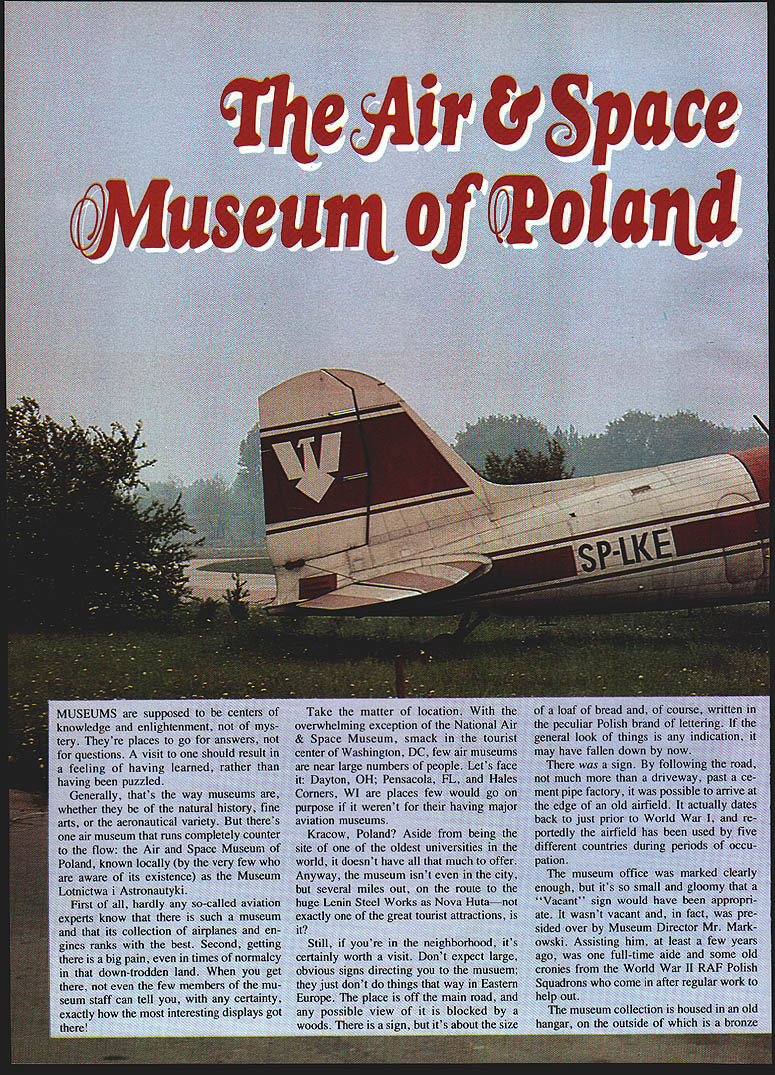
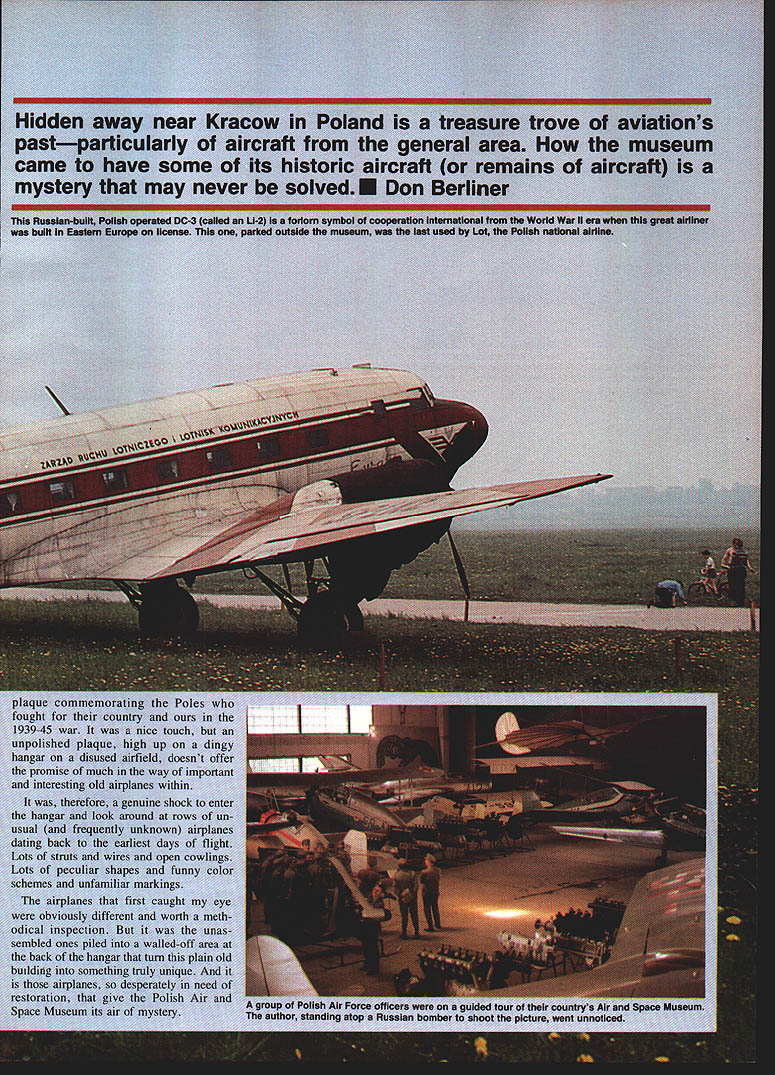
- Lisunov Li-2. A Douglas DC-3/C-47 built on licence in the U.S.S.R. This one is said to be the last one used by LOT, the Polish national airline.
- Lisunov Li-2. A Soviet-built C-47 in Polish Air Force markings.
- Polikarpov Po-2. A 1930s and 1940s Soviet open-cockpit biplane primary trainer.
- P.Z.L. P.11c. The Polish fighter sought by Norman Wiltshire and rumored to have shot down the first German plane of the war. This is doubtful, and the airplane was probably built from parts of several.
- Stinson L-5 Sentinel. U.S.A.A.C. s/n 42-98643. A standard U.S. liaison plane used by many countries during and after the war.
- Ilyushin Il-10 Stormovik. An improved Il-2 Soviet ground-attack plane, in Polish markings.
- Tupolev Tu-6. Twin-engined Soviet light bomber, used after the war for tests of an ejection seat.
Post-World War Two Era
- Yakovlev Yak-11. Standard Soviet-built piston-engined advanced trainer, in Polish markings.
- Yakovlev Yak-17. Very early Soviet jet fighter, using a copy of a German World War II Jumo 004 turbojet engine.
- Yakovlev Yak-23. Improved Yak-17, powered by a copy of a Rolls-Royce Derwent jet engine.
- Lim-1. Polish-built Soviet MiG-15 of the Korean War period.
There are lots of others, but most of them are obscure airplanes such as the L.W.D. JUNAK-1, several C.S.S. 13s and a J.K.-1 Trzmiel helicopter that never flew. To a real fan of Polish aviation history, they are very important. But to most people, they can be little more than curiosities.
What should be important to almost anyone involved in aviation is the existence of so many valuable and presumably lost airplanes from the Berlin Air Museum, and the continued existence of the Polish Air and Space Museum. This existence is tenuous, to be sure, depending completely on the financial and political support of the Polish government, which has so many more immediate matters of concern.
One day it may be possible for adventurous American enthusiasts to visit this out-of-the-way place and meet the hard-working, typically friendly Poles who do what they can to keep things alive. Already, one of the airplanes—the sole surviving de Havilland DH‑9A bomber of World War One—has been swapped to the RAF Museum for a spare Spitfire like the ones flown in the 1940s by Polish exile squadrons. Additions and trades may someday be possible, such as a Curtiss Hawk for, say, a P‑51 Mustang. Or the Me‑209V‑1 for half the Smithsonian's.
Unfortunately, the present political situation in Krakow is so depressing that it's hard to get a letter through, let alone consider planning a trip or a trade. To those of us on the other side of the line, this seems hopeless. To the Poles, it's just one more turn of the screw. After all, the irony of which this museum sits has served many masters: the Austro‑Hungarian Empire, Hungary, the Third Reich, Germany, the U.S.S.R., and finally Poland. It has survived some pretty hard times, but it has its wonderful old airplanes and the men who tend to their most vital needs.
Until things get a lot better, the museum outside Krakow will stand as a reminder that even where life is gray and unhappy, there are still people who have time for matters beyond their own lives.
Transcribed from original scans by AI. Minor OCR errors may remain.

