

Airborne Restarts
By controlling compression in both the combustion chamber and crankcase, and adding an extra servo, the engine (glo-plug) can be shut down at will during flight and restarted while diving to windmill the prop.
TODAY, JULY 18, 1976, was to my son and me a red-letter day. We have just completed and tested a prototype model aircraft. Now you may ask "What could be new and unusual about any model aircraft these days?" Originally, the plane was an ordinary Falcon 56, and the engine an O.S. 20. The plane was built to train this old free-flighter to fly RC. Two months ago a new purpose was begun for this plane.
At that time, we (my son Bill and I) were pondering over the idea of how nice it would be if we could stop an engine in flight and allow the plane to glide for a while and then restart it by RC. If you have not guessed yet, today was the day we did just that. We successfully restarted the engine not just once, but several times. This is what I believe to be a real breakthrough, which before today even I had some doubts about.
Now I must warn you in advance that you can't stand next to my plane on the flight line with transmitter in hand and signal the engine to start. It will ignore you. There is one other important ingredient (did I forget to say that?): altitude! The plane actually dives for a push-start!
The principle behind this is that the slipstream turns the propeller as in hand starting, but the compression is relieved for a high-speed spin-up. The compression is then snap-restored with the glo-plug on to start. The compression must be controlled in both the combustion chamber and crankcase.
As you could well imagine the modifications are mostly to the engine, but an extra servo and a C-size Nicad battery must be installed.
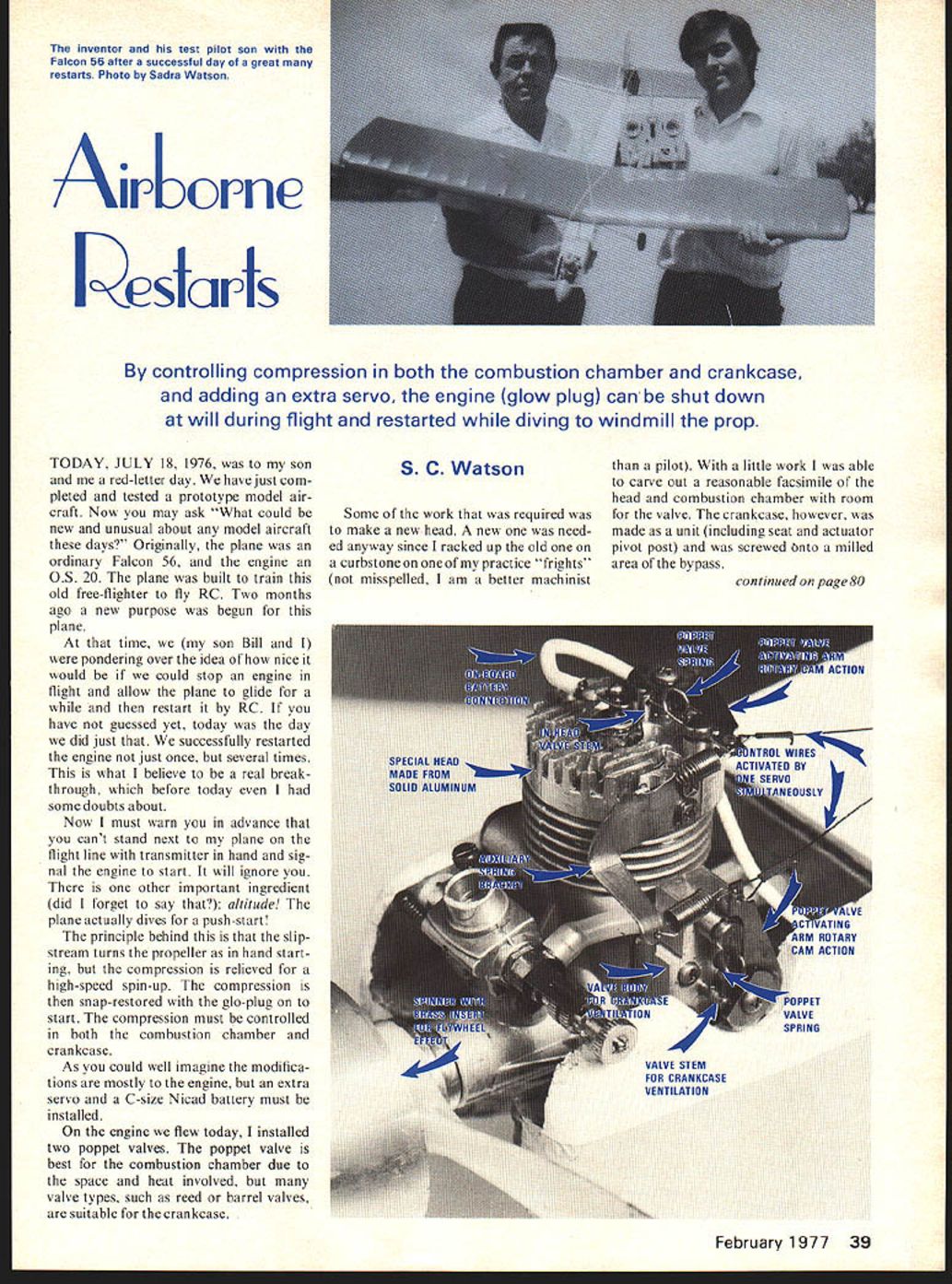
On the engine we flew today, I installed two poppet valves. The poppet valve is best for the combustion chamber due to the space and heat involved, but many valve types, such as reed or barrel valves, are suitable for the crankcase.
S. C. Watson
Some of the work that was required was to make a new head. A new one was needed anyway since I racked up the old one on a curbstone on one of my practice "frights" (not misspelled, I am a better machinist than a pilot). With a little work I was able to carve out a reasonable facsimile of the head and combustion chamber with room for the valve. The crankcase, however, was made as a unit (including seat and actuator pivot post) and was screwed onto a milled area of the bypass. The valves are controlled by a servo mounted in the radio compartment. The glo-plug battery was also mounted there, and a switch was mounted to the high side of the throttle servo to control the ignition power.
About two weeks' work was required to build the first prototype. On Saturday, July 10, we thought we were ready to challenge the air, but instead we learned a lesson.
After the usual range checks and engine tune-ups, we launched our invention. We didn't waste any time; we got the plane right up to about 400 feet. The glo-plug was turned on by advancing the throttle the last two notches, and the engine was killed by engaging both compression valves. We then placed the plane in about a 30-degree dive to about 200 feet and snapped the release on the valves. Nothing happened! We repeated the procedure hastily down to 100 feet. Nothing again! We landed the plane and began a heavy-hearted discussion of the possible problems.
We had no real clues since the engine was silent throughout the whole ordeal. We finally made the assumption that more starting energy was needed. We needed a flywheel. This was easy to add and it appeared that we could use a little nose weight anyway.
A week of construction and ground tests brought demonstrable progress. We could now kill the engine for short intervals on the ground and restart on the energy of the flywheel. All we needed was good weather.
Sunday was the day. Everything was ready, and after a few preliminaries, our Falcon took to the air. This time we went to 600 feet before we went to our test sequence. Compression off, glo-plug on, dive for five seconds—compression on! It worked! It worked so well that we decided to try a shallower dive so that we would not use a whole 150 feet of altitude. Again it worked well.
Up until now we had not allowed the engine to really stop dead; it didn't produce power, but it still spun. While we were still flying we thought we would give it a try. Compression off, compression on, compression off, glo-plug on, dive 100 feet, compression on. Nothing happened. We tried it again with a 250-foot, 30-degree dive to allow plenty of spin-up. It roared to life! What a relief. Two more tries produced starts on this flight. Out of eight tries we got six starts at various dive angles in the day's efforts.
We aren't stopping here. Improvements occur to us often and the system is becoming more feasible for general modeling. We feel that we can eliminate the excessive diving by using a higher pitch prop with a symmetrical airfoil. We will also free the dependence of the glo-plug power on the throttle to allow different settings for starting.
If you have an interest in this system to restart your glider motor when the thermals fade, or if you just want to talk shop write to: S. C. Watson, 1358 Rollercoaster Rd., Tucson, Arizona 85704.
Transcribed from original scans by AI. Minor OCR errors may remain.

