
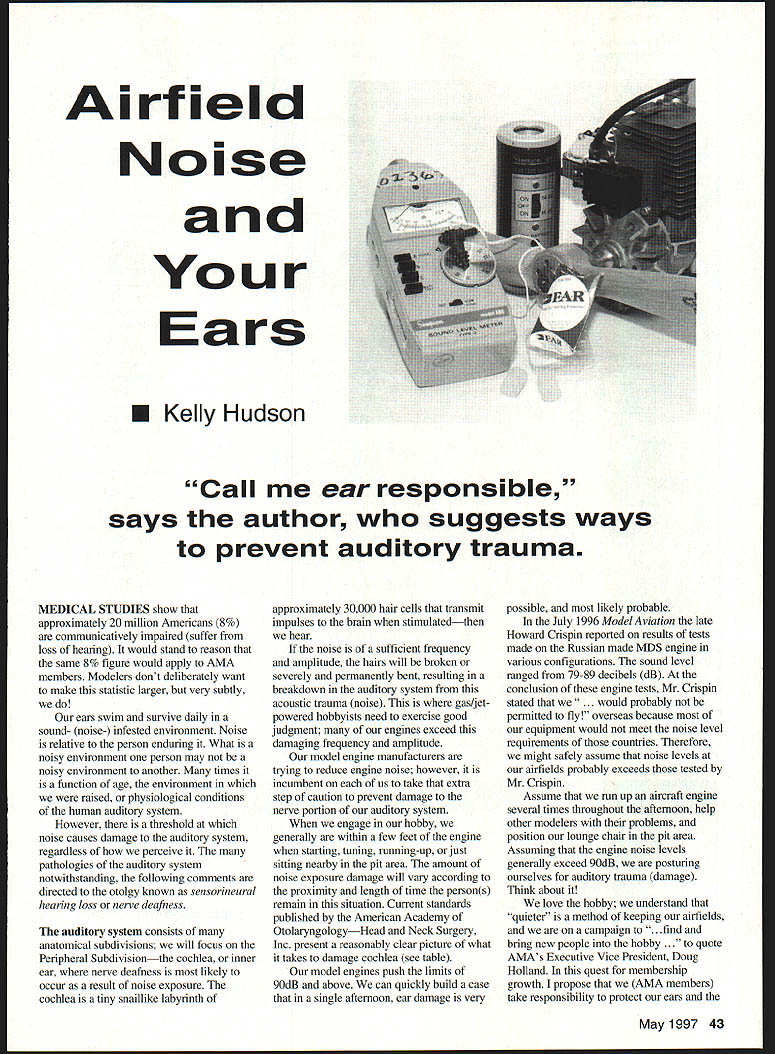

Airfield Noise and Your Ears
Kelly S. Hudson Hearing Instrument Specialist
"Call me ear responsible," says the author, who suggests ways to prevent auditory trauma.
Scope and statistics
MEDICAL STUDIES show that approximately 20 million Americans (about 8%) are communicatively impaired (suffer from hearing loss). It would stand to reason that a similar percentage applies to AMA members. Modelers do not deliberately want to increase this statistic, but our ears daily endure a sound- (noise-) infested environment. Noise is relative: what is noisy to one person may not be to another. Age, the environment in which we were raised, and physiological conditions of the auditory system all influence perception.
However, there is a threshold at which noise causes damage to the auditory system regardless of perception. The following comments are directed primarily to sensorineural hearing loss (nerve deafness), the otologic condition most likely to result from noise exposure.
The auditory system (peripheral focus)
The peripheral auditory subdivision — the cochlea or inner ear — is where noise-related nerve deafness is most likely to occur. The cochlea is a tiny, snail-like labyrinth containing approximately 30,000 hair cells that transmit impulses to the brain when stimulated — then we hear. If noise of sufficient frequency and amplitude strikes the ear, these hairs can be broken, severely bent, or permanently damaged, producing acoustic trauma and a breakdown in hearing.
Noise exposure and model engines
Many gas- and jet-powered hobby engines exceed damaging frequency and amplitude thresholds. Model engine manufacturers are attempting to reduce engine noise; however, it is incumbent on individual hobbyists to exercise caution to prevent damage to the nerve portion of the auditory system.
- We often stand or sit within a few feet of an engine when starting, tuning, running up, or socializing in the pit area.
- Noise-exposure damage varies with proximity and the length of exposure.
- Current standards published by the American Academy of Otolaryngology — Head and Neck Surgery present a reasonably clear picture of what it takes to damage the cochlea.
- Our model engines often push the limits of 90 dB and above. In a single afternoon, ear damage is very possible and even likely.
For example, in July 1996 Model Aviation, tests on a Russian-made MDS engine showed sound levels ranging from 79–89 dB. The tests suggested these engines might not meet some international noise requirements, and it is reasonable to assume that many airfields exceed those measured levels.
Hearing protection: what works
Until engines consistently operate below about 85 dB, hearing protection is the practical solution.
- Ear plugs (inserts): fit in the outer ear canal and form an airtight seal. They can reduce noise substantially when fitted correctly.
- Ear muffs: cup-shaped and fit over the entire outer ear; they must seal tightly with no leaks.
- Using both ear plugs and ear muffs together usually provides an additional 10–15 dB reduction beyond what each provides alone.
- Typical reductions:
- Ear plugs or ear muffs: about 15–30 dB reduction
- Both together: an extra 10–15 dB reduction
- Cotton in the ears: about 7 dB reduction (not recommended as primary protection)
- A by-product of good hearing protection is generally enhanced speech understanding in noisy places.
With proper hearing protection, the auditory system can tolerate the noisy airfield environment.
Protecting current and future hobbyists
If approximately 8% of the population already suffers hearing loss, we must not add to that number. Nerve deafness is accumulative. Adult AMA participants should:
- Wear hearing protection consistently.
- Encourage and model hearing-protection use for youth and new hobbyists — children generally emulate adults.
- Educate newcomers about the risk factors and the benefits of protection.
Hearing protectors range in price from about $3 to $600. The decision on which product to buy is yours; the important point is to use protection now, or risk needing hearing instruments later.
Conclusion
We love the hobby and want to bring new people into it. To do so responsibly we must protect our ears and the ears of younger participants. Hearing protection now — hearing instruments later. Are we professional enough to avoid causing preventable damage to ourselves and others? Pass the word. Protect your ears.
Kelly S. Hudson Hearing Instrument Specialist 101 E. Brunson St., #200 Enterprise, AL 36330
Transcribed from original scans by AI. Minor OCR errors may remain.

