
The Airplane: Laser 200
Introduction
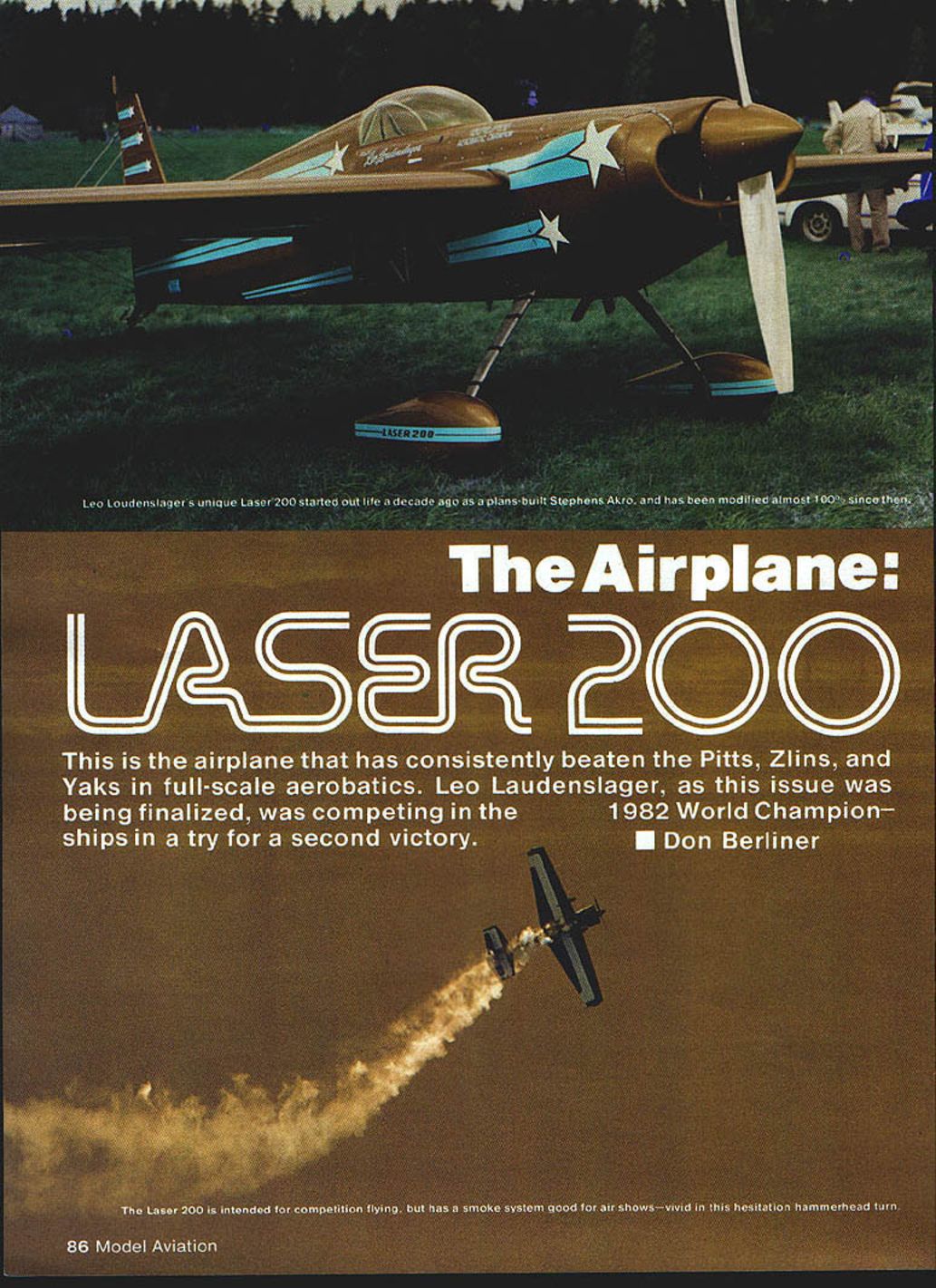
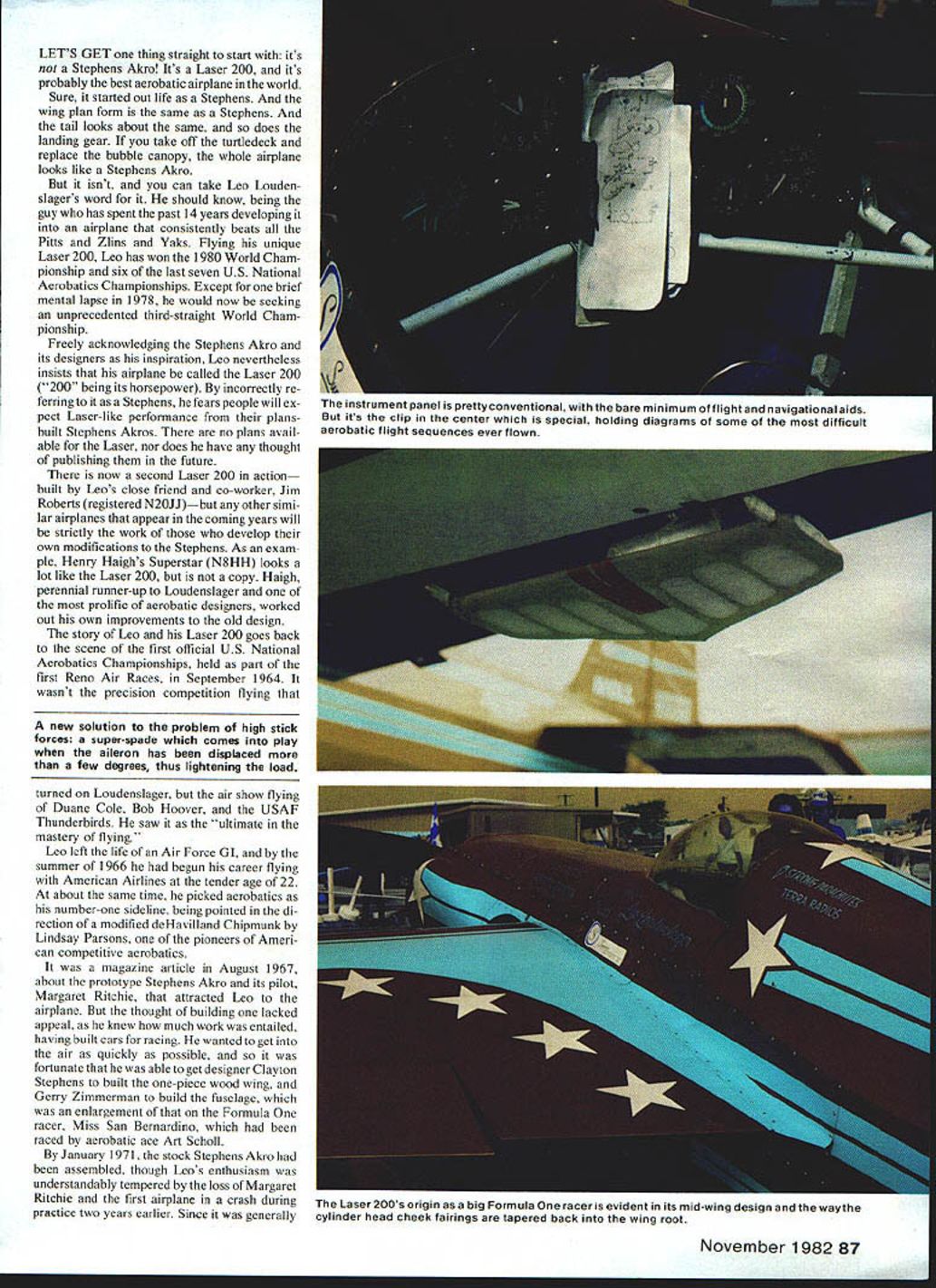
The Laser 200 is the airplane that has consistently beaten the Pitts, Zlins, and Yaks in full-scale aerobatics. Piloted and continuously developed by Leo Loudenslager, the Laser earned Loudenslager the 1980 World Championship and six of the last seven U.S. National Aerobatics Championships (as of the early 1980s). Loudenslager insists the aircraft be called the Laser 200 — “200” denotes its horsepower — and there are no plans available for it.
Origins and Inspiration
- The Laser 200 began life influenced by the Stephens Akro: wing planform, tail appearance, and landing gear show visual similarities.
- Loudenslager freely acknowledged the Stephens Akro and its designers as inspiration, but the Laser 200 evolved into a fundamentally different and superior competition airplane.
- Leo preferred not to publish plans or to have the Laser mistaken for a stock Stephens; he worried that calling it a Stephens would lead people to expect Laser-like performance from plans-built Akros.
Early Years and Entry into Aerobatics
- Loudenslager’s interest in air-show flying and aerobatics dates to the first official U.S. National Aerobatics Championships (Reno, 1964) and air-show flying by Duane Cole, Bob Hoover, and the Thunderbirds.
- After leaving the Air Force, he joined American Airlines in 1966 and pursued aerobatics on the side, first flying a modified de Havilland Chipmunk.
- A 1967 magazine article about the prototype Stephens Akro and pilot Margaret Ritchie led him to the design. To speed entry into the air, Clayton Stephens built the one-piece wood wing and Gerry Zimmerman built the fuselage.
Building and Early Development
- By January 1971 the Stephens Akro was assembled. Initial flight testing began in April 1971 and quickly led to continuous development and modification.
- Early handling problems included poor neutral feel in the ailerons and excessive control pressures. Closing gaps and refining control surfaces improved roll control.
- Loudenslager’s first contest was Brookhaven, Long Island (summer 1971), where he skipped Sportsman, flew Intermediate, and won. A few weeks later he won at the 1971 U.S. National Championships.
- Mechanical teething troubles (failed exhaust valve, broken oil line) and limited practice time highlighted the difficulty of developing both pilot and airplane simultaneously.
Competition Progress and Team Selection
- Despite being a rookie, Loudenslager impressed enough at early contests to be named to the U.S. team as an assistant in the 1972 Worlds selection process.
- International exposure — notably at Salon-de-Provence, France — helped him focus on the World Championships and on improving both himself and the airplane.
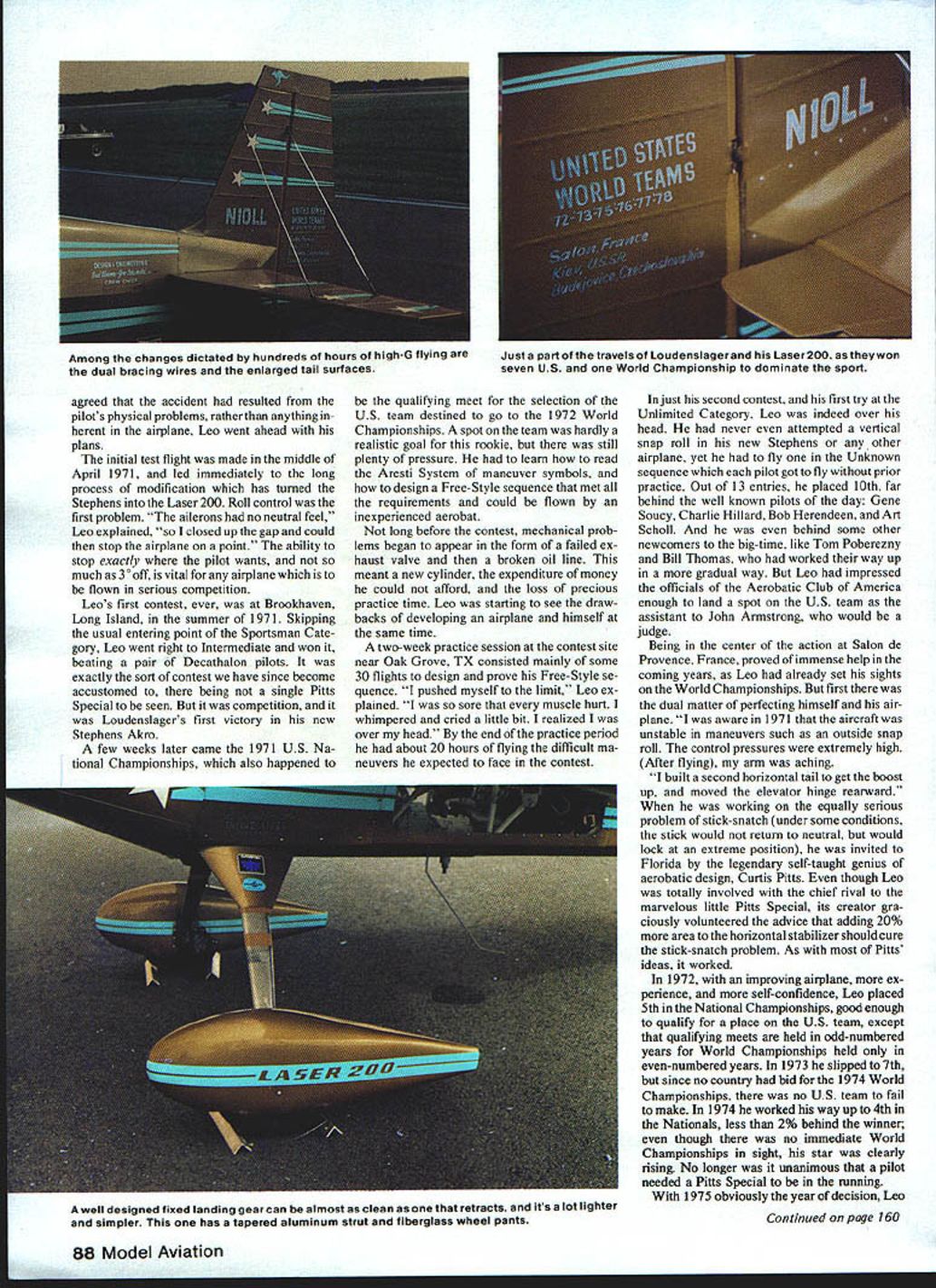
- He identified and addressed maneuver instabilities; for example, he built a second horizontal tail and moved the elevator hinge rearward to boost control authority.
- Curtis Pitts advised adding 20% more horizontal stabilizer area to cure stick-snatch; the modification worked.
Major Structural Rebuild and Birth of the Laser 200
- Early in 1975 a crack was found in the main spar of the single wing. Rather than abandon the monoplane concept, Loudenslager rebuilt and strengthened the aircraft.
- He cut off and discarded the front fuselage, kept the backbone and tail, and built a new lighter, stronger fuselage. A new wing, built in Texas, used a modified NACA 23012 airfoil, a routed spar, and a beefed-up center section with ultimate strength exceeding 10 G.
- The wing planform remained true to the original design by Eddie Allenbaugh, whom Loudenslager credited for many of the good numbers still used.
- The heavy plexiglass bubble was replaced with a low-drag canopy faired smoothly into a new turtledeck, which reduced drag, cut weight, and added lateral area beneficial for knife-edge flight. Cruising speed rose from about 136 mph to 158 mph.
- With major engineering help from Bud Stoms and Joe Oshinski, Jr., by 1975 the airplane had evolved so much that little remained of the original Stephens Akro beyond the fuselage framework and pilot’s seat. The name “Laser” was later applied by a promoter in Canada.
Competition Dominance and Key Results
- 1975: Loudenslager entered the Unlimited title against 19 men and one woman flying Pitts Specials — and defeated all 20 Pitts, a watershed moment for monoplanes in competition.
- 1976: Led a U.S. team to the World Championships in the U.S.S.R.; the contest results were widely regarded as compromised by judging irregularities.
- 1976 (domestic): Back home, Loudenslager won the National Championship by a wide margin (nearly 500 points out of about 18,000), proving the Laser’s effectiveness against modified Pitts designs.
- 1977: Won a third straight national title (tying Gene Soucy), beating highly modified Pitts S-1S entries.
- 1978: The World Championships held in Czechoslovakia were notable for strong efforts to ensure fairness and sportsmanship; the contest was important to the future credibility of the sport.
- Other notable achievements include Loudenslager’s 1980 World Championship and multiple U.S. national titles through the early 1980s.
Other Builders and Derivatives
- A second Laser 200 was built by Jim Roberts (N20JJ), a close friend and co-worker of Loudenslager.
- Other similar-looking airplanes appeared — for example, Henry Haigh’s Superstar (N8HH) — but these were not copies; Haigh and others developed their own improvements derived from Stephens designs.
- Loudenslager has no intention of publishing Laser plans; future similar airplanes would need to come from independent development.
Technical Highlights
- Roll control: refined ailerons with closed gaps improved neutral feel and precise roll authority.
- Tail and stabilizer: increased horizontal tail area and relocated elevator hinge improved stick forces and cured stick-snatch.
- Structure: routed spar, beefed-up center section, and a modified airfoil produced a wing capable of repeated high-load maneuvers.
- Aerodynamics: a faired low-drag canopy and turtledeck increased cruising speed and improved knife-edge performance.
Legacy and Significance
- The Laser 200 demonstrated that a well-engineered monoplane could outperform the dominant Pitts Special in Unlimited aerobatics, changing perceptions of what an aerobatic aircraft could be.
- Loudenslager’s continuous development over more than a decade turned a Stephens-inspired aircraft into a distinct, championship-winning design.
- The Laser remains proprietary to its developer; its success has nonetheless inspired other designers to pursue improvements in competitive aerobatic aircraft.
Notable Achievements (summary)
- Multiple U.S. National Aerobatics Championships (six of the last seven as of early 1980s)
- 1980 World Aerobatics Champion
- Pioneered monoplane success against dominant biplane competitors in Unlimited aerobatics
Transcribed from original scans by AI. Minor OCR errors may remain.

