
Airplanes and the wind!
by Ralph Grose
If you hang around the airport or the Radio Control (RC) flying field as I do, you will eventually hear comments which allude to one or more of the following statements.
- The airplane will tend to yaw toward the upwind direction.
- As you turn upwind, the airplane will tend to gain altitude and/or airspeed.
- As you turn downwind, the airplane will tend to lose altitude and/or airspeed.
- As you turn from upwind to crosswind, the airplane will tend to roll to a steeper bank angle.
- When flying downwind, the airplane is more likely to stall than when it is flying upwind.
Each of the five statements includes a horizontal wind direction relative to the heading of the airplane; that is, the airplane is flying upwind, downwind, or crosswind. Thus the horizontal movement of the air allegedly causes the airplane to turn, to gain or lose altitude, or to stall. The first statement is true, but only when the airplane is on the ground. All five statements are false when referring to the airplane while it is airborne.
The effect of the wind on an airplane in flight is simpler than the preceding statements imply. It's so simple that many, if not most, pilots do not believe it. An attempt to explain invites a challenge and often ends in an argument. Please bear with me; writing it down is my way of getting it all out there before the argument begins.
Wind and turbulence
My dictionary defines wind as "Any movement of air, especially a natural horizontal movement." This is a reasonable definition; however, a more extensive definition is needed to explain the effect of the wind on an airplane in flight.
Wind is the uniform, horizontal motion of an air mass. The air mass moves over the ground as a unit. It has a horizontal speed and a horizontal direction of motion. A weather report may say, "The wind is 15 mph from the northwest." This means that a large air mass is moving from northwest to southeast at a speed of 15 mph.
Turbulence is the nonuniform motion of part of the air within the air mass. Turbulence is ordinarily present where the moving air mass encounters obstacles, friction with the ground, where it is moving through mountainous areas, or where the ground is unevenly heated.
Whereas wind has a uniform speed and direction, the turbulent part of the air does not. The direction and intensity of the turbulent air is variable; it can be from many directions (including vertical) and many speeds within the same moving air mass. At higher altitudes it is common to find a very strong wind with little or no turbulence. In flat country, the altitude where the air becomes smooth is often as low as 1,500 feet above the ground.
Flying in wind where there is no turbulence is smooth—similar to riding a bicycle on a smooth road. Flying through turbulence is like hitting bumps or dips in the road. Just as a bump or dip can cause the bicycle to go through all kinds of gyrations, turbulence can cause an airplane to pitch, roll, yaw, start a climb, start a dive, cause the wing to stall, and may even cause structural damage.
The wind, as defined above (uniform horizontal motion without turbulence), can do none of these things.
Motion is relative
Motion, which is created by action and reaction between two entities that are in contact, is a relative motion between the two; it is an independent motion. It is not affected in any way by the fact that one or both of these entities may be in motion relative to a third entity.
An example not directly related to flying illustrates this principle. Although we do not normally notice it, the earth's surface is in motion. The earth rotates on its axis once every 24 hours. In Riverside, California, at 34 degrees north latitude, the earth's surface is moving toward the east at approximately 860 mph.
Suppose you are riding a bicycle in a circle at a forward speed of 10 mph relative to the ground. Taking into consideration the motion of the surface you are riding on, at one point (when riding east) you are actually moving forward at 870 mph (10 + 860 = 870). A moment later, when you are riding west, you are moving backward at 850 mph (10 − 860 = −850). As you ride around the circle, your total speed (10 mph ± 860 mph) is constantly changing.
However, to maintain the 10 mph relative to the surface you do not have to push harder on the pedals on one side of the circle than on the other. The motion you are creating is a relative motion between the bicycle and the surface. It is the result of the action and reaction between the bicycle and the surface. This motion is independent of the motion of the surface itself. If you keep constant pressure on the pedals, your forward speed of 10 mph relative to the surface is also uniform and continuous.
An airplane flying in the wind
Recall that wind is the horizontal movement of the air mass. Neglecting turbulence, the air mass's movement is uniform and continuous. Just as you and the bicycle were supported by and in contact with the surface you were riding on, the airplane is supported by and in contact with the air mass. Just as the motion of you and the bicycle was an independent motion, created by action and reaction between the bicycle and the surface it was in contact with, the airplane's motion is an independent motion generated by action and reaction between the airplane and the air mass. The wind (the uniform motion of the air mass relative to the ground) has absolutely no effect on the relative motion generated between the airplane and the air mass.
Thus, with any given sequence of control input from the pilot, the airplane acts and reacts with the air mass and forms a pattern within and relative to the air mass. Neglecting turbulence, that pattern is the same whether the air mass is moving (wind) or not moving (no wind).
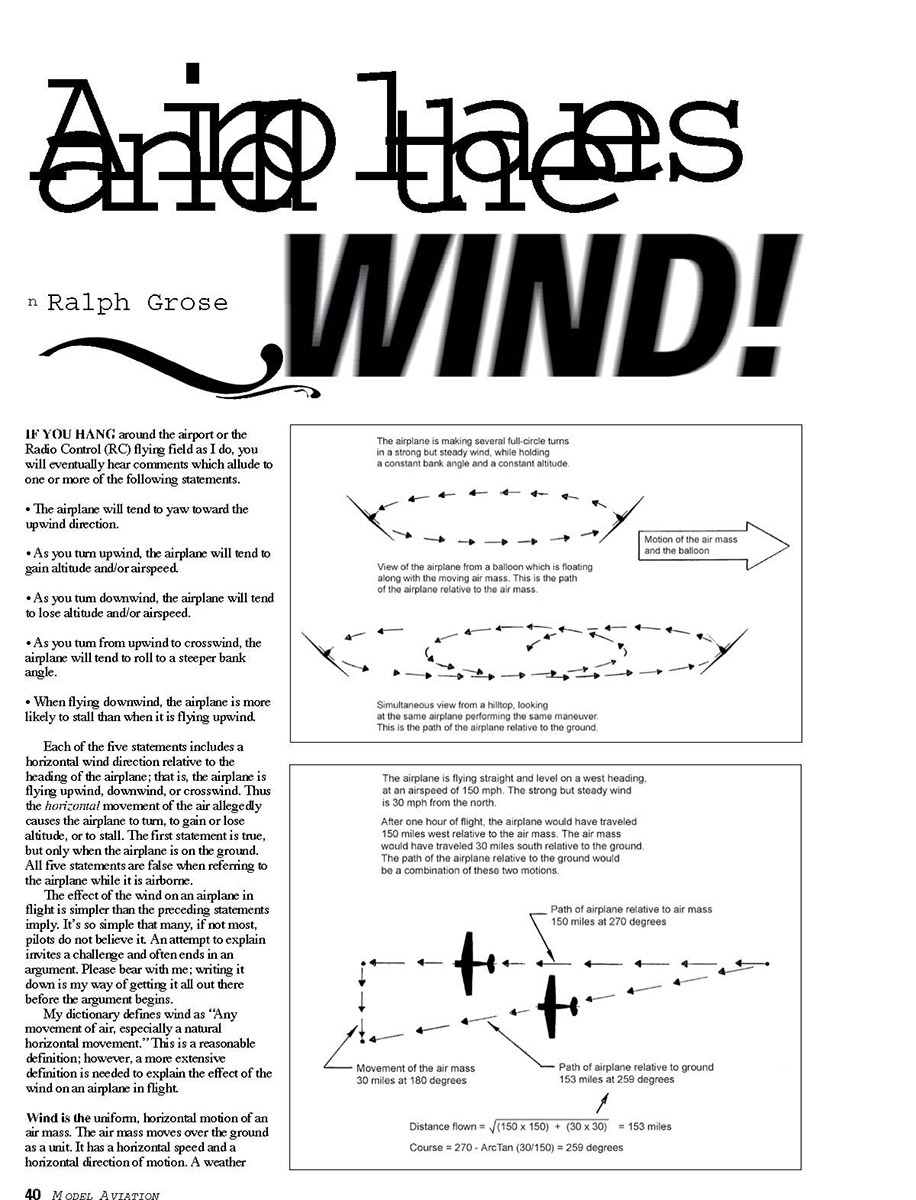
If the air mass is not moving relative to the ground (no wind), then while standing on the ground you could see and recognize the pattern. If the air mass is moving (wind), the pattern is not exactly the same relative to the air mass, but the view from the ground is distorted.
The airplane's pattern could be seen undistorted if you were in a balloon floating along with the air mass. If the airplane is making a normal 360° turn — that is, with a constant bank angle and holding a constant altitude — the airplane is making a perfect circle as seen in the air mass. If there was wind, you would not see it as a circle while viewing it from the ground.
However, if the airplane had smoke, the trail left would be seen as a circle, even when viewed from the ground. From the ground it could also be seen that the circle of smoke is drifting along with the airplane in the moving air mass.
Airplane performance values — top speed, cruising speed, maximum rate of climb, best glide ratio, minimum sinking speed in a glide, turn radius at a given bank angle, etc. — are given as motion relative to the air mass. The wind, as defined above without turbulence, no matter how strong it is, does not affect these performance characteristics. The wind only affects the pattern the airplane makes as seen on the ground.
If you are trying to make a specific path or pattern relative to the ground, on a typical day when the turbulence is not severe you can perform any maneuver you want relative to the air mass, using the controls the same as you would if you were flying in dead-calm air, except that you may have to make an occasional correction for turbulence.
The RC pilot is always flying at a relatively low altitude. Consequently, if the wind is blowing the pilot will have turbulence with which to contend. Turbulence can affect the maneuvers, but the direction and velocity of the wind, no matter how strong it is, cannot.
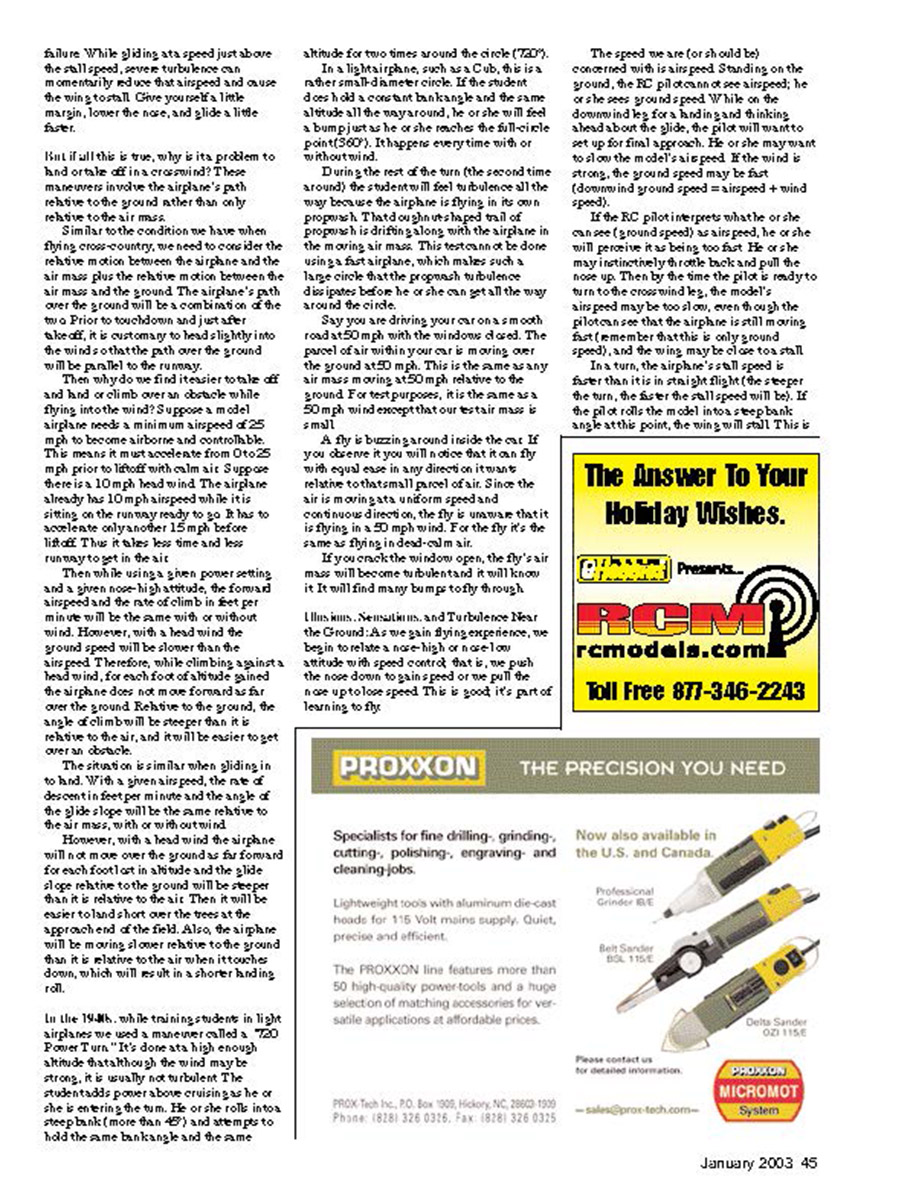
If you are trying to make a specific path or pattern relative to the ground, you will have to correct for wind drift. For conventional purposes, the correction consists of adjusting your heading slightly into the wind; it's called crabbing. The stronger the wind, the more adjustment you will need. After you find the heading that will get you to your destination, you would no longer have to hold a control off-center to correct for the wind.
The maneuvers performed in competition aerobatics are performed relative to the ground because the judges are on the ground. If you do a loop, the judge expects to see a loop that is round as seen from the ground, so the pattern must be made relative to the ground, and the contestant must constantly correct for wind drift.
If you are flying in severe turbulent air, be aware that it can cause structural damage, slow your cruising speed toward a structural limit, and make accurate control more difficult. While gliding at a speed just above the stall speed, severe turbulence can momentarily reduce that airspeed and cause the wing to stall. Give yourself a little margin, lower the nose, and glide a little faster.
Landing, takeoff, and low-altitude hazards
Why is it a problem to land or take off in a crosswind? These maneuvers involve the airplane's path relative to the ground rather than only relative to the air mass.
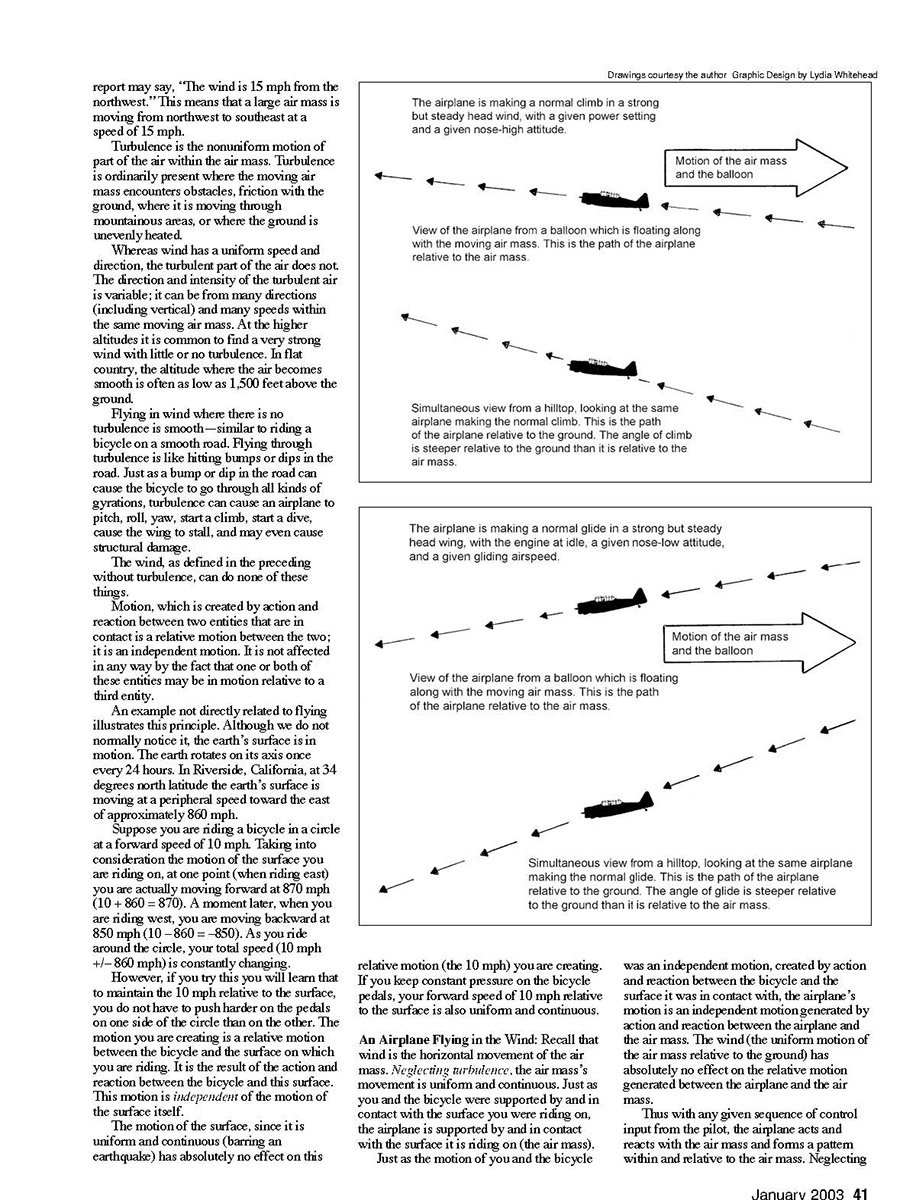
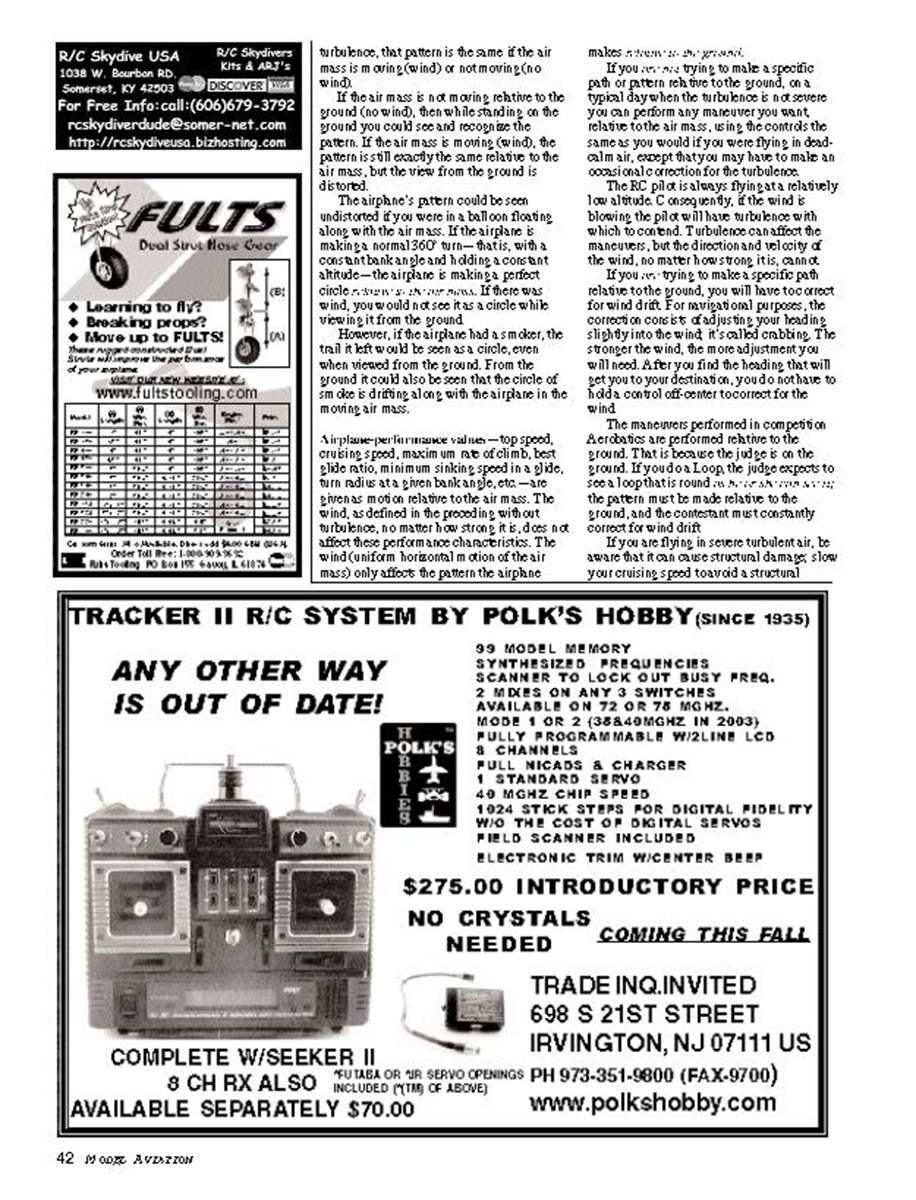
Similar to flying cross-country, we need to consider the relative motion between the airplane and the air mass plus the relative motion between the air mass and the ground. The airplane's path over the ground will be a combination of the two. Prior to touchdown and just after takeoff, it is customary to head slightly into the wind so that the path over the ground will be parallel to the runway.
With a given airspeed, the rate of descent in feet per minute and the angle of the glide slope will be the same relative to the air mass, with or without wind. However, with a headwind the airplane will not move over the ground as far forward for each foot lost in altitude and the glide slope relative to the ground will be steeper than it is relative to the air. Then it will be easier to land short or near the approach end of the field. Also, the airplane will be moving slower relative to the ground than it is relative to the air when it touches down, which will result in a shorter landing roll.
You may have heard that you should never make a downwind turn at low altitude. This is bad advice—especially for a novice flying a full-scale light airplane, but not for the reason it implies.
Say the pilot is flying a Cub at low altitude and headed upwind. If the wind is strong, the airplane will have a slow ground speed (upwind ground speed = airspeed − wind speed). Close to the ground there is a wind-velocity gradient because of friction with the ground; the air is moving slower near the ground than it is at 100 feet. This is a form of turbulence.
As the pilot banks and turns to the crosswind direction, the wing on the outside of the turn (the high wing) is in air that is moving faster than the wing on the inside of the turn (the low wing). This turbulence can cause the airplane to roll to a steeper bank angle. If the pilot did not expect this, he or she may not take action soon enough to prevent it.
Then, as the pilot is turning to the downwind direction, the ground speed increases rapidly (downwind ground speed = airspeed + wind speed). When the pilot sees the ground suddenly rushing by, he or she may interpret it as airspeed and may even get the feeling of diving. So the pilot may instinctively pull the nose up and stall the wing. If the pilot flies through that, he or she will probably believe the last three fallacies on my list.
Anecdotes and analogies
In the 1940s, while training students in light airplanes, we used a maneuver called a "720 Power Turn." It's done at a high enough altitude so that though the wind may be strong, it is usually not turbulent. The student adds power, banks steeply, and attempts to hold the same bank angle and the same altitude for two times around the circle (720°).
In a light airplane, such as a Cub, it can be a rather small-diameter circle. If the student does hold a constant bank angle and the same altitude all the way around, he or she will feel a bump just as he or she reaches the full-circle point (360°). It happens every time with or without wind.
During the rest of the turn (the second time around) the student will feel turbulence all the way because the airplane is flying in its own propwash. That outwash of the propwash is drifting along with the airplane in the moving air mass. This test can't be done using a fast airplane, which makes such a large circle that the propwash turbulence dissipates before he or she can get all the way around the circle.
Say you are driving your car on a smooth road at 50 mph with the windows closed. The passenger riding with you is moving over the ground at 50 mph. This is the same as an air mass moving at 50 mph relative to the ground for test purposes; it is the same as a 50 mph wind except that our test air mass is small.
A fly is buzzing around inside the car. If you observe it you will notice that it will dart with equal ease in any direction in the car relative to the small parcel of air. Since the car is moving at a uniform speed and continuous direction, the fly is unaware that it is flying in a 50 mph wind. For the fly it's the same as flying in calm air.
If you crack the window open, the fly's air mass will become turbulent and it will know it. It will find many bumps to fly through.
Illusions, sensations, and turbulence near the ground
As we gain flying experience, we begin to relate a nose-high or nose-low attitude with speed control; that is, we push the nose down to gain speed or we pull the nose up to lose speed. This is good as part of learning to fly.
The speed we are (or should be) concerned with is airspeed. Standing on the ground, the RC pilot can see ground speed; he or she sees how fast the model appears to be moving over the ground. While on the downwind leg for a landing and thinking ahead about the glide, the pilot will look to set up for final approach. He or she may want to slow the model's airspeed. If the wind is strong, the ground speed may be fast (downwind ground speed = airspeed + wind speed).
If the RC pilot interprets what he or she can see (ground speed) as airspeed, he or she will perceive it as being too fast. He or she may instinctively throttle back and pull the nose up. Then by the time the pilot is ready to turn to the crosswind leg, the model's airspeed may be too slow, even though the pilot sees that the airplane is still moving fast (remember that this is only ground speed), and the wing may be close to a stall. In a turn, the airplane's stall speed is higher than it is in straight flight (the greater the turn, the higher the stall speed). If the pilot rolls the model into a steep bank angle at this point, the wing will stall. This is particularly hazardous at low altitude.
If you fly gliders at the edge of a bluff, such as near the ocean where you have an onshore breeze, you may notice that sometimes the glider wants to turn away from the bluff. Since this is upwind, it may convince you that the first statement on my list of fallacies is true. As the air mass approaches the bluff, the air is compressed and moves up and over it. The air next to the bluff is compressed more and is moving up faster than the air a short distance away. This is a form of turbulence. When flying parallel and close to the bluff, the inland wing is in air that is moving up faster than the other wing. This causes a roll and resulting turn in a direction away from the bluff. The turn is caused by turbulence — not the horizontal movement of the air.
MA Ralph Grose 10071 Fox St. Riverside, CA 92503
Transcribed from original scans by AI. Minor OCR errors may remain.

