
AJ-2
Don Berliner
Introduction
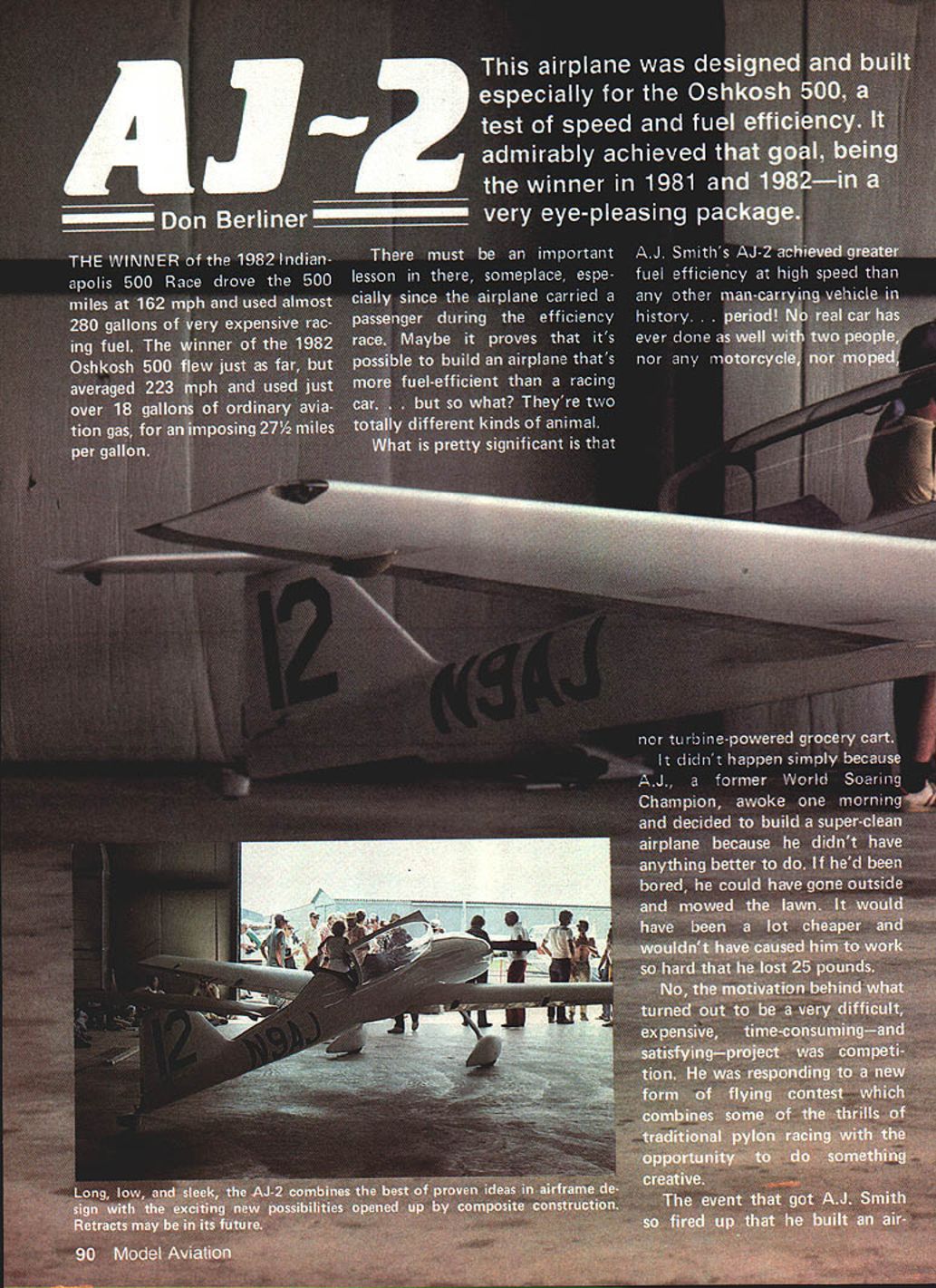
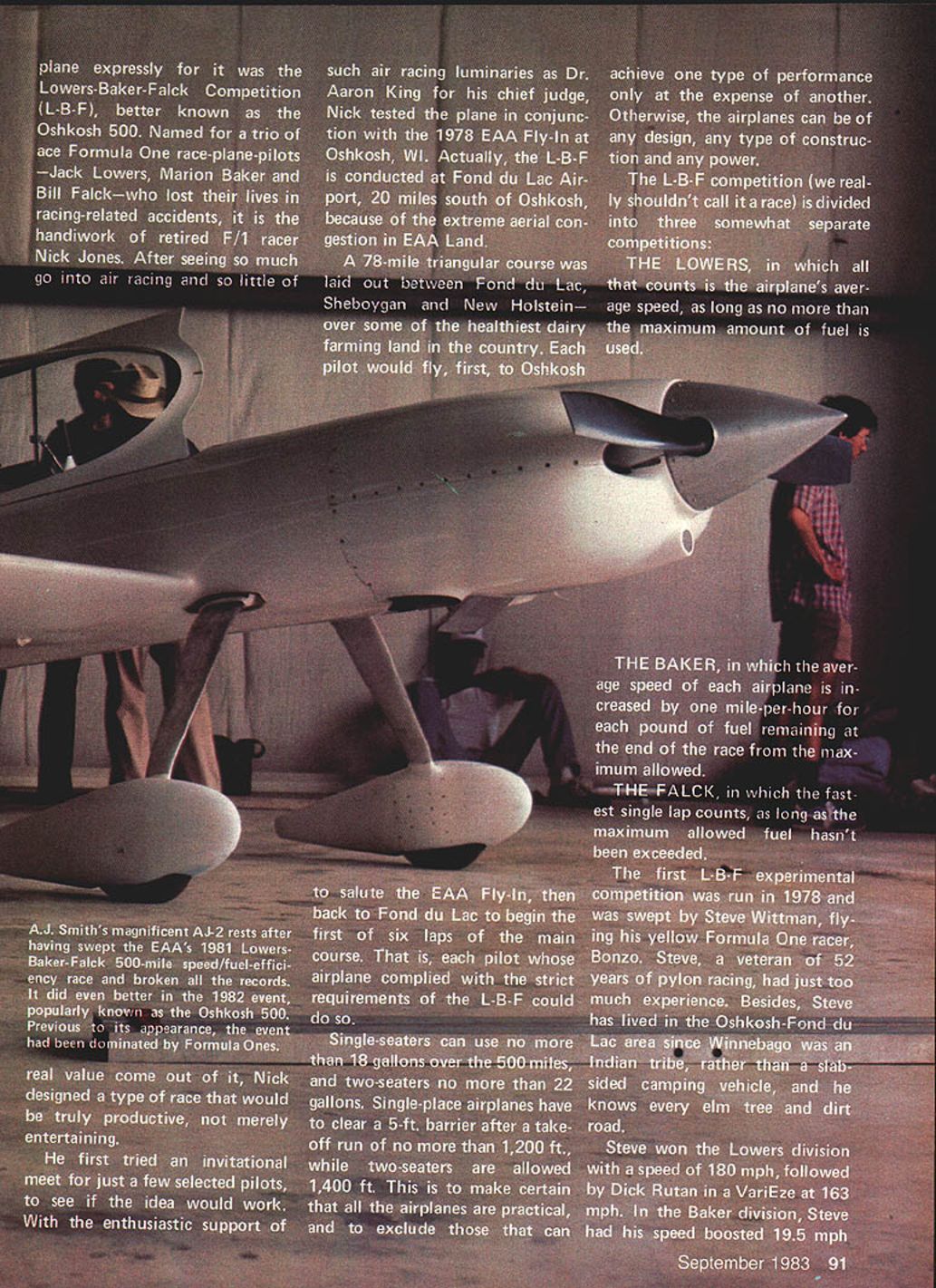
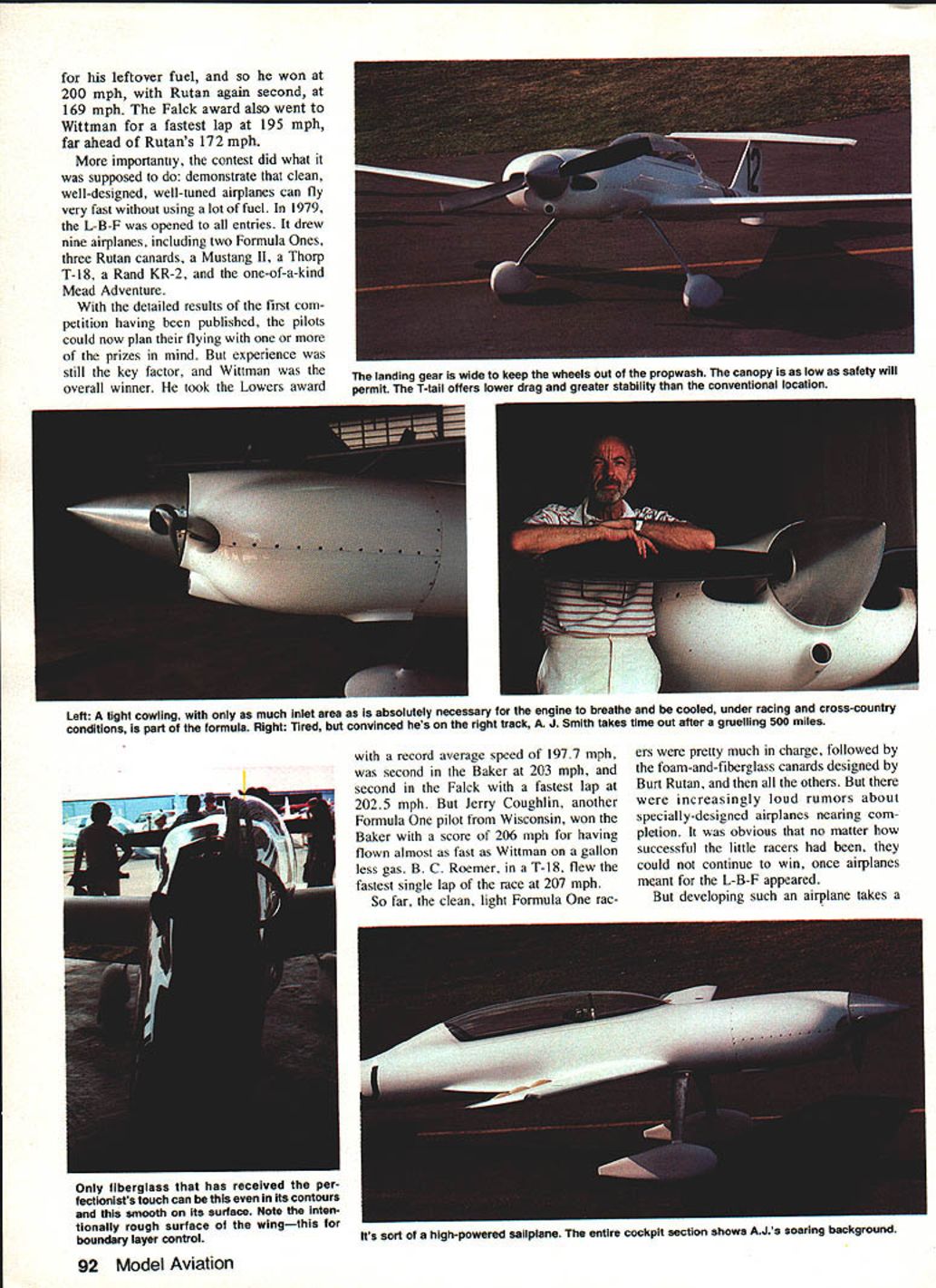
This airplane was designed and built especially for the Oshkosh 500, a test of speed and fuel efficiency. It admirably achieved that goal, being the winner in 1981 and 1982—in a very eye-pleasing package.
The winner of the 1982 Indianapolis 500 drove the 500 miles at 162 mph and used almost 280 gallons of very expensive racing fuel. The winner of the 1982 Oshkosh 500 flew just as far, but averaged 223 mph and used just over 18 gallons of ordinary aviation gas, for an imposing 27½ miles per gallon.
A. J. Smith’s AJ-2 achieved greater fuel efficiency at high speed than any other man-carrying vehicle in history. No real car has ever done as well with two people, nor any motorcycle, nor moped, nor turbine-powered grocery cart.
The motivation behind the AJ-2 was competition. A. J., a former World Soaring Champion, responded to a new form of flying contest that combines some of the thrills of traditional pylon racing with the opportunity to do something creative. The project was difficult, expensive, time-consuming—and ultimately satisfying.
The Oshkosh 500 (Lowers‑Baker‑Falck Competition)
The event that inspired Smith was the Lowers‑Baker‑Falck Competition (L‑B‑F), better known as the Oshkosh 500. Named for three Formula One race‑plane pilots—Jack Lowers, Marion Baker and Bill Falck—who lost their lives in racing accidents, the event was the handiwork of retired F/1 racer Nick Jones. Jones designed a type of race intended to be productive as well as entertaining.
The first trial was an invitational run in conjunction with the 1978 EAA Fly‑In at Oshkosh, WI. Because of aerial congestion at Oshkosh, the L‑B‑F is actually conducted at Fond du Lac Airport, 20 miles south of Oshkosh. A 78‑mile triangular course was laid out between Fond du Lac, Sheboygan and New Holstein. Each pilot first flew to Oshkosh to salute the EAA Fly‑In, then returned to Fond du Lac to begin the six laps of the main course.
Strict rules keep the competition practical and promote balanced designs:
- Single‑seat airplanes may use no more than 18 gallons over the 500 miles; two‑seat airplanes no more than 22 gallons.
- Single‑place airplanes must clear a 5‑ft. barrier after a takeoff run of no more than 1,200 ft.; two‑seaters are allowed 1,400 ft.
- Otherwise, airplanes can be of any design, construction, or power.
The L‑B‑F competition is divided into three separate contests:
- The Lowers — all that counts is average speed, provided the maximum fuel allowance is not exceeded.
- The Baker — the average speed is increased by 1 mph for each pound of fuel remaining from the maximum allowed.
- The Falck — the fastest single lap counts, provided the maximum allowed fuel hasn't been exceeded.
The first experimental competition in 1978 was swept by Steve Wittman in his Formula One racer Bonzo. Over the next few years the event grew more competitive and inventive, drawing an increasing variety of finely prepared aircraft.
Design and Construction of the AJ‑2
The AJ‑2 was designed by A. J. Smith and built by a crew of experienced EAAers headed by veteran designer/builder Leonard Niemi. Although collaborative, it was very much Smith’s project; he knew exactly what he wanted and how to get it.
There is nothing radical about the AJ‑2—rather, it is a beautiful combination of proven elements:
- A high‑aspect‑ratio wing for efficiency using a 12% thick NACA 64‑212 airfoil.
- A T‑tail for cleaner airflow, better stability and control, and reduced ground‑effect sensitivity.
- A long, low canopy similar to high‑performance sailplanes.
- Composite construction (fiberglass and aramid fabrics with epoxy resin) for high strength, low weight and exceptional finish.
Design work began in earnest in the summer of 1979. Construction drawings were started in the fall of 1979; building began two months later. The fuselage was built up from fiberglass sandwich bulkheads with foam filling the spaces between, then contoured and covered with glass and aramid fabrics and epoxy to produce a monocoque shell. A one‑piece wing was built similarly and plugged into a slot in the bottom of the fuselage. Most of the wing forward of the full‑span spar is a fuel tank, each side holding about 15 gallons. Flaps are electrically operated.
The landing gear is a single‑leaf aluminum‑spring type with snug‑fitting fiberglass wheel pants. The engine is a fuel‑injected, air‑cooled Lycoming IO‑360 rated by Smith at 215 hp after careful assembly and tuning. It turns a two‑bladed constant‑speed propeller.
Construction took about 20 months, the last three of which involved extremely intensive work. The AJ‑2 was rolled out and flown on July 15, 1981.
Racing Results
When Smith brought the AJ‑2 to Fond du Lac for the 1981 Oshkosh 500, it created a sensation. The airplane had been designed and built to win the 500; no major compromises were made to suit other types of racing or touring. On the ramp it looked like a winner, but results are decided in the air.
At the start of the race Smith kept to his game plan, managing power and turns to conserve fuel and maximize speed. His technique included starting turns far out and reaching a steep bank at the pylon, then leveling gradually to lose as little speed as possible. Even so, he lost about 10 mph at each turn and took nearly 10 miles to regain top speed.
Smith finished the 500 miles in 2:17:39, averaging 217.944 mph. Post‑race calculations showed he had used only 19.2 of the permitted 22 gallons, producing a Baker adjusted speed of 234.94 mph. His fastest lap was his first, at 221.8 mph. All were records and well ahead of the competition.
In 1982 Smith further dominated the event, setting new records in all three divisions: 223.2 mph actual speed in the Lowers, 246.2 mph adjusted speed in the Baker, and a 233.2 mph lap in the Falck. Never before had one pilot in one airplane so thoroughly dominated the competition.
World Speed Record Attempts
The day after the 1982 Oshkosh 500, Smith attempted the FAI Class C.1.b. world speed record for a 500‑kilometer closed circuit (piston‑engined airplanes weighing between 1,102 and 2,204 pounds at takeoff). He flew the Oshkosh 500 course for more than four laps at an average of 238.5 mph, topping the old record of 206.7 mph set in 1965 by Gerry Mock.
After waiting for better weather, Smith made a second attempt on August 6 in clear, cool conditions. He completed the run in an hour and 20 minutes with an average speed of 253.3 mph, establishing a new world speed record for the class.
In barely more than a year since its first flight, the AJ‑2 had won two Oshkosh 500s and boosted a World Speed Record by more than 20 percent.
Legacy and Potential Developments
The AJ‑2 is a long‑distance, efficiency racer designed to combine outstanding speed and economy. It was not intended for freight, Reno pylon racing, or short‑field ops—but in its own arena it outperformed all others.
A. J. Smith made no claims that the AJ‑2 had reached its development limit. Potential future modifications could include a new wing and retractable landing gear, which might increase speed and efficiency further. Even without modifications, the AJ‑2 made a name for itself and showcased the capabilities of a soaring pilot knowledgeable about powered aircraft.
Specifications
Aircraft
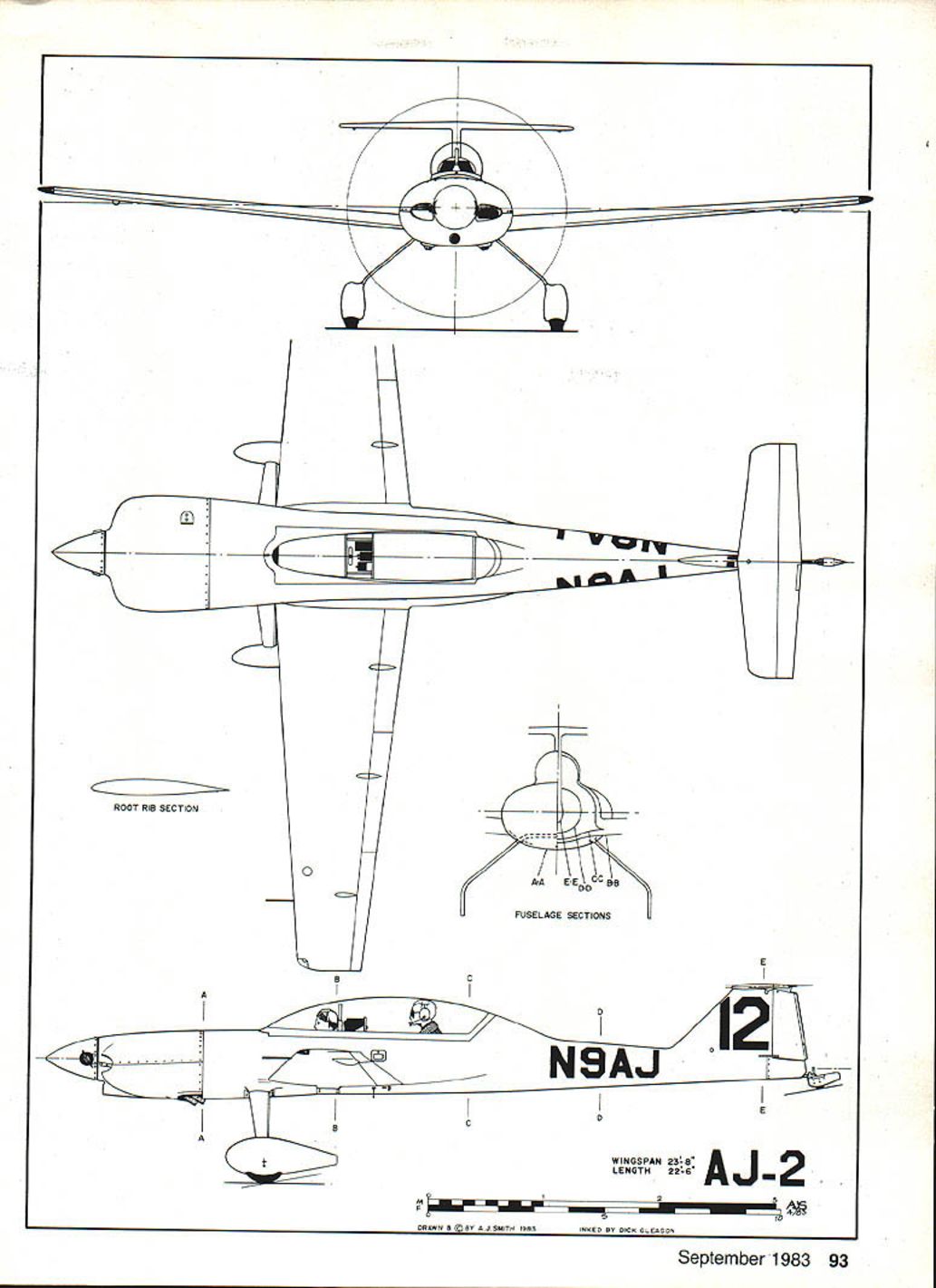
- Wingspan: 23 ft 8 in (variously reported; commonly cited as about 23 ft)
- Length: 22 ft 6 in
- Wing area: 44 sq ft (as cited)
- Airfoil: NACA 64‑212, 12% thickness
- Engine: Lycoming IO‑360, tuned to about 215 hp (fuel‑injected, air‑cooled)
- Propeller: Two‑bladed constant‑speed
- Fuel capacity: Wing tanks approximately 15 gallons per side (total in wing tank area)
- Configuration: T‑tail, low‑wing monoplane, composite construction
Racing achievements
- 1981 Oshkosh 500: 217.944 mph actual, 234.94 mph Baker adjusted; fastest lap 221.8 mph
- 1982 Oshkosh 500: 223.2 mph Lowers; 246.2 mph Baker adjusted; 233.2 mph Falck lap
- FAI Class C.1.b. 500 km closed‑circuit record: 253.3 mph (August 6, 1982)
Model Kit
Sketched by Dick Gleason
The AJ‑2 model kit has molded rigid urethane foam parts and a white epoxy gelcoat surface that picks up a great amount of detail. Fuselage, wings, aileron, fin, rudder, stabilizer, elevator and cowl are molded ready. Assembly, installation of equipment, painting and hardware, including scale wheels and struts, are extras.
- Suggested list: $285
- Factory direct: $228
Send SASE for brochure to: Great Lakes Model & Mold P.O. Box 308 Tawas City, MI 48763
Illustration and drawing credits:
- Sketched by Dick Gleason
- Drawn and (c) by A. J. Smith 1983; inked by Dick Gleason
Transcribed from original scans by AI. Minor OCR errors may remain.

