
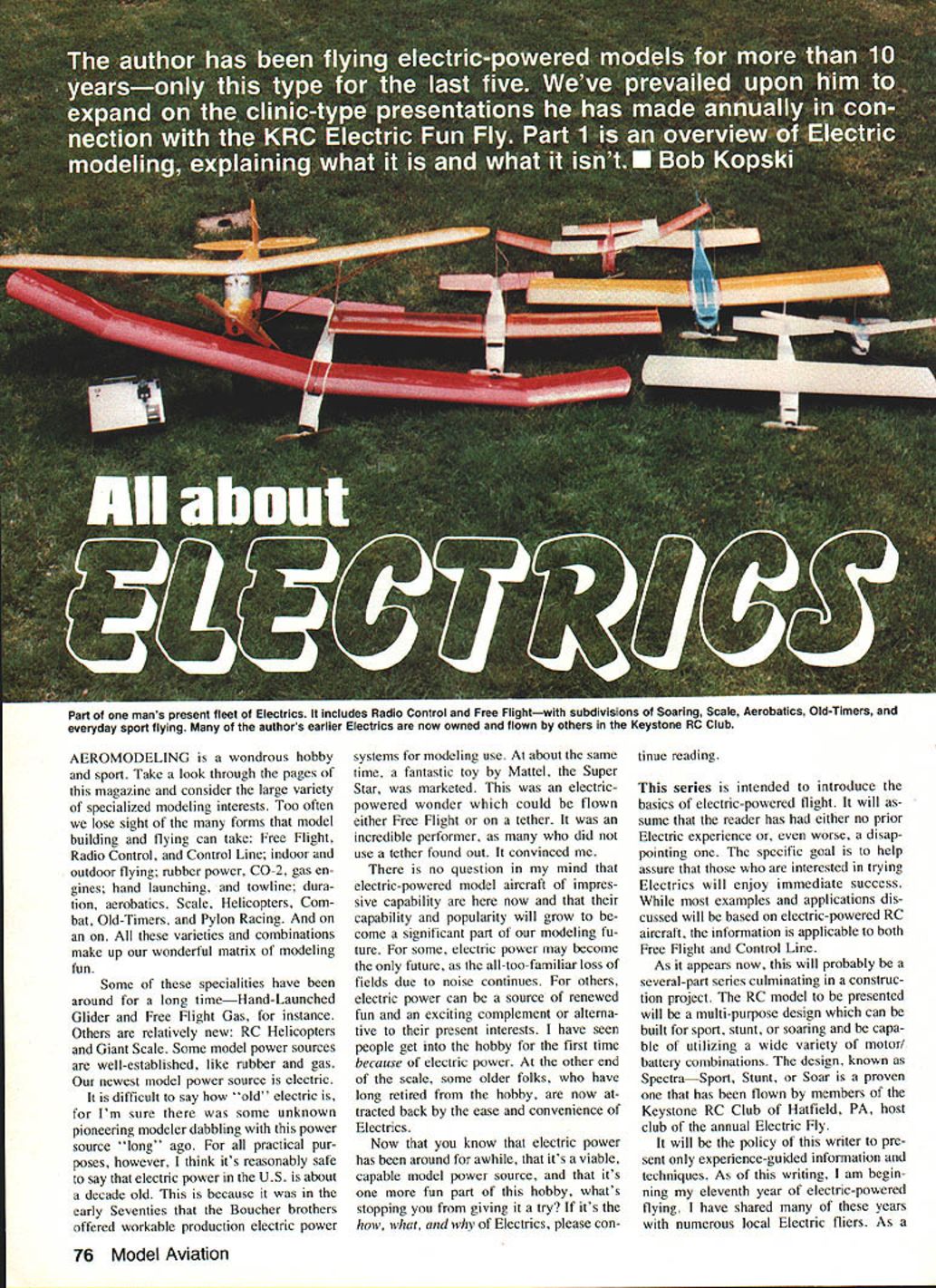
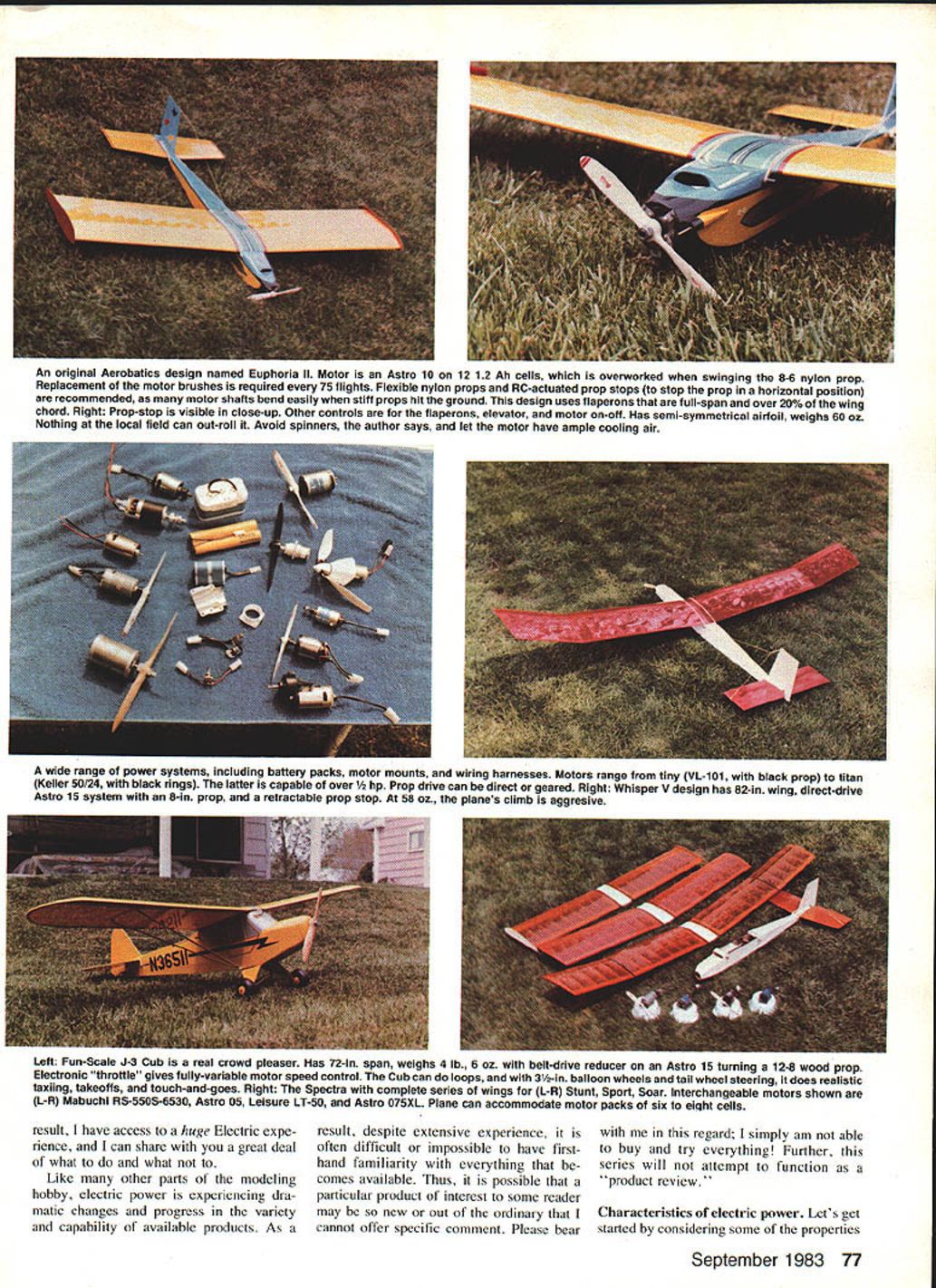
All about Electrics
Aeromodeling is a wondrous hobby and sport. Take a look through the pages of this magazine and consider the large variety of specialized modeling interests. Too often we lose sight of the many forms that model building and flying can take: Free Flight, Radio Control, and Control Line; indoor and outdoor flying; rubber power, CO-2, gas engines; hand launching and towline; duration, aerobatics, Scale, Helicopters, Combat, Old-Timers, and Pylon Racing. And on and on. All these varieties and combinations make up our wonderful matrix of modeling fun.
Some of these specialties have been around for a long time—Hand-Launched Glider and Free Flight Gas, for instance. Others are relatively new: RC Helicopters and Giant Scale. Some model power sources are well-established, like rubber and gas. Our newest model power source is electric.
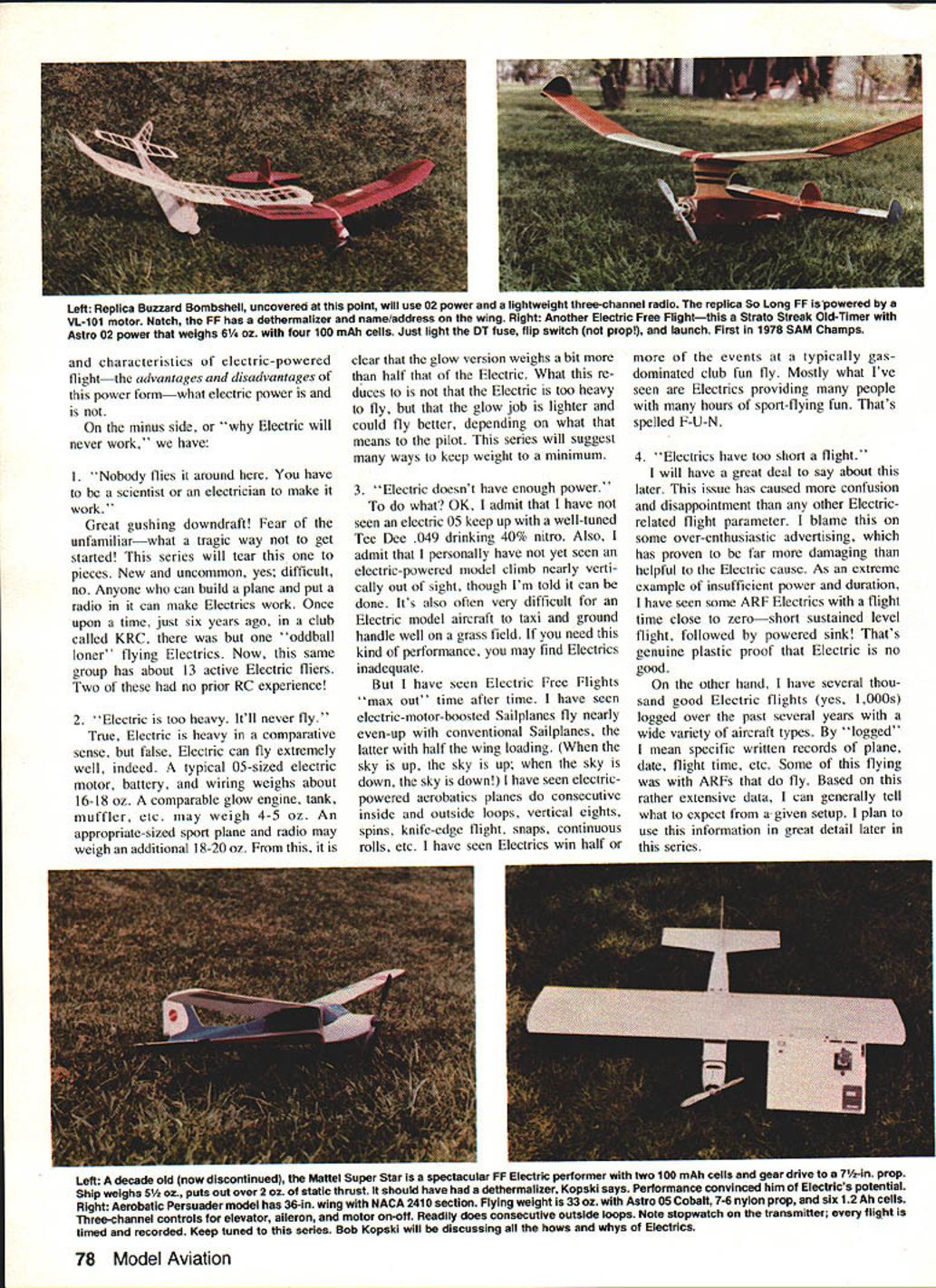
It is difficult to say how "old" electric is, for I'm sure there was some unknown pioneering modeler dabbling with this power source long ago. For all practical purposes, however, it's reasonably safe to say that electric power in the U.S. is about a decade old. This is because it was in the early seventies that the Boucher brothers offered workable production electric power systems for modeling use. At about the same time, a fantastic toy by Mattel, the Super Star, was marketed. This was an electric-powered wonder which could be flown either Free Flight or on a tether. It was an incredible performer, as many who did not use a tether found out. It convinced me.
There is no question in my mind that electric-powered model aircraft of impressive capability are here now and that their capability and popularity will grow to become a significant part of our modeling future. For some, electric power may become the only future, as the all-too-familiar loss of fields due to noise continues. For others, electric power can be a source of renewed fun and an exciting complement or alternative to their present interests. I have seen people get into the hobby for the first time because of electric power. At the other end of the scale, some older folks, who have long retired from the hobby, are now attracted back by the ease and convenience of electrics.
Now that you know that electric power has been around for a while, that it's a viable, capable model power source, and that it's one more fun part of this hobby, what's stopping you from giving it a try? If it's the how, what, and why of electrics, please continue reading.
This series is intended to introduce the basics of electric-powered flight. It will assume that the reader has had either no prior electric experience or, even worse, a disappointing one. The specific goal is to help assure that those who are interested in trying electrics will enjoy immediate success. While most examples and applications discussed will be based on electric-powered RC aircraft, the information is applicable to both Free Flight and Control Line.
As it appears now, this will probably be a several-part series culminating in a construction project. The RC model to be presented will be a multi-purpose design which can be built for sport, stunt, or soaring and be capable of utilizing a wide variety of motor/battery combinations. The design, known as Spectra—Sport, Stunt, or Soar—is a proven one that has been flown by members of the Keystone RC Club of Hatfield, PA, host club of the annual Electric Fly.
It will be the policy of this writer to present only experience-guided information and techniques. As of this writing, I am beginning my eleventh year of electric-powered flying. I have shared many of these years with numerous local electric fliers. As a result, I have access to a huge body of electric experience, and I can share with you a great deal of what to do and what not to do.
Like many other parts of the modeling hobby, electric power is experiencing dramatic changes and progress in the variety and capability of available products. As a result, despite extensive experience, it is often difficult or impossible to have first-hand familiarity with everything that becomes available. Thus, it is possible that a particular product of interest to some reader may be so new or out of the ordinary that I cannot offer specific comment. Please bear with me in this regard; I simply am not able to buy and try everything! Further, this series will not attempt to function as a "product review."
Characteristics of electric power
Let's get started by considering some of the properties and characteristics of electric-powered flight—the advantages and disadvantages of this power form—what electric power is and is not.
On the minus side
- "Nobody flies it around here. You have to be a scientist or an electrician to make it work."
- Fear of the unfamiliar—what a tragic way not to get started! This series will tear this one to pieces. New and uncommon, yes; difficult, no. Anyone who can build a plane and put a radio in it can make electrics work. Once upon a time, just six years ago in a club called KRC, there was but one "oddball loner" flying electrics. Now, this same group has about 13 active electric fliers. Two of these had no prior RC experience!
- "Electric is too heavy. It'll never fly."
- Electric is heavy in a comparative sense, but that does not mean it won't fly. A typical .05-sized electric motor, battery, and wiring weighs about 16–18 oz. A comparable glow engine, tank, muffler, etc., may weigh 4–5 oz. An appropriate-sized sport plane and radio may weigh an additional 18–20 oz. From this, it is clear that the glow version is a bit lighter overall. What this reduces to is not that the electric is too heavy to fly, but that the glow job is lighter and could fly differently, depending on what that means to the pilot. This series will suggest many ways to keep weight to a minimum.
- "Electric doesn't have enough power."
- To do what? I admit that I have not seen a .05 electric keep up with a well-tuned Tee Dee .049 drinking 40% nitro. Also, I personally have not yet seen an electric-powered model climb nearly vertically out of sight, though I'm told it can be done. It's often difficult for an electric model to taxi and ground-handle well on a grass field. If you need that kind of performance, you may find electrics inadequate.
- But I have seen electric Free Flights "max out" time after time. I have seen electric-motor-boosted sailplanes fly nearly even with conventional sailplanes, the latter with half the wing loading. (When the sky is up, the sky is up; when the sky is down, the sky is down!) I have seen electric-powered aerobatics planes do consecutive inside and outside loops, vertical eights, spins, knife-edge flight, snaps, continuous rolls, etc. I have seen electrics win half or more of the events at a typically gas-dominated club fun fly. Mostly what I've seen are electrics providing many people with many hours of sport-flying fun. That's spelled F-U-N.
- "Electrics have too short a flight."
- This issue has caused more confusion and disappointment than any other electric-related flight parameter. I blame this on some over-enthusiastic advertising, which has proven to be far more damaging than helpful to the electric cause. As an extreme example of insufficient power and duration, I have seen some ARF electrics with a flight time close to zero—short sustained level flight, followed by powered sink! That's genuine plastic proof that electric is no good.
- On the other hand, I have several thousand good electric flights (yes, thousands) logged over the past several years with a wide variety of aircraft types. By "logged" I mean specific written records of plane, date, flight time, etc. Some of this flying was with ARFs that do fly. Based on this rather extensive data, I can generally tell what to expect from a given setup. I plan to use this information in great detail later in this series.
- This is my 28th year of RC. Five years ago, I sold all of my gas stuff because I found I was flying electrics more and enjoying gas less. Since then, I've done more flying than ever before. True, you can always double the fuel tank size and keep a gas engine running longer, and there's no equivalent trick easily done with electrics. However, when done right, there's nothing inadequate or unsatisfying about today's electric flight times.
- "Electric is hard to understand. What do I do and how do I do it? I have no one to help me."
- Read on! Model Aviation and I will do our very best to answer this one.
Advantages and opportunities
- Electric is a challenging "new" kind of modeling fun.
- Fun is what the hobby is all about, and modelers are renowned for taking up a challenge.
- Electric power is applicable over a very broad range of model flying categories.
- Offhand, I can't think of any gas-powered category that could not have an electric equivalent. Thus, no matter what your favorite modeling specialty, if it's gas-powered, an electric-powered version is probably possible.
- Electric can create new categories.
- For example, sailplane enthusiasts are generally purists; they want nothing to do with onboard power. But there are times when hauling the winch out or untangling a hi-start is unappealing. A sleekly-cowled, quietly-geared electric motor turning a folding-blade propeller that blends with the fuselage contours is one solution. This is not entirely new—it's called F3E electric soaring, an event in the FAI section of the AMA rule book. F3E does not yet have a strong foothold in the U.S., so there is opportunity here for competitive types.
- Electric is very convenient.
- Often, I find there is only time and opportunity available for a flight or two. These are the times when it will be dark in an hour, and cleaning the greases off your favorite neighbor-irritator just isn't worth the bother. No bother with electrics! Just toss it in the car, charge along the way to the nearest field, and fly. You don't even need a field box! Then, while you're quietly recharging, you can talk in a very loud voice over the flight line roar to your buddies. Now take another flight, and then pack it in, while everyone else is tearing up paper towels and swabbing gobs of icky goo off of drippy gassers.
- Electric is quiet.
- There's no argument to this one. It's very sad but true that many modeling groups are finding it harder and harder to keep fields. There are several reasons, but more often than not it's because of noise. People don't like noise, and often they choose to make it a neighborhood cause célèbre. Electric can be a savior here.
- I have had an interesting personal experience. Prior to the mid-1960s no one in my club had used mufflers. Then one day there was a "casual" complaint. Then harsh words. Then a petition, etc., etc. Fortunately, we saved the field by adopting a mandatory muffler rule, backed up with a sound level meter, etc.
- After an extended period of flying with mufflers, I had occasion to visit another field where mufflers were not used. I personally found the higher noise level very irritating, for I had become accustomed to muffled engines! More recently, when only electrics are on the field for part of the day and then a gas job is brought out, I find the lost peace from the noise very discomforting.
- Electric makes you a better model builder.
- An electric power installation is heavier than a comparable glow one. I have learned many ways to build stronger, lighter structures to help accommodate these extra ounces. I will discuss these as we continue this series. Some ideas may even help make better gas jobs!
- Electric makes you a better model flier.
- Since there are, relatively speaking, the realities of higher weight and lower power with electrics, you cannot always "horse" your plane off the ground or through a maneuver. You have to do more flying and less guiding of a power plant. A wing is a wonderful thing; many have forgotten (or never knew) how to really fly with one, because it's easy to fix everything with more throttle. I've seen good, experienced pilots with their first electric—pulling back hard on the elevator stick only to have the plane tumble to the ground. What they got was a simple stall without the familiar power reserve to pull them through. But take the same plane and ease in a little up. Presto! The wing does its thing (lift), and the plane goes up smoothly and steadily.
- Electrics can open up new flying fields.
- This point goes beyond the earlier discussion of keeping the one you have. I've had the personal experience of lunchtime flying on the property of my employer. Other than some lunchtime strollers, no one knew I was there. I did not attract any significant attention because no one heard me flying.
- You can run the motor in the house at midnight and probably survive the incident long enough to do it again and again.
- This is a big help in getting a new ship ready for a Saturday or Sunday morning flying session.
- Electric is absolutely clean.
- Consider flying your .60-powered Pattern ship in a new suit, and note your feelings. Now, mentally convert that picture to an electric one, same suit. See? No problem. Electrons and ozone don't leave stains.
- Multi-motor aircraft are very easy with electrics.
- Electric motors are usually well-matched in performance characteristics. When powered from the same battery, several motors will run, and run down, at the same rate. No chance of losing one side! This is great for Scale. Some local fliers have several twins and quads that are operational.
- Electric motors can be fully controlled in flight.
- This can be done in an on-off fashion, with power steps in-between, or with fully-variable speed control from zero to maximum. Try that with gas!
- Electric power is virtually vibration-free.
- This often allows a simple radio installation, as less foam packing and shock mounting is needed. Many of my installations are nearly rigid—receivers, servos, etc. are squeezed in tightly. More on this as we go along.
- Electric is simply perfect! Wrong!
- Like everything else in life, electrics have both limitations of capability and requirements for proper handling. Example: just as any conscientious modeler should be careful not to allow his gas engine to overheat, so also should such a modeler pay close attention to battery heat. This series will attempt to be thorough, honest, and realistic, and include "everything you didn't know you needed to know" about electrics.
I realize that some of the writing above makes redundant points. My purpose is not to fill pages with the same words, but rather to express a range of thoughts in several ways to give you, the reader, variety in viewpoint and perspective.
Next installment and contact
The next installment in this series will get into the electric power systems—motors, batteries, and some other electric goodies. Later, we'll get into installations, suitable planes, and more. Till then, just ponder the possibilities!
Any questions related to this part of the series may be directed (with SASE) to the author:
Bob Kopski 25 West End Dr. Lansdale, PA 19446
Please resist the temptation to jump ahead. I have yet to write all of the series, and I'm unable to handle letters which require a book's worth of writing to answer properly. Otherwise, I will attempt to respond in an expedient fashion.
Transcribed from original scans by AI. Minor OCR errors may remain.

