
All about Electrics
By Bob Kopski Part 4
Nickel-cadmium (Ni-Cd) batteries are a necessary part of most electric flight systems (yes, a few have used solar cells experimentally). Being perhaps the most expensive part of your flight system, you'll want to know how to use Ni-Cds to best advantage and how to take care of them. The following is experience-guided information and techniques based on many years of flying electrics.
1. Kinds of batteries
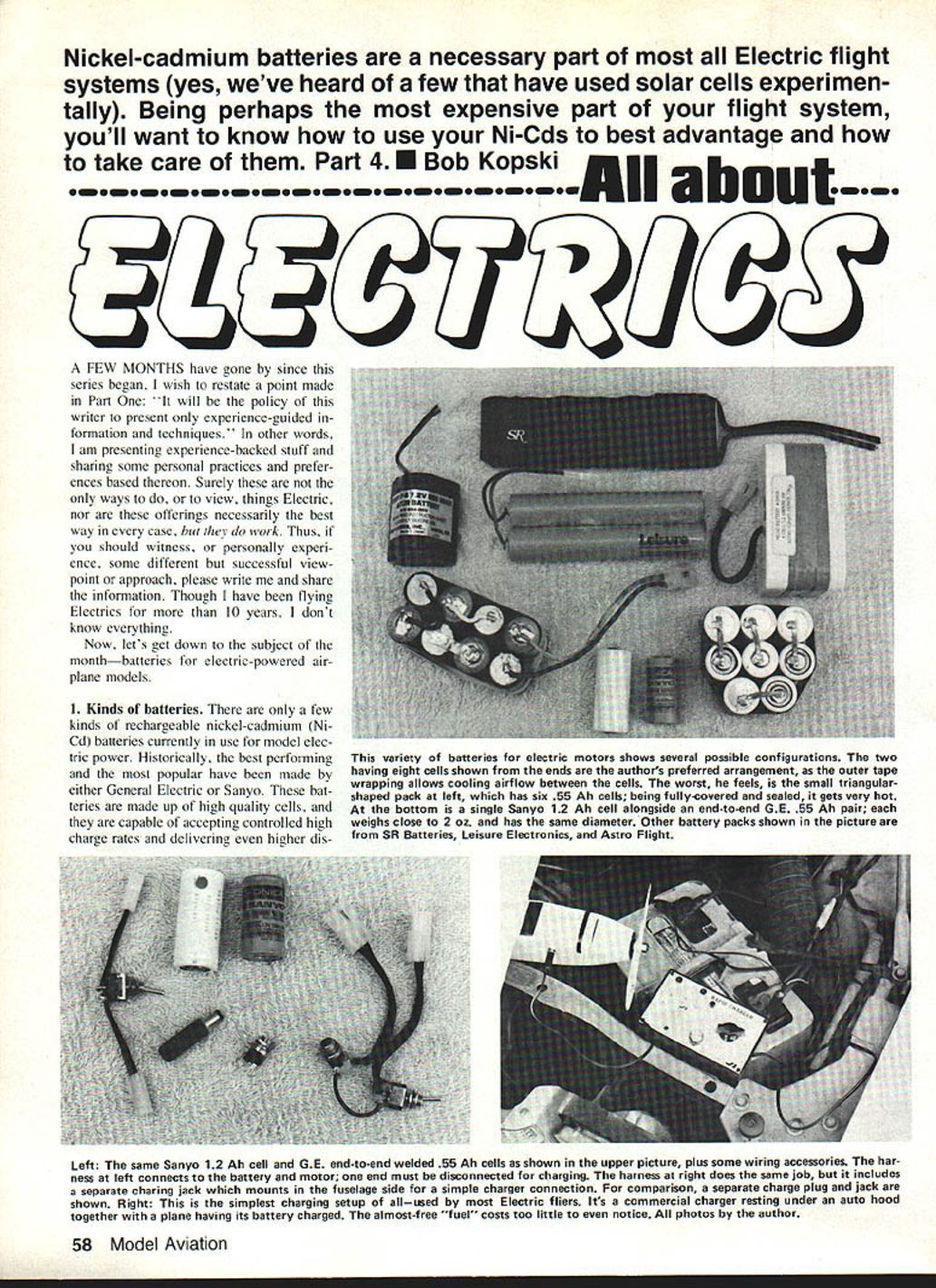
- Only a few kinds of rechargeable Ni-Cd batteries are commonly used for model electric power.
- Historically, the best performing and most popular have been made by General Electric (G.E.) and Sanyo.
- Sanyo yellow-cased cells are increasingly popular. Sanyo also makes a red-label variety that can deliver higher discharge currents but has somewhat reduced capacity per cell; these are popular in Europe.
- Recently SR Batteries introduced electric-power packs; the cell manufacturer is unknown.
- Economy or low-cost cells often deliver reduced performance, have higher failure rates, and create maintenance problems. Recommendation: stay with proven quality products.
2. Battery size and power
Ni-Cd cell basics:
- Nominal cell voltage: 1.2 volts (independent of cell size).
- Cells are always wired in series to form a battery; voltages add.
- Common cell capacities range roughly from 550 mAh to 2 Ah.
- A battery's ampere-hour (Ah) capacity equals the Ah rating of the individual cells (do not mix cell sizes).
Voltage, current, and power:
- Power (watts) = voltage × current.
- Watt-hours (energy available) = nominal voltage × delivered current × time.
- Example: a six-cell pack of 1.2 Ah cells has nominal voltage 7.2 V and can deliver 1.2 A for 1 hour or 12 A for 1/10 hour (6 minutes). Watt-hours = 7.2 V × 1.2 A × 1 h = 8.64 Wh.
Real-world performance:
- Under heavy loads, internal resistance lowers terminal voltage; under high loads the per-cell terminal voltage can drop to about 1.0–1.1 V.
- Ampere-hour capacity also falls short of label values at high discharge rates because ratings are often given at low drain rates.
- From experience, terminal voltage averages a little over 1.0 V per cell under normal motor loads, and usable capacity is typically 85–90% of label value at about a 10 A load.
- Using the 6-cell, 1.2 Ah example above, usable energy might be ≈ 6.12 Wh (instead of 8.64 Wh) under realistic load conditions.
Example application:
- If a motor/prop draws 48 W (e.g., 7.95 A at ~6 V for a 7×6 prop at 8,000 rpm), a pack with usable 6.12 Wh would run it for about 6.12 / 48 ≈ 0.127 hours ≈ 7.6 minutes on a full charge.
Practical note:
- Batteries can be assembled with different numbers of cells and cell sizes to match motor requirements and desired flight times (fewer larger cells or more smaller cells can achieve similar results).
3. Battery configuration
- Cells are cylindrical and can be arranged end-to-end, side-by-side, or in combinations to form different pack shapes.
- Common pack shapes: rectangular (preferred by the author) or flat-pack; both have pros and cons.
- Cell connections are either welded or made with soldered wires/braids. Lead-out wires are typically 18-gauge or heavier.
- Many packs come with plastic wrap or shrink covering; the author removes outer coverings to allow better air contact for cooling.
- Individual cells usually have thin insulating sleeves. Packs can be held together with plastic tape, a few drops of CyA adhesive, and outer glass-cloth tape.
- If soldering, take care to avoid overheating the cells. Provide mechanical support and strain relief for lead-out wires to prevent fatigue failures.
4. Preferred battery charging techniques
Charging is one of the most important aspects of electric flight systems. The following are practical, experience-based charging techniques.
Safe charge (author's usual method)
- Charge a discharged battery with a conservative, known number of ampere-hours—somewhat less than the absolute maximum—but sufficient for satisfactory flight.
- Example (1.2 Ah cells): capacity = 1.2 Ah = 72 ampere-minutes. With popular 15-minute timers, label-capacity charging would be 72 / 15 = 4.8 A. The author charges at about 4.2 A for 15 minutes = 63 ampere-minutes = 1.05 Ah. This gives reliable performance without overcharging.
- For 550 mAh (0.55 Ah) cells: label capacity = 33 ampere-minutes. Label-capacity charge in 15 min would be 2.2 A; the author charges at ≈1.9 A for ≈29 ampere-minutes (≈0.48 Ah).
- Current-adjustable chargers are recommended because the current can be set and maintained reasonably well over the charge period.
- This method is convenient and safe for sport fliers and yields hundreds of good flights with proper care.
Digital (top-off) charge
- Used occasionally to safely put the maximum possible charge into a battery.
- Charge at a constant current while monitoring cell voltage with an accurate voltmeter. Terminal voltage rises during charge, then levels off and shows a slight drop at full charge—this is the cue to stop charging.
- For 1.2 Ah cells charged at about a 4 A rate, topping off typically takes about 18–22 minutes.
- This method requires attention and suitable instrumentation; it's useful for demonstrations or when you want every last bit of capacity safely.
Partial (quick) charge
- If short on time, a short charge (e.g., 5 minutes) can give enough extra energy for a final flight. Undercharging is acceptable; it’s better to fly than not.
5. Other battery charging techniques
Voltage-charge method (car-battery charging)
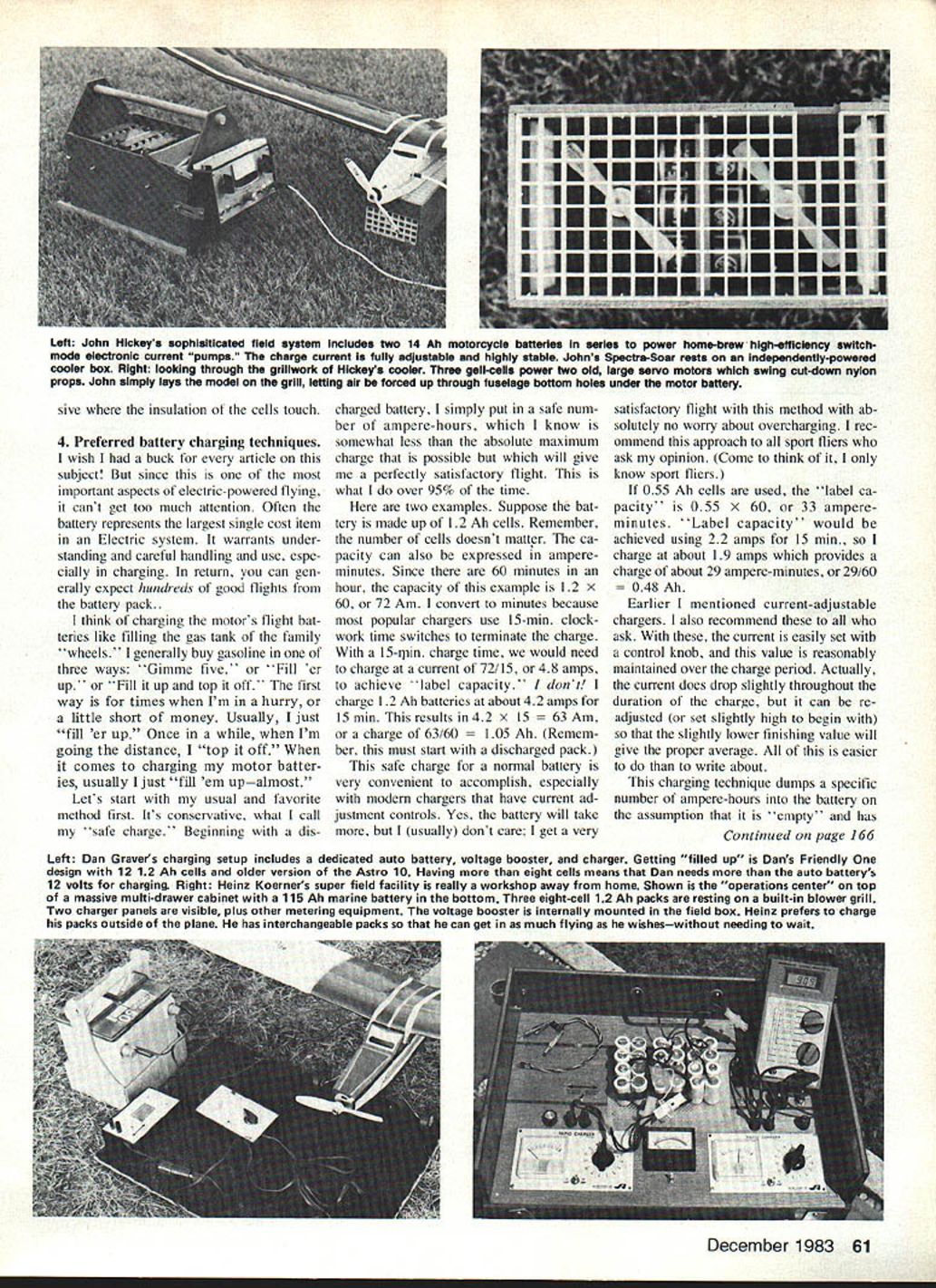
- An older, still-common field technique connects the pack to a 12 V car battery (often via a simple charger with a meter and timer).
- As a pack approaches full charge, per-cell voltage rises (1.50–1.55 V per cell); an 8-cell pack reaches ~12.0–12.4 V. The method uses this characteristic for charging.
- Initial currents can be high (greater than 6 A for 0.55 Ah packs, near 10 A for 1.2 Ah packs), and current falls off as the pack charges.
- Advantages: simple, self-limiting for partly charged packs, and adaptable to pack sizes that match the car battery voltage.
- Disadvantages: pack must have the "right" number of cells for a 12 V source; source battery condition matters; do not charge with the engine running because alternator output may overcharge the pack.
Overnight (trickle) charge
- Classic RC technique: 0.55 Ah cells at ~50–60 mA, 1.2 Ah cells at ~120 mA for 14–16 hours.
- This is safe and useful for long-term storage or conditioning new packs but may yield slightly different performance than rapid-charge methods.
- Overnight charging equalizes cells in a pack, which can be useful if cells have become unbalanced from storage or differential self-discharge.
- Fast-charging should start with a discharged pack; if a pack has been stored with a stale charge, an overnight full charge equalizes the cells before fast-charging.
Practical charging practice:
- The author charges only when going to fly. He does not store planes with batteries charged—this avoids accidental double-charging and helps prevent cell imbalance.
- Some users observe that the first charge of the day yields slightly worse performance than the second charge (noted with some G.E. cells).
6. Precautions
- Heat is the enemy of Ni-Cd cells. Do not charge or fly when cells are hot.
- A practical test: touch the cell ends lightly. If any cell feels uncomfortably hot (roughly approaching 140°F / 60°C), let the pack cool. All cells in a pack should be roughly the same temperature; a single unusually hot cell usually indicates a problem.
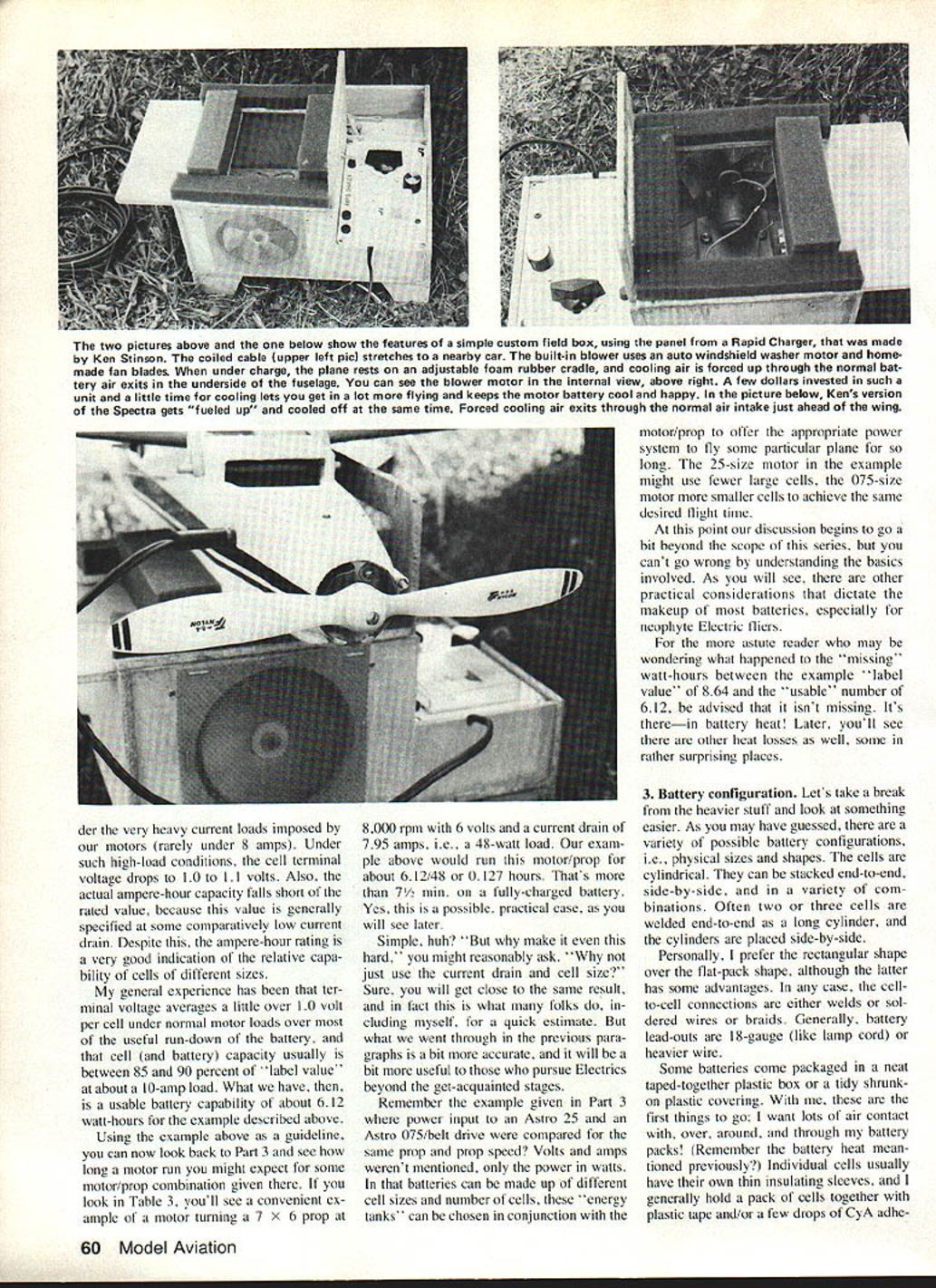
- Cooling techniques: remove the pack from the model to cool, force air with a small blower while the plane is on the ground, or (in the field) place the pack in a cooler temporarily.
- To avoid overheating: use conservative charging methods, provide generous in-flight air circulation through the pack, and shut off the motor when motor power drops noticeably (this avoids reverse-charging and heating cells by continued running).
- Glider configurations allow plenty of cooling time between power runs. Performance planes that rely on motor run to sustain flight will typically land with hotter batteries and need more attention.
- Field practice: take more than one plane to the field ("fly one, charge one") so packs can cool and you have continuous flying time.
7. Battery-charging equipment and accessories
- Common chargers include: a current meter, a single-turn 15-minute wind-up timer, and an adjustable current control. Some units add an indicator lamp and voltmeter jacks or a built-in digital voltmeter. Some chargers have an internal line-operated power supply for workshop use.
- Lower-cost chargers may use fixed or switched resistors for limited charge options; these can work if they match your needs and budget.
- Charger input: most have clips for an auto battery. Cigarette-lighter plugs are less reliable and less convenient—clip leads to the car battery are preferred.
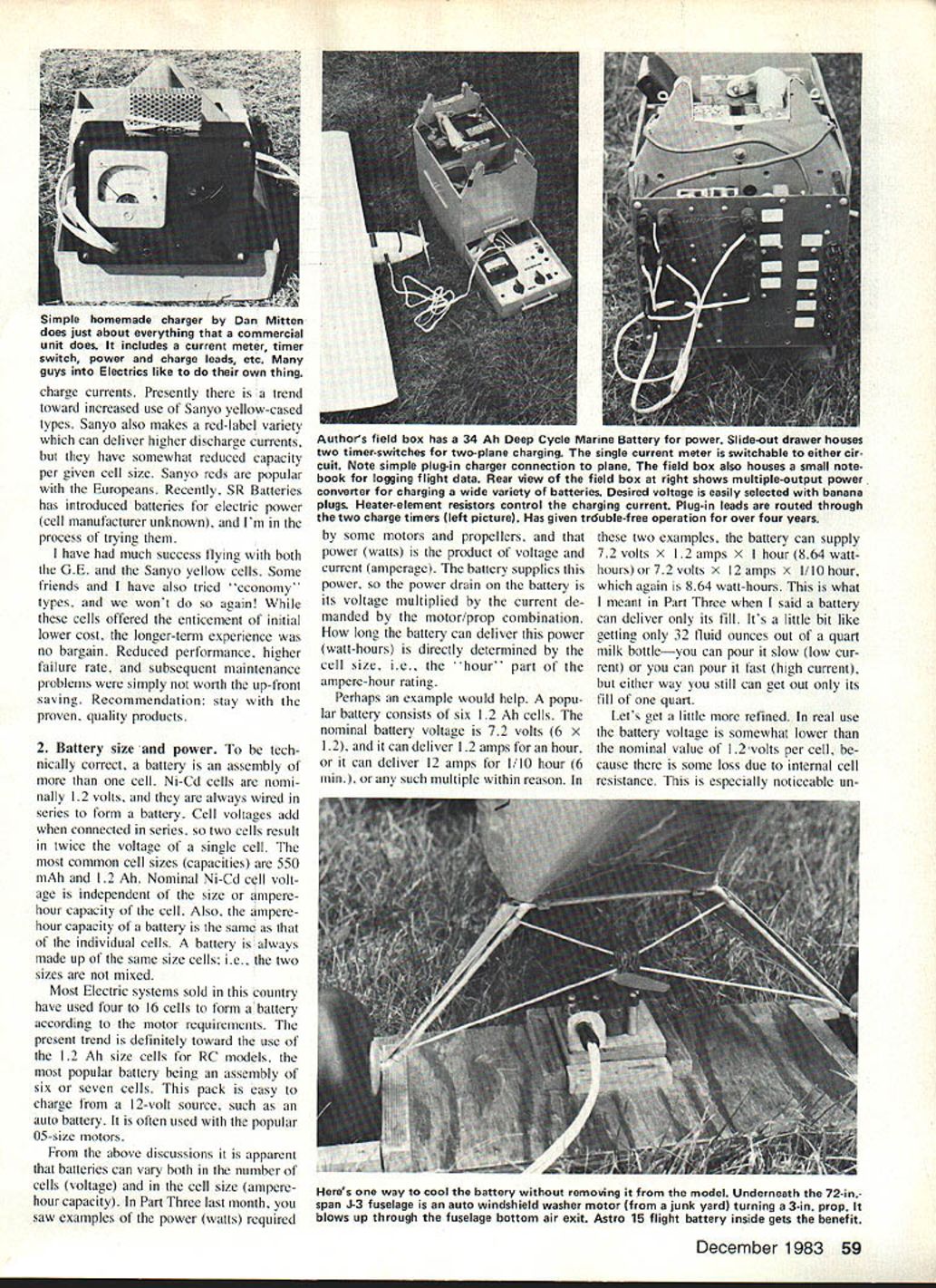
- Output: chargers typically provide a mate to the motor battery connector or a separate charge jack. The author prefers a separate charge jack to avoid wear on motor connectors and to allow checking battery voltage under load with a voltmeter.
- For packs with more cells than a single car battery can charge, use two car batteries in series or a voltage booster (a small device that converts 12 V input to higher voltage).
- Field boxes: many modelers build a field box that contains chargers (custom or commercial), voltage boosters, cooling fans, meters, a battery to power the gear, tools, props, and a tachometer. A good field box makes flying sessions easier.
- Power sources: car batteries, motorcycle batteries (if large enough and well-maintained; at least 12 Ah recommended), or deep-cycle marine batteries (e.g., 34 Ah) are common choices. Car batteries are convenient (the car is a source of "free fuel").
8. Battery life
- The motor battery may be the most costly part of an electric system; proper care extends life.
- The author favors conservative techniques and generous airflow for cooling; this approach yields long battery life for sport flying.
- With careful use, motor batteries can last for hundreds of flights. Example: many glider flights with power runs of 2–5 minutes can yield total flight times of 5–13 minutes and allow ample cooling between runs.
- High-performance competition use (e.g., FAI gliders drawing 25–30 A for short bursts) is much harder on cells and may reduce longevity.
- Battery life shows as a gradual loss of rpm or reduced motor run time. Replacement criteria are subjective:
- For gliders: the author suggests a conservative example of 200 flights per pack; at $35 for a six-cell pack, that is about $0.175 per flight.
- For sport/performance planes: performance degradation becomes evident sooner; some experience cites around 100 flights for G.E. cells before performance loss becomes noticeable (Sanyo may last longer).
- Used packs with reduced performance from a performance plane can be re-purposed in a sport plane where the reduced output is less critical.
Conclusion and contact:
- This series is guided by field experience, reader questions, and correspondence. If any point above is unclear, incomplete, or could be improved, your feedback is welcome.
- Bob Kopski, 25 West End Dr., Lansdale, PA 19446.
Important organization:
- SEAM (Society of Electric Aircraft Modelers) is a national organization dedicated to electric-powered model flying. The SEAM newsletter contains news, views, and how-tos. Membership: $10 (Junior under 16 is $5). Write: SEAM, 11632 Flamingo Dr., Garden Grove, CA 92644.
- AMA membership is required.
Transcribed from original scans by AI. Minor OCR errors may remain.

