
All about Electrics
Planes and flying are this month's topic. Our author describes in detail what works for him (as examples for what should work for you), complete with charts that record the history of his own overall flying activity and the flight-time performances of four basic model types, each with electric motor power. One theme runs throughout: the most successful models have strong, lightweight structures. Part 7. Bob Kopski
IN THIS SECTION
IN THIS SECTION and the next, I'll try to "bring it all together" as so often promised in past issues. If you've been following this series, by the time you finish next month's segment, you should be well-equipped and on your way to experiencing first-time and continuing Electric success—with understanding. It's what I call Electric Elation.
Four electrifying profiles of success. Long ago in Part 1, I took strong issue with some of the common misconceptions of electric-powered flying: that it is too difficult, that it is too heavy to fly well, that it doesn't have enough power, and that it offers too short a flight. This month I'm going to take an all-encompassing swipe at these false impressions by presenting an array of hard data for four different Electric airplanes. These success stories include a powered glider, an aerobatics type, a Sport Scale, and an Old-Timer. It should cover the majority of reader interests. These are relatively simple airplanes—no complicated, high-technology machines that are beyond the reach of the average modeler.
The data I mentioned include information from hundreds of flights of these planes. As you read on, you will see histograms of flight time performance (no wild claims here!) and the particular "vital statistics" of the planes involved. Later, we'll look at some rules-of-thumb that apply to them and there are easy guidelines you can apply to achieve the same satisfying, gratifying Electric success.
An electric year
Before I get into the details of these planes, let me describe the kind of flying I do and the basis for the performance information presented earlier in this series. I'm basically a sport flier. Other than some friendly club fun-fly events, no competitive flying. I also live and fly in southeastern Pennsylvania, which makes the subject in terms and conditions a four-season year. Although my club, Keystone RC Club, flies year round, with the moderated proviso "weather permitting," the fact is a great percentage of our aero exploits take place in about six or seven months of the year. Obviously, flying is done in summer as well as winter, but the distribution is as shown.
As a general rule, there is no reason you cannot fly Electrics year round. As far as equipment goes, it's a matter of climate, personal desire and determination (or craziness). Along this line, KRC holds its annual First Frosty Fingers Fun Fly on January 1 — no matter what the weather.
In the data format, plane performance generally is better in the cooler, drier months; that's peculiar to Electrics. Let's break the flight-year profile down a little. Being a sport flier, I fly when it's enjoyable and convenient. Specifically, I find evenings, weekends and mornings most gratifying; these are the best thermal conditions for the kind of activity I do. The data I have collected can safely be viewed as typical Electric flying facts — they are factual and conservative. Good and bad flights alike are graphed, so you can confidently read and see for yourself what Electric performance can be like and compare it to experiences you may have heard about.
A comment about flight times: watch always seems either too short or too long depending upon the point being made. For the purposes of this article, flight times shown were clocked from launch to landing to the nearest second. However, for simplicity in graphing, times are rounded to the larger fraction of a minute.
Profile 1: powered glider
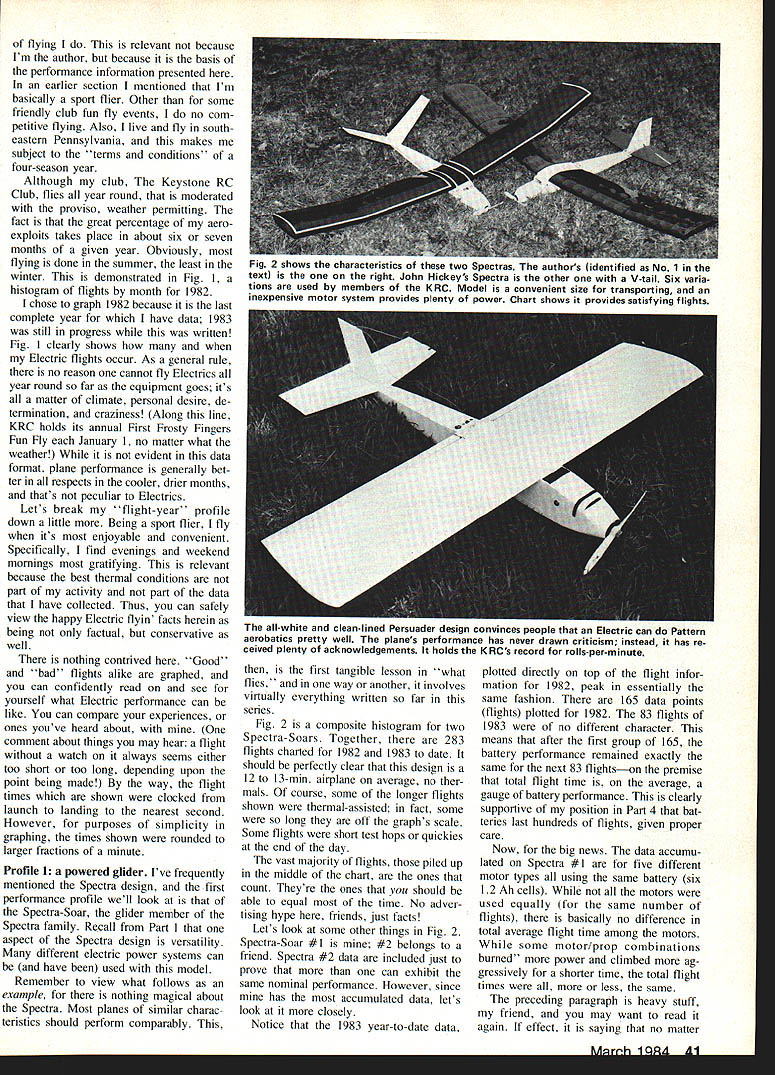
I've frequently mentioned the Spectra design and its performance profile. We'll look at the Spectra-Soar, a glider member of the Spectra family. Recall from Part 1 the aspect of Spectra design versatility; different electric power systems can be used. Many different electric power systems can be (and have been) used with this model.
Remember to view what follows as an example, for there is nothing magical about the Spectra. Most planes of similar characteristics should perform comparably. This, then, is the first tangible lesson in "what flies," and in one way or another, it involves virtually everything written so far in this series.
Fig. 2 is a composite histogram for the Spectra-Soars. Together, there are 283 flights charted for 1982 and 1983 to date. It should be perfectly clear that this design is a 12- to 13-min. airplane on average, no thermals. Of course, some of the longer flights shown were thermal-assisted; in fact, some were so long they are off the graph's scale. Some flights were short test hops or quickies at the end of the day.
The vast majority of flights, those piled up in the middle of the chart, are the ones that count. They're the ones that you should be able to equal most of the time. No advertising hype here, friends, just facts!
Let's look at some other things in Fig. 2. Spectra-Soar #1 is mine; #2 belongs to a friend. Spectra #3 data are included just to prove that more than one can exhibit the same nominal performance. However, since mine has the most accumulated data, let's look at it more closely.
Notice that the 1983 year-to-date data, plotted directly on top of the flight information for 1982, peak in essentially the same fashion. There are 165 data points (flights) plotted for 1982. The 83 flights of 1983 were of no different character. This means that after the first group of 165, the battery performance remained exactly the same for the next 83 flights — on the premise that total flight time is, on the average, a gauge of battery performance. This is clearly supportive of my position in Part 4 that batteries last hundreds of flights, given proper care.
Now, for the big news. The data accumulated on Spectra #1 are for five different motor types all using the same battery (six 1.2 Ah cells). While not all the motors were used equally (for the same number of flights), there is basically no difference in total average flight time among the motors. While some motor/prop combinations burned more power and climbed more aggressively for a shorter time, the total flight times were all, more or less, the same.
The preceding paragraph is heavy stuff, my friend, and you may want to read it again. In effect, it is saying that no matter what motor you use, provided it's not grossly under- or over-propped, the battery energy sets the flight-time envelope. Thus, selection of a motor for the Spectra becomes a matter of power and climb performance, not flight duration. Whatever appropriate motor (and suitable prop) I use, this plane flies about the same total time, for the same battery and charge. That's not just true for this plane; it should hold true for any similar plane.
Do you remember Part 4's discussion about batteries? There, I described ways of charging, including my "conservative" charging technique. This method does not fill the battery to the maximum but stops short by about 20%, on the average. The flight data of Fig. 1 are for such charging (as are the other examples). Of course, even longer flights would result if I used "digital" charging, but as I've said before, I don't care! It is clear that, for this kind of airplane, "charge one, fly one" will keep you in the air almost continuously. Oh, such "Electric Elation"!
Now, let's take a detailed look at the Spectra-Soar. Remember, any plane similar to this example should perform comparably.
So much for the fine details. Let's step back and look at the bigger picture. Particulars that stand out in this tabulation include the fact that the power system is about half the total plane weight. This is a typical number. Also, the battery is about 30% of the total. The plane, itself, is light. It is also strong, and holds the record for consecutive loops in KRC—a real wing-twister.
The wing loading is typical for many electric-powered gliders I've seen. Actually, wing loading is easily improved; wing area can be increased far more rapidly than the corresponding increase in overall weight. Of all the statistics, the key one is that the plane is light. But the need for lightness is not a license for weakness; the plane must have strength in the right places and overall durability to survive year after year of routine handling. Later we'll see some ways to help accomplish this.
Now, let's get back to the motors and props. The motor/prop combinations used in this model include two Astro 05s (pm 2107, now discontinued) with 7-6 and 8-4 Top Flight Nylon, Astro 075 XL with 7-4, 7-6, and 8-4 Top Flight Nylon (the last two were much too large), Leisure LT-50 Pattern Wind with 6-4 and 7-6 Top Flight Nylon (the 7-6 was too large) and Cox Gray, Mabuchi RS-550S-6530 and Mabuchi 550S, both using the 7-6 and 8-4 props. For all practical purposes, the total flight times for all these combinations were virtually the same.
As an additional point of interest, these combinations were for my Spectra. My friend's Spectra (#2) has only been flown with the original Astro 05, pm 2107, an economy motor that's perfectly satisfactory for this application. The 2107 was originally marketed with an eight-cell, .55 Ah battery for swinging a 6-4 prop. The documented flight performance for Spectra #2 is with six 1.2 Ah cells and larger props. As an estimate, based on other planes and experience, the eight-cell, .55 Ah pack would result in Spectra-Soar flights of about 6 to 7 min.
Profile 2: an aerobatic plane
For some reason, one measure of Electrics in modelers' minds is how well (or poorly) they do in Pattern flying. This is particularly curious because, for the most part, the people I've seen with Electrics aren't into aerobatics and don't seem the least bit concerned that they are having fun without blowing holes in the sky. Nevertheless, for those who find this phase of flying to their liking, we'll take a closer look at this application.
First of all, from what I've seen, an Electric is no match for conventional glow-powered Pattern planes, at least not for very long flights. Thus, if you're thinking of doing what the "big boys" do, forget it. On the other hand, if relatively simple aerobatics for 5 min. or so are to your liking, read on.
What are relatively simple aerobatics? I'll only list what I have either seen or done myself: inside and outside loops, aileron rolls, sustained inverted flight, spins, knife-edge, Immelmanns, hammerheads, and split-Ss. For how long? One answer is depicted in Fig. 3.
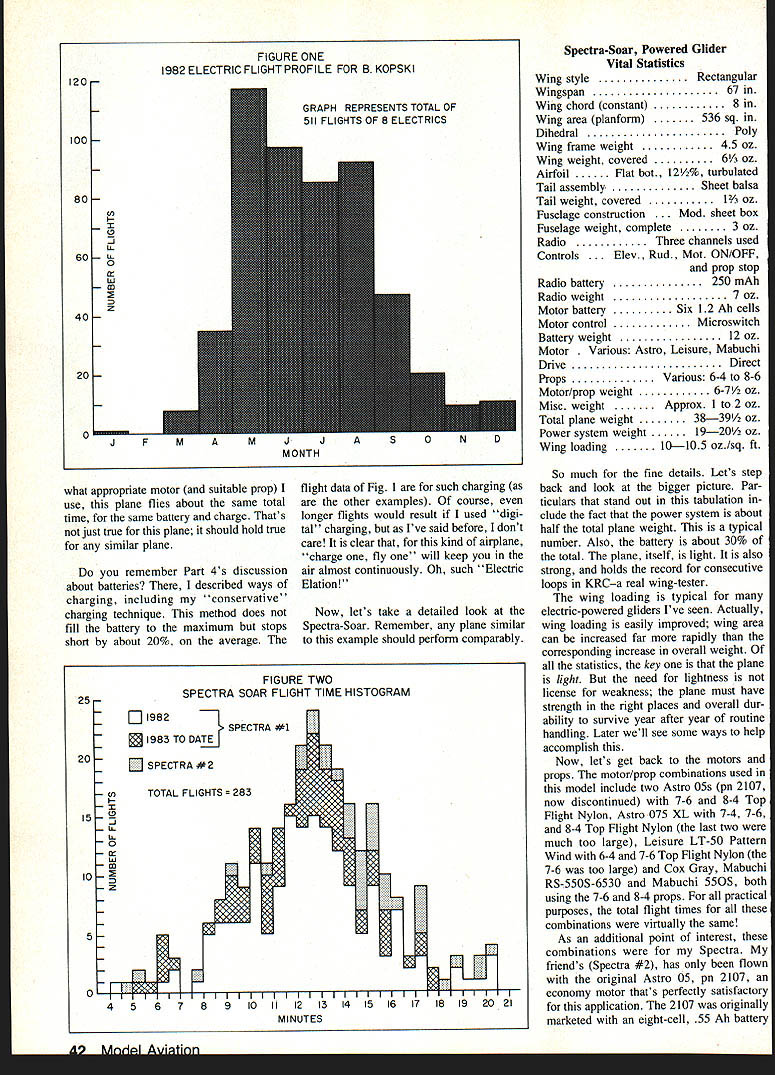
Fig. 3 is a histogram of flight time and number of flights for my Persuader. (The name has a purpose: this plane convinces people!) Unlike a glider, flight time for an aerobatic plane is not much longer than the useful motor run time. Such a plane depends on continuous power to perform. Also, unlike the glider, motor and prop choices are more limited because efficient power delivery is required for the desired flight characteristics.
For a given power system, in an aerobatic plane, flight time is determined to a large extent by the nature of the flight. For constant maneuvering, flight in windy conditions, or in very hot, humid air, average power consumption is relatively high. This contrasts with power consumption where more flying is done "straightaway"—as speed increases and the prop unloads, current drain is reduced, and flights are longer. Putting it another way, longer flights will result from a simple up-and-down-the-field flight than from the aerobatics listed previously.
With this in mind, let's examine Fig. 3. Notice the general lack of "peaking" and a flatter, broader shape to the histogram "envelope." I like to think of this plane as a 4 to 5-min. machine, depending on my mood, because that influences how I fly it. Of course, the data and conclusions assume "equal charges" each flight.
The data shown is essentially all for flights resulting from my "conservative charge." In a limited number of cases where I chose to "digital charge," the resulting flight was about 1/2 min. longer than the apparent average of 4 1/2 min. The relatively few shorter flights graphed were almost all due either to a "short charge" or a purposely-terminated flight.
Unlike the Spectra, the Persuader has only been flown with a Cobalt 05 and a six-cell, 1.2 Ah battery. This is not to say that this is the only workable power system.
The Persuader is derived from the Wasp, published by Jim Zarembski in RCM. I have seen several Wasps at KRC Electric Fly events powered by both Astro Cobalt 05s and Leisure LT-50s, both with impressive performance. In fact, Jim lists several candidate power systems on his Wasp plans. Since I've only used the one combination above, I can only report on it.
Incidentally, the Persuader will fly most of the aerobatic maneuvers that were listed. Since it has no rudder control, maneuvers requiring this are, of course, out. Since I've now begun to talk about the makeup of the plane, let's move on to the Vital Statistics of the Persuader. As in the case of the Spectra, the Persuader is only an example. Similar designs should perform comparably.
FIGURE THREE PERSUADER FLIGHT TIME HISTOGRAM 1982 1983 TO DATE TOTAL FLIGHTS: 93
Persuader, Aerobatic
Vital Statistics
- Wing style: Rectangular
- Wingspan: 37 in.
- Wing chord (constant): 8 in.
- Wing area (planform): 296 sq. in.
- Dihedral: None
- Wing frame weight: 3 oz.
- Wing weight, covered: 4 oz.
- Airfoil: NACA 2410 (semi-sym., 10%)
- Tail assembly: Sheet balsa
- Tail weight, covered: No data
- Fuselage construction: Modified sheet box
- Fuselage weight: No data
- Radio: Three channels used
- Controls: Elev., Ail., Motor ON/OFF
- Radio battery: 70 mAh
- Radio weight: 5½ oz.
- Motor battery: Six 1.2 Ah cells
- Motor control: Microswitch
- Battery weight: 12 oz.
- Motor: Astro Cobalt 05
- Drive: Direct
- Prop: 7-6 Top Flight Nylon
- Motor/prop weight: 6 oz.
- Misc. weight: Approx. 1–2 oz.
- Total plane weight: 33 oz.
- Power system weight: 19 oz.
- Wing loading: 16 oz./sq. ft.
Again, the basic airplane is very light—only about 8.5 oz. The structure is, nonetheless, strong and durable; it must be to withstand the aerobatics and survive general flying, landing, and handling. Notice that the power system here is about 58% of the total weight and that the plane, itself, is less than 26%. Later, you will see quantitatively how important weight really is.
As a special point of interest, notice the mention of the 70 mAh radio battery. It consists of four cells removed from a General Electric 9V Ni-Cd consumer-grade battery. It provides enough power for more than four flights. I stop at four, for safety, discharge, and recharge on the field. As of this writing, I have 436 flights on this pack; it was first used in an earlier aerobatic plane before finding a home in the Persuader.
You may very well have read about or heard of better performance than is described here (I have), and I'm sure it exists. At the other extreme, I'm sure many of you have had the impression that Electric is "only for gliders." What is presented here is the profile of a real, workable electric-powered aerobatic plane. There's no magic involved. For anyone used to flying on the prop, you will have to learn how to fly on the wing. Nevertheless, you should be able to match this kind of performance. If you beat it, please let me know. (But remember that I'm not easily impressed with a lot of shouting and hand-waving about how great some flight seemed to be. There's been too much of that sort of prop watch already. Instead, come to the 1984 Electric Fly, and persuade me!)
Profile 3: Sport Scale
This is perhaps the most "charming" of Electric applications.
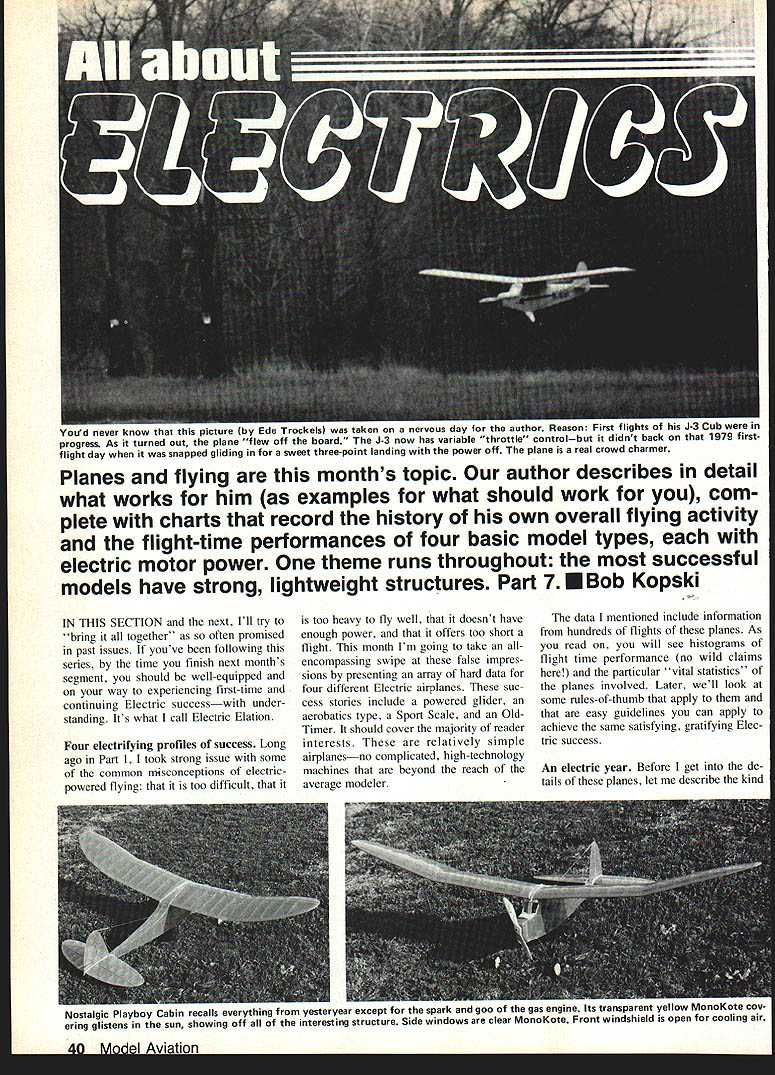
My J-3 has proven over the years to be a real crowd pleaser—probably because it's a good old J-3, a fact which "touches" many observers.
This plane was built in the winter of 1978-79, and it was first flown on March 3 of the latter year. I didn't know it till later, but Bob Boucher of Astro Flight was designing his Porterfield at the same time. The two planes are very similar.
To date, the J-3 has accumulated 334 flights (not one drop of oil has soaked in!), and 150 of these are depicted in Fig. 4. Prior to 1980 I was not keeping records of flight time, only date and number of flights, and that's the reason only about half are plotted.
From Fig. 4, it is obvious that this is a "five-min. airplane," and you can see from the "vital statistics" what the details are. Here's some more information about the plane.
The J-3 was scratch-built using Sig plans as a guideline. Since this was to be electric-powered, I knew the plane itself had to be lightweight, and the more rugged kit version for a glow engine would not do. I set about redrawing the plans and choosing construction techniques and wood sizes consistent with the application. I also changed the airfoil to a 12½% flat-bottom section. Dihedral was added in lieu of ailerons. Result: a real charmer!
Admittedly, the J-3 is a fair-weather flier. It does not handle wind well, and it is definitely more fun to fly in calm air. A typical flight starts with a small amount of ground handling followed by taxi and takeoff. Following climb-out, I back off the proportional "throttle" and cruise around. Flybys are a snap—beautiful to experience. The plane is a pussycat in handling, and several times I've nearly hypnotized myself into flying it into myself.
Usually I'll do some touch-and-goes and one or two inside loops, playing the "throttle" control as needed to do this. While the plane glides nicely (note some of the longer lift-assisted flight times in Fig. 4), I generally keep the power on the whole flight, only varying the amount for the desired effect. About a third of the time I have enough power left after landing to taxi back to the pit area. Otherwise, I power it out and have to bring it back dead-stick.
This J-3 is a good example of inadequate battery cooling. I'm on my fourth battery, and heat is the reason. At the time of design and construction, what looked like a good installation for cooling has proved to be inadequate. (Whatever knowledge I may have in Electrics has not come cheaply.) The 15-size motor used in this plane was a new version when the plane was new, the so-called "black back 15." The current model of the Astro 15 is a rather different motor (the Ferrite 15), and it uses 12 cells of 1.2 Ah. I may install one of these sometime, and get longer flights. The overall weight will increase by about 9 oz., but I estimate the flight time should increase to about 8–9 min.
Look over the vitals and get the general idea. There are many candidate designs around that would perform comparably but that would require some modeling effort to make suitable for electric power. My J-3 is but one example. The Astro Porterfield is an excellent kit example. By the way, it is my opinion that roughly this size plane and power system are about the minimum necessary for reliable ground handling and takeoff on grassy fields under varying weather conditions. Except for some occasional "tail-dragger-itis," this plane always gets off.
J-3, Sport Scale Vital Statistics
- Wing style: Scale
- Wingspan: 70½ in.
- Wing chord (constant): 10½ in.
- Wing area (planform): 700 sq. in.
- Dihedral: 5°/panel
- Wing frame weight: 6¼ oz.
- Wing weight, covered: 10½ oz.
- Airfoil: 12½% flat-bottom
- Tail assembly: Built-up
- Tail weight, covered: 2 oz.
- Fuselage construction: Stick, built-up
- Fuselage weight: No data
- Radio: Three channels used
- Controls: Rudder, Elevator, Motor
- Radio battery: 250 mAh
- Radio weight: 8 oz.
- Motor battery: 16 cells; .55 Ah
- Motor control: Variable speed
- Battery weight: 16 oz.
- Motor: Astro 15 with reducer
- Drive: With reducer
- Prop: Top Flight 12-8, wood
- Motor, reducer, prop weight: 13½ oz.
- Misc. weight: Approx. 1–2 oz.
- Total plane weight: 68 oz.
- Power system weight: Approx. 30 oz.
- Wing loading: 14 oz./sq. ft.
- Other included weights:
- Wing struts and hardware: 1½ oz.
- Wheels (Trexler 10G): 2½ oz.
- Complete landing gear assembly: 4½ oz.
Again, the same message: the plane must be lightweight. Please don't confuse this with being weak and fragile, for such need not be the case. This particular model has had over 300 flights, and it is approaching its fifth birthday. The J-3 has had its share of rough landings, aborted takeoffs, hectic fun-fly events, and hangar dings. It once spun down because I ran the radio battery down. It's on its third set of wheels! I've used it for test purposes to carry dead weights of 8 oz. and 1 lb. iron blocks. Other pilots have flown it, including a young boy who had never held a transmitter. Obviously, it has taken much abuse.
Profile 4: Old-Timer
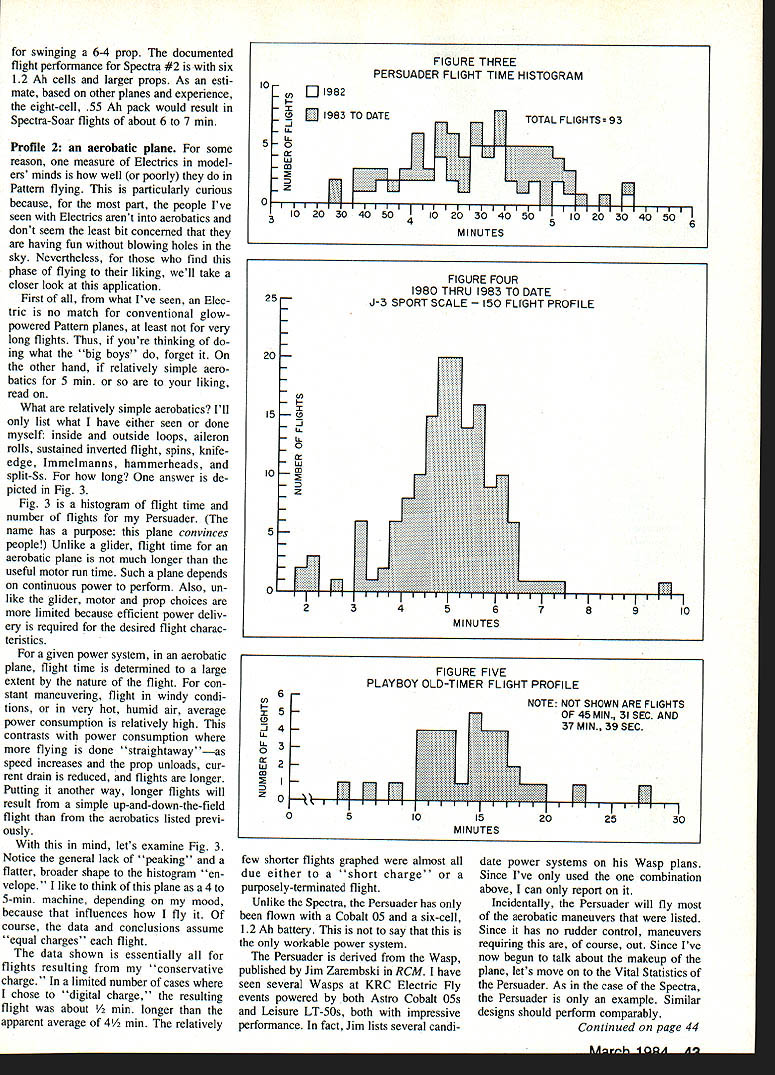
My most recent plane is a Playboy Cabin Old-Timer built from a Leisure kit. I am ordinarily not a kit builder, but I wanted a new plane in a hurry, and I've been wanting an Old-Timer for years. This one is a natural. As of this writing, the plane was about two months old, so I don't have nearly as much accumulated flight data as for the other examples.
The plane is perfectly delightful to fly, and while Old-Timers are not everyone's preference, everyone seems to enjoy watching this one fly. It currently holds the KRC Longest Flight Record of 45 min., 31 sec., but as you can see from Fig. 5, it is characteristically a 10- to 16-min. plane. I suspect that, as I accumulate more flights, a peak will be reached in the flight profile, and it will probably fall around 13 min.
This plane handles well and surprisingly well even with its light wing loading, polyhedral, and undercambered airfoil. Lacking a steerable tailwheel, the plane doesn't do much on the ground, but it will take off unassisted from the trim, low grass. With some headwind, ground roll approaches zero! With enough wind and some tricky controlling, the plane will fly back-wind — with no bad tendencies.
Like gliders, I would normally not think of putting variable-speed control in an Old-Timer. No doubt this is because of my Free-Flight "conditioning" to just get the thing up as high as possible as quickly as possible. However, I'm not into that stuff anymore (no fields), and now I wish I had built it with proportional motor control. Having the "throttle" adds a new dimension to an already enjoyable airplane. I found this out with the J-3; it was first flown with OFF-LO-HI power control. In many ways the Playboy is similar, and it is an excellent candidate for this feature. Of course, if you're into Electric Old-Timer competition, just stay with ON-OFF motor control.
As before, the vital statistics give some more detail. Again, lightweight is the operative word. I cannot stress this point too much. I have seen a magnificently-constructed Old-Timer Kadet and an equally superb FlyLine Megowocopter (truly fine craftsmanship by the same modeler) fail to fly. This was solely because the planes were too heavy. To say the least, these planes were a bit over-embellished with extra structure, lots of heavy wood pieces, various nit-picky fittings, and more.
I'm convinced that both of these planes are good candidate designs for Electric, but the structures must be "beefed up" with lightness! Personally, I felt terrible, because somehow I failed to convey the importance of lightweight to my flying friend—not once, but twice. Being a determined, stalwart modeler, he is now off finishing two electric-powered Old-Timers, a Buzzard Bombshell and a Playboy.
Remember what was said earlier in this series: I suggest thinking in terms of quarter ounces—four of them make up every ounce, and four of those make up a "quarter pound"!
FIGURE FIVE PLAYBOY OLD-TIMER FLIGHT PROFILE NOTE: NOT SHOWN ARE FLIGHTS OF 45 MIN., 31 SEC. AND 37 MIN., 39 SEC.
Playboy, Old-Timer Vital Statistics
- Wing style: Elliptical tips
- Wingspan: 68 in.
- Wing chord (constant): 9½ in.
- Wing area (planform): 576 sq. in.
- Dihedral: Polyhedral
- Wing frame weight: 4½ oz.
- Wing weight, covered: 6 oz.
- Airfoil: Undercambered
- Tail assembly: Built-up
- Tail weight, covered: 1½ oz.
- Fuselage construction: Built-up, stick
- Fuselage weight, covered: 3½ oz.
- Radio: Three channels used
- Controls: Rudder, Elevator, Motor ON/OFF
- Radio battery: 250 mAh
- Radio weight: 6½ oz.
- Motor battery: Six 1.2 Ah cells
- Motor control: Microswitch
- Battery weight: 12 oz.
- Motor: Leisure LT-50
- Drive: Leisure 2.5:1 gearbox
- Prop: 10-6 to 11-6
- Motor, gear, prop weight: 7½ oz.
- Misc. weight: Approx. 1–2 oz.
- Total plane weight: 41 oz.
- Power system weight: 20 oz.
- Wing loading: 10½ oz./sq. ft.
We need more "new timers" that fly like this plane!
With the second installment of "Planes and Flying" next month, we'll look at some ways to build strong, lightweight model structures. There'll be some rules of thumb that will help you maximize your Electric achievement—and some thoughts on what plane to choose. Meanwhile, please direct any comments or questions (with SASE) to the author:
Bob Kopski 25 West End Dr. Lansdale, PA 19446
Transcribed from original scans by AI. Minor OCR errors may remain.

