
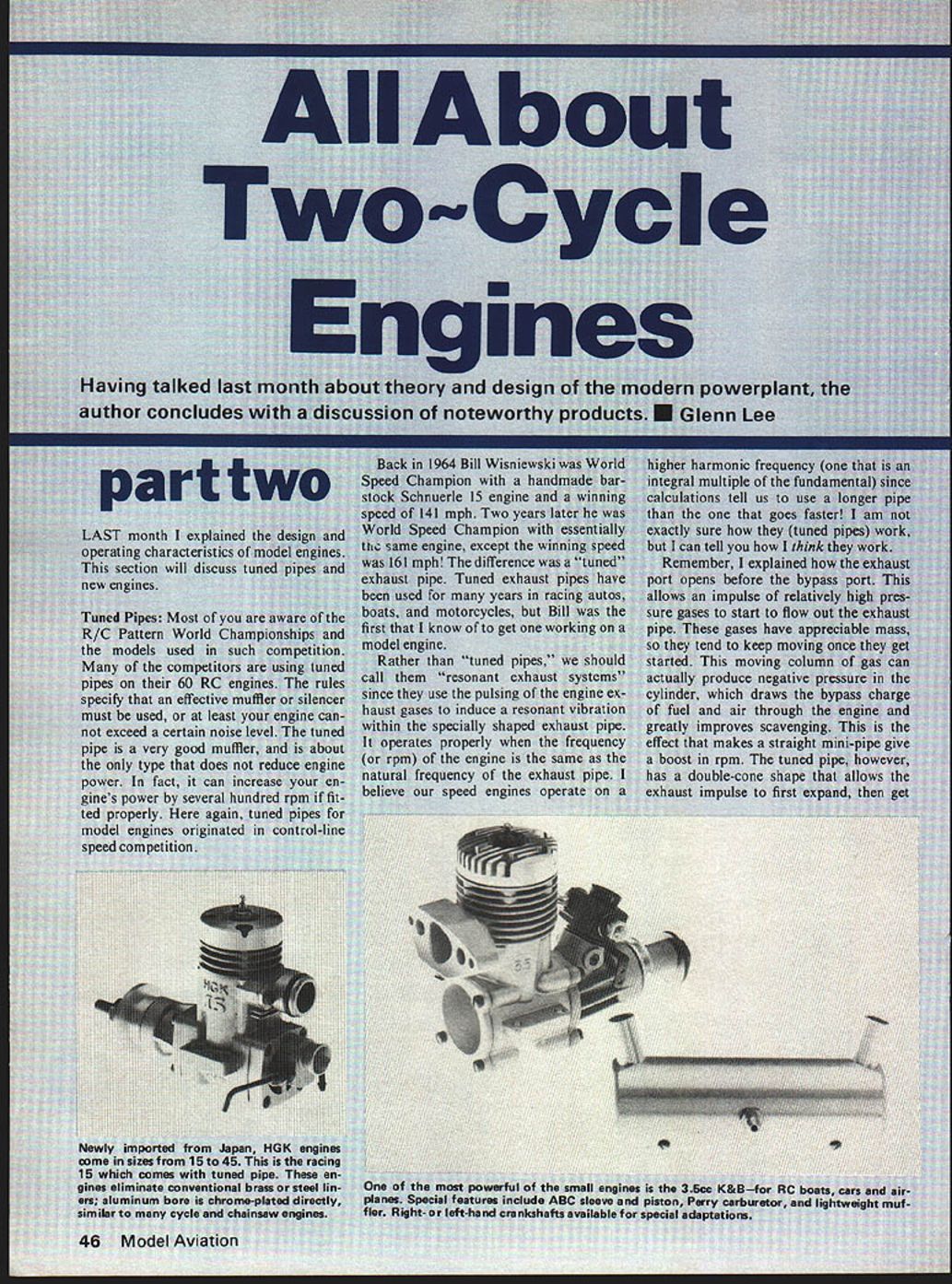
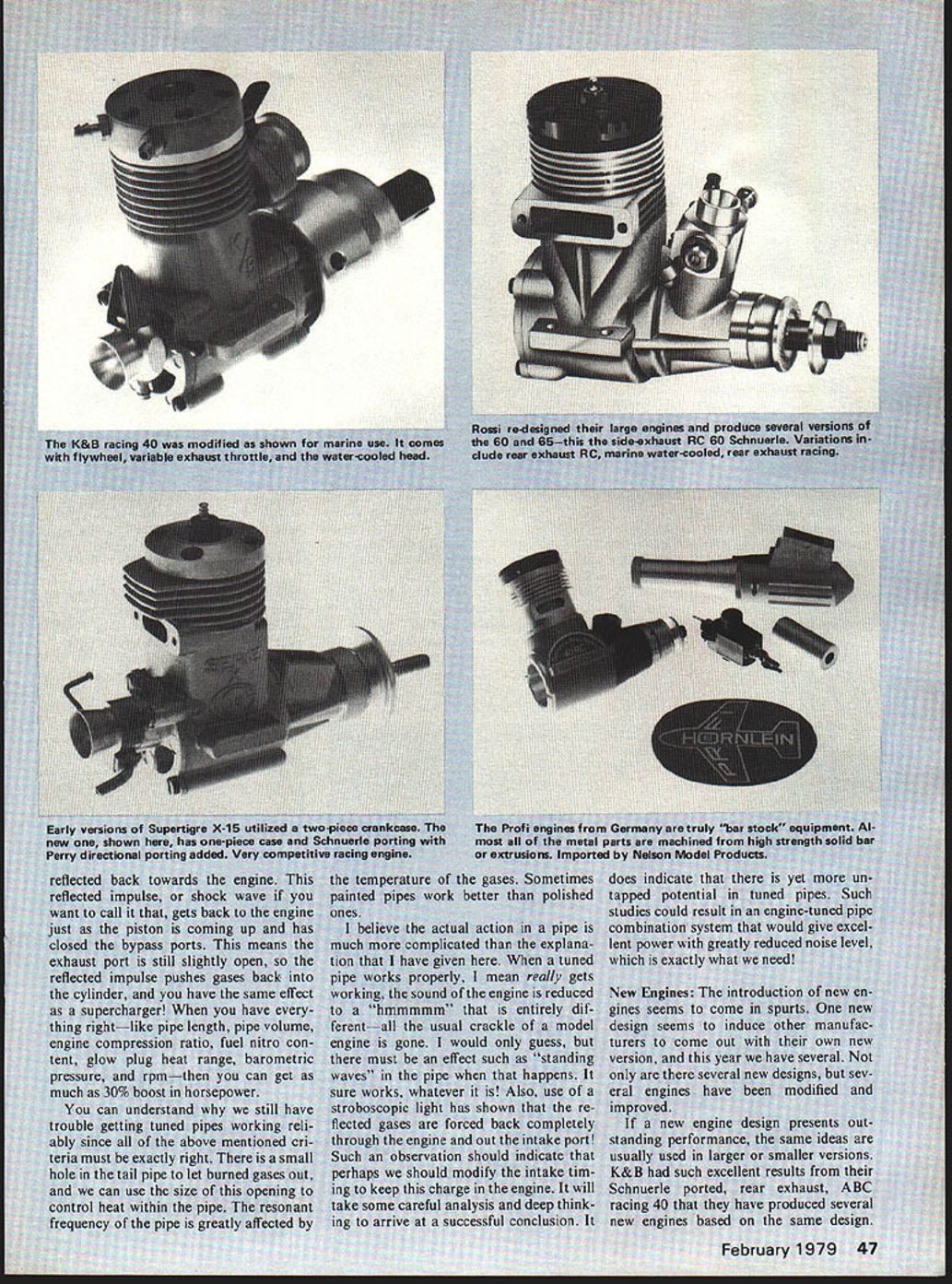
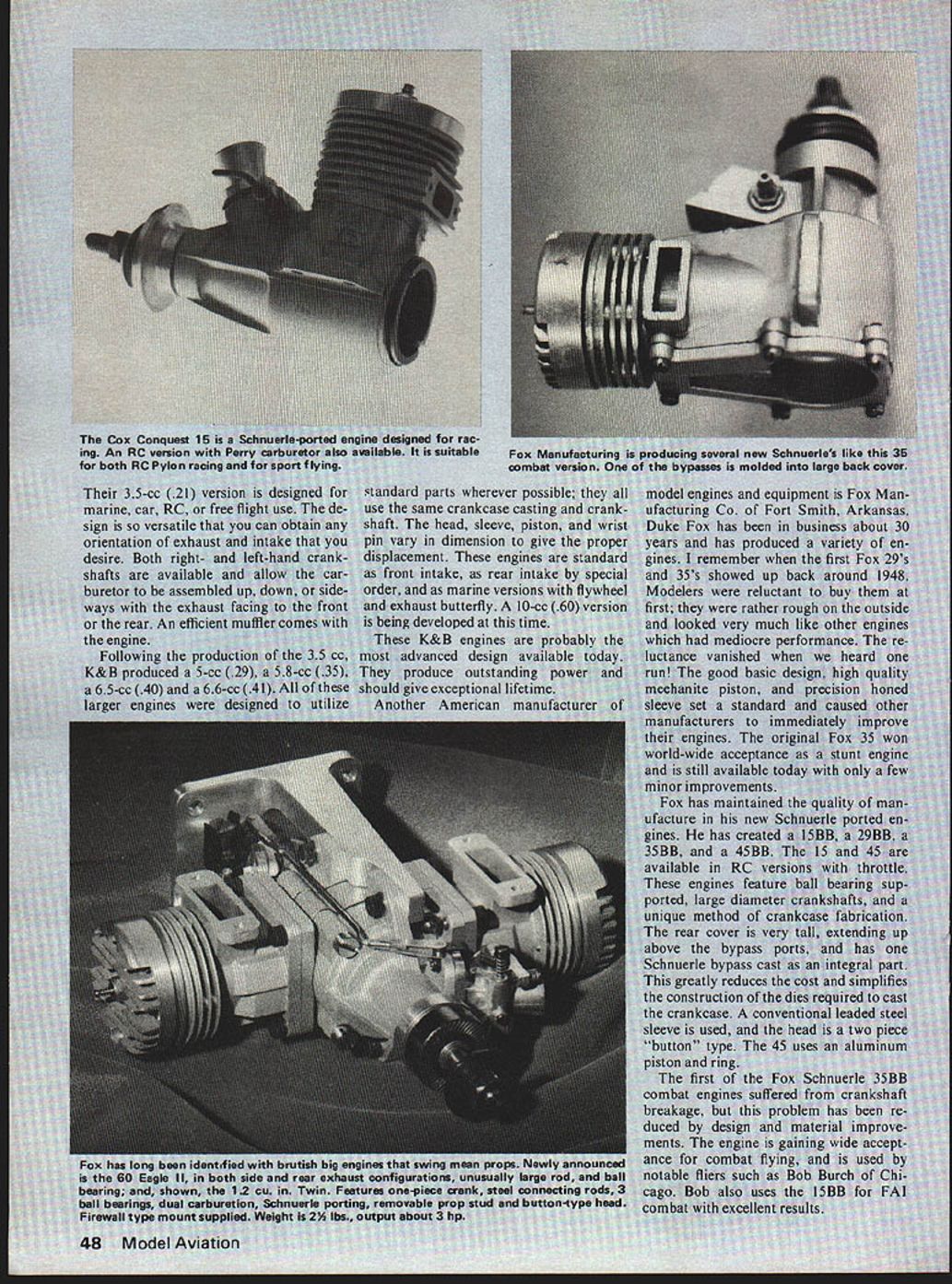
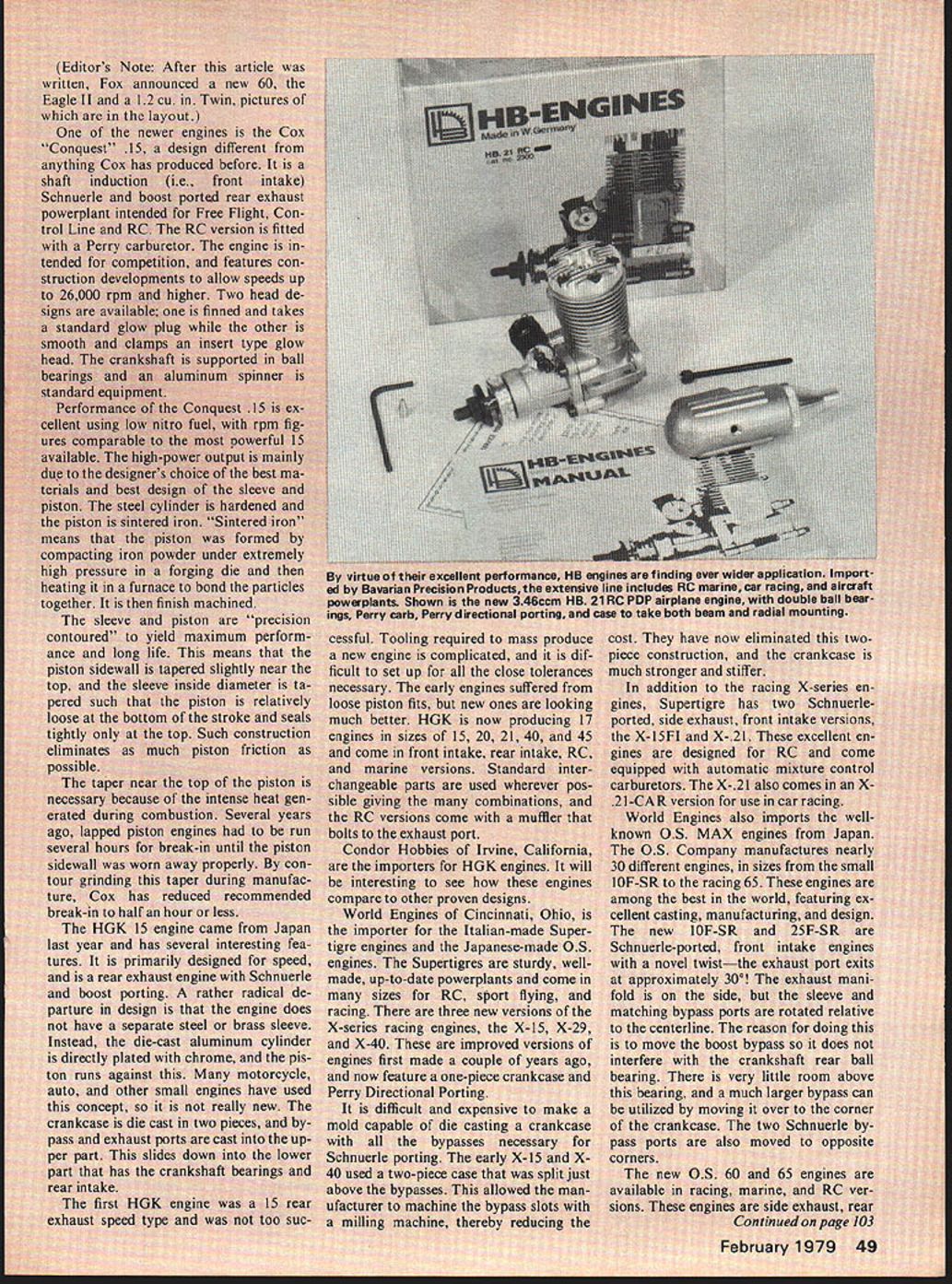
All About Two-Cycle Engines - Part 2
— Glenn Lee
Part Two
Last month I explained the design and operating characteristics of model engines. This section will discuss tuned pipes and new engines.
Tuned Pipes
Most of you are aware of the R/C Pattern World Championships and the models used in such competition. Many competitors are using tuned pipes on their .60 R/C engines. The rules specify that an effective muffler or silencer must be used, or at least your engine cannot exceed a certain noise level. The tuned pipe is a very good muffler, and is about the only type that does not reduce engine power. In fact, it can increase your engine's power by several hundred rpm if fitted properly. Tuned pipes for model engines originated in control-line speed competition.
Back in 1964 Bill Wisniewski was World Speed Champion with a handmade bar-stock Schnuerle .15 engine and a winning speed of 141 mph. Two years later he was World Speed Champion with essentially the same engine, except the winning speed was 161 mph! The difference was a "tuned" exhaust pipe. Tuned exhaust pipes have been used for many years in racing autos, boats, and motorcycles, but Bill was the first that I know of to get one working on a model engine.
Rather than "tuned pipes," we should call them "resonant exhaust systems" since they use the pulsing of the engine exhaust gases to induce a resonant vibration within the specially shaped exhaust pipe. It operates properly when the frequency (or rpm) of the engine is the same as the natural frequency of the exhaust pipe. I believe our speed engines operate on a higher harmonic frequency (one that is an integral multiple of the fundamental) since calculations tell us to use a longer pipe than the one that goes faster. I am not exactly sure how they work, but I can tell you how I think they work.
Remember, I explained how the exhaust port opens before the bypass port. This allows an impulse of relatively high-pressure gases to start to flow out the exhaust pipe. These gases have appreciable mass, so they tend to keep moving once they get started. This moving column of gas can actually produce negative pressure in the cylinder, which draws the bypass charge of fuel and air through the engine and greatly improves scavenging. This is the effect that makes a straight mini-pipe give a boost in rpm.
The tuned pipe, however, has a double-cone shape that allows the exhaust impulse to first expand, then get reflected back towards the engine. The timing of the reflected impulse, or shock wave if you want to call it that, gets back to the engine just as the piston is coming up and has closed the bypass ports. This means the exhaust port is still slightly open, so the reflected impulse pushes gases back into the cylinder, and you have the same effect as a supercharger! When you have everything right — pipe length, pipe volume, engine compression ratio, fuel nitro content, glow plug heat range, barometric pressure, and rpm — you can get as much as a 30% boost in horsepower.
You can understand why we still have trouble getting tuned pipes working reliably since all of the above criteria must be exactly right. There is a small hole in the tail pipe to let burned gases out, and we can use the size of this opening to control heat within the pipe. The resonant frequency of the pipe is greatly affected by the gases. Sometimes painted pipes work better than polished ones.
I believe the actual action in a pipe is much more complicated than the explanation I have given here. When a tuned pipe works properly — when it really gets working — the sound of the engine is reduced to a "hmmmmmm" that is entirely different: all the usual crackle of a model engine is gone. I would only guess, but there must be an effect such as standing waves in the pipe when that happens. It sure works, whatever it is! Also, use of a stroboscopic light has shown that the reflected gases are forced back completely through the engine and out the intake port. Such an observation should indicate that perhaps we should modify the intake timing to keep this charge in the engine. It will take careful analysis and deep thinking to arrive at a successful conclusion. It does indicate that there is yet more untapped potential in tuned pipes. Such studies could result in an engine–tuned-pipe combination system that would give excellent power with greatly reduced noise level, which is exactly what we need.
New Engines
The introduction of new engines seems to come in spurts. One new design seems to induce other manufacturers to come out with their own version, and this year we have several. Not only are there several new designs, but several engines have been modified and improved.
If a new engine design presents outstanding performance, the same ideas are usually used in larger or smaller versions. K&B had such excellent results from their Schnuerle-ported, rear-exhaust, ABC racing .40 that they produced several new engines based on the same design.
K&B
Their 3.5 cc (.21) version is designed for marine, car, R/C, or free-flight use. The design is so versatile that you can obtain any orientation of exhaust and intake that you desire. Both right- and left-hand crankshafts are available and allow the carburetor to be assembled up, down, or sideways with the exhaust facing to the front or the rear. An efficient muffler comes with the engine.
Following the 3.5 cc, K&B produced:
- 5.0 cc (.29)
- 5.8 cc (.35)
- 6.5 cc (.40)
- 6.6 cc (.41)
All of these larger engines were designed to utilize standard parts wherever possible; they all use the same crankcase casting and crankshaft. The head, sleeve, piston, and wrist pin vary in dimension to give the proper displacement. These engines are standard as front-intake, available as rear-intake by special order, and available as marine versions with flywheel and exhaust butterfly. A 10 cc (.60) version is being developed.
These K&B engines are probably the most advanced design available today. They produce outstanding power and should give exceptional lifetime.
Fox Manufacturing
Fox Manufacturing Co. of Fort Smith, Arkansas, has been in business about 30 years and has produced a variety of engines. I remember when the first Fox .29s and .35s showed up around 1948. Modelers were reluctant at first; they were rather rough on the outside and looked very much like other engines with mediocre performance. The reluctance vanished when we heard one run! The good basic design, high-quality machined piston, and precision-honed sleeve set a standard and caused other manufacturers to immediately improve their engines. The original Fox .35 won worldwide acceptance as a stunt engine and is still available today with only a few minor improvements.
Fox has maintained the quality of manufacture in his new Schnuerle-ported engines. He has created the 15BB, 29BB, 35BB, and 45BB. The 15 and 45 are available in R/C versions with throttle. These engines feature ball-bearing-supported, large-diameter crankshafts, and a unique method of crankcase fabrication. The rear cover is very tall, extending up above the bypass ports, and has one Schnuerle bypass cast as an integral part. This greatly reduces the cost and simplifies the construction of the dies required to cast the crankcase. A conventional leaded steel sleeve is used, and the head is a two-piece "button" type. The 45 uses an aluminum piston and ring.
The first of the Fox Schnuerle 35BB combat engines suffered from crankshaft breakage, but this problem has been reduced by design and material improvements. The engine is gaining wide acceptance for combat flying and is used by notable fliers such as Bob Burch of Chicago. Bob also uses the 15BB for FAI combat with excellent results.
(Editor's note: After this article was written, Fox announced a new .60, the Eagle II, and a 1.2 cu. in. twin; pictures are in the layout.)
Cox
One of the newer engines is the Cox "Conquest" .15, a design different from anything Cox has produced before. It is a shaft-induction (front intake) Schnuerle and boost-ported rear-exhaust powerplant intended for free flight, control line, and R/C. The R/C version is fitted with a Perry carburetor. The engine is intended for competition and features construction developments to allow speeds up to 26,000 rpm and higher. Two head designs are available: one finned that takes a standard glow plug, and the other smooth that clamps an insert-type glow head. The crankshaft is supported in ball bearings and an aluminum spinner is standard equipment.
Performance of the Conquest .15 is excellent using low-nitro fuel, with rpm figures comparable to the most powerful .15s available. The high-power output is mainly due to the designer's choice of the best materials and best design of the sleeve and piston. The steel cylinder is hardened and the piston is sintered iron. "Sintered iron" means the piston was formed by compacting iron powder under extremely high pressure in a forging die and then heating it in a furnace to bond the particles together. It is then finish-machined.
The sleeve and piston are "precision contoured" to yield maximum performance and long life. This means the piston sidewall is tapered slightly near the top, and the sleeve inside diameter is tapered such that the piston is relatively loose at the bottom of the stroke and seals tightly only at the top. Such construction eliminates as much piston friction as possible.
The taper near the top of the piston is necessary because of the intense heat generated during combustion. Several years ago, lapped-piston engines had to be run several hours for break-in until the piston sidewall was worn properly. By contour-grinding this taper during manufacture, Cox has reduced recommended break-in to half an hour or less.
HGK
The HGK .15 engine came from Japan last year and has several interesting features. It is primarily designed for speed, and is a rear-exhaust engine with Schnuerle and boost porting. A rather radical departure in design is that the engine does not have a separate steel or brass sleeve. Instead, the die-cast aluminum cylinder is directly plated with chrome, and the piston runs against this. Many motorcycle, auto, and other small gasoline engines have used this concept, so it is not really new. The crankcase is die cast in two pieces, and bypass and exhaust ports are cast into the upper part. This slides down into the lower part that has the crankshaft bearings and rear intake.
The first HGK .15 was a rear-exhaust speed type and was not too successful. Tooling required to mass-produce a new engine is complicated, and it is difficult to set up all the close tolerances necessary. The early engines suffered from loose piston fits, but new ones are looking much better. HGK is now producing .17, .20, .21, .40, and .45 engines, and they come in front-intake, rear-intake, R/C, and marine versions. Standard interchangeable parts are used wherever possible, giving many combinations. The R/C versions come with a muffler that bolts to the exhaust port.
Condor Hobbies of Irvine, California, are the importers for HGK engines. It will be interesting to see how these engines compare to other proven designs.
World Engines / Super Tigre / O.S.
World Engines of Cincinnati, Ohio, is the importer for the Italian-made Super Tigre engines and the Japanese-made O.S. engines.
Super Tigre: The Super Tigres are sturdy, well-made, up-to-date powerplants and come in many sizes for R/C, sport flying, and racing. There are three new versions of the X-series racing engines: the X-15, X-29, and X-40. These are improved versions of engines first made a couple of years ago, and now feature a one-piece crankcase and Perry directional porting.
It is difficult and expensive to make a mold capable of die-casting a crankcase with all the bypasses necessary for Schnuerle porting. The early X-15 and X-40 used a two-piece case that was split just above the bypasses. This allowed the manufacturer to machine the bypass slots with a milling machine, thereby reducing cost. They have now eliminated this two-piece construction, and the crankcase is much stronger and stiffer.
In addition to the racing X-series engines, Super Tigre has two Schnuerle-ported, side-exhaust, front-intake versions: the X-15FI and X-21. These excellent engines are designed for R/C and come equipped with automatic mixture-control carburetors. The X-21 also comes in an X-21-CAR version for car racing.
O.S. MAX: World Engines also imports the well-known O.S. MAX engines from Japan. The O.S. Company manufactures nearly 30 different engines, in sizes from the small 10F-SR to the racing 65. These engines are among the best in the world, featuring excellent casting, manufacturing, and design. The new 10F-SR and 25F-SR are Schnuerle-ported, front-intake engines with a novel twist — the exhaust port exits at approximately 30°. The exhaust manifold is on the side, but the sleeve and matching bypass ports are rotated relative to the centerline. The reason for doing this is to move the boost bypass so it does not interfere with the crankshaft rear ball bearing. There is very little room above that bearing, and a much larger bypass can be utilized by moving it to the corner of the crankcase. The two Schnuerle bypass ports are also moved to opposite corners.
The new O.S. 60 and 65 engines are available in racing, marine, and R/C versions. These engines are side-exhaust, rear-intake, rotary-valve, Schnuerle-ported, ringed designs.
Bar-Stock and Profi
Several times I have mentioned "bar stock" engines. This term is used when we literally "hog" a new crankcase out of a solid chunk, or bar, of aluminum for a new or prototype engine. It is an awful lot of work to make patterns and core boxes to get a crankcase casting, so it is much simpler and cheaper to use bar stock to make one-of-a-kind crankcases. It is unusual to find large production R/C engines made this way, but there is one line that utilizes solid aluminum instead of castings for their crankcases.
The Profi engines, imported by Nelson Products, are manufactured in West Germany and come in five sizes from a .10 (1.76 cc) to a .76 (12.65 cc). Almost every part in the engine except for bearings, carburetor, and carburetor housing is machined from solid metal stock. The crankcase is machined out of solid aluminum, and an aluminum cylinder jacket with integral Schnuerle bypass ports screws into the top. A hardened steel liner is held in place by a conventional bar-stock squish-band head and a single-ringed machined piston is utilized. The carburetor is different from most since it uses a sliding rather than rotating barrel. This excellent engine comes complete with muffler and wrenches.
Model Rectifier Corporation / Webra / Enya / Suevia
Model Rectifier Corporation imports several lines of engines including the Webras, Enyas, and the monster 25-cc Suevia. Webra has several new Schnuerle-ported engines such as the .109 rear-exhaust, a .20 side-exhaust, and the large .90 R/C engine. Enya also has several new side-exhaust, Schnuerle-ported engines: the 19X, 40X, and 60X. I have very little additional information on these engines except the 60X. This 60 has a chrome-plated aluminum sleeve rather than brass or steel.
A lapped, or ringless, piston is used, so both piston and sleeve are made of high-silicon alloy to achieve matched thermal expansion. It will be interesting to see if this combination will give acceptable lifetime compared to chromed brass sleeves.
Rossi
Rossi engines are imported by Bill's Miniature Engines, Memphis, Tennessee. A new .60 R/C engine and racing .60 and .65 have been developed following the world-famous success of their racing .15. The .60 R/C is a front-intake, Schnuerle-boost ported engine, while the racing .60 and .65 versions have a rear exhaust and rear rotary-valve intake. They have a single-ring piston rather than an ABC. These engines have already proved to be as powerful as anything available and have gained immediate acceptance and success in competition.
Materials, Coatings and the Future
Most of the design features of present engines have been around many years, but there is always the possibility of some radical new development. I believe there will be more large engines built, and some of these may be four-cycle similar to the new O.S. .60. By going to four cycle, we can make twins, in-lines, or radial engines.
I predict the next major improvement in small engines will be the use of solid-state coatings, not to reduce friction, but to increase lifetime and reduce the amount of lubrication required. A series of proprietary coatings known as "sinterigit" coatings was developed by NASA for the space program. These coatings consist of a porous plating or chemical treatment of the surface, which is impregnated with a suitable lubricant. The first dry, self-lubricating material was polytetrafluoroethylene (PTFE) bonded to anodized aluminum and is familiar to everyone in frying pans and other cookware. Such bearing material is not suitable for our high-velocity surfaces although it has been used on pistons with limited success. Graphite and molybdenum sulfide have also been used as the lubricant, and probably would be superior for model engine parts.
There are several relatively new platings that may prove quite successful in drastically reducing wear. I have used an electroless nickel-boron plating on an aluminum piston, but adhesion was not adequate for racing stress. It would probably work fine, however, on the sleeve, since the sleeve is subjected to much lower stress than the piston. Electroless plating differs from electroplating in that no electrical power is applied to the parts. In electroplating, negative voltage is applied to the part which is immersed in the plating solution containing a positive terminal. In electroless plating, parts are cleaned, the surface is activated by a chemical solution, and then they are immersed in the plating solution. The solution contains metallic ions that adhere to the immersed metal parts.
Other plating or coating may prove practical on moving surfaces in model engines. One coating developed by DuPont is called composite diamond coating (CDC) and has been successfully used to extend the lifetime of drill bits, extrusion dies, and other critical parts in high-wear areas. The coatings contain a uniform distribution of micron-size diamond particles in an ion nickel-phosphorous matrix in concentrations of 10% to 40%. The thickness is less than .002 inches, but coated parts have sometimes lasted several hundred times longer than uncoated parts.
It might be possible to design an engine that will operate with no lubrication other than fuel itself.
Conclusion
Most of the design features of present engines have been around many years, but there is always the possibility of radical new development. I hope I have presented information adequately and clearly so everyone can understand it. I apologize if I have neglected any new data or engines; if so, it was not intentional. I did neglect carburetors and mufflers, since those should be covered in a separate, complete article.
Transcribed from original scans by AI. Minor OCR errors may remain.

