
AMA Air Show Teams
Celebrating its 10th anniversary in 1982, the AMA Show Team Program begins this season with 26 teams throughout the country entertaining and enlightening the general public with the sport of aeromodeling. The teams and their shows have earned wide acclaim by audiences for their professionalism in representing the sport. — Luther Hux
History
For as long as modelers have been building miniature aircraft, there have been those who are willing, sometimes eager, to share their experiences. One of the current favorite ways of sharing is banding together as a team to put on model air shows.
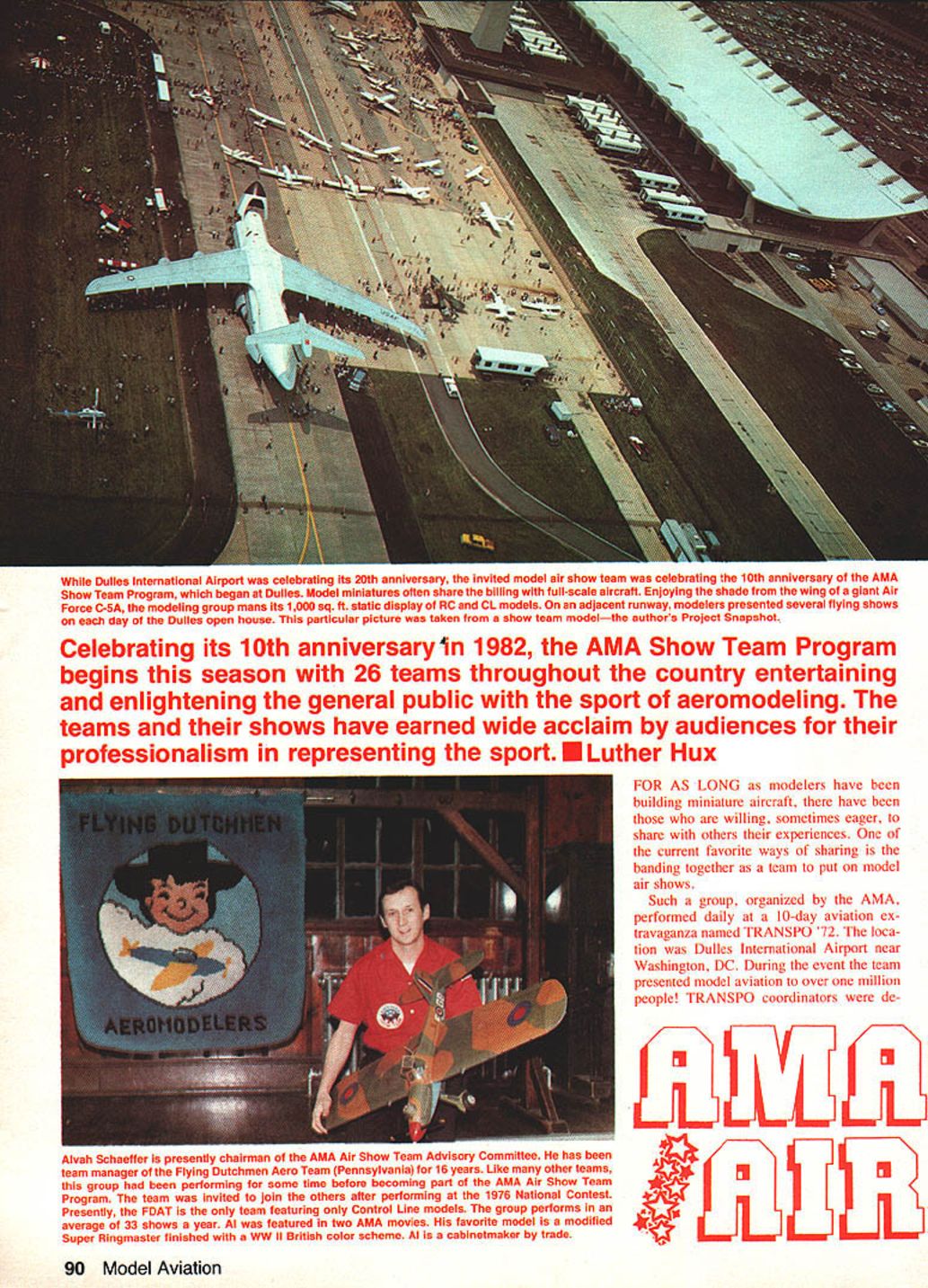
Such a group, organized by AMA, performed daily at a 10-day aviation extravaganza named TRANSPO '72 at Dulles International Airport near Washington, D.C. During the event the team presented model aviation to over one million people. Dulles officials were delighted to be able to call on the modeling team for several extra shows when low cloud ceilings or mechanical problems caused delays in the full-scale show.
The man in charge of that team was Bob Lopshire, then AMA public relations director. Bob organized a group of fliers from several mid-Atlantic states to put on the shows. With several performances a day for the 10 days, the event was very demanding on its participants. But the group was so well received by the audience and sponsors that Bob proposed the official organization of an AMA Show Team, and the proposal met with favor.
The new team was called The Official AMA Show Team until 1976, when they adopted the name Alpha Squadron #101. The name change resulted from AMA’s decision to authorize more than one official team. Ten years after Bob began the AMA show team concept, his idea had grown to 26 teams with over 300 individual members and perhaps an equal number in support crews.
When Dulles Airport officials planned the 1982 EXPO, an AMA-sanctioned team was invited to perform. Their invitation included many favorable comments about the team that performed 10 years previously.
Sanctioning and Support
The sanctioning of a team provides the backing and prestige of a national organization. This backing can help open doors to new opportunities. Several teams currently sanctioned by AMA had been active performers long before joining the AMA program. These veteran teams—one reporting 28 years of air show service—lend the sanctioned program the credentials of accumulated experience.
Sanctioned teams receive a range of assistance:
- Eligibility to display the AMA Show Team emblem and to be listed as official AMA teams in Model Aviation and AMA publications.
- Help with uniform shirts, caps, patches, name tags, pins, and literature.
- Distribution in the bimonthly Showgram, which lets teams share program ideas and achievements.
- Grants and assistance from industry groups such as the Hobby Industry of America (HIA).
- The same insurance coverage enjoyed by all AMA members; team shows can also be covered by site insurance similar to contest insurance. Providing a prospective show sponsor with an insurance document in the sponsor’s name can greatly help secure opportunities.
To encourage growth and help with costs, some manufacturers and sponsors provide equipment at reduced cost. (To protect local hobby shops, these discounts are available only through authorized AMA channels.) Manufacturers receive exposure, and the industry benefits from new customers introduced to modeling by the exhibitions. Teams also sometimes receive consideration from local hobby shops. The estimated audience for 1982 was 1.8 million.
The AMA Show Team Advisory Committee provides guidelines and references for safety, staging, and media relations, and is available to consult with clubs considering displays. If your club is interested in presenting model demonstrations as part of a community or air show, contact the AMA Air Show Team Advisory Committee c/o AMA Headquarters for information on how to apply for sanctioning and for assistance in planning your event.
Team Responsibilities and Costs
People on a show team are those who want to share their hobby and have the experience to give a quality performance. Team members must have the time and discipline to develop and practice their chosen show routines. Planning and practice sessions require far more time than the actual shows.
Typical expectations and requirements for AMA-sanctioned teams include:
- Demonstrating safe operations.
- Providing competent announcers.
- Maintaining a uniform appearance.
For the most part, a team member pays his own way. Expenses include:
- Building and maintaining models—often in greater complexity and number than for casual sport flying.
- Travel costs (gas, vehicle upkeep).
- Replacement and upkeep of model equipment.
- Overall team equipment such as public address and music systems.
To compensate, teams often seek sponsors and industry discounts through AMA channels. The AMA and HIA assistance, local hobby shop support, and insurance documents in sponsors’ names all help reduce financial barriers.
Safety
The audience’s safety is carefully considered in planning every show and each routine. Because of the close proximity of the public, AMA has established special AMA Show Team (AST) safety guidelines in addition to the AMA Safety Code.
Shows and Routines
Producing and performing in an air show requires hard work by team members, and without the support of spouses and fellow club members, the teams probably would not exist. The teams often publicly thank family members, club members, sponsors, AMA staff, and friends for their support.
Most teams follow a similar recipe for a successful show:
- Start with the basics.
- Add realism.
- Select from a variety of aircraft and routines.
- Accent with the unique.
- Serve at a fast pace.
One team specializes in Control Line models, but the majority are Radio Control (RC). Many RC teams include Control Line (CL) routines. Other segments of the hobby, such as Peanut Scale or Free Flight, are often included by team members eager to show other modeling skills. AMA encourages variety; sanctioning of a team does not require the use of an engine or flying outdoors.
Key show elements:
- Basic trainer: A must-have routine. The trainer pilot’s skilled, make-it-look-easy flying encourages audience members to try the sport. Team members provide prospective pilots with local club and hobby shop information and AMA literature.
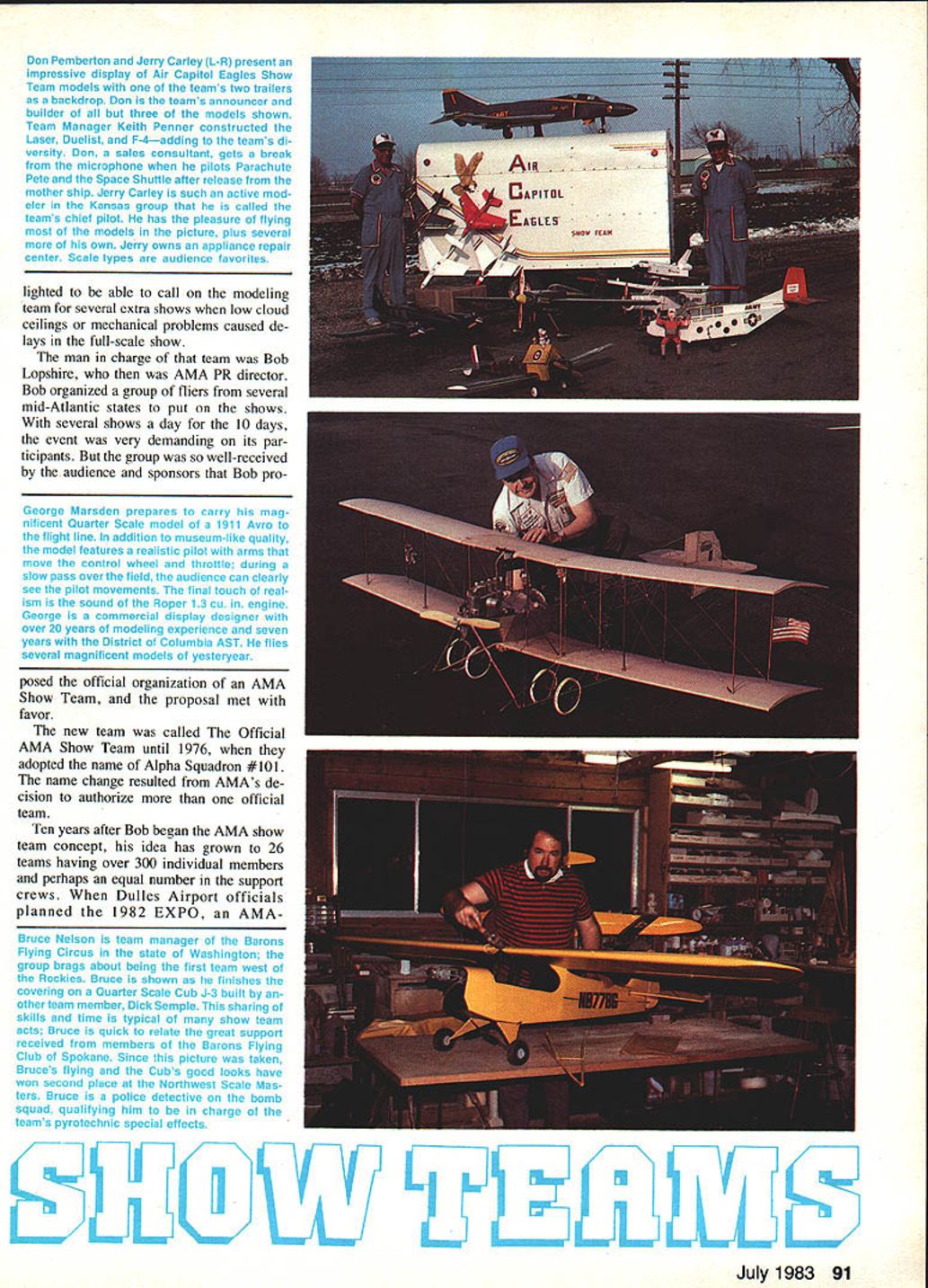
- Scale miniatures: Often audience favorites, especially among full-scale pilots. Detail ranges from simple stand-off models to museum-quality replicas, covering everything from old biplanes to modern jets and ducted-fan jets. Scale-like operating features and recreation of full-scale events—such as barnstorming aerobatics, air races, dogfights, and carrier landings—add to the illusion of a miniature world.
- Flow: Models presented from slow to fast and simple to complex keep audience interest.
Occasionally models outperform their full-scale counterparts—have you ever seen a full-scale helicopter loop or hover inverted?
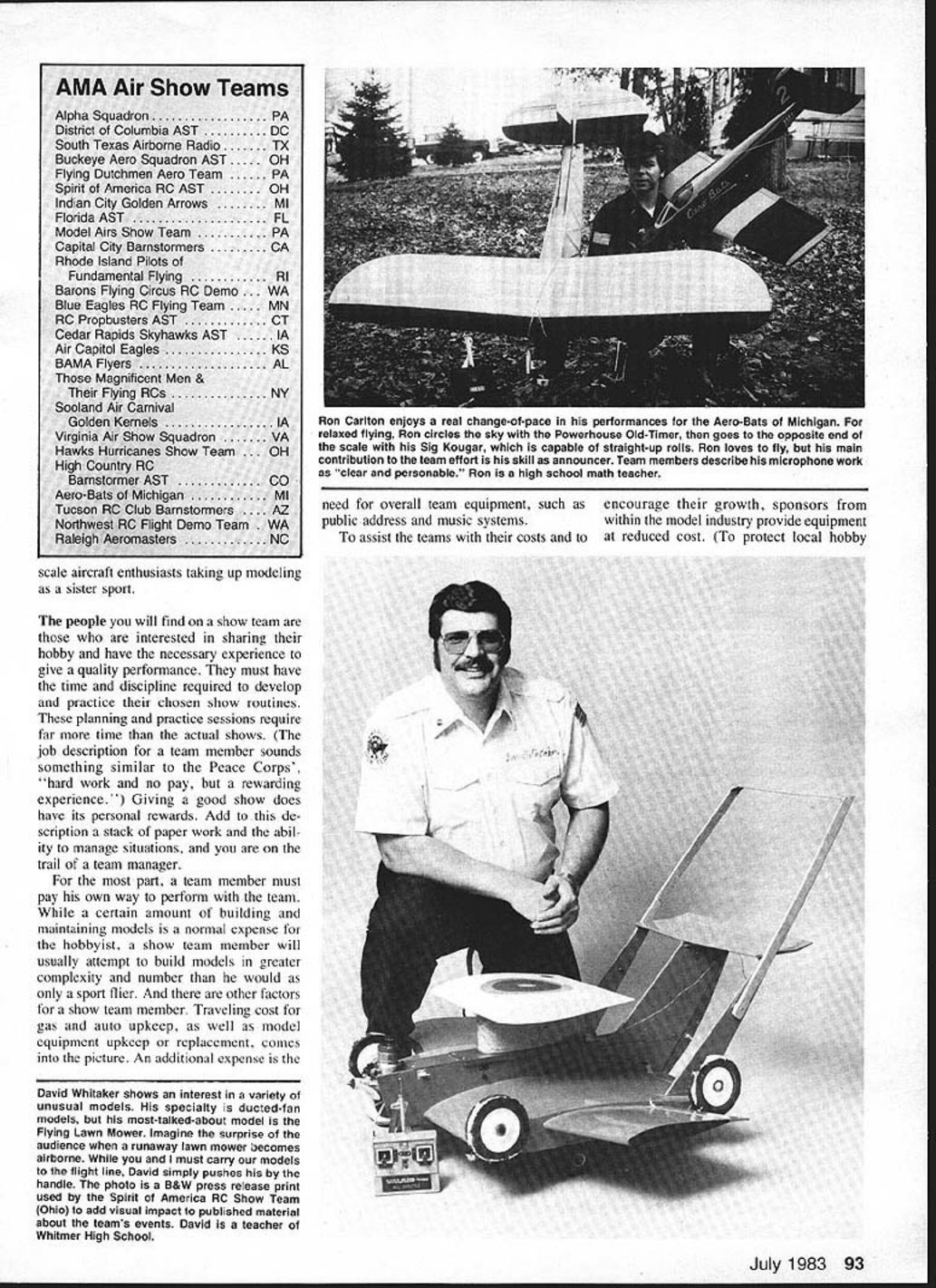
The unique model is a major entertainment asset. While no one has flown a kitchen sink, team members have flown unusual designs that astonish audiences. Examples of non-aviation items flown include:
- Lawn mower
- Doghouse
- Stop sign
- Hamburger
- Flatiron and ironing board
- Witch on a broom
- Powered parachutes
- Flying saucers and flags
Small figures and novelty acts, such as RC parachutists, wing walkers, Snoopy dolls, and cartoon-character pilot figures, delight children.
Characters and Announcers
Personalities and staged characters add entertainment and realism:
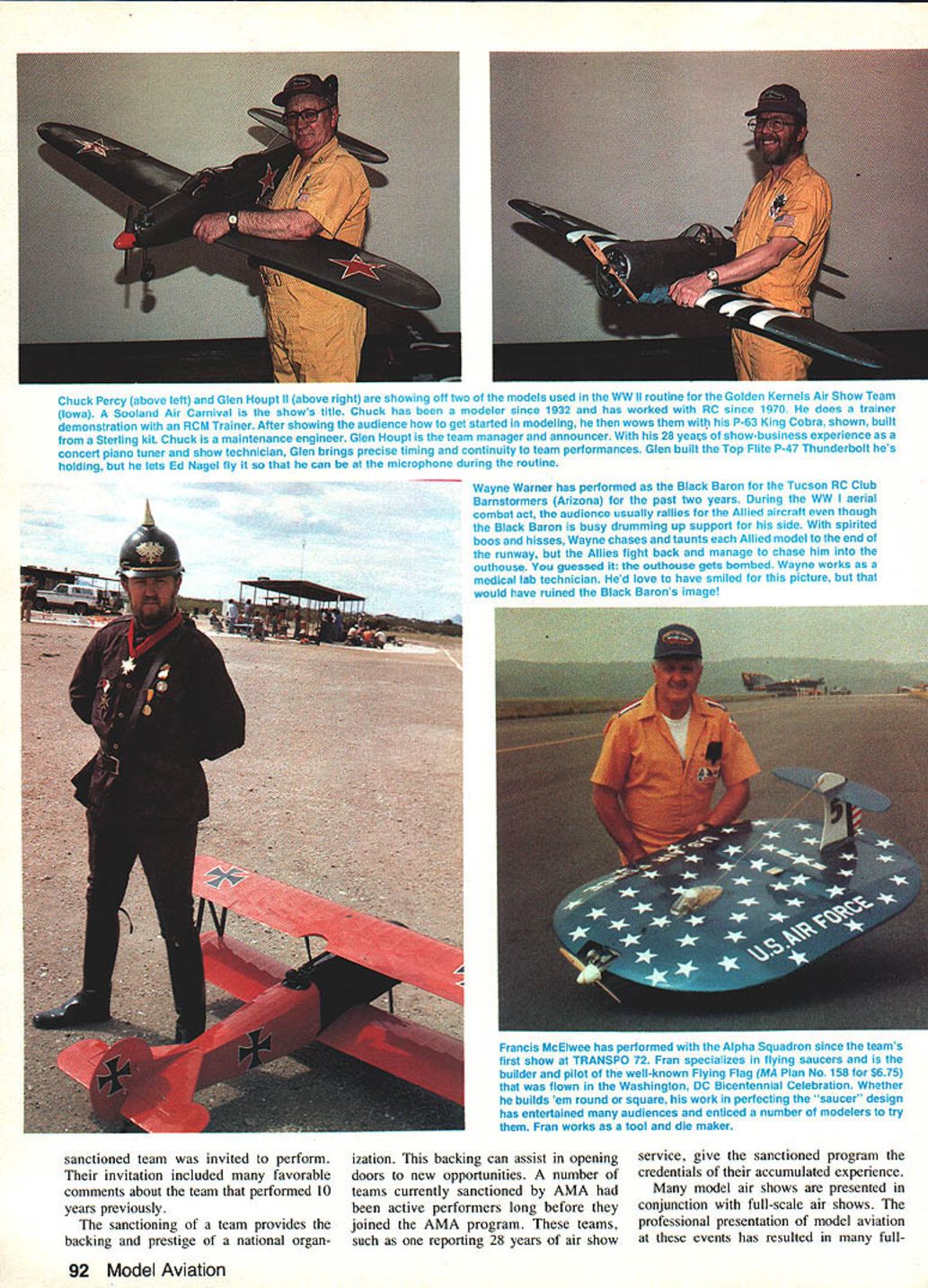
- The Black Baron: For WW I–themed teams, a character who boos Allied aircraft and leads cheers for his side until being chased into a breakaway outhouse rigged to emit smoke charges on cue.
- The novice (clown) act: Often dressed as an out-of-date pilot. Small hints (a model made from “leftovers,” a radio labeled “Klutz”) set up comic doubt. The clown is “distracted” while another hidden pilot actually flies the model. A caller keeps the hidden pilot informed about the clown’s attention; every distraction makes the model behave crazily—and the audience erupts.
The announcer is a central figure—master of ceremonies whose job far exceeds naming performers and airplanes. The announcer sets scenes and creates atmospheres of nostalgia, surprise, laughter, appreciation, or anticipation, enhancing every performance and helping routines like the novice act succeed.
Starting a Team
Clubs interested in establishing a team (or teams considering the AMA-sanctioned program) can get information by calling AMA Headquarters and asking for the Public Relations Department. The phone number at the National Center for Aeromodelling is (703) 435-0750.
Impact and Reception
Is all the hard work worth it? Do teams make a lasting impression? Three experiences answer for many:
- After one team’s large air show, a local hobby shop reported a considerable increase in model sales; many buyers said their interest was sparked by the air show.
- A radio personality told a DJ partner after seeing a team’s show, “I never knew model airplanes could do all the things I saw them do yesterday.”
- Repeat events generate loyal audiences: attendees return year after year, bring cameras, notice changes, and even recall details from previous shows.
Are the teams making a good and lasting impression? You bet they are!
Transcribed from original scans by AI. Minor OCR errors may remain.

