
AMA Building Fund: Update IX
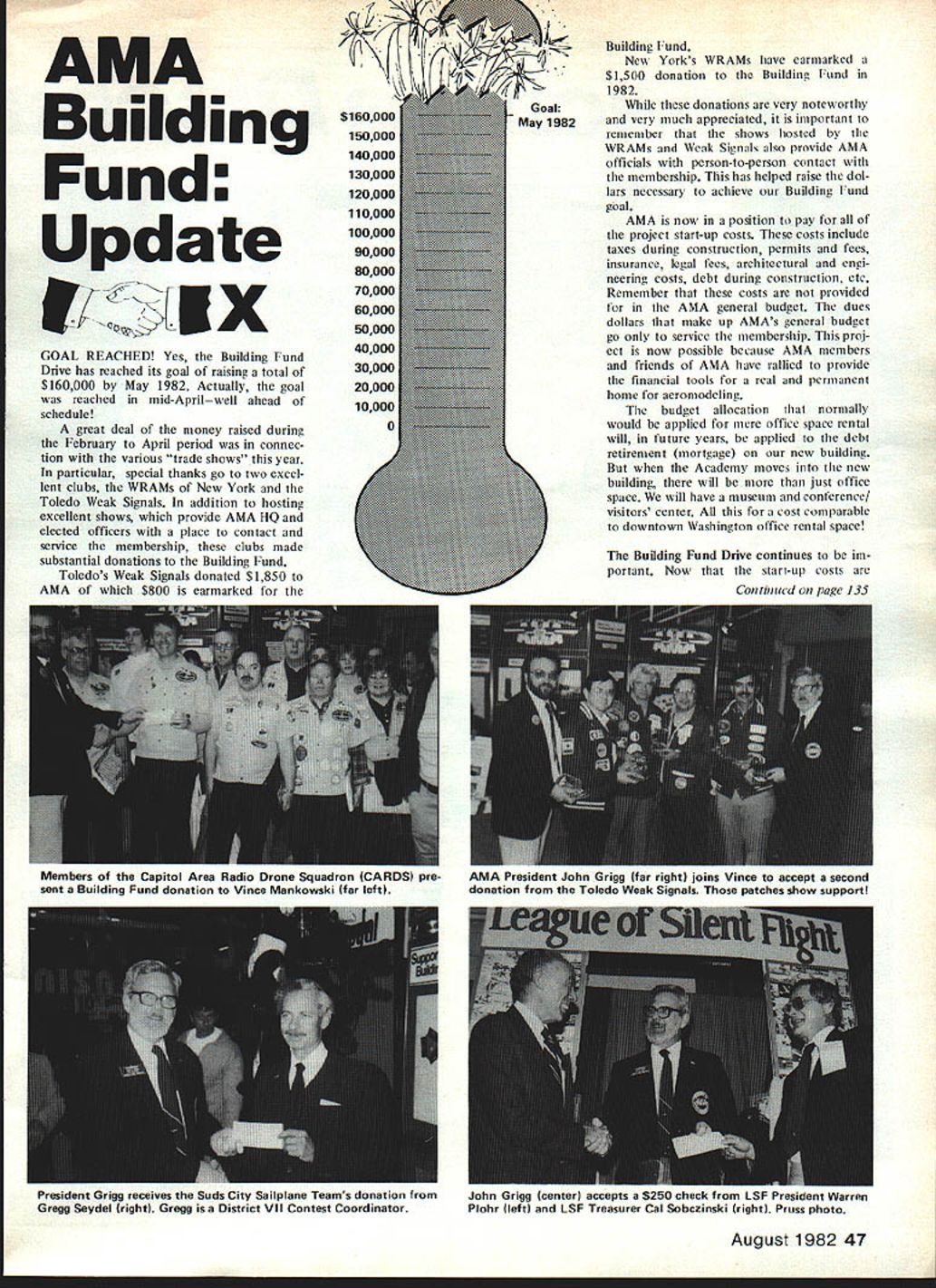
GOAL REACHED! The Building Fund Drive has reached its goal of raising a total of $160,000 by May 1982. In fact, the goal was reached in mid‑April — well ahead of schedule.
Special thanks to clubs and trade shows
- A great deal of the money raised during February–April came from trade shows.
- Special thanks to the WRAMs (New York) and the Toledo Weak Signals. These clubs not only hosted excellent shows that gave AMA HQ and elected officers a place to contact and serve the membership, but they also made substantial donations to the Building Fund.
Notable donations
- Toledo Weak Signals donated $1,850 to AMA, of which $800 is earmarked for the Building Fund.
- New York’s WRAMs have earmarked a $1,500 donation to the Building Fund.
Use of donations and member contact
- These donations are very much appreciated.
- Equally important, the shows provide AMA officials with person‑to‑person contact with members, which helped raise the dollars necessary to achieve the Building Fund goal.
Project start‑up costs covered AMA is now in a position to pay all project start‑up costs. These include:
- taxes during construction
- permits and fees
- insurance
- legal fees
- architectural and engineering costs
- debt during construction
Note: These start‑up costs are not provided for in the AMA general budget. Dues dollars that make up AMA’s general budget go only to service the membership. This project became possible because AMA members and friends rallied to provide the financial tools for a real and permanent home for aeromodeling.
Future budget allocation
- The budget allocation that normally would be applied to office space rental will, in future years, be applied to debt retirement (mortgage) on the new building.
- The Academy’s new building will include more than office space: it will house a museum and a conference/visitors’ center — all for a cost comparable to downtown Washington office rental space.
The Building Fund Drive continues to be important.
Giant Scale Operations and Safety
Flight testing and probabilities
- Initial test flights are usually conducted with minimal people present and well away from other activities. This keeps both the likelihood of engine failure at liftoff (probability No. 1) and the risk to bystanders (probability No. 2) low.
- Example: One pilot experienced an engine failure on liftoff but had reduced the second probability to almost zero by testing in a remote area; the risk was low.
- Example: On April 18, 1982, Bob Campbell flew his B‑29 for the first time at a full‑scale airport with few people present; the first flights were completely successful and the risk remained minimal.
Spectator interest and increased risk
- After successful initial testing, owners understandably want to show their creations. As spectator interest increases, probability No. 2 (risk to people) increases even though probability No. 1 (mechanical failure) may be lower.
- Because the probability of a crash can never be reduced to zero, it is important to keep probability No. 2 as low as possible through crowd control.
AMA insurance condition and flight‑line rules
- AMA has lifted its 40‑pound limitation for insurance purposes (separate from competition rules), but included a condition: any aircraft over 20 pounds must abide by the rules for Air Show Team operations.
- Practically, this means establishing a flight line so that all flight operations stay on one side and all spectators remain on the other. This is an important step toward crowd control.
Recommended separation distances
- Many Giant Scale operations go further and specify a minimum distance (usually about 100 ft.) between spectators and the flight line.
- Some outstanding events (Merwin Ranch fly‑ins in California, STARS Spangled Rally in Olean, NY) enforce about 300 ft. separation between flight line and pits/spectators.
- For sites that lack large separation, a reasonable minimum separation for any RC model (from 1/2A up to Giant Scale) is 50–75 ft, with an upper weight limit of about 30–40 pounds. Aircraft above that weight should require increased separation to keep risk low.
- Larger and multi‑engined aircraft builders typically will not fly unless conditions meet these more restrictive safety standards.
Characteristics of the “average” Giant Scale model
- Often single‑engined
- Weighs about 25–27 pounds
- Wing loading three‑quarters to one‑half that of normal sport and pattern models
- Flies more slowly and is generally more stable than smaller models
- Such aircraft, when flown properly, can be operated as safely as any normal model and are often operated even more safely.
Examples of safe, well‑controlled operations
- Merwin Ranch fly‑ins (California)
- STARS Spangled Rally (Olean, NY)
In both cases, the flight line is about 300 ft. from pits and spectator areas and the separation is actively enforced.
Attitudes toward Giant Scale
- Some critics call Giant Scale aircraft “dangerous monsters,” using arguments similar to those used decades ago against gasoline‑engine models.
- We are not unfeeling; we are simply modelers who take safety seriously and respect the rights and safety of others.
AMA Building Fund: Update X
GOAL REACHED Yes — the Building Fund Drive has reached its goal, raising a total of $160,000 (May 1982). The goal was actually reached mid‑April — well ahead of schedule.
Fundraising highlights
- Much of the February–April fundraising came through trade shows.
- Special thanks to WRAMs (New York) and Toledo Weak Signals for hosting shows and making substantial donations.
Notable donations (1982)
- Toledo Weak Signals: $1,850 total; $800 earmarked for the Building Fund.
- WRAMs (New York): $1,500 earmarked for the Building Fund.
Importance of shows
- Shows provided AMA headquarters and elected officers with opportunities for person‑to‑person contact with members, which helped raise the funds needed to reach the Building Fund goal.
Project funding and purpose
- AMA can now pay project start‑up costs (taxes during construction, permits and fees, insurance, legal and architectural/engineering costs, debt during construction).
- Dues dollars in the AMA general budget serve the membership; this building project was made possible by members and friends who provided the financial resources for a permanent home for aeromodeling.
- Future savings from not renting office space will be applied to mortgage retirement.
- The new facility will include office space, a museum, and a conference/visitors’ center at a cost comparable to downtown Washington office rental space.
The Building Fund Drive remains important as the project moves forward.
Transcribed from original scans by AI. Minor OCR errors may remain.

