
AMA Indoor Nats and NFFS U.S. Indoor Champs
This year the combined AMA and NFFS events followed hot on the heels of the important FAI World Champs at the Johnson City Minidome. The event attracted a record 142 entrants from 27 states and several foreign countries. —Bob Clemens
Overview
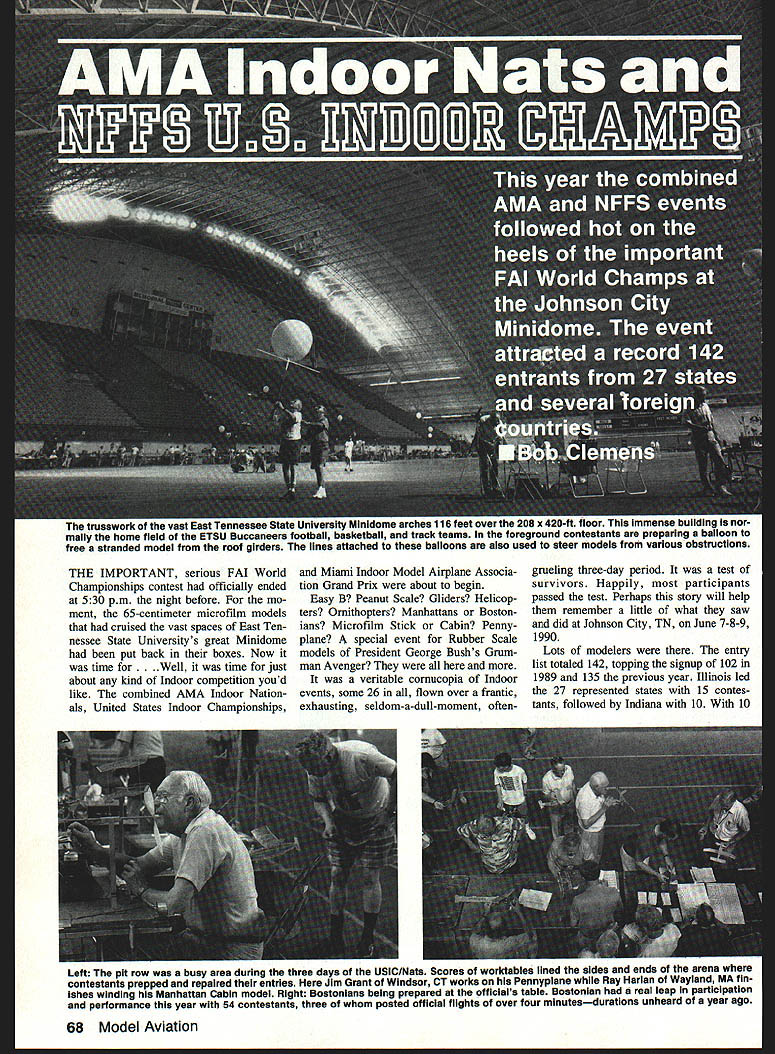
The formal FAI World Championships had officially ended the night before. The 65-centimeter microfilm models that had cruised the vast spaces of East Tennessee State University's Minidome had been put back in their boxes. Now it was time for nearly any kind of indoor competition you could imagine. The combined AMA Indoor Nationals, United States Indoor Championships (USIC), and Miami Indoor Model Airplane Association (MIAMA) Grand Prix ran across a frantic, exhausting, seldom-dull three-day period (June 7–9, 1990).
There were 26 events in all. The entry list totaled 142—topping 102 in 1989 and 135 the previous year. Illinois led the 27 represented states with 15 contestants, followed by Indiana with 10. Entries came from Canada, the U.K., France, and Switzerland; many competitors were layovers from the FAI Championships who wanted more flying in the Minidome's nearly ideal atmosphere.
Event turnout and atmosphere
- Total entrants: 142 from 27 states
- International entries: Canada, U.K., France, Switzerland
- Number of events: 26
- Dates: June 7–9, 1990
It was the second time the Indoor competition had been completely separated, in time and place, from the rest of the AMA Nationals. Many contestants welcomed the move, recalling less-than-ideal venues used in integrated Nats of past years.
Gliders
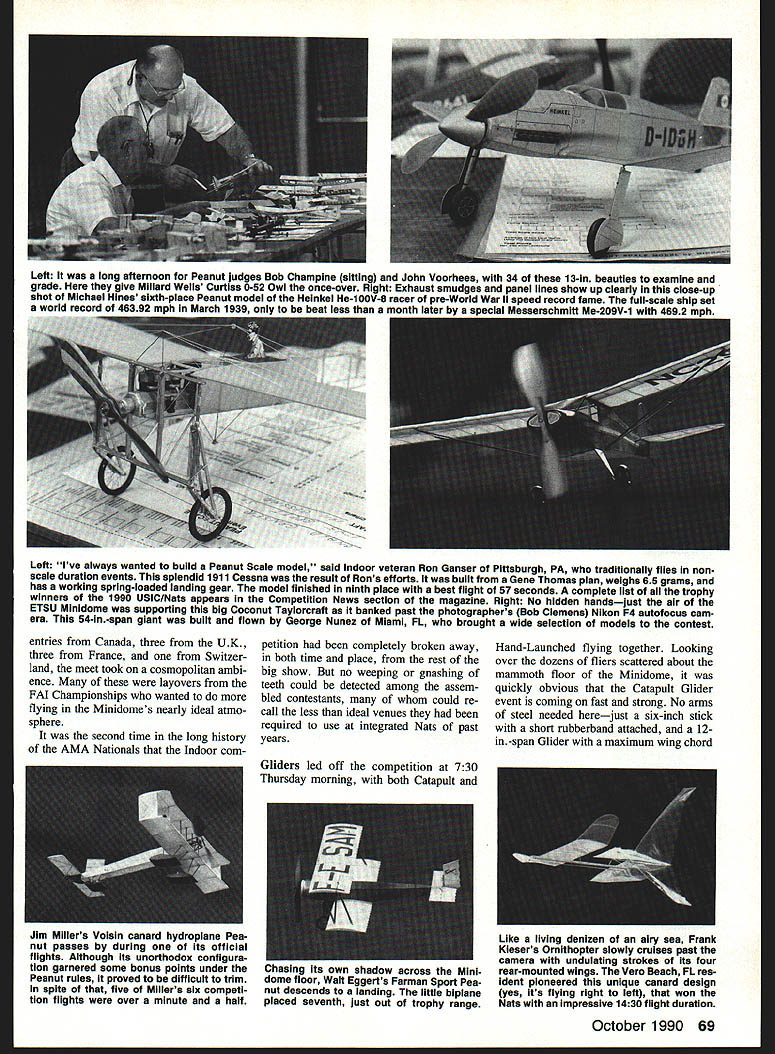
Gliders opened the competition at 7:30 Thursday morning, with Catapult and Hand-Launched flying together. Looking over dozens of fliers scattered across the Minidome floor, it was clear Catapult Glider is growing fast. The event requires only a six-inch stick of short rubber and a 12-inch-span glider with a maximum wing chord of three inches.
Catapult Glider vs Hand-Launched
- Catapulters: 46
- Hand-launched throwers: 27
Many newcomers discovered the subtleties of catapult technique. If you couldn't fly over a minute, you had little chance of winning. The best flights rode an arrowlike launch to just under the 116-ft. ceiling, then flicked to the floor with a quarter-roll into a slow descending circle.
Notable pilots included Cezar Banks (member of the U.S. World Champs team), longtime microfilmer Bob Champine (6th), Phil Kintworth, Gordon Wisniewski, and Rich Doig.
Easy B
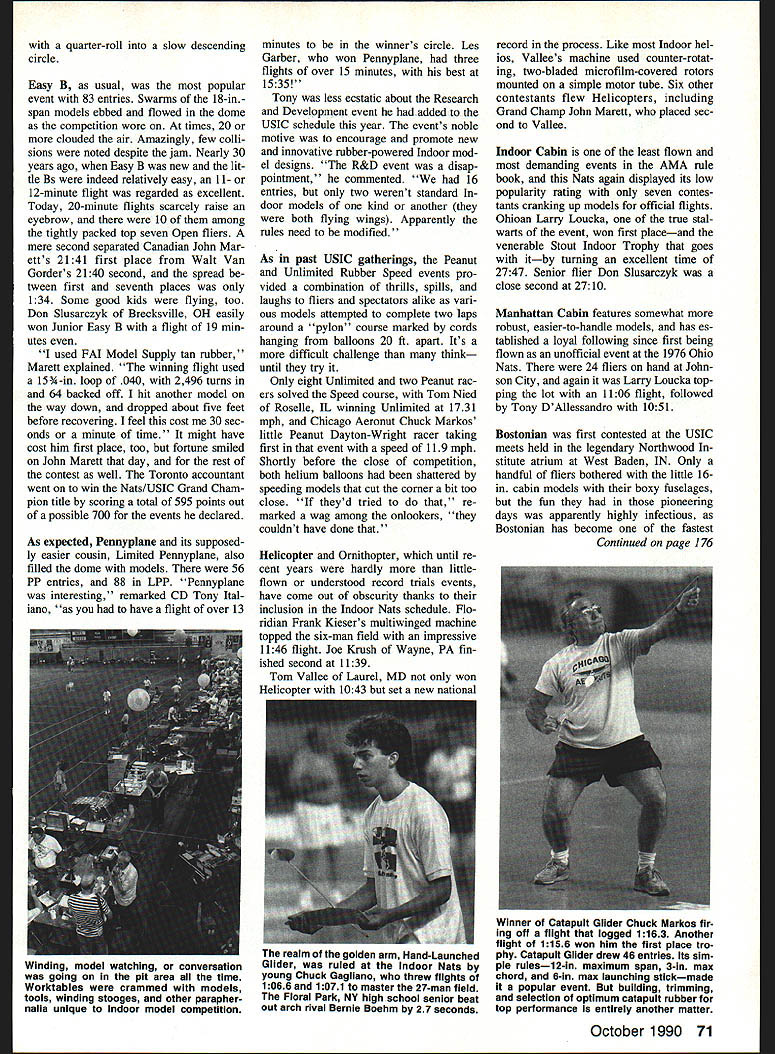
Easy B was the most popular event with 83 entries. The 18-inch-span models filled the dome; at times 20 or more models were airborne simultaneously, yet collisions were rare. Flight times have increased dramatically since Easy B's early days—today, 20-minute flights are common.
- Winner (Open): John Marett, 21:41
- Second: Walt Van Gorder, 21:40
- Junior Easy B winner: Don Slusarczyk (Brecksville, OH), 19:00
Marett used FAI Model Supply tan rubber, a 1-5/8-inch loop of .040, and 2,496 turns in the 64-back. He went on to win the Nats/USIC Grand Champion title with 595 points out of a possible 700 for declared events.
Pennyplane and Limited Pennyplane
Pennyplane (PP) and Limited Pennyplane (LPP) were well attended.
- Pennyplane entries: 56
- Limited Pennyplane entries: 88
Les Garber won Pennyplane with three flights over 15 minutes; his best was 15:35. According to Contest Director Tony Italiano, a flight over 13 minutes was needed to make the winners' circle.
Research & Development (R&D)
Tony Italiano added an R&D event to encourage innovative rubber-powered indoor designs. The turnout was disappointing: 16 entries, but only two were not standard indoor models (both were flying wings). Italiano felt the rules may need modification to better meet the event's goals.
Rubber Speed (Peanut and Unlimited)
Peanut and Unlimited Rubber Speed provided thrills as models attempted to complete two laps around a pylon course marked by cords hung from balloons 20 ft. apart. Only a few racers completed the course cleanly.
- Unlimited winner: Tom Niel (Roselle, IL), 17.31 mph
- Peanut winner: Chuck Markos (Chicago Aeronut), 11.9 mph
Shortly before the close of competition both helium balloons were shattered by models cutting corners too closely.
Helicopter and Ornithopter
Ornithopter
Ornithopter has emerged from obscurity as a competitive event. Floridian Frank Kieser's multi-winged machine topped the six-man Ornithopter field with an 11:46 flight. Joe Krush (Wayne, PA) finished second at 11:39.
Helicopter
Tom Vallee (Laurel, MD) won Helicopter with 10:43, setting a new national record. Like most indoor helicopters, Vallee's machine used counter-rotating, two-bladed microfilm-covered rotors mounted on a simple motor tube. Six other contestants flew Helicopters, including Grand Champ John Marett, who placed second to Vallee.
Indoor Cabin, Manhattan Cabin, and Bostonian
Indoor Cabin
Indoor Cabin is one of the least-flown and most demanding AMA events. Only seven contestants flew. Ohioan Larry Loucka won first place and the venerable Stout Indoor Trophy with 27:47. Senior flier Don Slusarczyk was a close second at 27:10.
Manhattan Cabin
Manhattan Cabin features more robust, easier-to-handle models. Twenty-four contestants competed. Larry Loucka again topped the field with 11:06, followed by Tony D'Allessandro with 10:51.
Bostonian
Bostonian grew from early USIC meets and has become one of the fastest-growing indoor events. No fewer than 54 people signed up; 48 actually flew. Flight times increased noticeably, likely due to wider use of tan rubber.
- Tied for first: Richard Miller and Bill Henderson, 4:16 (charisma ratings 1.15), forcing a flyoff.
- Flyoff winner: Richard Miller (used a 42-in. loop of .075 tan, 4,000 turns, ROG'd for 4:10)
- Henderson (Canadian) attempted to power through but blew two motors in the flyoff.
Both used models with the required 1.5 x 2.5 x 3-inch box-section tail that provided partial lift. Three- and four-bladed propellers were common among entries.
AMA Rubber Scale
AMA Rubber Scale had 14 entries, including one biplane and three low-wingers. Canadian Ken Groves won flying another in his long series of well-crafted Fike Dream replicas with a total score of 183 and flights of 90 and 89 seconds (90 seconds is the max). Second place went to Cincinnati's Jim Miller, flying a Lacey M-10.
Federation ROG (FROG)
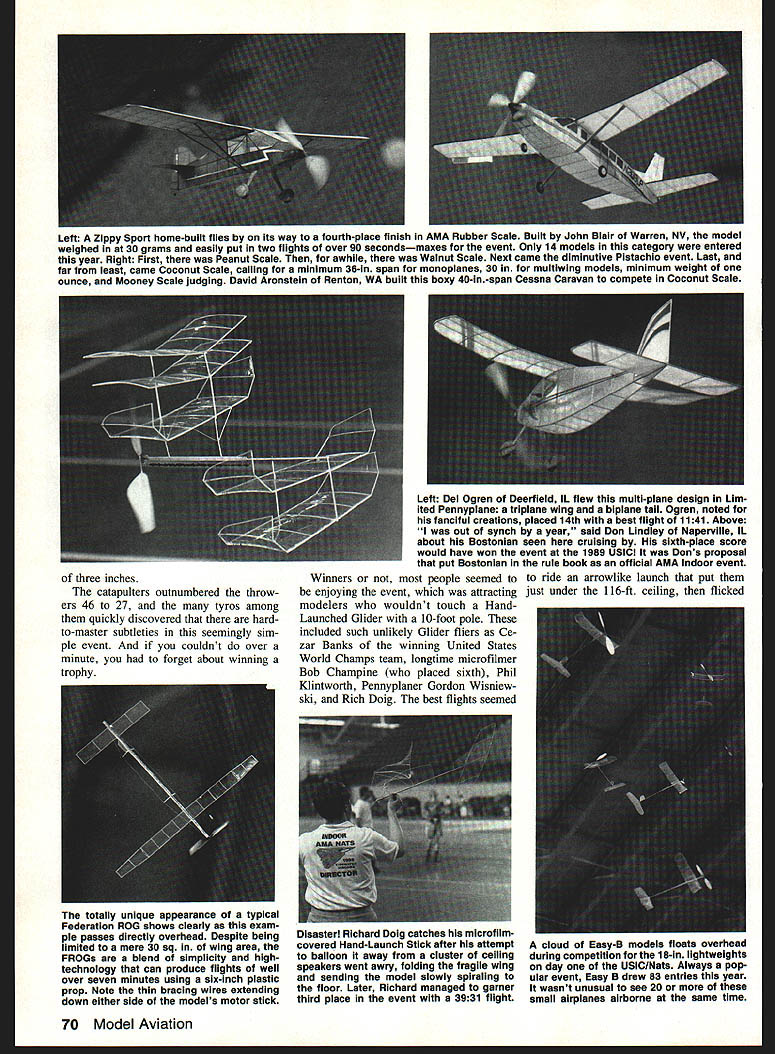
Federation ROG (FROG) traces its origins to the Delaware Federation's beginner ROG event. Today’s FROGs must weigh at least 3.1 grams, use a six-inch plastic propeller, and have a maximum wing area of 30 sq. in. Modern FROGs are hybrids with long motor sticks and lightweight plastic film covering, and they use long rubber loops (about 50 in. or more) stretched to some 27 ft. or more during winding.
FROG flights were impressive—many over six minutes, several topping seven.
- Team winners (Washington State): Dave Aronstein and Andrew Tagliamico — best two-flight total 25:39 (Aronstein 7:17)
- Individual winner: Jim Clem — high time 7:51
MIAMA Grand Prix
The MIAMA Grand Prix (held Saturday) added unique small-scale and novelty events.
Events:
- Pistachio Scale: models no longer than 6 inches or spans no greater than 8 inches.
- Coconut Scale: stand-off Rubber Scale for 36-in. or larger monoplanes and 30-in. or better multiplanes with a minimum weight of one ounce (only monoplanes entered).
- President George Bush's Grumman Avenger: contestants built 20-in. replicas from the same Comet kit pattern.
Results:
- Coconut Scale winner: Dr. John Martin — Messerschmitt M-20b transport, 2:01 flight (higher scale score despite a shorter duration than Dan Andersson's Cessna Caravan)
- Third: Millard Wells — Ford 2-AT transport with simulated corrugation
- Special mass ROG launch (Coconuts): Dave Aronstein, 1:34 (was still cruising after others had landed)
- President George Bush Grumman Avenger: George Nunez (FL) — best 1:10.8; Nunez also won Pistachio Scale with a Sopwith Triplane
- Ridotto award (smallest scale model to exceed 30 seconds): Millard Wells — 4½-inch Beardmore Wee Bee, 40 seconds
Microfilm Duration and FAI Events
Microfilm Duration returned late Saturday night. Few contestants or spectators remained as the slow-flying lightweights battled in the closing hours.
- Microfilm Duration winner: Hewitt Phillips (Hampton, VA), 24:45
In the FAI event, Bob Randolph outflew World Champion Jim Richmond and runner-up Cezar Banks with flights of 41:29 and 40:40 for a 1:22:09 total. Cezar Banks was second at 1:21:11, and Jim Richmond third at 1:18:21.
AMA Hand-Launch Stick
Jim Richmond won AMA Hand-Launch Stick with 4:42.20, earning the Stout Commercial Trophy for 1990. Other award winners included Bob Randolph, Rich Doig, Larry Loucka, and Dan Belieff.
Closing
As their flights ended, so did the 1990 USIC/AMA Nats contest. CD Tony Italiano summed it up: "The start of a new indoor flying decade came off with a most successful competition. The turnout was the best we have ever experienced, and the cooperation was great!"
Transcribed from original scans by AI. Minor OCR errors may remain.

