
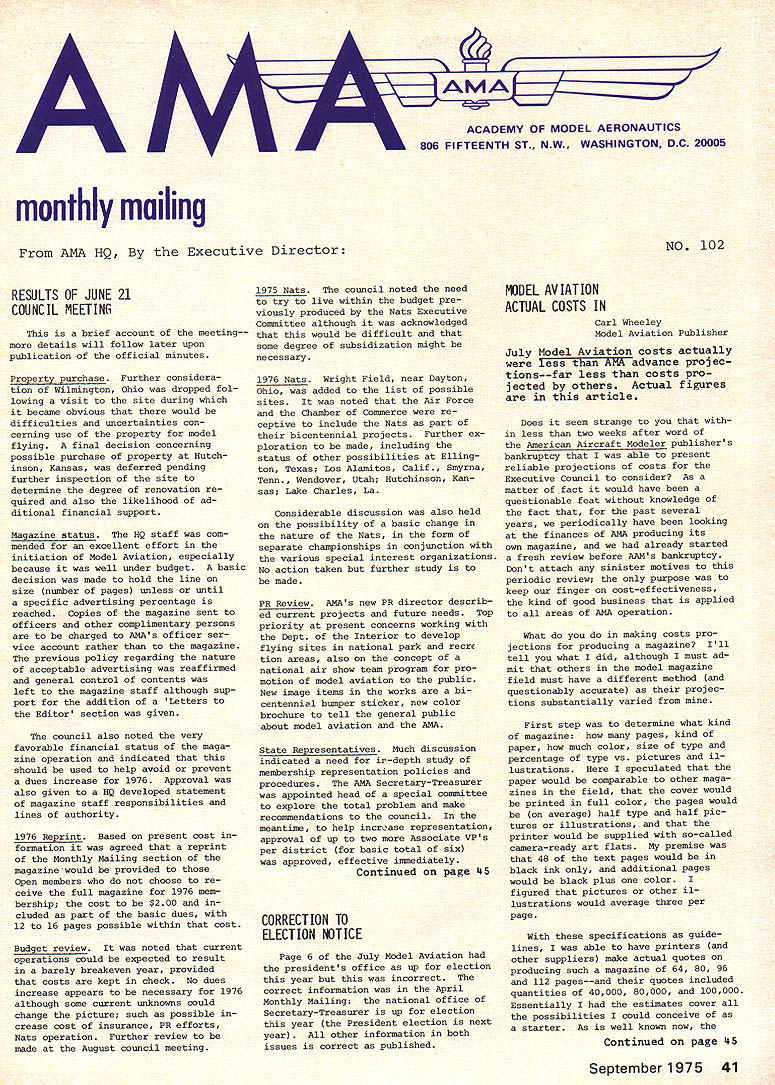
From AMA HQ, By the Executive Director:
RESULTS OF JUNE 21 COUNCIL MEETING
This is a brief account of the meeting—more details will follow later upon publication of the official minutes.
Property purchase. Further consideration of Wilmington, Ohio was dropped following a visit to the site during which it became obvious that there would be difficulties and uncertainties concerning use of the property for model flying. A final decision concerning possible purchase of property at Hutchinson, Kansas, was deferred pending further inspection of the site to determine the degree of renovation required and also the likelihood of additional financial support.
Magazine status. The HQ staff was commended for an excellent effort in the initiation of Model Aviation, especially because it was well under budget. A basic decision was made to hold the line on size (number of pages) unless or until a specific advertising percentage is reached. Copies of the magazine sent to officers and other complimentary persons are to be charged to AMA’s officer service account rather than to the magazine. The previous policy regarding the nature of acceptable advertising was reaffirmed and general control of contents was left to the magazine staff although support for the addition of a "Letters to the Editor" section was given. The council also noted the very favorable financial status of the magazine operation and indicated that this should be used to help avoid or prevent a dues increase for 1976. Approval was also given to a HQ developed statement of magazine staff responsibilities and lines of authority.
1976 Reprint. Based on present cost information it was agreed that a reprint of the Monthly Mailing section of the magazine would be provided to those open members who do not choose to receive the full magazine for 1976 membership; the cost to be $2.00 and included as part of the basic dues, with 12 to 16 pages possible within that cost.
Budget review. It was noted that current operations could be expected to result in a barely break-even year, provided that costs are kept in check. No dues increase appears to be necessary for 1976 although some current unknowns could change the picture; such as possible increase in cost of insurance, PR efforts, the Nats operation. Further review to be made at the August council meeting.
1975 Nats. The council noted the need to try to live within the budget previously produced by the Nats Executive Committee although it was acknowledged that this would be difficult and that some degree of subsidization might be necessary.
1976 Nats. Wright Field, near Dayton, Ohio, was added to the list of possible sites. It was noted that the Air Force and the Chamber of Commerce were receptive to include the Nats as part of their bicentennial projects. Further exploration to be made, including the status of other possibilities at Ellington, Texas; Los Alamitos, Calif.; Smyrna, Tenn.; Wendover, Utah; Hutchinson, Kansas; Lake Charles, La. Considerable discussion was also held on the possibility of a basic change in the nature of the Nats, in the form of separate championships in conjunction with various special interest organizations. No action taken but further study is to be made.
PR Review. AMA’s new PR director described current projects and future needs. Top priority at present concerns working with the Dept. of the Interior to develop flying sites in national park and recreation areas, also on the concept of a national air show team program to promote model aviation to the public. New image items in the works are a bicentennial bumper sticker, new color brochure to tell the general public about model aviation and the AMA.
State Representatives. Much discussion indicated a need for in-depth study of membership representation policies and procedures. The AMA Secretary-Treasurer was appointed head of a special committee to explore the total problem and make recommendations to the council. In the meantime, to help increase representation, approval of up to two more Associate VPs per district (for a basic total of six) was approved, effective immediately.
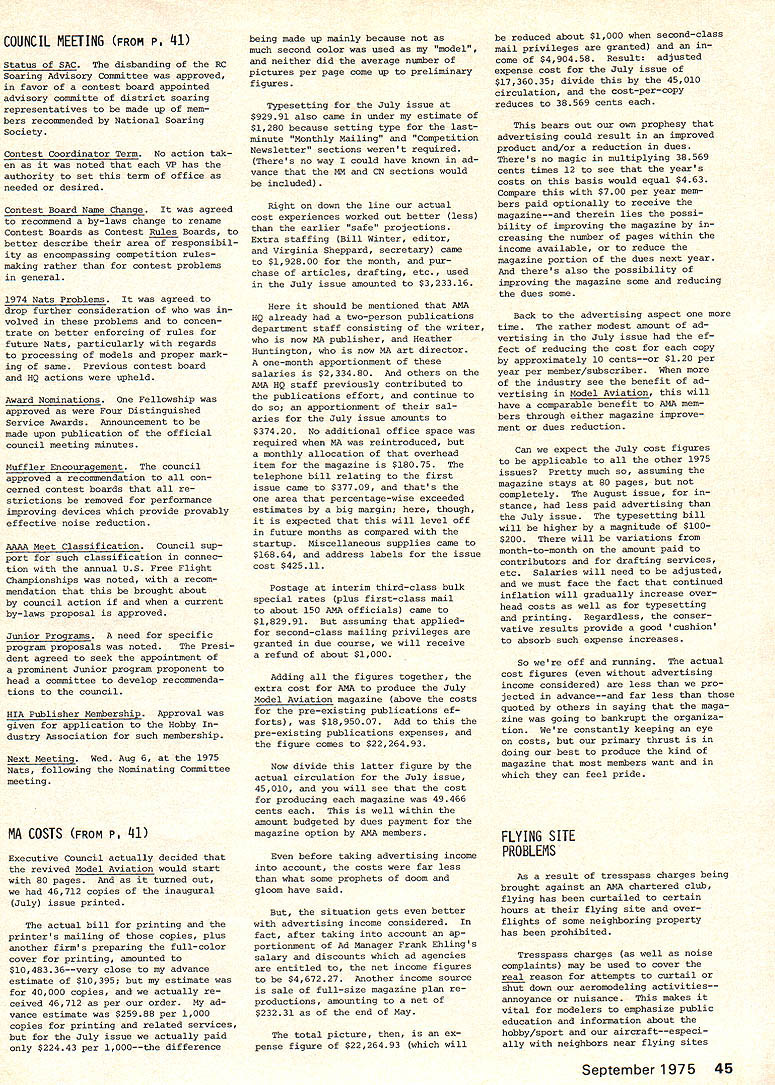
AMA: Monthly Mailing
being made up mainly because not as much second color was used as my "model", and neither did the average number of pictures per page come up to preliminary figures.
Typesetting for the July issue at $929.91 also came in under my estimate of $1,280 because setting for the last-minute "Monthly Mailing" and "Competition Newsletter" sections weren't required. (There's no way I could have known in advance that the MM and CN sections would not be included.)
Right on down the line our actual cost experiences worked out better (less) than the earlier "safe" projections. Extra staffing (Bill Winter, editor, and Virginia Sheppard, secretary) came to $1,928.00 for the month, and purchase of articles, drafting, etc., used in the July issue amounted to $3,233.16.
Here it should be mentioned that AMA already had a two-person publications department staff consisting of the writer, who is now AMA publisher, and the other Huntington, who is now MA art director. A one-month apportionment of these two salaries is $2,334.80. Other than the previous contributions to the publications effort, and continued to do so, an apportionment of their salaries for the July issue amounts to $874.20. No additional office space was required when MA was reintroduced, but a monthly allocation of that overhead item for the magazine is $180.75. The telephone bill relating to the first issue came to $372.09, and that's the area that percentage-wise exceeded estimates by a big margin; here, though, it is expected that this will level off with future issues as compared with the start-up. Miscellaneous supplies came to $168.64, and address labels for the issue cost $425.11.
Postage at interim third-class bulk special rates (plus first-class mail to about 150 AMA officials) came to $1,829.91. But assuming that applied-for second-class mailing privileges are granted in due course, we will receive a refund of about $1,000.
Adding all the figures together, the extra cost for AMA to produce the July Model Aviation magazine (above the costs for the pre-existing publications effort), was $18,950.07. Add to this the pre-existing publications expenses, and the figure comes to $22,264.93.
Now divide this latter figure by the actual circulation for the July issue, 45,010, and you will see that the cost for producing each magazine was 49.66 cents each. This is well within the amount budgeted by dues payment for the magazine option by AMA members.
Even before taking advertising into account, the costs were far less than what some prophets of doom and gloom have said.
But, the situation gets even better with advertising income considered. In fact, after taking into account an apportionment of Ad Manager Frank Ehling's salary and discounts which ad agencies are entitled to, the net income figures are $6,672.27. Another income source is sale of full-size magazine plan reproductions amounting to a net of $232.31 as of the end of May.
The total picture, then, is an expense figure of $22,264.93 (which will be reduced about $1,000 when second-class mail privileges are granted) and an income of $4,904.58. Result: adjusted expense cost for the July issue of $17,360.35; divide this by the 45,010 circulation, and the cost-per-copy reduces to 38.569 cents each.
This bears out our own prophesy that advertising could result in an improved product and/or a reduction in dues. There's no magic in multiplying 38.569 cents times 12 to see that the year's costs on this basis would equal $4.63. Compare this with $7.00 per year members paid optionally to receive the magazine—and there lies the possibility of improving the magazine by increasing the number of pages within the income available, or to reduce the magazine portion of the dues next year. And there's also the possibility of increasing the magazine income and reducing the dues some.
Back to the advertising aspect one more time. The rather modest amount of advertising in the July issue had the effect of reducing the cost for each copy by approximately 10 cents—or $1.20 per year member/subscriber. When more of the industry sees the benefit of advertising in Model Aviation, this will have a comparable benefit to AMA members through either magazine improvement or dues reduction.
Can we expect the July cost figures to be applicable to all the other 1975 issues? Pretty much so, assuming the magazine stays at 80 pages, but not completely. The August issue, for instance, had less paid advertising than the July issue. The typesetting bill will be higher by a magnitude of $100 to $200, and there will be variations from month-to-month depending on contributions and on drafting services, etc. Salaries will be more stable and we must face the fact that continued inflation will gradually increase overhead costs as well as for typesetting and printing. Regardless, the conservative results provide a good "cushion" to absorb such expense increases.
So we're off and running. The actual cost figures (even without advertising income considered) are less than we projected in advance—and far less than those quoted by others in saying that the magazine was going to bankrupt the organization. We're constantly keeping an eye on costs, but our primary thrust is in ensuring our best product—the kind of magazine that most members want and in which they can feel pride.
RESULTS OF JUNE 21 COUNCIL MEETING
Property purchase. Further consideration of Wilmington, Ohio was dropped following a visit to the site during which it became obvious that there would be difficulties and uncertainties concerning use of the property for model flying. A final decision concerning possible purchase of property at Hutchinson, Kansas was deferred pending further inspection of the site to determine the degree of renovation required and also the likelihood of additional financial support.
Magazine status. The HQ staff was commended for an excellent effort in the initiation of Model Aviation, especially because it was well under budget. A basic decision was made to hold the line on size (number of pages) unless or until a specific advertising percentage is reached. Copies of the magazine sent to officers and other complimentary persons are to be charged to AMA’s officer service account rather than to the magazine. The previous policy regarding the nature of acceptable advertising was reaffirmed and general control of contents was left to the magazine staff although support for the addition of a “Letters to the Editor” section was given. The council also noted the very favorable financial status of the magazine operation and indicated that this should be used to help avoid or prevent a dues increase for 1976. Approval was also given to a HQ developed statement of magazine staff responsibilities and lines of authority.
1976 Reprint. Based on present cost information it was agreed that a reprint of the Monthly Mailing section of the magazine would be provided to those or open members who do not choose to receive the full magazine for 1976 membership; the cost to be $2.00 and included as part of the basic dues, with 12 to 16 pages possible within that cost.
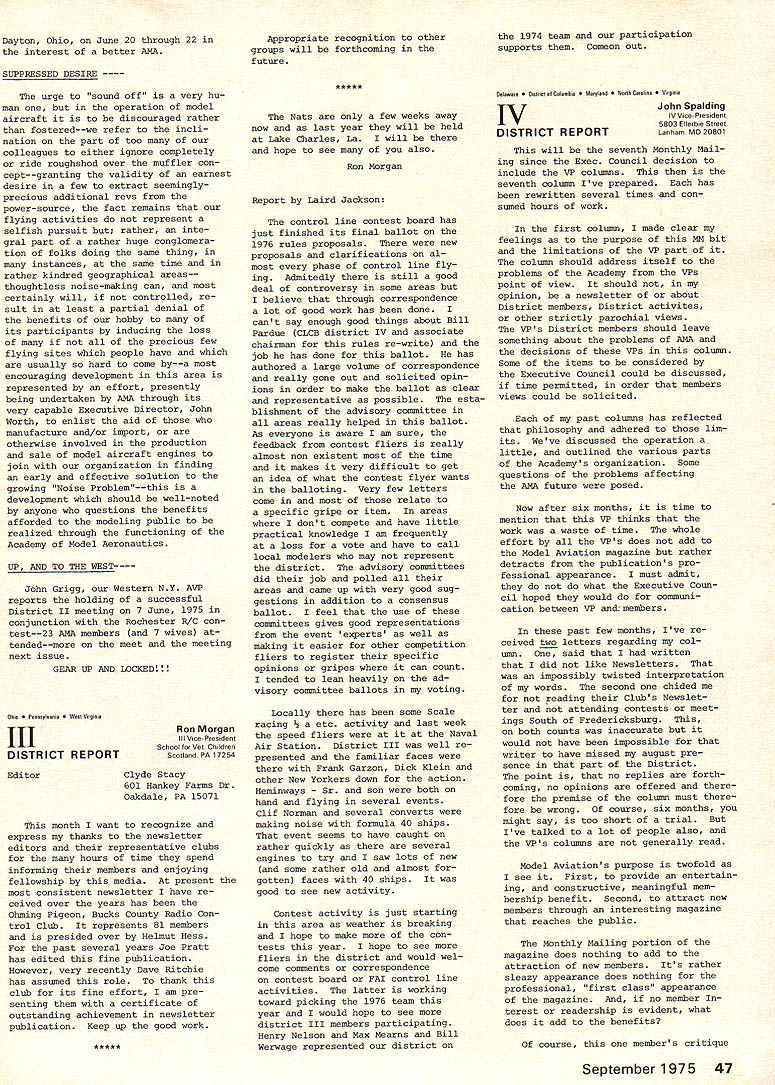
State Representatives. Much discussion indicated a need for in-depth study of membership representation policies and procedures. The AMA Secretary-Treasurer was appointed head of a special committee to explore the total problem and make recommendations to the council. In the meantime, to help increase representation, Appropriate recognition to other groups will be forthcoming in the future.
*****
The Nats are only a few weeks away now and as last year they will be held at Lake Charles, La. I will be there and hope to see many of you also.
Ron Morgan
Report by Laird Jackson:
The control line contest board has just finished its final ballot on the 1976 rules proposals. There were new proposals and clarifications on almost every phase of control line flying. Admittedly there is still a good deal of controversy in some areas but I believe that through correspondence a lot of good work has been done. I can't say enough good things about Bill Pardue (CLC district IV and associate chairman for this rule re-write) and the job he has done for this ballot. He has authored a large volume of correspondence and really gone out and solicited opinions in order to make the ballot as clear and representative as possible. The establishment of the advisory committee in all areas really helped in this ballot. As everyone is aware I am sure, the feedback from contest fliers is really almost nonexistent most of the time and it makes it very difficult to get an idea of what the contest flyer wants in the balloting. Very few letters come in and most of those relate to a specific gripe or item. In areas where I don't compete and have little practical knowledge I am frequently at a loss for a vote and have to call local modelers who may not represent the district. The advisory committees did their job and polled all their areas and came up with very good suggestions in addition to a consensus ballot. I feel that the use of these committees gives good representation from the events' "experts" as well as making it easier for other competition fliers to register their specific opinions or gripes where it can count. I tended to lean heavily on the advisory committee ballots in my voting.
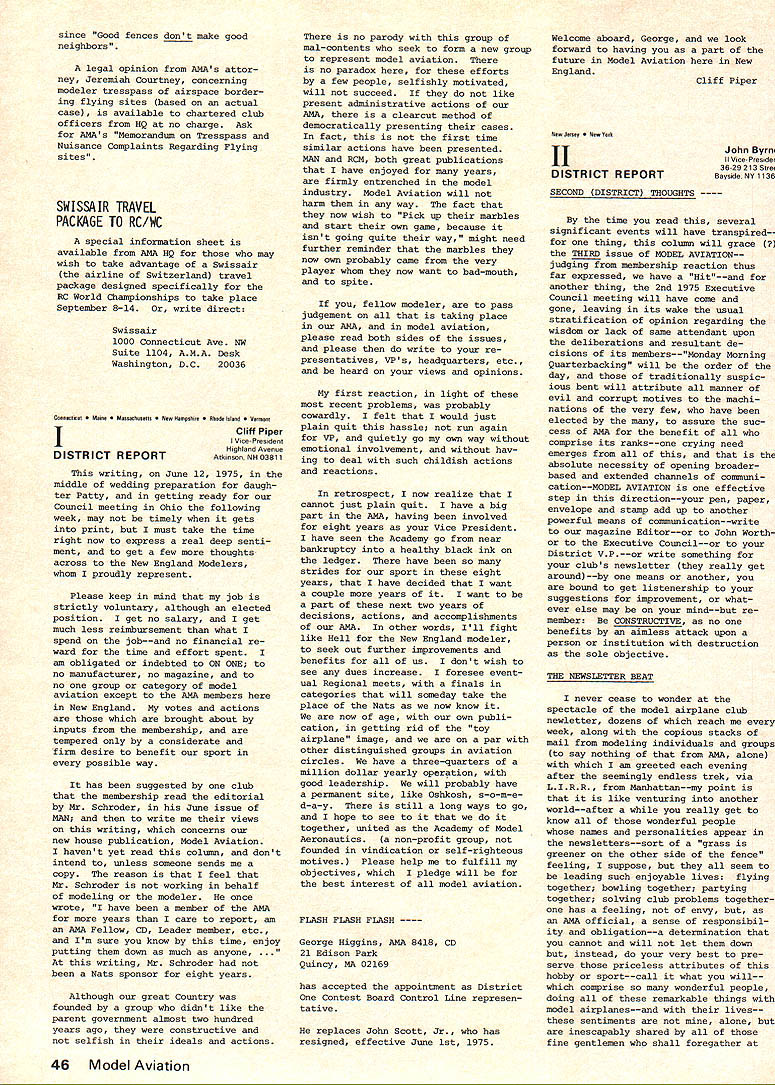
AMA: Monthly Mailing
From AMA HQ, By the Executive Director: RESULTS OF JUNE 21 COUNCIL MEETING
State Representatives. Much discussion indicated a need for in-depth study of membership representation policies and procedures. The AMA Secretary-Treasurer was appointed head of a special committee to explore the total problem and make recommendations to the council. In the meantime, to help increase representation. the Louisville Radio Control Club, Southern Indiana RC Modelers, River City Radio Controllers, the Isotopes (from Owensboro, Ky.), the Knox Model Airplane Club from Fort Knox, and the Lexington Model Airplane Club.
The banquet Saturday night was held at the resort dining hall with Kentucky Park Commissioner Bruce Montgomery attending. Kentucky is one of the most progressive states for recognizing the needs of modelers, and the availability of more model parks there are being considered.
DeKalb, Illinois will be the site for the First Area Aero-Challenge for Muscular Dystrophy on Sunday, August 31. This will be an AAA control-line contest with all proceeds going to the Muscular Dystrophy fund. Prizes will be trophies plus merchandise. Much interest is being generated for this contest, and it looks like an excellent way to promote modeling besides raising money for a notable cause. Your attendance at any other support would be greatly appreciated. Bill "Moose" Allen is the Contest Director and will need help with the various events since he does not have a club in that area.
There is a photo of Margaret and her son, Danny, age 18 months, and another showing her launching her sailplane. Any other women interested in joining W.I.N.G.S. can do so by sending $4.00 to Helen Olsen, Secretary-Treasurer, 70 Durkin Drive, Apt. 349, Springfield, Ill. 62704.
State Representatives. Much discussion indicated a need for in-depth study of membership representation policies and procedures. The AMA Secretary-Treasurer was appointed head of a special committee to explore the total problem and make recommendations to the council. In the meantime, to help increase representation a selection procedure with 50 separate state elections was discussed. The appointment process could be left to the Dist. V.P. At this time our A.V.P.’s are Bud Tenney—Texas, Ned Barnes—Louisiana, Buzz Averill—New Mexico, and Frank Osborne—Arkansas. I am considering some names for Oklahoma now. I am open to suggestions. Let me hear from you Sooners.
The matter of dues structure will be another agenda item. I am sure that no one will be forced to take the Mag. next year. If you are in favor of the magazine, you can show it with your renewal next year. Most of the people I have contacted like it. Get the same from the other A.V.P.’s around the district. We can always expect a few to disagree.
I have a few letters from district members regarding the agenda, but I did not get near enough. I did manage to get to some more contests and talk with the people there. I was at Plano for the Dallas Cliff Cloud Climbers meet. I also made it over to TCU for a Thunderbird soaring bash. The winds were up at both sites, but the interest and flying were good.
Got up to Port Sill for the LAFFS’ soaring contest. Had quite a nice turnout. Buzz Averill was in with a car load from New Mexico. Dale Nutter was down from Tulsa with both boys. Sorry that Jim Simpson was not there, he was at Omaha at the Falcons contest. Hope that Melton Johnson filled him in when they got home. The LAFFS put on a good contest and it was well attended. They are not a soaring club, but rather general interest.
I have been getting rumors similar to the ones before Oshkosh. This is not the last NATS. It will be the last one for Lake Charles. How it goes may have a direct bearing on how the future NATS go. We have been getting suggestions for revamping the NATS for as long as I can remember. If you are planning to come to Lake Charles to compete or just to spectate, your help would be appreciated by the NATS Association.
Attending the NATS is a unique experience. The action takes place at the competition sites, but that is only half of the greatest show in modeling. With the return to the old format, the activity and sessions in the hanger will be as big a part of NATS as it was in the past.
As always I will try to see as many of you as I can when I make it to as many contests as I can. When I do come to your town, you don’t have to be a contestant to look me up. I’ll be happy to talk to you on any subject. Remember if you need help contact the AMA staff and our test board members with your problems. If you come to the LAKE CHARLES NATS, look me up. I may be able to help you.
May 30, 1975
OPEN LETTER TO AMA MEMBERS:
In the past several months we have seen our organization, AMA, and its officers and directors criticized, laid about, kicked in the back and dragged through the mud. It is not pleasant to read about your organization and the people who work for it in such a manner. Some of the mail I have received, and some of the remarks made publicly, have been downright vicious. Many of the letters to the editor and some of the newer organizations have been particularly outspoken.
Throughout all my contacts with AMA members and with members in our district, one outstanding fact stands out—everybody is interested in the future of model aviation and of AMA. You will find that people who complain are usually the ones who are not working with their local clubs. I have written close to a thousand letters in my own defense and in my own behalf. Many of these were to explain the facts as I understood them. I have answered questions and tried to clear up misunderstandings. At times I have been blunt, but only in defense of the organization and those who work for it.
They cried about the qualifications for an editor to run for President of AMA, for the qualifications of the public relations director, and a number of other appointments and actions. They cried because some officers and directors did not meet their personal desires. They cried because AMA publishes a magazine and runs competition programs. They will continue to complain, but please remember that it is impossible to satisfy everyone.
I have tried to answer as many letters as I could and to get to as many of the contests as possible to find out what the membership wants. I have also asked for suggestions and recommendations from those of you who are willing to help. Please continue to let me know your feelings and your ideas. I will try to act upon them where possible, and I will explain why I cannot act when I must refuse.
We have got a fine organization and a staff that tries to do a professional job. They are not perfect and they make mistakes, but they deserve our support. If you have a complaint, please write or call and let us have a chance to correct the situation. We will do the best we can to keep AMA a strong, representative organization for model aviation. I overlooked mentioning before that newsletter editor Brock Brickey of "Flightline," Southern California Ignition Flyers did his best to help promote a 1976 California NATS by writing to congressmen and asking others to follow suit. (Brick, incidentally, is not one of the two newsletter people previously mentioned.) Also, Larry Vance of Las Vegas obtained some 200 signatures on the 1976 California NATS effort and sent them off to Washington, D.C.
Sorry to have to report, I know of no reply to our written proposal to Perry J. Filakos, Deputy Assistant Secretary of Defense, where we asked for permission to use Los Alamitos as a 1976 NATS site.
Remember a couple of months ago I reported that Richard A. Kirchhoff, #8591 watched his R/C aircraft with the new Kraft S channel fly away from the spare prop? Well, Kraft Systems wanted to help, so Richard won a new Airborne Package. He has been helping some of the other fellows get started and they are about ready to form a club. It's great to see how modeling can improve someone's life.
Glenn Carter of E.B.R.C. asked me a while back to promote the idea of clubs obtaining A.M.A. sanction for their contests. Most of the information is on pages 3, 4, and 5 of your 1974-1975 A.M.A. Rule Book, but let's see if we can put together most of the highpoints.
Under authority of the National Aeronautic Association, American Representative of the Federation Aeronautique Internationale, worldwide governing body for all sporting aviation, the Academy of Model Aeronautics prescribes specific model aircraft classifications and regulations as enacted by the A.M.A. Contest Rules Boards.
Sanctions are granted by A.M.A. for Contests, Fun Flys and Technical Meets. An A.M.A. sanction means that the activity is endorsed by the Academy, is supervised by an A.M.A. Contest Director who will enforce A.M.A. rules which provide contestants with a standard for competition and provide for safety of contestants, officials and spectators.
Sanctioning provides that the activity and all participants are insured. Meet sponsors and flying site owners can be provided with required insurance coverage and proof of club and member insurance. Ever thought about a local club contest where one of the contestants was not an A.M.A. member? He could cause a severe situation for which the club might be responsible in law. The only way to diminish liability for which the club would be responsible is to have all contestants be A.M.A. members and all for all contests. The C.D. is required to charge any non-member competitor the proper A.M.A. fees so all others can be sure that he is insured too.
Sanction applications are obtained from A.M.A. Headquarters. These can be submitted by any A.M.A. member but they must be signed by an A.M.A. Contest Director. Completed sanction applications must be forwarded to the nearest Contest Coordinator for approval to avoid any conflict of dates with other nearby contests which have already been sanctioned.
If you want to deviate in some fashion from the A.M.A. Rule Book, explain it in advance to your Contest Director. They have rights too. Don't let them complain that the C.D. made up the rules himself.
Congratulations to Patty Sak, newsletter editor of "Patty's Pinkie." Every month she publishes a neat, short bulletin and this month she's asking other newsletter editors to help find contributors to "Model Aviation." I met Patty at the MACS Show. I would never have known by observing this lovely young lady from the A.M.A. booth that she is an outstanding leader in Control Line Combat Flying!
XI DISTRICT REPORT
Homer Smith XI Vice President 1417 N.W. 19th Street Seattle, WA 98177
I recently received a letter from Bob Stallck concerning the current events under discussion within the AMA. Parts of the letter are passed on for your thought. The entire letter cannot be reproduced due to the size (four typed pages). Bob begins with the events of the sixties when he was elected to the council. He starts by reminding us that in 1966 the AMA was in bad shape. Membership was down and AAM magazine made an offer that was impossible to refuse. A flap ensued. In 1973 the "deal" was AAM was up for renewal. Comment was rampant, and the council hit upon the compromise of making the magazine optional. As long as 75% of the membership bought, the "deal" was on. Through the early 70's the average renewal percentage with magazine ran well over the 75% minimum. In 1975 the percentage got tight and AMA finally folded. At that early '75 council meeting, Bob says that all honesty that John Worth did not favor making a monthly AMA mag. to be one of the news stands. The Executive Council voted by a slim margin to explore the issue of a monthly news stand publication. At that point, Bob left the Executive Council and I was elected. So, the decision to go with a monthly mag. is not really that new. "Except that we knew that we would have a year to make the decision and prepare for publication of the new Model Aviation—since our contracts with AAM were annual.... Little did any of us know...." (Quote from Bob's letter)
Next Bob discusses the alternative organization. "What can it do that the AMA can not do? Please note, it didn't say what can it do that AMA hasn't done, but rather what it cannot do. I suggest that it can do nothing that the AMA cannot do. So what will it accomplish? Fragmentation. Duplication. Who will the F.C.C. listen to? The answer rests with those who are elected to the AMA Executive Council."
Bob next suggests that we all read the AMA by-laws. Note that alterations can be made by 2/3 majority vote of elected members. Bob next explains how to change the by-laws for those that have not read them. He also explains some changes that he personally would like to see.
- Sliding scale of dues.
- Put meaning and prestige back in the competition aspect of flying by using an accumulated point system.
- More membership votes on major decisions.
Next Bob explains that he is biased toward the AMA. He also admits that it is not without its faults and strengths. The mag is not a loser. See the financial reports elsewhere. If the Executive Council does not agree with your individual position, there are several ways to cure it. Bob contends that election of new council members and change of the by-laws are the most productive ways to effect change, and should be explored first. The question is whether what is being done is the best for organized modeling in the U.S.?
"Better to have thought out the alternatives which will lead to this goal before too many get hurt, than to have acted hastily without enough foresight and regret it later. When it's all over, it will be the modeler who will win—or lose."
Thank you Bob, for sharing some of your thoughts with us. What do you think? Feel free to let me know and I will be happy to pass it on.
Tom Cavanaugh, President of the Western Ohio Radio Kontrol Society (WORKS) wrote an excellent editorial in the June, 1975 issue of their club newsletter, WORKSHEET. I wish that there were space to reproduce it, but there isn't. Maybe the Model Aviation staff can be persuaded to print the entire editorial in an issue of Model Aviation.
Tom says in one place, "Most of AMA's troubles can be traced to apathy in the membership. Most of us are just waking up to that fact. Ask any model club president and he'll tell you how easy it is to become an 'apparent dictator.' This attitude is prevalent in society today—just look around and observe." Thanks Tom for the comments.
See you next month. Happy landings!
HOMER
YOUTH COMMITTEE REPORT
ED ABRAM, OUAUAGAGA, N.Y., 13826
I'm beginning to wonder if my mailman is still alive—nothing for over a month now. Part of this is probably due to the fact that this column didn't make it into the first issue of MA, mostly due to a shortage of space. Anyway, I'm still at the same old stand, so let's hear from you guys and gals out there.
This was the month to do the Delta Dart lab in my science class, and as usual I had a lot of kids who thought that it'd be a drag. I had more groans than cheers when I announced the program.
I passed out the instruction sheets and then went over the modifications we used at the Nats. These are simply that: you don't need to pin the plan to the table, just lay it flat, and also, you don't need a cardboard to build on. We used a sheet of paper to prevent the glue from getting to the table, but, that was all.
I had previously built two Darts; one was complete, and the other was still glued to the plan sheet and then pinned up on the bulletin board. This one was marked in red ink to indicate building details.
The kids worked with two of them to one Dart, due both to space and kit restrictions. The only real argument came over who would get to keep the finished Dart!
The first class period was used up in passing out parts, razor blades, and glue; which was dispensed in bottle caps and in gluing the wood to the plan sheets. Then we had to pack up the plan sheets and stack them until the next day. I was not too surprised, since I've seen this before, when most of the kids wanted to come in after school or during study hall to work on their kits. The most eager kids were the ones who had done the most groaning in the beginning.
I explained that we had another group to come in each period, and we couldn't allow extra work for that reason. This explanation was grudgingly accepted.
We cut the parts out and put the wings and stab on during the next period, and this had time to demonstrate how to trim the finished Dart, using the one I had completed earlier. I had also taken the time to trim it to fly in a neat circle and return to my hand. Very impressive!
On the third day we moved out to the gym for flying. It wasn't too long before I saw most of the models skim along the beams near the top, and saw many pleased faces on my kids. I spent some time after the kids had cleaned up and picked a weight and drag would affect the flight. We did a lesson on planing at 8; that tells you in detail if you're interested.
After all the balsa scraps had been picked up, several of the kids kept their Darts in school to fly during lunch hour. One of the guys reported a flight of almost a minute. Again, I had many of the kids come up and tell me that this was the best class they'd had so far, and it was the first time they'd ever built anything by themselves that really worked. Friends, that's what our committee is all about!
Our Free made some comments regarding our efforts in the last issue of MA, for which we are grateful. It's nice to know that someone out there recognizes us, since we sent our work seems to be public! Thank you, Johnny, and we're still—I Please see next month.
Also I read the invitation to join up with a new modeling group, the one that is apparently being sponsored by the people from the model mags. On the basis of the first show in Youth activities by these people in the past, I wonder what kind of skill level they would get? I notice the other groups are maintaining their own interest and do not necessarily exclude the younger ones. This is what our committee is all about; not to make a clique or dethrone others, but to help the kids.
As I've said before, I know there are people in the AMA who care about kids, even if the call to keep them is not heard. We're not shut out completely.
Also, I know that if I should decide to come for someone else, I won't have to compete with somebody who holds 51 per cent of the stock.
See you next month.
Transcribed from original scans by AI. Minor OCR errors may remain.

