
AMA National Fun Fly
"It was the inaugural event of its kind for the AMA. If the response of those who attended and worked at Reno is any indication, don't be surprised if it turns into an idea whose time has come." — John Oldenkamp
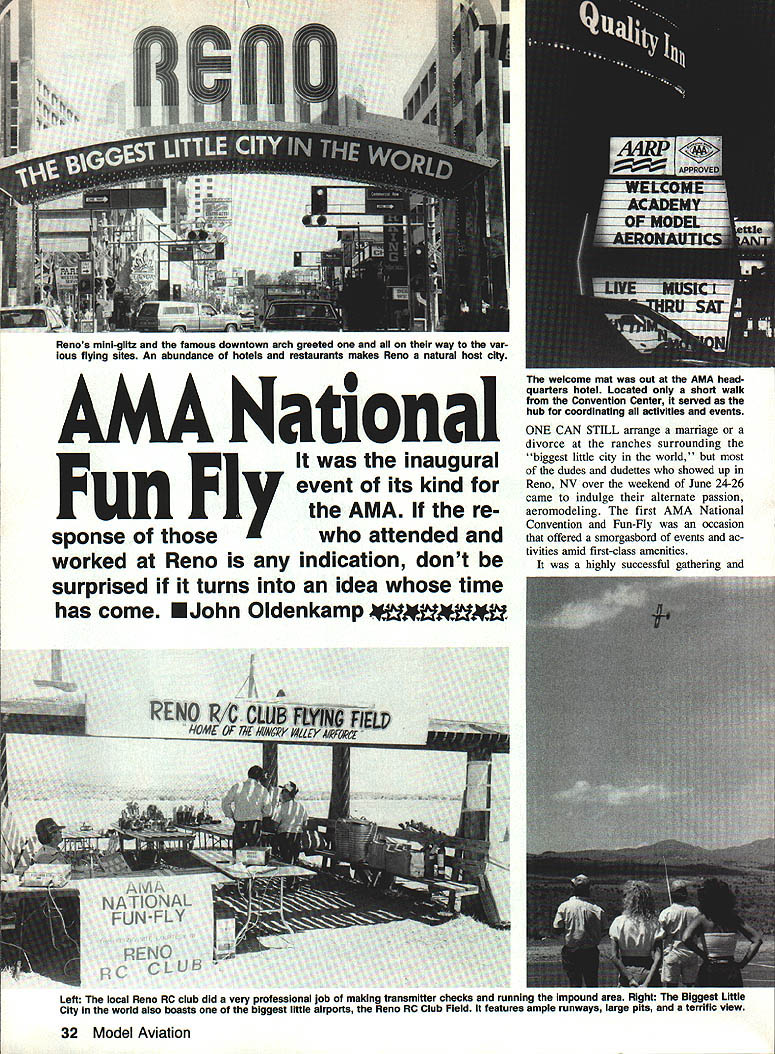
The welcome mat was out at the AMA headquarters hotel. Located only a short walk from the Convention Center, it served as the hub for coordinating all activities and events.
One can still arrange a marriage or a divorce at the ranches surrounding the "biggest little city in the world," but most of the folks who showed up in Reno, NV over the weekend of June 24–26 came to indulge their alternate passion: aeromodeling. The first AMA National Convention and Fun-Fly offered a smorgasbord of events and activities amid first-class amenities.
This carnival-like format was both exciting and educational. Conceivably, three or four sites in various parts of the country could host the event in rotation, each drawing from its own particular geographic market. The National Convention/Fun-Fly concept combined an industry trade show, seminars, technical workshops, and static displays with world-class flying, both indoors and out. The low-key approach to flying—eliminating the need for timers, bean counters, et al.—made good sense even for die-hard competitors. It was also an opportunity to involve the public, our pool of potential enthusiasts, in a three-day extravaganza that, being fun as well as informative, can only benefit the hobby.
Reno is a natural host. The surrounding scenery is beautiful and the city offers a full range of lodging from inexpensive to luxurious, good food at every price point, excellent transportation facilities, entertainment of all sorts, fine weather and, importantly, plenty of open space.
Getting to Reno by way of Owens Valley (San Diego Highway 395) winds through miles of high desert. The Sierra escarpment climbs to about 8,000 ft; the Bishop area plunges along the Walker River toward the Truckee Meadow. Long drives through that landscape—eleven hours of soul-satisfying solitude for some—remind one anew of breathtaking Western scenery. I spent part of a December break last year enjoying what is rare from a southern California home base: snow. Side trips to the Lake Tahoe area and the surrounding valley make for a laid-back, comfortable stay. The long summer days of National Fun-Fly week were equally pleasurable. The pristine Nevada skies are endlessly interesting and occasionally dramatic, with tall cumulonimbus clouds spreading to great heights.
Arrival and Convention Center
I arrived late Friday afternoon as a few thunderstorms pocketed the area and found the Fun-Fly well underway. AMA officers were in Executive Council session, indoor activities at the Convention Center were heating up, and the static display was taking shape. I spent a lot of time meeting old acquaintances and new friends.
The convention activities were housed in the modern, spacious Reno Convention Center. A wing booked by the AMA contained event headquarters, registration, the trade show, swap meet, and indoor flying. The halls were impressively large—removing the central accordion doors would have created a space roughly two football fields by one, with ceilings around 35–40 ft—easily supporting serious indoor activity.
Outdoor Flying Venue
Outdoor flying—both Free Flight and RC—took place about 20 miles north of Reno. The last four miles of ingress ran along a primitive, sandy road newly cut by the Bureau of Land Management and were about as smooth as riding over a washboard. Today's closed, quiet, air-conditioned vehicles were more forgiving than those of yore, and our airplanes arrived without visible dust.
The outside site comprised three separate flying areas spaced roughly a mile apart: one for RC power and sailplanes, one for Free Flight, and the most distant for the old-timer RC-assist crowd. The Society of Antique Modelers (SAM) 51 held its West Coast Championship in conjunction with the Fun-Fly/Convention. Informal counts on Saturday and Sunday showed about 700 vehicles on site, including many motor homes camping there.
The Reno Radio Control Club (home of the Hungry Valley Fliers) hosted the RC activities. The field features a long, wide runway, vast pit areas, a sheltered control center, and excellent frequency control. Traffic and flow management were well set up on a gentle plateau oriented away from sunglare. Adjacent parking and a takeoff/operational clearing for sailplanes made operations convenient. The view from the field is spectacular.
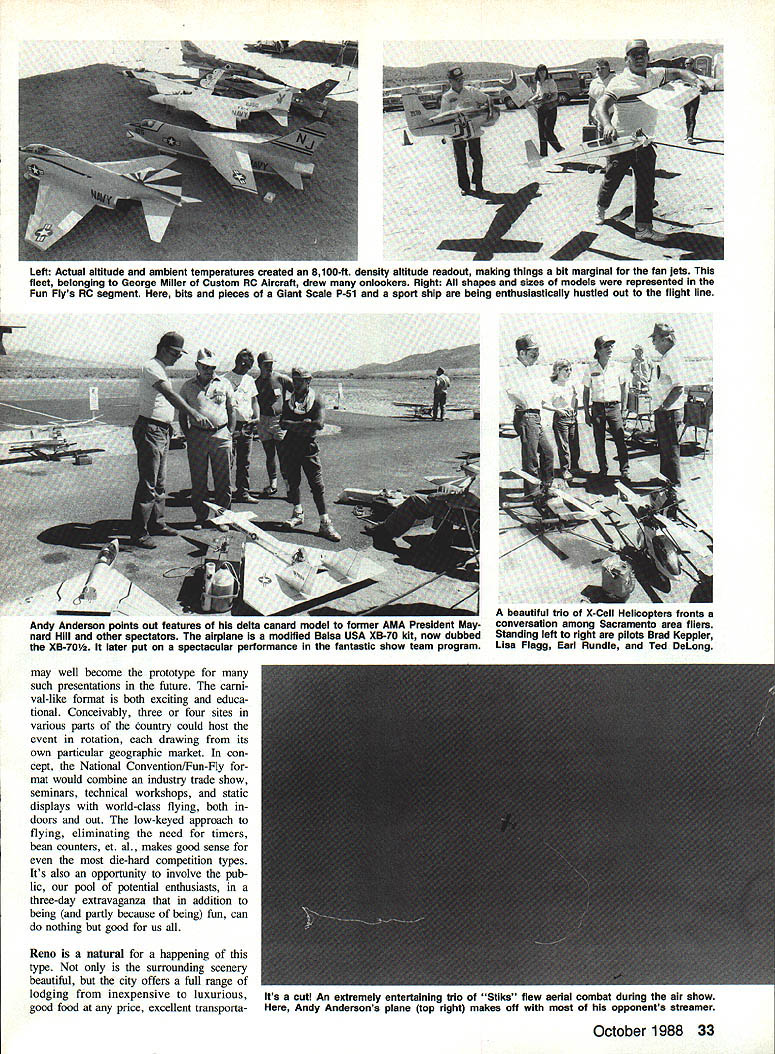
Actual altitude and ambient temperatures produced an 8,100-ft density-altitude effect, which made conditions marginal for fan jets. The fan-jet fleet belonging to George Miller (Custom RC Aircraft) drew considerable attention. Models of all shapes and sizes were represented; giant-scale P‑51s and sport ships were enthusiastically hustled to the flight line. The purring four-stroke engines were common, and electric-powered models were increasingly impressive.
Public Shows and Demonstrations
The Capitol City Barnstormers from Sacramento put on a couple of stirring one-hour air shows over the weekend, with public-address systems and music. If you disregarded strict Scale features, these productions equaled many professional air-show acts. The shows included aerial combat, bomb drops, parachutes, twin- and single-engine aerobatics, and helicopter thrills. Spectator reactions—often spine-tingling and hair-raising—confirmed the entertainment value. Before and after the shows there were hours of open fun-flying for anyone who wished to participate.
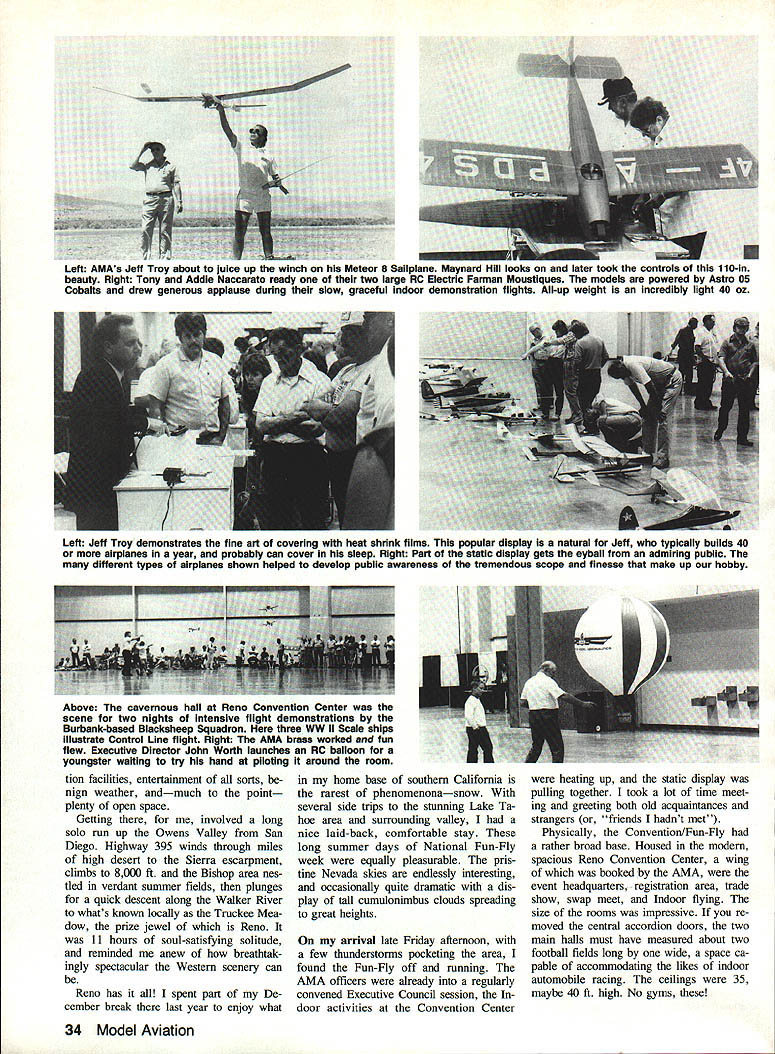
At the Convention Center, Tony and Addle Naccarato's Black Sheep Squadron (Burbank, CA) delivered delightful and entertaining exhibits demonstrating Control Line, Radio Control, and Indoor Free Flight disciplines. One youngster flew a kit-built ornithopter for several minutes, astonishing the crowd. The magnificent RC electric-powered Moustiques drew applause and demonstrated how quickly the technology is changing—quiet, precise, buoyant flights that were unheard of a few years ago.
In Control Line demos, five- and six-year-olds were recruited from the audience for "first flights," again to widespread applause. If public relations are handled effectively and in advance, events like this will likely draw sizable, responsive crowds. Even simple all-balsa ready-made planes can be decent steppingstones for newcomers when flown by experienced pilots.
Free Flight
The Free Flight site was huge—perhaps a mile by four miles—varying from rolling to flat terrain with short, dried grass and laid out in the usual drift pattern. Gusty weather and showers on Saturday caused some retrieval difficulties as models drifted across sloping, sagebrush-covered areas; Sunday was calmer.
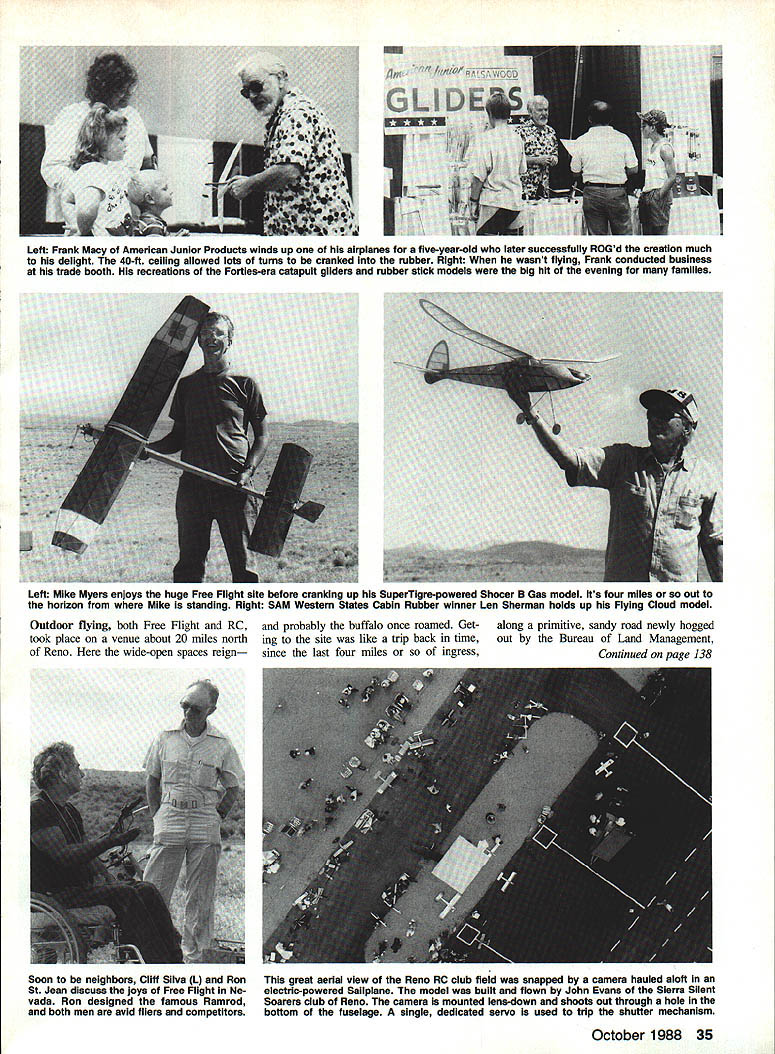
Cliff Silva flew a big Texaco model for a 32-minute flight that landed within a half-mile of launch. Glendale attorney Mike Myers tested the site specifically for future use and suggested that chase crews use "fat" wheels, horses, or sturdy footwear rather than narrow-tread chase bikes. Given tolerable weather, this site is a godsend for Free Flight aficionados who remember days of nearly unlimited space.
Old-Timer RC / SAM Championships
The Old-Timer RC crowd perhaps had the best site of all. The SAM Championships took place on roughly a thousand acres of level land, free of sagebrush and with sun angles that posed no vision difficulties. Vistas of the surrounding mountains and valley stretched in every direction. The area offered excellent camping possibilities for motor homes, though access inlets could benefit from grading and additional parking. With its relatively unlimited horizons, the site was ideal for maximum-duration flights.
Indoor Flying
The indoor flying area could easily support big-time auto racing, so it's unquestionably up to modeling standards. In conversation with recent U.S.A. Indoor Team member Cezar Banks, he reported that his F1D micro ships could average 30–35 minutes here in Reno if the building were made draft-free. The exhibitor area at the convention center was first-rate and hosted many eye-catching displays.
Assessment and Conclusion
In my view, this first National Convention-cum-Fun-Fly-cum-public AMA display was a resounding success. The planners did their homework, and the rationale behind the event was sound. Reno is an ideal setting with unique attributes; while not every city can match it, the format could be repeated in many locales. The event can be scaled as needed, but organizers should preserve the core idea—heightened AMA visibility through a fun, public-oriented gathering—rather than reverting to trophy-heavy competition.
Running through my mental balance sheet on the 550-mile trip home, the pluses clearly outweighed the minuses. I decided I would go to another national Fun-Fly for what it offers at its core. Next time I'll bring a few friends, take as many airplanes as my vehicle will hold, buy that commemorative T-shirt that seemed expensive at the time, and even take my dog along for a vacation among the buffalo ruins.
In designing and executing the first National Convention and Fun-Fly, the AMA took a bold step forward—one that should set a lasting pattern. This prototype certainly flew, and, as advertised, it was great fun!
Entrants in the first AMA National Fun Fly
- Charles Abrahams, Downey, CA
- Cliff Adams, Pomona, CA
- Gail K. Adams, Pomona, CA
- Mark J. Anderson, Lakeport, CA
- Richard C. Anderson, Reno, NV
- Eric T. Ballman, Reno, NV
- Al Beam, Ketchum, ID
- Stanley J. Bellatti, Gagsequet, CA
- David A. Belleniger, Granada Hills, CA
- Ron Bodwell, Alameda, CA
- James Bowman, Modesto, CA
- Vernon W. Brandtner, Monterey Park, CA
- Robert G. Brogan, Carson City, NV
- Franklyn A. Bryant, Renton, WA
- Leland H. Buhr, San Mateo, CA
- Bill E. Burkett, Alameda, CA
- David S. Burwell, San Jose, CA
- Nick M. Caruso, Brookings, OR
- Donald R. Chipman, Arnold, CA
- Peter H. Chow, Sunnyvale, CA
- Thomas J. Crowley, Monrovia, CA
- Art Cummings, Nevada City, CA
- Cecil A. Dennis, Boise, ID
- Hurley M. Dodd, Vista, CA
- Lester V. Douglass, Placerville, CA
- John L. Evans, Reno, NV
- Ken P. Evans, Green River, WY
- Michael Fasolo, Gold River, CA
- David Flint, Green River, WY
- John O. Gaines, San Jose, CA
- Dave Gardner, Renton, WA
- Melvin J. Geiger, Eureka, CA
- Ron L. Gilman, Rosamond, CA
- Blanche A. Goodell, N. Hollywood, CA
- Carlo A. Godel, N. Hollywood, CA
- Frank L. Godel, N. Hollywood, CA
- Connie R. Goyette, San Andreas, CA
- Patrick N. Grubbs, Rancho Murieta, CA
- Gary Hait, San Jose, CA
- Robert Hair, Parump, NV
- Phillip J. Haley, Carson City, NV
- John A. Harlan, Reno, NV
- Andy H. Herskind, Rohnert Park, CA
- John M. Hood, San Diego, CA
- Lawrence R. Horacek, Sparks, NV
- Gerald Howell, Alpine, CA
- Ken Jensen, Reno, NV
- David Johnson, Hemet, CA
- S. Johnson Kanakona, Reno, NV
- Ed Kaufman, Santa Rosa, CA
- Kathy Kautz, Reno, NV
- Marshall D. Keegan, Burbank, CA
- Brant K. Kennedy, Sun Valley, NV
- Eric G. Knox, Walnut Creek, CA
- Stephen Korney, Norwalk, CA
- Lawrence A. Krutz, Reno, NV
- Silas S. Krow, Fremont, CA
- O. Lambert, San Jacinto, CA
- Jeff D. Lastoka, Canoga Park, CA
- Brandon Lee, Reno, NV
- Donald L. Lee, Rone, NV
- Mahlon R. MacPhee, Carmichael, CA
- Jeffrey A. Martin, Sun Valley, NV
- Leo J. Martin, Laguna Hills, CA
- George E. Mason, Arnold, CA
- Billy O. McDowd, Portland, OR
- Howard W. McFarland, Crescent City, CA
- Shannon N. McGuffey, Reno, NV
- Cecil Mead, Buena Park, CA
- Kenneth G. Meade, Alhambra, CA
- Larry Metz, Hemet, CA
- George A. Miller, Rohnert Park, CA
- Lee H. Miller, Sterling, CO
- Reed D. Moore, Elverta, CA
- Sean M. Moore, Elverta, CA
- Donald S. Morse, Carson City, NV
- Michael J. Myers, Glendale, CA
- Kirk S. Nelson, Sacramento, CA
- Ron Nelson, Reno, NV
- Bill G. O'Bellito, Monterey Park, CA
- Robert D. Ortman, Campbell, CA
- Bruce D. Patterson, Great Falls, MT
- Jeremy A. Patterson, Great Falls, MT
- Cecil M. Reynolds, Sunnyvale, CA
- James H. Riccio, Glendora, CA
- Wenzel Roller, New England, ND
- Dennis A. Ross, Reno, NV
- Earl H. Rummel, Travis AFB, CA
- John T. Russo, Arcadia, CA
- Samuel C. Russo, Arcadia, CA
- Monte C. Salot, Glendora, CA
- George J. Santikian, Fresno, CA
- Wilbur L. Schneider, San Jose, CA
- Alan D. Sharky, Alhambra, CA
- Yoshio Shida, Los Angeles, CA
- Earl N. Stackhouse, Reno, NV
- David C. Tcal, Coos Bay, OR
- John F. Tavares, Colorado Spgs., CO
- Nicholas M. Tenaza, Concord, CA
- Col. Bob Thacker, San Clemente, CA
- Joel E. Thomas, Exford, AL
- Ross S. Thompson, Vancouver, WA
- Jim Trimlett, Portola, CA
- Jeff Troy, Reston, VA
- Joseph M. Tshigg, Santa Ana, CA
- David A. Turner, Spanaway, WA
- Dale C. Utterback, Studio City, CA
- William H. Vanderbeek, Cupertino, CA
- Robert E. Wagen, Netwales, CA
- Derek S. Walkington, Lancaster, CA
- John W. Walkington, Lancaster, CA
- George E. Wasson, Sparks, NV
- James A. Weller, Keith R. Wesson, Lancaster, CA
- James W. White, Covina, CA
- Melvin G. White, Sparks, NV
- Thomas D. White, Sparks, NV
- Charles L. Wilcox, Reno, NV
- John M. Wisniewski, Scottsdale, AZ
- Harry G. Wood, Long Beach, CA
- John Worth, Fairfax, VA
- Myron E. Yorzer, Sacramento, CA
Reno's mini-glitz and famous downtown arch greeted visitors on the way to the various flying sites. An abundance of hotels and restaurants makes Reno a natural host city. The local Reno RC Club did a very professional job making transmitter checks and running the impound area.
Transcribed from original scans by AI. Minor OCR errors may remain.

