
AMA National Rally
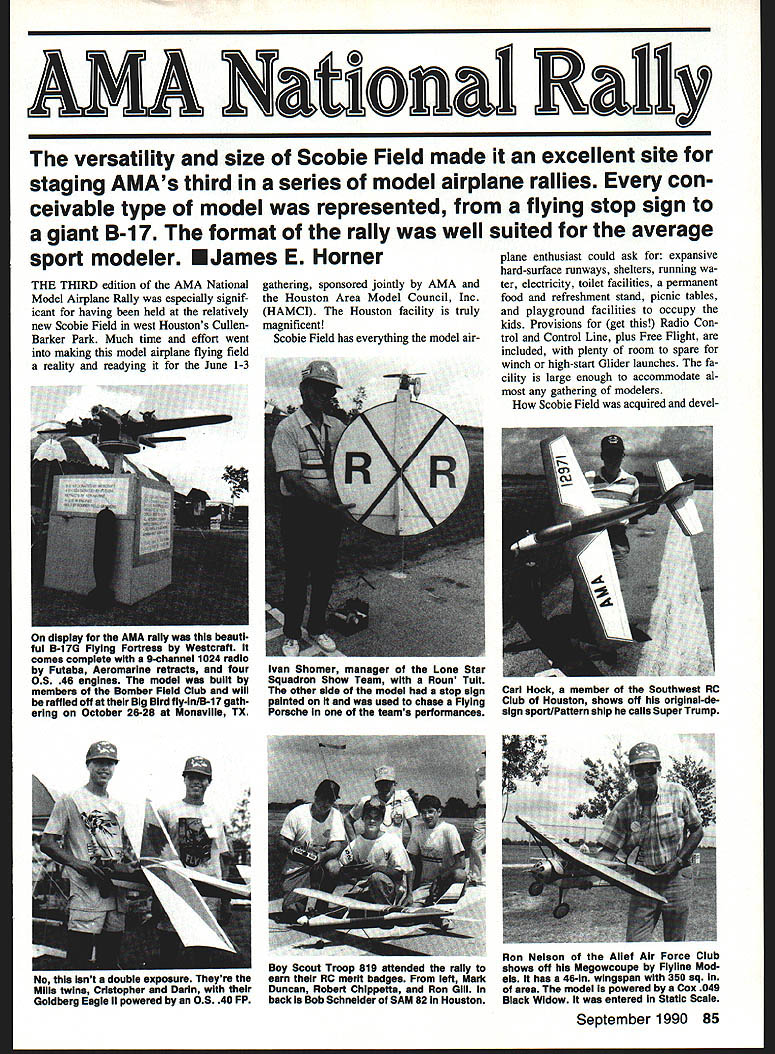
The third edition of the AMA National Model Airplane Rally was held June 1–3 at the relatively new Scobie Field in west Houston's Cullen‑Barker Park. Sponsored jointly by the Academy of Model Aeronautics (AMA) and the Houston Area Model Council, Inc. (HAMCI), the rally attracted over 120 modelers, recorded roughly 310 flights during the three‑day event, and drew an estimated 3,000 spectators. Every conceivable type of model was represented, from a flying stop sign to a giant B‑17.
Scobie Field — facilities and administration
Scobie Field is a purposefully developed model airplane facility offering amenities to support nearly every facet of the hobby:
- Expansive hard‑surface runways
- Shelters and picnic tables
- Running water and electricity
- Toilet facilities
- A permanent food and refreshment stand
- Playground facilities for children
- Designated areas and room for Radio Control, Control Line, and Free Flight (including winch and high‑start glider launches)
The field is administered by HAMCI under the direction of its president and representatives from the Houston area member clubs. Day‑to‑day maintenance and coordination with Harris County supervisors are handled by local volunteers and club members, ensuring year‑round use.
Development and challenges
The acquisition and development of Scobie Field were the results of a long, concerted effort by many individuals and organizations. A core group—Bert Streigler, Rollie McGinnis, and Carl White—labored for 17 years to secure and develop the Houston field, negotiating with politicians, the U.S. Corps of Engineers, environmentalists, competing organizations, gun clubs, hot‑air balloon groups, and other stakeholders.
Key challenges included:
- The site is an emergency reservoir owned by the federal government to protect Houston from hurricane flooding; it is administered by Harris County and claimed by the city of Houston.
- The presence of protected plant and animal species, and a large northwest wetland area.
- Federal concern about potential boating hazards led to requirements (originally including tall conductor poles) that threatened development; the issue was resolved by restricting boating access (hence “No Boating Allowed” signage at park entrances).
The field’s realization underscores that, with sustained effort and community cooperation, large and complicated sites can be won and developed for model aviation.
The rally — flying, displays, and swap shops
The AMA National Rally was organized as an inclusive, non‑competitive gathering emphasizing participation and the sharing of ideas. In addition to the flying program, the event featured static displays and swap shops for both modelers and the general public. The rally’s value was measured less by statistics than by participant enthusiasm, exchange of knowledge, and exposure to new modeling types.
Categories represented included (among others):
- Scale
- Sport
- Control Line (Stunt, Carrier, Combat)
- Old‑Timer
- Pattern
- Giant Scale
- Helicopters
- Gliders
- Electrics
- Pylon Racers
Shows and special exhibitions
Several show teams and individual demonstrations were crowd favorites.
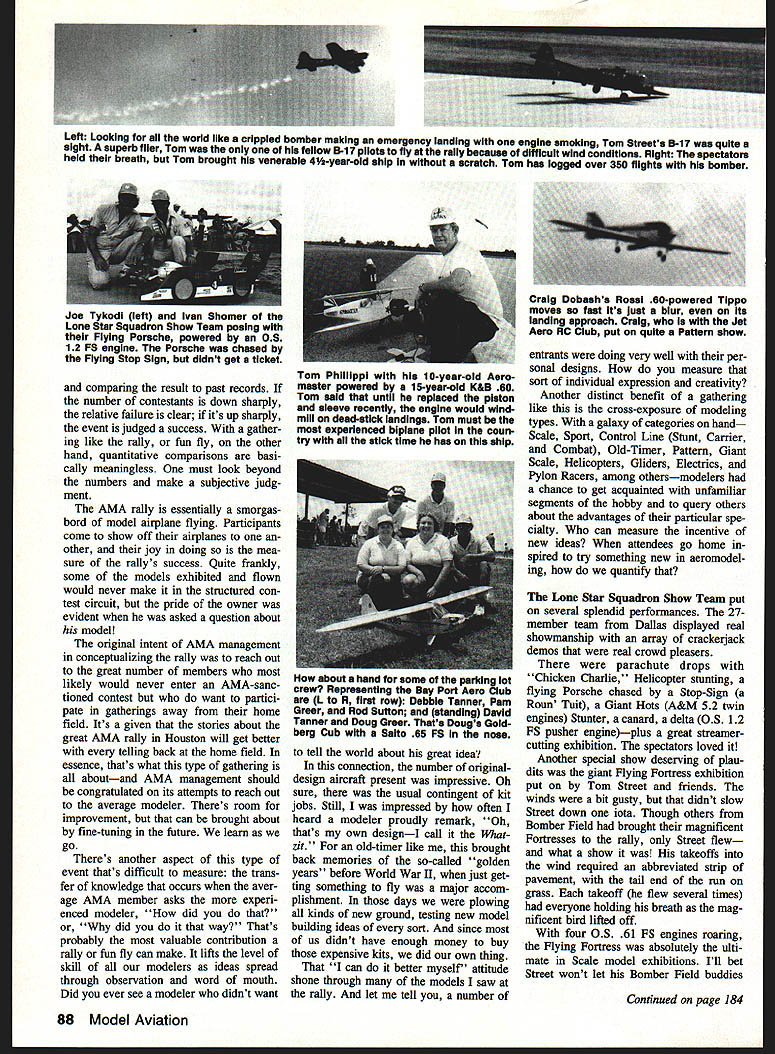
- Lone Star Squadron Show Team (27 members, Dallas) — a series of polished, crowd‑pleasing demos and formation routines.
- Special routines included:
- Parachute drops with "Chicken Charlie"
- Helicopter stunting
- A flying Porsche chased by a stop‑sign (a Rough ’n’ Tumble routine)
- A Giant Hotliner, a canard, and a delta with an O.S. 120 FS pusher engine
- Streamering exhibitions
Tom Street and friends staged a memorable Flying Fortress (B‑17) exhibition. Street’s four O.S. .61 FS‑powered model made dramatic takeoffs (partially on pavement, partially on grass), thrilling spectators despite gusty winds.
Notable models and builders
A broad mix of original designs and kit builds highlighted the rally’s creative spirit. Examples mentioned at the event include:
- Original‑design sport/pattern ships and many homebuilt “Wha‑zits” reflecting the “I can do it myself” tradition.
- Super Trump (Ron Nelson, Alief Air Force Club) — a Megow coupe flying model, 46‑inch wingspan, ~350 sq. in., powered by a Cox .049.
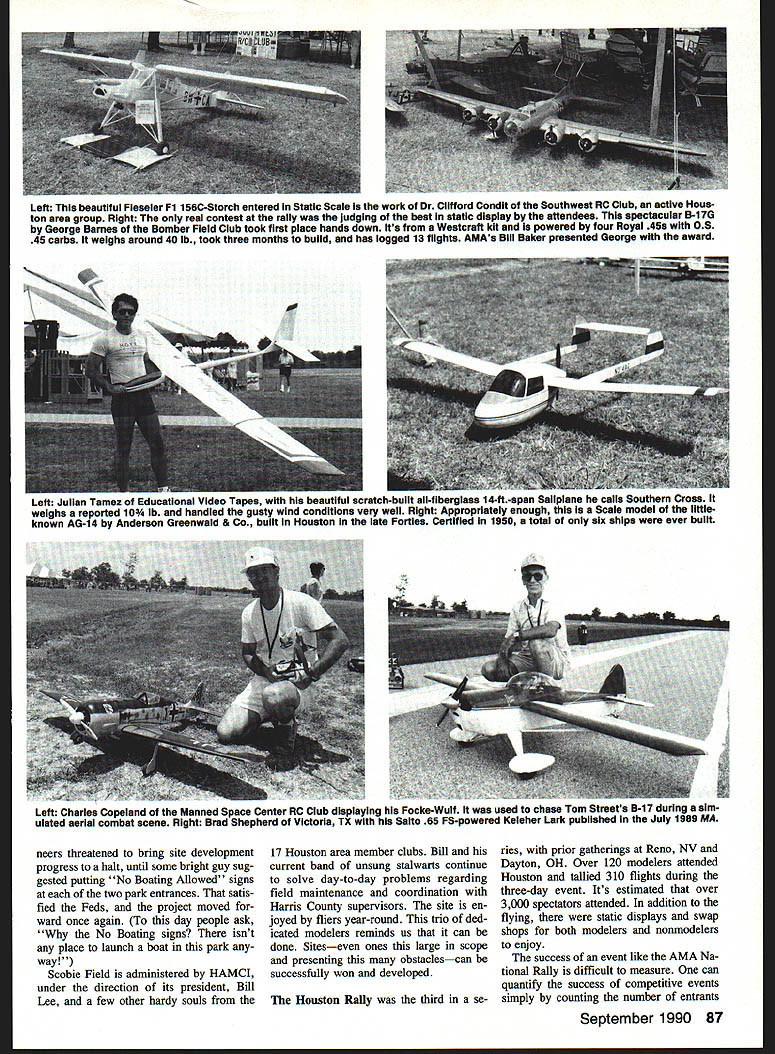
- A Black Widow entered in Static Scale.
- A Westcraft B‑17G Flying Fortress, built by members of the Bomber Field Club and equipped with 9‑channel radio, retracts, and four .46 engines — slated to be raffled off at a future Big Bird/B‑17 gathering in the area.
- Goldberg Eagle II powered by an OS .40 FP (displayed by Bob Schneider, SAM 62 Houston).
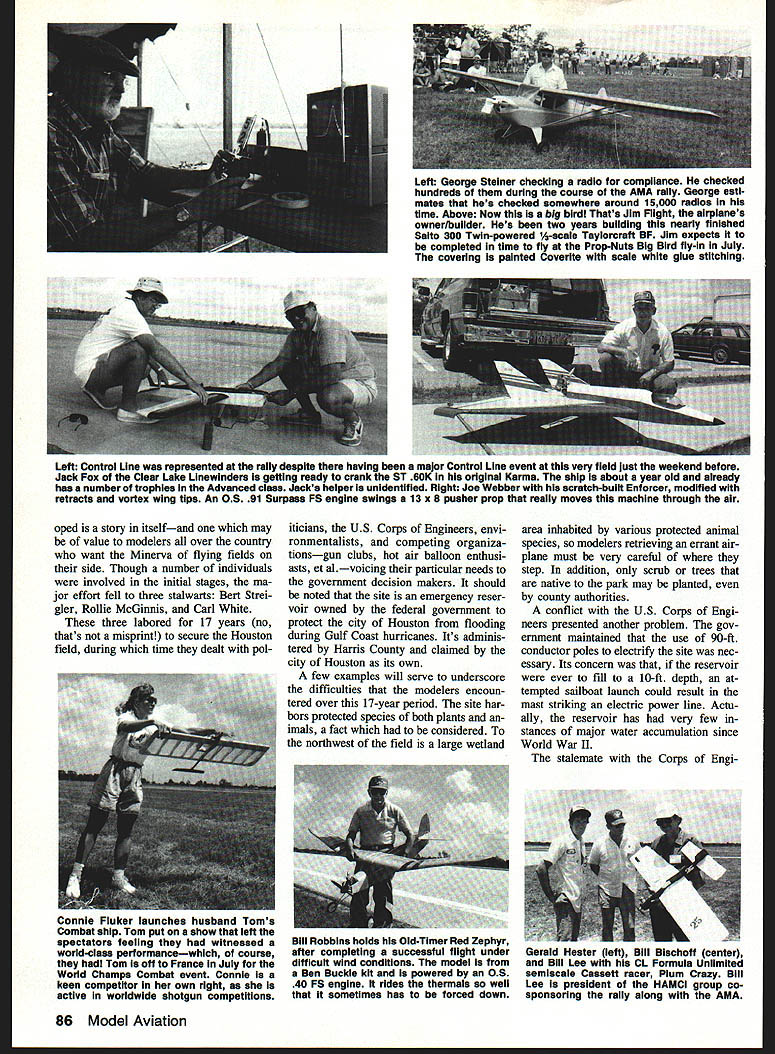
- Jim, a builder flying a nearly finished Salto 300 twin‑powered 1/3‑scale Taylorcraft, covered with Ceconite and finished with white‑glue stitching; expected to fly at an upcoming Big Bird event.
- Joe Webber’s scratch‑built Enforcer, modified with retracts and vortex wingtips, powered by an .91 Surpass FS engine with a 13x5 pusher prop.
- Bill Robbins flying an Old‑Timer Red Zephyr (Ben Buckle kit) powered by an O.S. .40 FS engine.
Control Line and other disciplines
Control Line remained well represented despite a major Control Line event having occurred at the field the prior weekend. Participants included:
- Jack Fox of the Clear Lake Linewinders, preparing to run an ST‑60K.
- An original Karma design that had already won several trophies in Advanced class competition.
Volunteers, radio checks, and event staff
Volunteers and staff ensured safety and smooth operation:
- George Steiner handled radio compliance checks, noting he has inspected thousands of radios over time.
- Event staff included local helpers and club members (names noted in reports: Chip Smith, Bob Underwood, Bill Baker).
- HAMCI volunteers continue to maintain the field and coordinate with county authorities.
Significance and conclusions
The AMA Rally’s original intent is to reach members who are unlikely to attend sanctioned contests but who enjoy flying and sharing with others away from their home fields. The rally’s strengths include:
- Inspiring cross‑exposure to different modeling disciplines.
- Encouraging the exchange of knowledge between experienced and less experienced modelers.
- Showcasing individual creativity and original designs.
- Bringing the hobby to the public and potentially recruiting new enthusiasts.
Measuring the rally’s success is more qualitative than quantitative: the pride of owners showing their models, the transfer of ideas, and the inspiration attendees take home are the true markers of success. AMA should continue to fine‑tune and expand the concept to bring exhibitions into the mainstream public view. The Houston rally demonstrated that hundreds of modelers and thousands of spectators can benefit from well‑organized events — and that, with dedication, excellent flying fields can be won and developed.
Transcribed from original scans by AI. Minor OCR errors may remain.

