
CL Racing
John Ballard
THE 1983 NATS is now in the history books. The racing events were as exciting as ever, and the site was the best that the competitors have had to fly on in recent years. The circles were table-top smooth with very few irregularities, and the Air Force personnel did an excellent job installing barricades at both the front and rear of the circles to keep the spectators at a safe distance. Since the townspeople of Chicopee are supportive of Westover Air Force Base, many thousands came out on a daily basis to observe the competitive activities. At one point during the Rat Racing finals I counted over 200 spectators at the circle. I also noticed unusually large numbers of people at both the Speed and Stunt circles.
The schedule was the same as last year:
- Monday: Open Scale Racing (Goodyear)
- Tuesday: FAI Team Race and Mouse Race
- Wednesday: Junior and Senior Scale Racing
- Thursday: Open Rat Race
- Friday: Junior and Senior Fast and Slow Rat
- Saturday: Open Slow Rat Racing
There was some extremely competitive and exciting FAI Team Racing on Tuesday. The weather this year was much better than in the past, with temperatures around 82° to 85° F and relative humidity approximately 40%, which made the long hours on the concrete runways more bearable. The Nats organizers should be given high marks for locating the processing site and headquarters area in a motel conference center. The Quality Inn, on the outskirts of Chicopee, was the first time I remember this being done. This helped competitors because the hobby shop, executive offices, manufacturers' displays and model processing were all on the motel premises. Competitors staying at the headquarters and surrounding hotels could also use amenities such as the swimming pool, volleyball courts and horseshoes. On several occasions I heard competitors mention that the major officers and members of AMA were available on-site to meet and promote the model.
I would like Racing competitors who did not attend the Nats to write me their views on any of the subjects raised below.
Scale Racing
Practice
Most competitors arrived Saturday evening to have the complete day on Sunday to practice for the Open event that commenced early Monday morning. Sunday practice dawned with rain showers and cooler temperatures; the rain lasted most of the day but stopped around 3:00 p.m. The sun came out — as did the Scale Racers. Everyone was stunned when Vic Garner's Nelson .15-powered ship gave consistent clockings of 13.5 to 13.8. Several other competitors using Nelson engines were running in the very low 14s. Apparently Nelson users have found a fuel and prop combination that "brings the Nelson to life." The rest of the afternoon was spent trying to get consistency in pit stops and landing techniques.
Qualifying and Finals
Monday morning dawned with bright sunshine but unusually cool temperatures (approximately 70° to 75° F). As temperatures warmed, some Nelsons had pitting problems, but the qualifying times were unusually good. To qualify for the finals it took times in the 2:50 to 3:00 range. Jim Ong (Pineville, LA) had the low qualifying time of 2:46. There was an hour lunch break during which all competitors tuned their equipment for the finals. Just prior to the lunch break an unusually heavy wind developed, slowing some competitors in the later qualifying heats. The wind was gusty, which affected the light aircraft on landings for pit stops; I saw several props broken due to bad catches and pit men scampering to catch models that overran the pitting position.
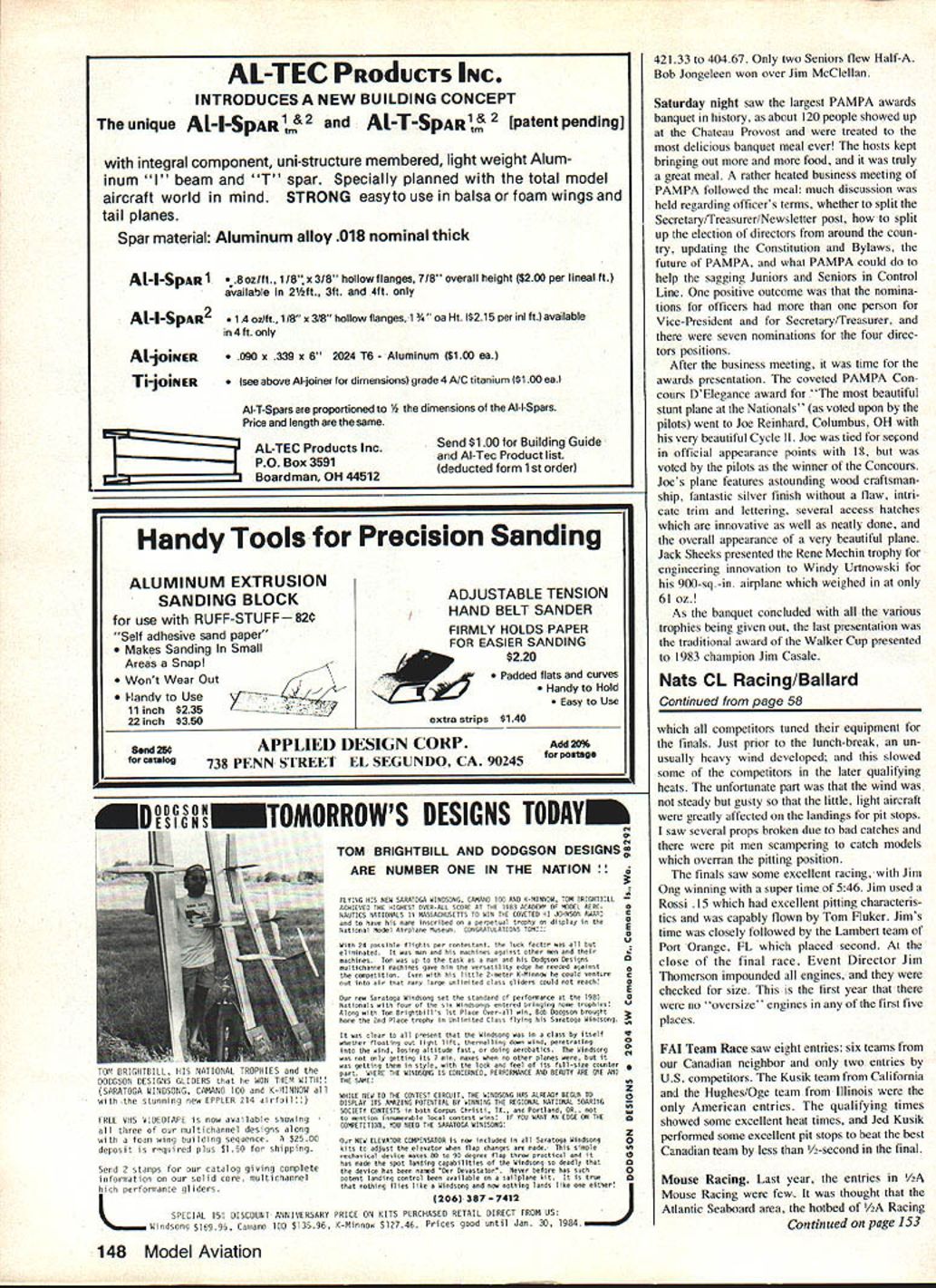
The finals saw excellent racing. Jim Ong won with a super time of 5:46. Jim used a Rossi .15, which had excellent pitting characteristics and was capably flown by Tom Fluker. Jim's time was closely followed by the Lambert team of Port Orange, FL, which placed second. At the close of the final race, Event Director Jim Thomson impounded all engines and had them checked for size. This was the first year there were no "oversize" engines in any of the first five places.
FAI Team Race
Eight entries competed in FAI Team Race: six teams from Canada and only two U.S. entries (the Kusik team from California and the Hughes/Oge team from Illinois). The qualifying heats showed some excellent times. Kusik performed excellent pit stops to beat the best Canadian team by less than half a second in the final.
Mouse Racing
Last year entries in 1/2A Mouse Racing were few, and it was hoped that the Atlantic Seaboard area — the hotbed of 1/2A racing activity — would bring out more competitors. Fortunately for Team Race and Mouse Race pilots and pit men, the intense wind present on Monday afternoon was absent on Tuesday. There were very few unfortunate incidents in Mouse Racing, except for one reverse engine-run in which a pit man allowed the airplane to run a lap or two backwards on the ground. This year the Mouse Race observers saw another young lady as a potential racing pilot: Jennifer Berner did an excellent job piloting her Mouse Racer, with her father Richard Berner as pit man.
Rat Racing
Preparation
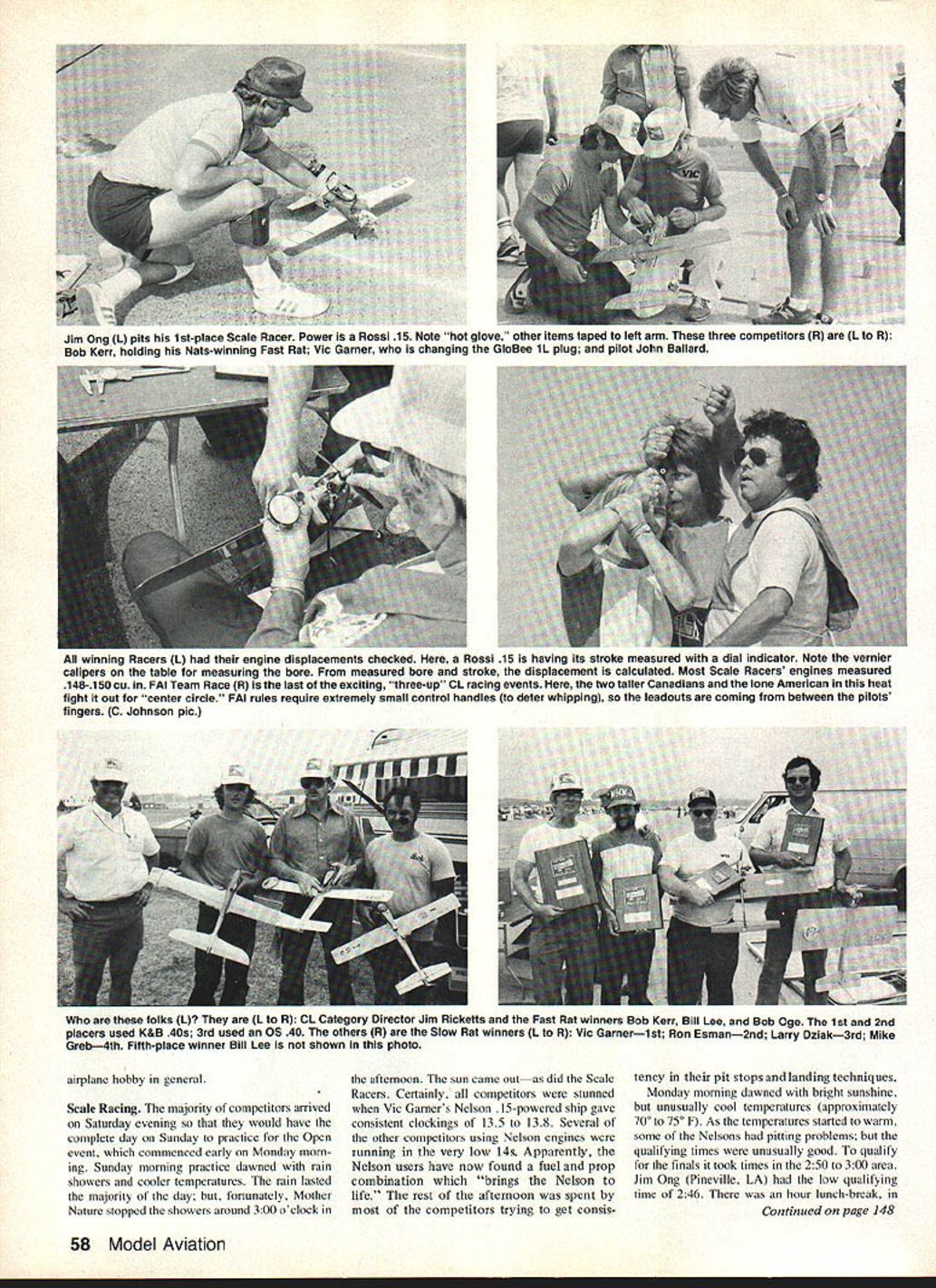
Most competitors spent Wednesday preparing their planes for competition on Thursday. The new OS .40 Rat and Pylon engine made definite inroads, with several competitors using it successfully for both speed and pitting. Only one competitor used the upside-down Gillott Shark powered by a K&B .40 with an AAC piston liner assembly. This Shark, built and pitted by Bob Kerr of California, drew attention when its airspeed produced times in the 10.3 to 10.5 bracket. Several people said none of his clockings were above 10.8, and his pit stops, even though they required a 1½-lap shutdown, were in the 0.5 to 0.8-second range. Bob had practiced with a brand-new plane on Tuesday when the engine disintegrated before he even made a flight; had that occurred on Wednesday he might not have been able to re-prepare in time for Thursday.
Race Day and Finals
Thursday dawned cool and sunny with very little wind, and tension and excitement permeated the racing area. Initial heat times were excellent, with Bob Kerr posting the fastest recorded heat times I can remember: 2:09.21 and 2:10.85 for a total of 4:20.06. This was followed by Dick Stubblefield at 4:30.44 and Mike Greb at 4:30.8. During the lunch break several competitors adjusted nitro concentrations and tried different propellers to increase airspeed. With Bob Kerr's low qualifying combined time, pressure was enormous by the time the first final began.
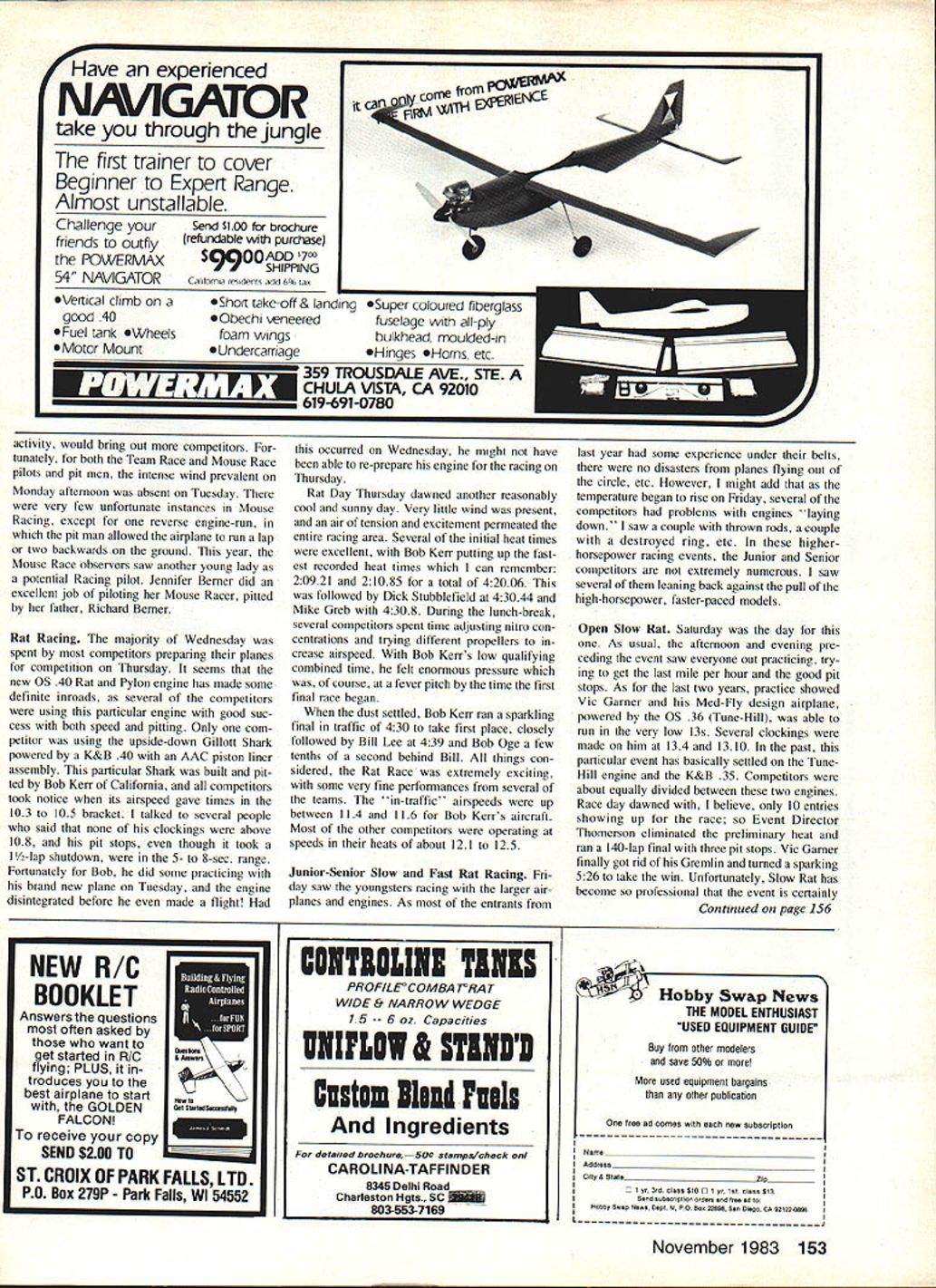
When the dust settled, Bob Kerr ran a sparkling final in traffic of 4:30 to take first place, closely followed by Bill Lee at 4:39 and Bob Oge a few tenths of a second behind Bill. The Rat Race was extremely exciting, with fine performances from several teams. In-traffic airspeeds for Bob Kerr's aircraft were up between 11.4 and 11.6; most other competitors operated at speeds in their heats of about 12.1 to 12.5.
Junior–Senior Slow and Fast Rat Racing
Friday saw the youngsters racing with the larger airplanes and engines. Most entrants had experience from last year, so there were no major disasters such as planes flying out of the circle. However, as temperatures began to rise on Friday several competitors had engines "laying down": I saw a couple with thrown rods and a couple with a destroyed ring. In these higher-horsepower events the Junior and Senior fields are not very numerous. I saw several pilots leaning back to handle the pull of the high-horsepower, faster-paced models.
Open Slow Rat
Saturday was the Open Slow Rat. The afternoon and evening preceding the event saw everyone out practicing to eke out the last mile per hour and to hone pit stops. For the last two years practice showed Vic Garner and his Med-Fly design airplane, powered by the OS .36 (Tune-Hill), could run in the very low 13s. Several clockings were made on him at 13.4 and 13.10. In the past this event has basically settled on the Tune-Hill engine and the K&B .35; competitors were about equally divided between the two engines. Race day dawned with only 10 entries, so Event Director Thomson eliminated the preliminary heat and ran a 140-lap final with three pit stops. Vic Garner finally got rid of his Gremlin and turned a sparkling 5:26 to take the win. Unfortunately, Slow Rat has become so professional that the event is on a downturn and new blood is sorely needed.
The Low-Nitro Rule
There was much discussion around the Lambert team's "Ark" motor home about reducing fuel nitromethane to 10%. This fuel has been tried in contests by many competitors and found to be quite satisfactory. It seemed the consensus that lowering nitro would save competitors considerable expense given the large amounts of fuel required for the racing events.
There was also considerable discussion about establishing an Intermediate or Advanced status that "professional" entrants could not enter, possibly by restructuring current events or adding an additional event such as "Big Goodyear" (as it is called in Texas) or "Sport Race" (as it is called in the Midwest).
I would certainly like Racing competitors who did not have an opportunity to attend the Nats to write me their views on any of these subjects.
Transcribed from original scans by AI. Minor OCR errors may remain.

