
FF Indoor Duration
Larry Kruse
It would be difficult to imagine a better site for indoor competition this year than we had at Westover Air Force Base. The base hangar we used was situated at the apex of a triangular hangar area adjacent to the main taxiway and easily accessible by paved roads from two directions. Memory doesn't have to go very far back to recall having to drive from Dayton to Cincinnati to fly indoor models, or from Lake Charles to a blimp hangar near Houston. Having the indoor site this year within walking distance from all other Nats FF events was great.
Most everyone had questions about how workable a hangar might be. Would drafts be created as spectators came and went? Would doors be opened and closed at crucial times? Because of the basic construction of the main hangar, the big building surrounded by perimeter offices and hallways tended to serve as air locks against outside gusts and spectator traffic. As added bonuses, raised concrete areas on two sides permitted spectator seating at floor level; a balcony on both long sides proved popular with spectators who wanted a good view of the models in flight. From the fliers' viewpoint, everyone seemed very happy. The approximately 65-ft ceiling and newly painted floor allowed errant models to come down haphazardly without suffering damage; obstructions drifting inside the hangar were slight.
Indoor competition was expanded this year to three days from the more usual two. The expanded schedule was good for some, not so good for others. Those with my kind of situation (flying only the FF scale events, indoors and outdoors) appreciated the extra indoor time that was available. Those like the Brown family and the Fred Anderson brood, who were flying practically all the FF events, found themselves bouncing like yo-yos from the sites on Tuesday, when outdoor FF began.
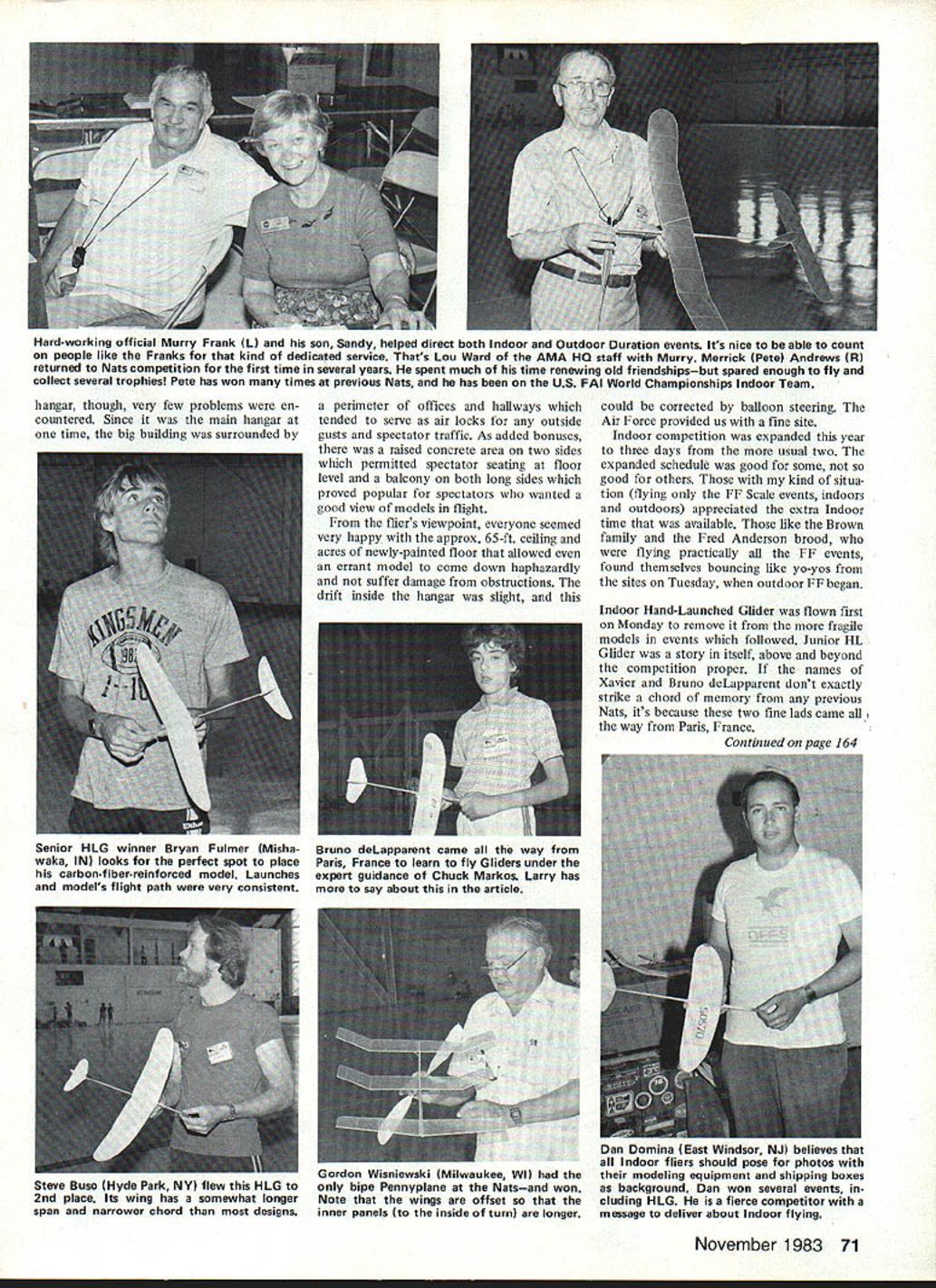
Indoor Hand-Launched Glider was flown first on Monday to remove it from the more fragile models in events which followed. Junior HL Glider was a story in itself, above and beyond the competition proper. If the names of Xavier and Bruno de Lapparent don't exactly strike a chord of memory from any previous Nats, it's because these two fine lads came all the way from Paris, France.
It seems the boys' father had seen Chuck Markos' name featured prominently in NFFS publications and had contacted Chuck about teaching the two youngsters to fly gliders. The Markos family promptly "adopted" Xavier and Bruno for a month before the Nats as live-in pupils, and then they brought the boys to Massachusetts to compete.
The event scores bear testimony to Chuck's success as an instructor. Xavier and Bruno were second and third, respectively, to Chuck's son Aaron in Indoor HL Glider; Xavier won first in Outdoor HL Glider. While talking about these lads, it should be mentioned that Xavier was second in Indoor Easy B, and Bruno had the high junior score in A-2 Towline Glider.
That's a nice summer's work, Chuck. Congratulations are in order for you and your family. We're proud of you for giving two lads a summer they'll never forget—and for contributing to international goodwill and understanding through our great hobby/sport.
Senior HL Glider was a cakewalk for Bryan Fulmer and his V-dihedral glider, which featured a carbon-fiber leading edge. His score was a full 27 sec. better than Draycott Hooke's 74 sec. David Hooke followed his brother into third place by just 7 sec.
Dan Domina, also a proponent of carbon-fiber reinforcement, won Open HL Glider with a total of 107.8, followed by Steve Buso at 90.2 sec. K. J. Strack pushed Buso hard, but he came up short at 87.6.
FAI Stick saw Dan Domina's excellent two-flight total of 52:39 take the lead. Although lightly contested in terms of numbers, Stan Chilton, Dan Belieff, and Pete Andrews joined Domina to provide class to the FAI competition. Jon Harlan was most impressive as a junior; in the future he certainly will be a name to reckon with. Susan Brown was the sole senior competitor, but she put up a credible 16-minute-plus flight.
AMA Stick was much the same story as FAI, with Domina leading the way at 28:30 (one flight). Dan Belieff had 24:48, and Pete Andrews had 22:04. (It should be said on behalf of many-times-indoor winner Pete Andrews that, by his own description, he was at the Nats more to socialize and renew old acquaintances than to compete. Under a full head of steam, Pete can always be counted on to be right at the top of almost any indoor event.)
Junior and Senior AMA Stick were carbon copies of the FAI event, with Jon Harlan and Susan Brown doing the flying.
In Paper Stick, the Domina string was broken by Stan Chilton. Stan's 20:59 was pushed hard by Dan Belieff's 20:04, with Charlie Scott coming in third. Junior and senior events were much better contested, but with very little difference in the scores, considering the age differential of the fliers. Aaron Markos led junior with 10:25; Bryan Fulmer had a similar 10:35 in senior. Second-place junior Jon Harlan's 9:26 was better than second-place senior Pat Winkler's 9:17. Junior David Brown's 8:49 was very close to sister Susan's 9:04 for third in senior. There are some very good junior fliers, led by Aaron Markos and Jon Harlan, who are coming up fast in indoor.
For Cabin, only seven fliers total in all three classes chose to participate this year. Dan Belieff had the best flight in Open, 17:02. Dan Domina had 14:52, and the next best flight was by junior Jon Harlan, 13:52. It's a shame that Cabin has dwindled to such few participants. It's the only mic-covered class of model that requires an ROG launch, giving the planes a particularly curious mantis-like beauty in flight.
Easy B, which has picked up the sophistication that seems to be inherent in all indoor events, had some excellent performances in all three age-group classes. Aaron Markos led the juniors with a 10:23 clocking. Xavier de Lapparent came in second at 8:38, and David Brown was third with 7:49.
Patrick Winkler was a surprise winner in senior Easy B, given his experience and the quality of the competition. Scale flier David Aronstein was second, and Bryan Fulmer rounded out the first three.
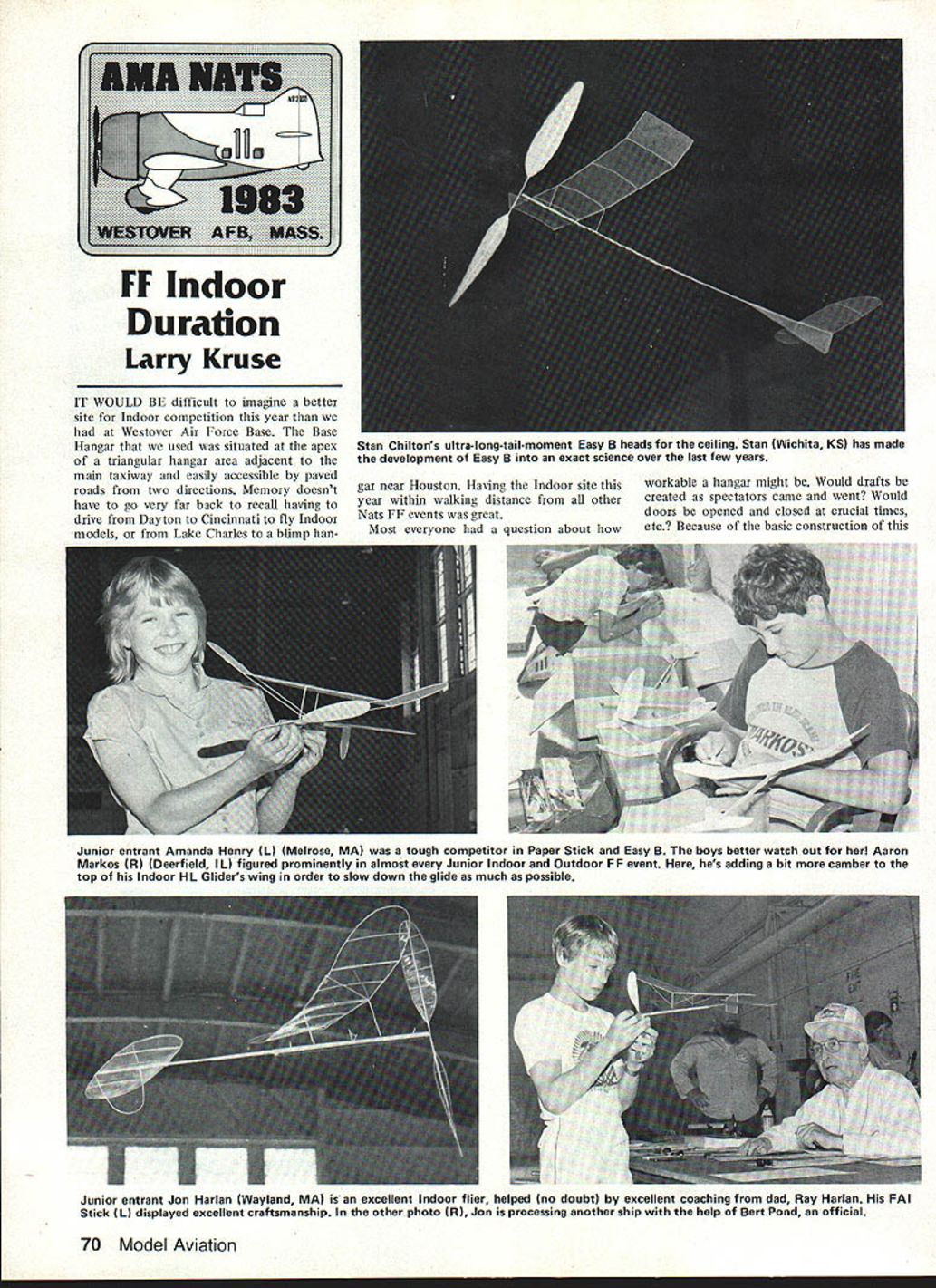
Pete Andrews showed his true form in Open by besting Stan Chilton in an event that has been Stan's specialty for several years. Stan's Easy B was particularly interesting: short nose and long, flexible tail. Third place ended up in the hands of Frank Haynes.
Pennyplane, like Easy B, maintained its numerical popularity this year. Gordon Wisniewski showed the way in Open with a 13:02 flight. Gordon had the only biplane entered in the event. Charlie Sotich came in second, flying a plane with a prop of 19-in. dia., 24-in. pitch patterned after that of the Gossamer Albatross. Jim Fiorello was third.
Patrick Winkler did it again in senior after some initial trimming problems, besting Bryan Fulmer by over 30 sec. Susan Brown was a distant third.
Jon Harlan was the star of the junior Pennyplane event, and he would have placed third in Open with his fine 9:42. Aaron Markos was a very tight second at 9:18, and David Brown bested two members of the fairer sex, Melinda Anderson and Amanda Henry, for third.
The most bothersome fact about indoor this year (excluding scale) was the low number of entries. In a year when overall Nats entries almost doubled, indoor showed no such propensity. The site was excellent. The contest was held in the midst of a major population center. Yet neither of these facts was reflected in a numerical fashion. Part of the explanation is obviously the number of fliers who were siphoned off by Indoor Week at West Baden. Most people can afford only so much travel nowadays, and so they had to make a choice.
Some competitors, such as Dan Domina, feel that indoor growth can be fostered by re-instituting the category championships of past years. Points earned by competing in various indoor events would apply to an overall Free Flight Championship and serve as a stimulus for participation in more events. While the feasibility of going back to the old age-group national champion setup may be just about nil, the category championship idea may be well worth reconsidering for Reno next year. If indoor is to be awakened from its lethargy at the Nats, we'd best apply some sort of stimulus quickly.
Transcribed from original scans by AI. Minor OCR errors may remain.

