
FF Outdoor Glider
Larry Kruse
THE EIGHTY ENTRIES in Outdoor Hand‑Launched Glider was not a record number for a Nationals, but it was certainly an indication that interest in this deceptively simple event is very strong on the East Coast. If you went down the list of contestants, you wouldn't find many west of the Mississippi who participated. Consequently, names like Stoy, Lueken, Matsuno, Boyer and others we’re used to seeing in Nats listings were not in evidence — they were replaced by competitors with eastern seaboard addresses.
The weather on Thursday, HLG day, was anything but conducive to good scores. A stiff, steady breeze blew out of the southeast from 8 a.m. until the close of competition, without letup. Those who sought to fly early to take advantage of “dew thermals” didn't find them. Those who waited to fly later, hoping for warm bubbles of air, suffered the same fate. Streamers, soap bubbles, cattail fuzz, and electronic detectors all indicated the same thing — light, spotty lift moving downfield with the wind.
Piggybacking the rubber fliers became the order of the day, but even this technique was only mildly successful. On one occasion Craig Dunlop, former Tulsa Glue Dobber Trophy winner, actually threw his Polly variant higher than the rubber job he was trying to piggyback, only to have it return to earth at 78 seconds by my watch.
Little towing finesse was in evidence in A‑1, partly because these little ships don't lend themselves very well to hanging on the line for any length of time. Most fliers seemed willing to bring their planes to the top of the line as quickly as possible and then pop them off, hopefully into lift. Things weren't much different in A‑2 as far as towing technique was concerned. Circle towing or zoom launches weren't common. While the air was fairly good at times, several fliers could have benefited from keeping their ships on the towline longer to make sure the models were centered in lift before releasing them.
Junior Hand‑Launched Glider
- 1st: Xavier deLapparent (Paris, France), tutored by Chuck Markos — his score would have placed him sixth in Open.
- 2nd: John Rice.
- 3rd: Kevin Mahan.
A human‑interest note: Xavier’s win was a standout story of the meet.
Senior Hand‑Launched Glider
- 1st: Chris Balcer (Morristown, PA).
- 2nd: Bryan Fulmer (13 seconds behind Balcer on a three‑flight total).
- 3rd: Raymond Audet (91 seconds behind Fulmer).
Open Hand‑Launched Glider
Open HLG became a family affair for the Pelatowskis of Ansonia, CT:
- 1st: Lawrence Pelatowski — 305 (a good score given the conditions).
- 2nd: Ed Pelatowski — 281.
- 3rd: Craig Dunlop — 255 (he can throw an HLG so high it is just a speck overhead).
- Close behind: Gerald Donahue came within 4 seconds of Dunlop.
A‑1 Towline
A‑1 Towline was fairly bunched once you got beyond the leader:
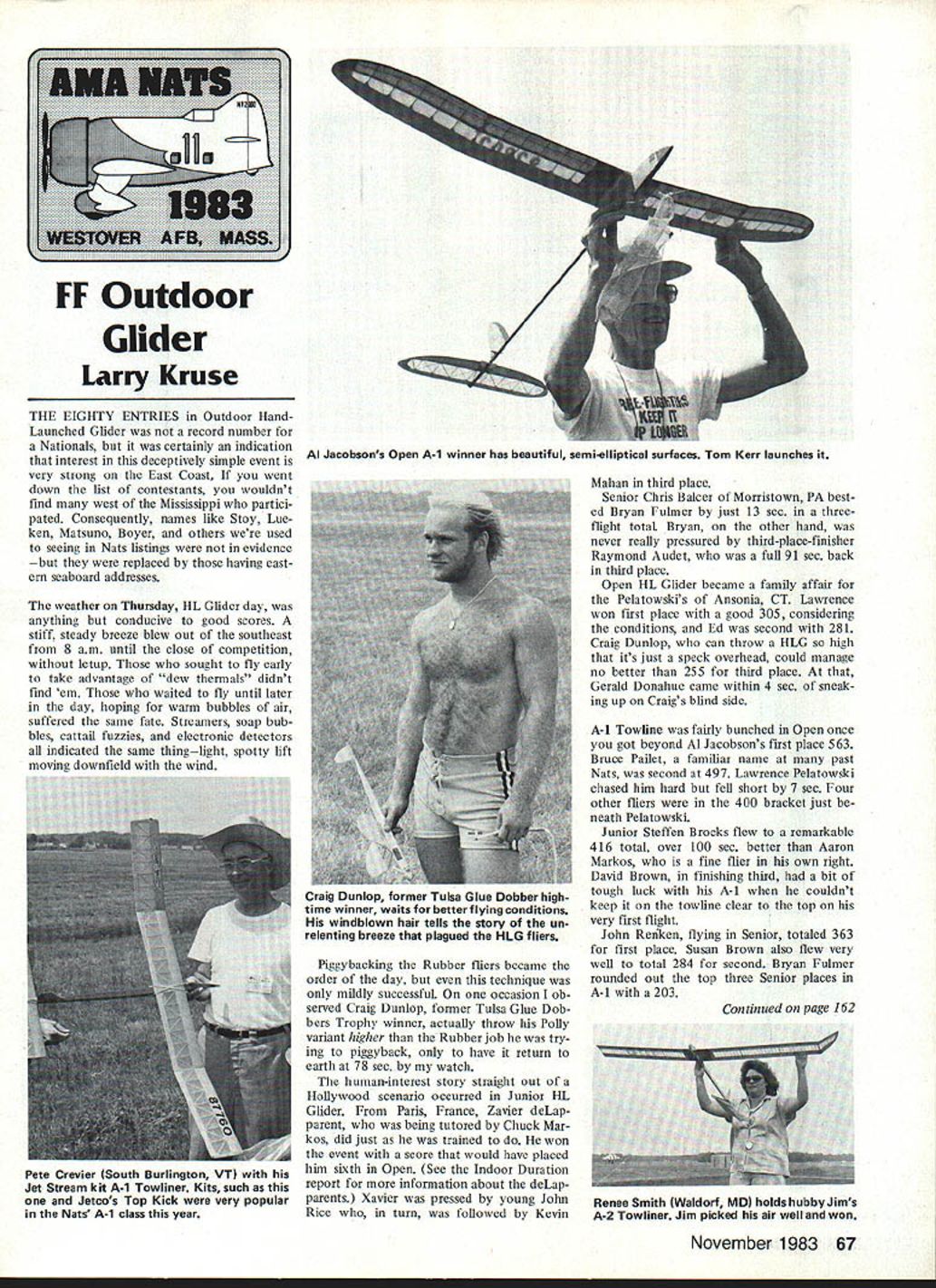
- 1st: Al Jacobson — 563.
- 2nd: Bruce Paillet — 497.
- 3rd: Lawrence Pelatowski — 7 seconds behind Paillet.
- Four other fliers were in the 400‑second bracket just beneath Pelatowski.
Junior A‑1:
- 1st: Steffen Brocks — 416 (remarkable; over 100 seconds better than the next junior).
- 2nd: Aaron Markos.
- 3rd: David Brown — had bad luck on his first flight when he couldn't keep the A‑1 clear to the top on the towline.
Senior A‑1:
- 1st: John Renken — 363.
- 2nd: Susan Brown — 284.
- 3rd: Bryan Fulmer — 203.
A‑2 Towline
- 1st: Jim Smith — 761 total.
- 2nd: Bob Silsbee — 4 seconds behind Smith (Silsbee was flying almost every event on the schedule).
- 3rd: Kevork Fags.
- Best Senior in A‑2: Bryan Fulmer (he finished sixth overall).
Overall, the meet showed strong regional interest and competitive flying despite marginal lift and steady wind.
Transcribed from original scans by AI. Minor OCR errors may remain.

