
FF Power
Larry Kruse
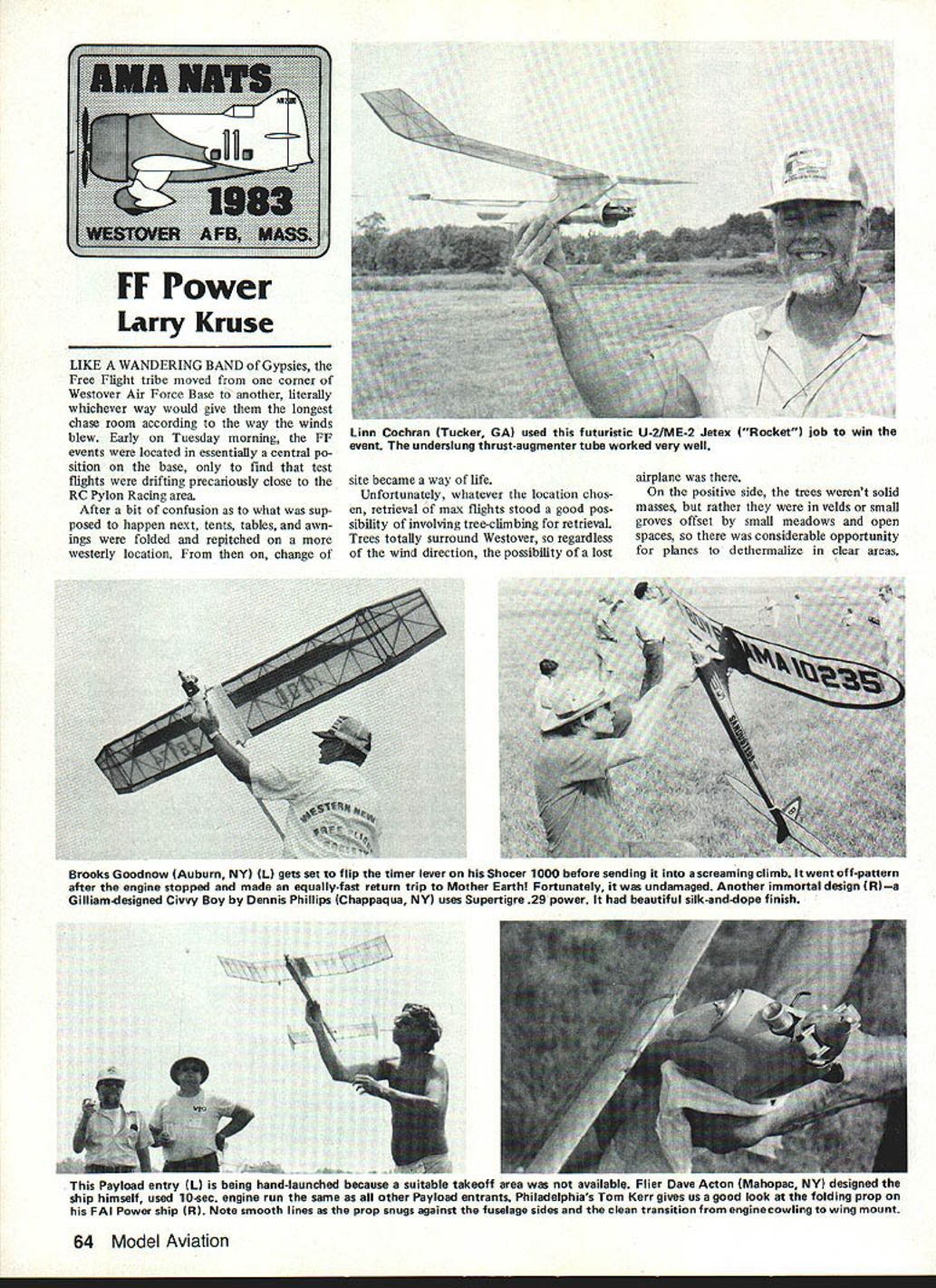
Like a wandering band of Gypsies, the Free Flight tribe moved from one corner of Westover Air Force Base to another, literally whichever way would give them the longest chase room according to the way the winds blew. Early on Tuesday morning, the FF events were located in essentially a central position on the base, only to find that test flights were drifting precariously close to the RC Pylon Racing area.
After a bit of confusion as to what was supposed to happen next, tents, tables, and awnings were folded and repitched on a more westerly location. From then on, change of site became a way of life.
Unfortunately, whatever the location chosen, retrieval of max flights often involved tree-climbing. Trees totally surround Westover, so regardless of the wind direction, the possibility of a lost airplane was ever present. On the positive side, the trees weren't solid masses but were in velds or small groves offset by small meadows and open spaces, so there was considerable opportunity for planes to dethermalize in clear areas.
Indeed, the number of retrieval complaints I heard was far fewer than from the cornfields of Nebraska or the soybeans of Ohio—and certainly far fewer than some advance negative publicity would have indicated.
Half-A Gas
Half-A Gas had the third-largest entry at the Nats, exceeded only by two RC sailplane events in popularity. Joe Wagner of Rowayton, CT, turned in six maxes-plus to take first place in Open. Bob Rambo finished second at 628, and Kevin Barrett was third at 600.
There remains a question in many minds whether Category III sites are a good measure of man and airplane at the national level. Whatever the answer, Aaron Markos (Junior) and David Hooke (Senior) made the best of the circumstances to lock up first places in their respective age divisions.
Aaron was followed in Junior by Melinda Anderson—the only Junior female entrant—and persistent David Brown. Bryan Fulmer was second in Senior, followed by Susan Brown.
Class D Gas
Class D Gas had only five contestants, but what it lacked in quantity it made up for in quality. Mark Heller, Sal Taibi, and Brooks Goodnow finished one–two–three, unleashing the big ships. The much-moved launch site happened to be right up against a runway during D Gas, and a considerable crowd got a close-up look at Free Flight for some—the first time. The Class D ships rumbled into the air to appreciative onlookers.
FAI
FAI was run on the same day (Thursday), so spectators also saw high-revving, auto-surfaced, prop-folding screamers. Tom Kerr, flying a ship equipped with a folding prop and engine brake, took first. In direct contrast, second place went to Senior Susan Brown, flying a plain-vanilla Midi Pearl with no auto surfaces or gimmickry. Bob Gutai was third at 408.
As finely tuned as these FAI ships are, success still requires picking the right air.
Open C Gas
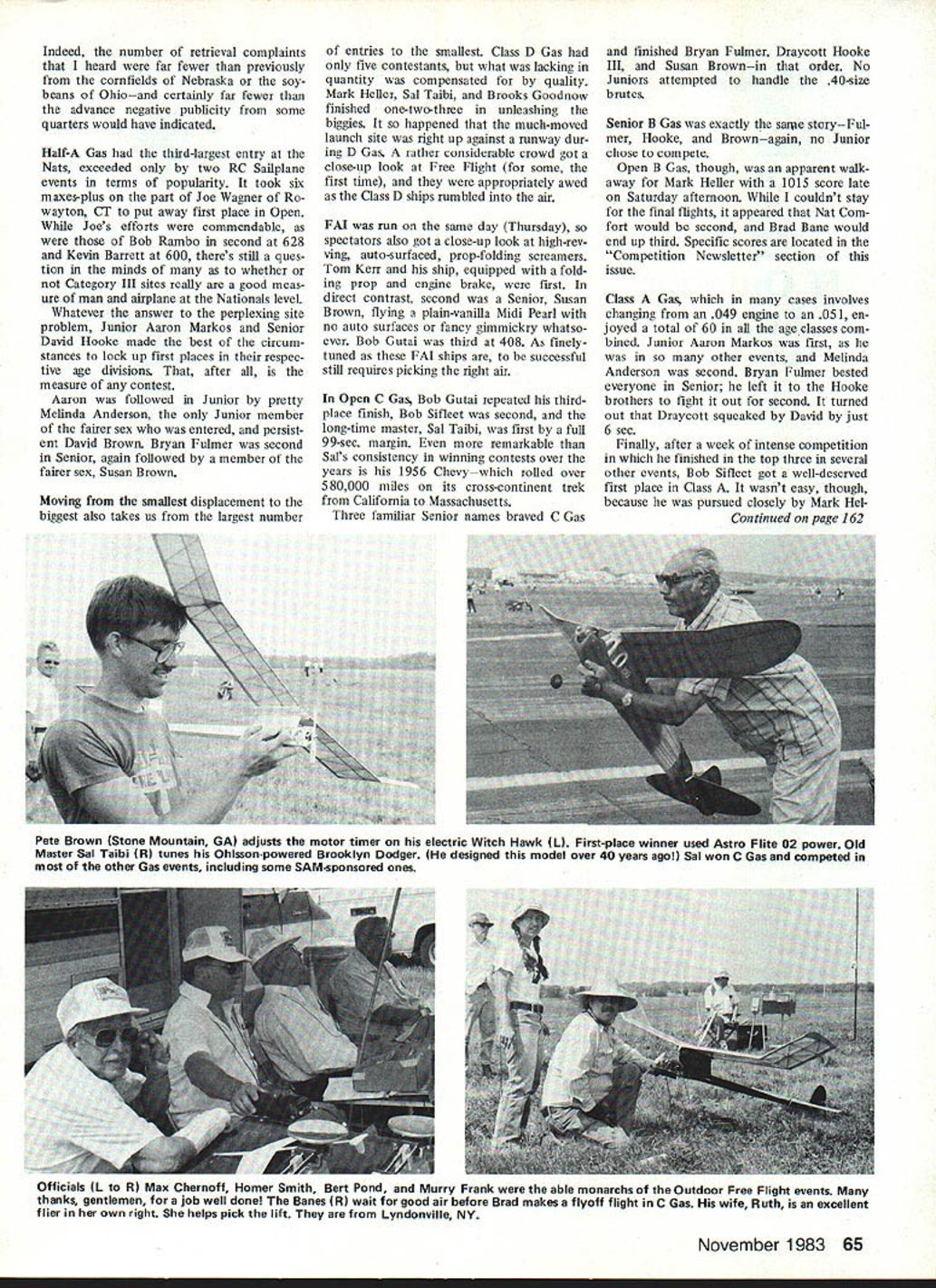
In Open C Gas, Bob Gutai repeated his third-place finish, Bob Sifleet was second, and long-time master Sal Taibi won by a full 99-second margin. More remarkable than Sal's consistency is his 1956 Chevy—which rolled over 580,000 miles on its cross-continent trek from California to Massachusetts.
Three familiar Senior names braved C Gas and finished Bryan Fulmer, Draycott Hooke III, and Susan Brown—in that order. No Juniors attempted the .40-size brutes.
Senior B Gas
Senior B Gas produced the same top three: Fulmer, Hooke, and Brown—again with no Junior entries.
Open B Gas
Open B Gas appeared to be a walkaway for Mark Heller, who posted a 1015 score late on Saturday afternoon. Nat Comfort finished second and Brad Bane third. Fourth place went to Ruth Bane of Lyndonville, NY. Ruth flies a design called the Wind Whip and can be counted on to be very competitive in any event she enters.
Class A Gas
Class A Gas, which often involves changing from an .049 engine to an .051, drew a total of 60 entries across the age classes. Junior Aaron Markos again took first, with Melinda Anderson second. Bryan Fulmer bested everyone in Senior; Draycott squeaked by David by just 6 seconds for second in Senior.
In Open A (Class A), after a week of intense competition and several other top-three finishes, Bob Sifleet earned a well-deserved first place. He was pursued closely by Mark Heller.
Speed fuel rule discussion
There were numerous discussions concerning an upcoming rule to standardize the Speed fuel for all Speed events (except Jet), similar to the Formula "40" fuel mixture. The Speed fliers voted to defeat the proposal. Even though the Speed Advisory Committee had endorsed it, the majority felt the existing rules were satisfactory.
Designs and notable equipment
The Shocer design was prevalent, being built and entered in all sizes. Punctuated by an occasional Satellite and a random Starduster, the East Coast has been taken over by the Shocer. If memory serves, this Mel Schmidt design originated on the West Coast over a decade ago, but it is very much alive and well in the East—and it flies well.
Nats FF Power / Kruse
Payload
ROGing (rise-off-ground) was hampered by the lack of a suitable runway surface due to the prevailing wind, so hand-launching was the order of the day. The elimination of ROG takeoffs tends to favor heavier .020 ships. Fred Anderson repeated his Payload win with a ship appropriately named Midnight Oil. K. Peter Brooks was second, and Stephen Landy was third. Landy's ship was a 1952 Denny Davis design called the Mini-PAAgon, resurrected from the days when Pan American Airways sponsored the Payload event.
Electric
Electric is still an event trying to happen, with just seven contestants entered. Peter Brown won flying a Jim Clem-designed Witch Hawk powered by an Astro 020. His sister Linda was second with a similar setup, and Joe Reshar was third. Even though electric technology is available, Free Flighters have not yet widely adopted it—perhaps next year.
Thanks and closing
This report, together with the other FF segments, should give some idea of what happened at the largest Nats in the past several years. Special thanks go to the officials who manned the tables, to Homer Smith for masterful organization, and to Col. Roy E. Ayers, commanding officer of Westover Air Force Base, whose fine facilities we enjoyed.
Westover brought back the crowds, the competition, and the excitement of the old-time Nats. My family and I had a terrific time. I hope you did, too.
Transcribed from original scans by AI. Minor OCR errors may remain.

