
Radio Technique
George M. Myers
RC Equipment at the 1983 Nats
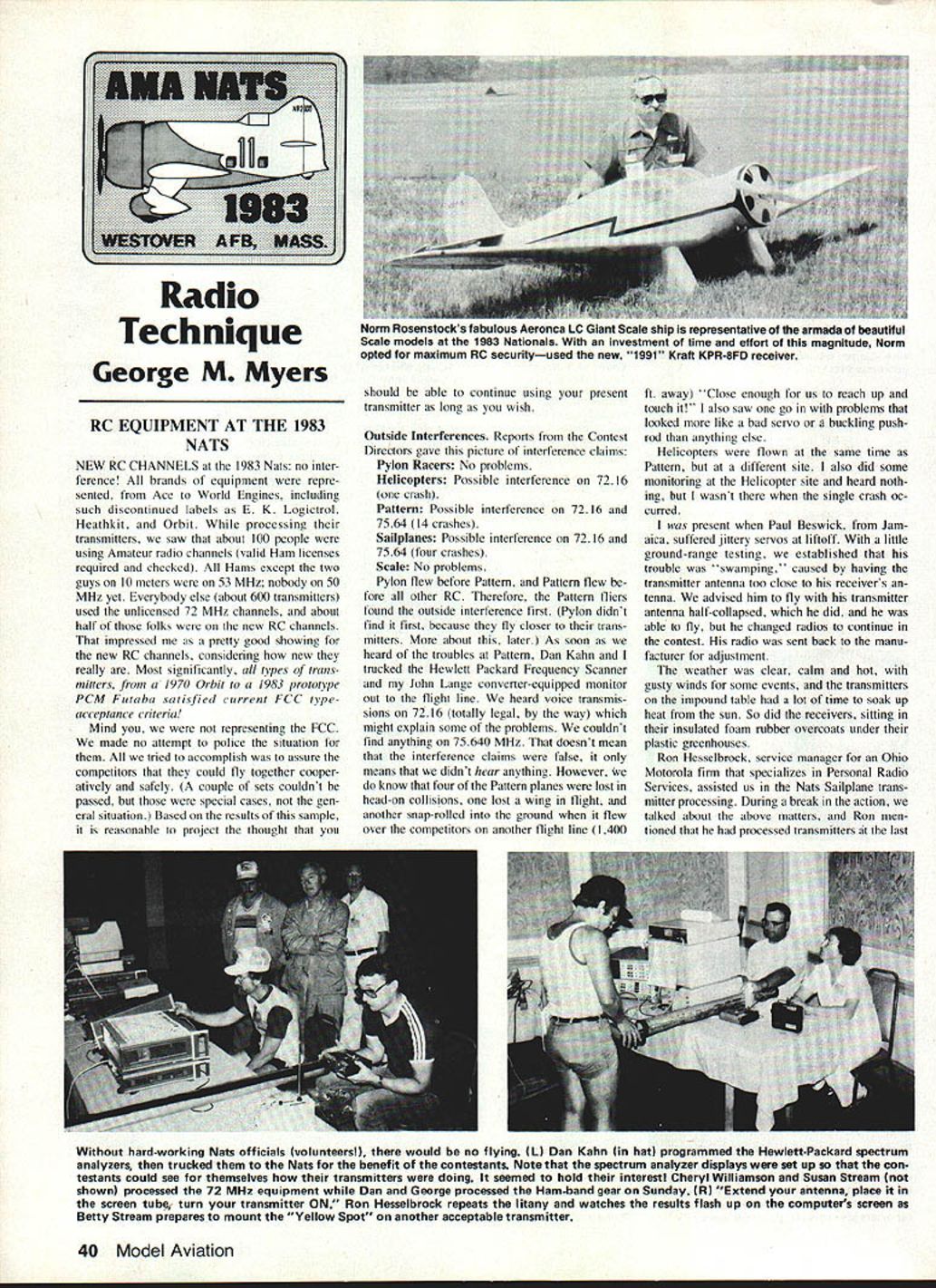
New RC channels at the 1983 Nats: no interference! All brands of equipment were represented, from Ace to World Engines, including such discontinued labels as E.K., Logictrol, Heathkit, and Orbit. While processing transmitters, we saw about 100 people using amateur radio channels (valid HAM licenses required and checked). All Hams except two operators on 10 meters were on 53.000 MHz; nobody was on 50.000 MHz. Everybody else (about 600 transmitters) used the unlicensed 72 MHz channels, and about half of those were on the new RC channels. That was an impressive showing for the new channels, considering how new they are. Most significantly, all types of transmitters — from a 1970 Orbit to a 1983 prototype PCM Futaba — satisfied current FCC type-acceptance criteria.
We were not representing the FCC and made no attempt to police the situation for them. Our goal was to assure competitors that they could fly together cooperatively and safely. A couple of sets couldn't be passed, but those were special cases, not the general situation. Based on this sample, it is reasonable to project that you should be able to continue using your present transmitter as long as you wish.
Outside Interference
Reports from the contest directors gave this picture of interference claims:
- Pylon racers: no problems.
- Helicopters: possible interference on 72.160 MHz (one crash).
- Pattern: possible interference on 72.160 MHz and 75.640 MHz (14 crashes).
- Sailplanes: possible interference on 72.160 MHz and 75.640 MHz (four crashes).
- Scale: no problems.
Pylon flew before Pattern, and Pattern flew before all other RC. Therefore Pattern fliers found the outside interference first. (Pylon pilots didn't find it first because they fly closer to their transmitters; more about this later.) As soon as we heard of the troubles at Pattern, Dan Kahn and I trucked the Hewlett-Packard frequency scanner and my John Lange converter-equipped monitor out to the flight line. We heard voice transmissions on 72.160 MHz (totally legal, by the way), which might explain some of the problems. We couldn't find anything on 75.640 MHz. That doesn't mean the interference claims were false; it only means we didn't hear anything.
We know of four Pattern planes lost in head-on collisions, one that lost a wing in flight, and another that snap-rolled into the ground when it flew over competitors on another flight line (about 1,400 ft. away). I also saw one crash that looked more like a bad servo or a buckling pushrod than outside interference.
Helicopters were flown at the same time as Pattern but at a different site. I monitored at the Helicopter site and heard nothing, but I wasn't there when the single crash occurred.
I was present when Paul Beswick, from Jamaica, suffered jittery servos at liftoff. Ground-range testing established that his trouble was swamping, caused by having the transmitter antenna too close to his receiver antenna. We advised him to fly with his transmitter antenna half-collapsed; he did and was able to fly, but he changed radios to continue in the contest. His radio was sent back to the manufacturer for adjustment.
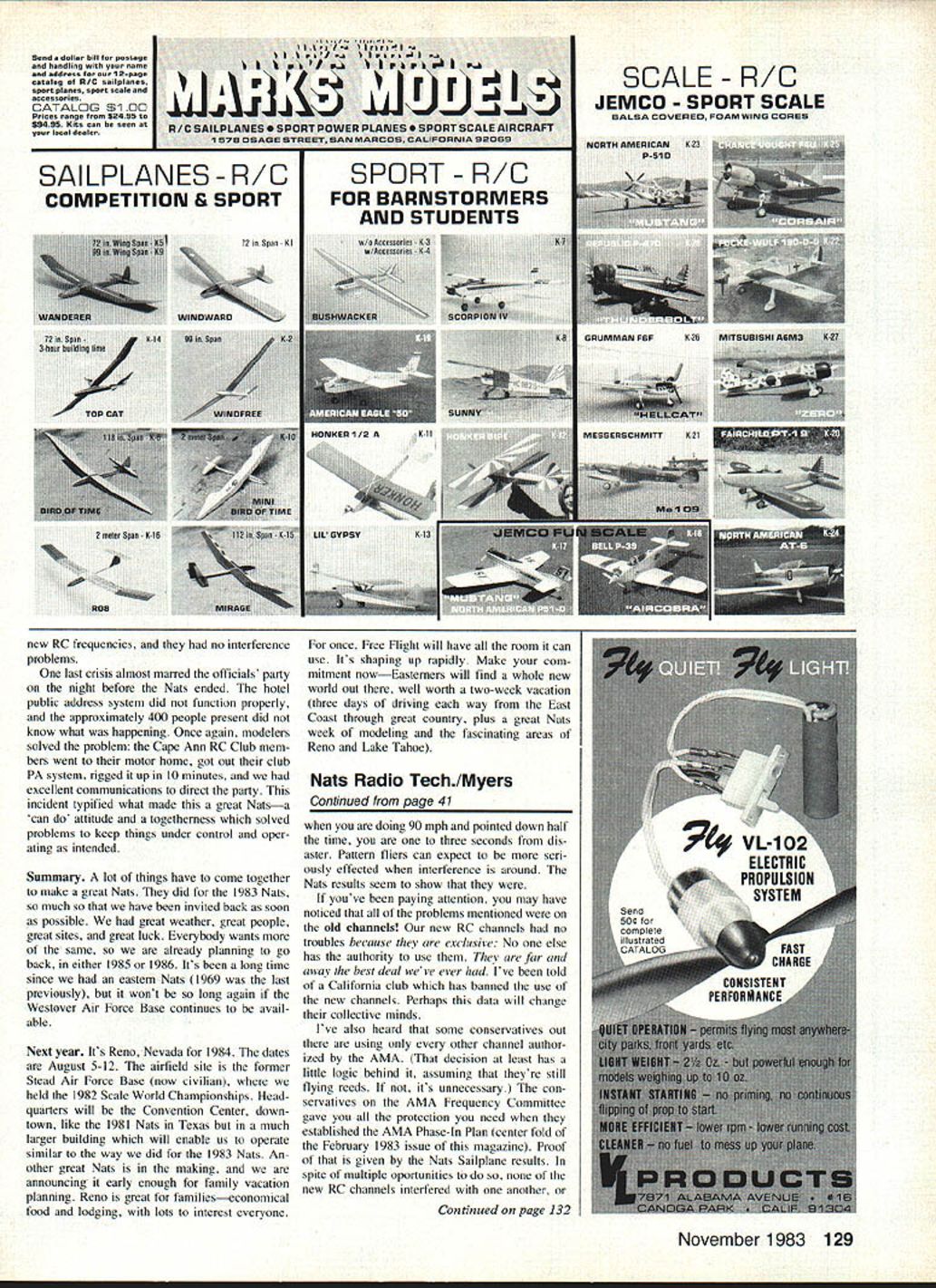
The weather was clear, calm and hot, with gusty winds for some events, and the transmitters on the impound table spent a lot of time soaking up heat from the sun. Receivers similarly sat in their insulated foam rubber overcoats under plastic "greenhouses." Ron Hesselbrock, service manager for an Ohio Motorola firm that specializes in personal radio services, assisted us in Sailplane transmitter processing. During a break in the action, Ron and others discussed processed transmitters at length.
A helpful tip: sew up a transmitter bag from a white terry cloth towel (remove it to fly). Throw a towel over the airplane, too, to keep the receiver and its battery cool. The reason Jim Fosgate chose white for the Pro Line sets in 1969 was to keep them cool in Western deserts; Ace RC, Inc. equipment is white for the same reason.
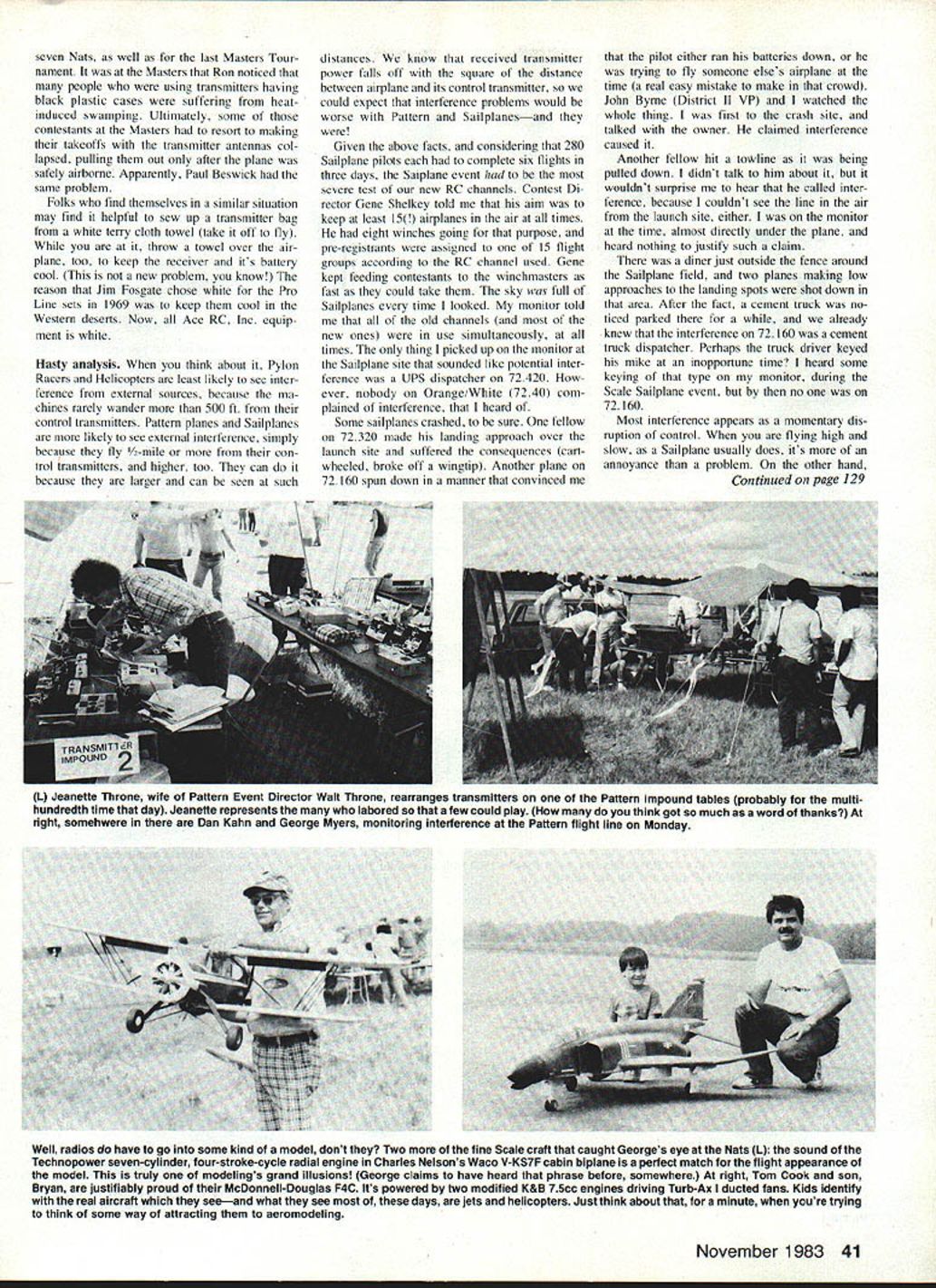
Dan Kahn had programmed Hewlett-Packard spectrum analyzers and trucked them to the Nats for contestants. The spectrum analyzer displays were set up so contestants could see what their transmitters were doing — they drew a lot of interest and helped convince contestants that their equipment was operating properly.
Hasty Analysis
Pylon racers and helicopters are least likely to see interference from external sources because the machines rarely wander more than about 500 ft. from their control transmitters. Pattern planes and sailplanes are more likely to see external interference, simply because they fly a half-mile or more from their control transmitters and fly higher, too. Received transmitter power falls off with the square of the distance between airplane and control transmitter, so interference problems can be worse with Pattern and Sailplanes — and they were.
Sailplanes and Flight Operations
With 280 sailplane pilots each required to complete six flights in three days, the Sailplane event was the most severe test of the new RC channels. Contest Director Gene Shelkey aimed to keep at least 15 airplanes in the air at all times. He had eight winches going and assigned pre-registrants to one of 15 flight groups according to the RC channel used. Gene fed contestants to the winchmasters as fast as they could take them. The sky was full of sailplanes every time I looked. My monitor showed that all of the old channels (and most of the new ones) were in simultaneous use.
The only potential interference I picked up on the monitor at the Sailplane site was a UPS dispatcher on 72.420 MHz. Nobody on Orange/White (72.400 MHz) complained of interference that I heard of. Some sailplanes did crash: one fellow on 72.320 MHz cart-wheeled and broke off a wingtip after making a landing approach over the launch site. Another plane on 72.160 MHz spun down in a manner that suggested the pilot either ran his batteries down or was trying to fly someone else's airplane (a real easy mistake in that crowd). One pilot hit a towline as it was being pulled down.
There was a diner just outside the fence around the Sailplane field where two planes making low approaches were shot down. After the fact, a cement truck was noticed parked there for a while, and we already knew that some of the interference on 72.160 MHz was a cement truck dispatcher. Perhaps the truck driver keyed his mike at an inopportune time; I heard that type of keying on my monitor during the Scale/Sailplane event, but by then no one was on 72.160 MHz.
Most interference appears as a momentary disruption of control. When you are flying high and slow, as a sailplane usually does, it's more of an annoyance than a problem. On the other hand, when you are doing 90 mph and pointed down half the time, you are one to three seconds from disaster. Pattern fliers can expect to be more seriously affected when interference is around. The Nats results seem to show that they were.
If you've been paying attention, you may have noticed that all of the problems mentioned were on the old channels. Our new RC channels had no troubles because they are exclusive — no one else has the authority to use them. They're far and away the best deal we've ever had. I've been told of a California club that has banned the use of the new channels; perhaps these data will change their minds.
Some conservative fliers are using only every other channel authorized by the AMA. That decision has a little logic behind it if they're still flying reeds; if not, it's unnecessary. The AMA Frequency Committee has given protection in the AMA Phase-In Plan. The Nats sailplane results show that none of the new RC channels interfered with one another or with the ham band.
Scale and Later Events
Scale was flown last. By then, the interference on 72.160 MHz and 75.640 MHz was well established. The Contest Director gave competitors a choice: "Get off 72.160 and 75.640, or take your money back and leave!" It worked. The only crashes I witnessed during Scale were stall/spin accidents attributable to attempts to fly too low and too slowly in gusty conditions while trying to display realistic flight.
Summary
- No problems at all with the new RC channels.
- Great accommodations, friendly people, salubrious weather.
- Tremendous effort by the many who worked in supporting tasks so that a few could fly — many thanks to the hardworking AMA HQ crew, to wives and families of competitors, and to members of the Pioneer Valley RC Club.
In Memoriam
We've lost a good friend. John Kanakos, a leader in helicopter flying on Long Island, NY, and founder of the Long Island Hover Lovers (AMA 1930), died suddenly just after completing a tethered helicopter demonstration at Rockefeller Center, NYC, as part of the Sixth Annual Model Aviation Fan Day celebration. John had the Greek zest for life and tried everything. In his 70 years he made many friends. We'll miss him.
Transcribed from original scans by AI. Minor OCR errors may remain.

