
RC Pattern
By Chuck Shade
THIS YEAR'S Pattern site must be one of the best flying sites ever for a Nationals competition.
Saturday evening, July 23, found us looking for a parking space in front of the Quality Inn, Chicopee, MA — Nats headquarters — located about five miles from Westover Air Force Base. The area was crowded with contestants and families, and Sunday registration/check-in and transmitter (TX) processing produced an aviation mob that was a lot of fun, seeing old friends from Nats past. This was also the first surge: the largest Pattern entry in the past few years, with over 150 competitors.
Registration and transmitter processing
- TX processing ran from 1:00 to 5:00 p.m. on Sunday. It was slow due to the large entry but well organized.
- Dan Kahn brought a Hewlett-Packard computer-controlled spectrum analyzer. As competitors put their transmitter antennas in the screen tube and turned them on, Suzi Stream entered AMA numbers and names; the unit automatically checked bandwidth compatibility with the new frequencies and verified the channel number against the entry form.
A pilots' meeting at 5:00 p.m. informed us that Pattern had a large entry and Scale had over 100 entries, which would require additional time to complete Scale flying. Organizers hoped to complete Pattern by Thursday to allow Pylon events on Friday and free Saturday and Sunday for Scale. Starting time for Pattern was moved so TXs had to be impounded by noon to allow competitors to fly that day.
Practice fields, camping, and local help
- District I V.P. Ed Izzo arranged for no less than three practice fields within about a 25-mile radius. Finding them in New England was not always easy despite good directions from local Pioneer Valley RC Club members.
- Ed Izzo also obtained permission from Base Commander Roy Ayers to camp on the air base, a hospitable gesture that earned the Air Force high marks from competitors.
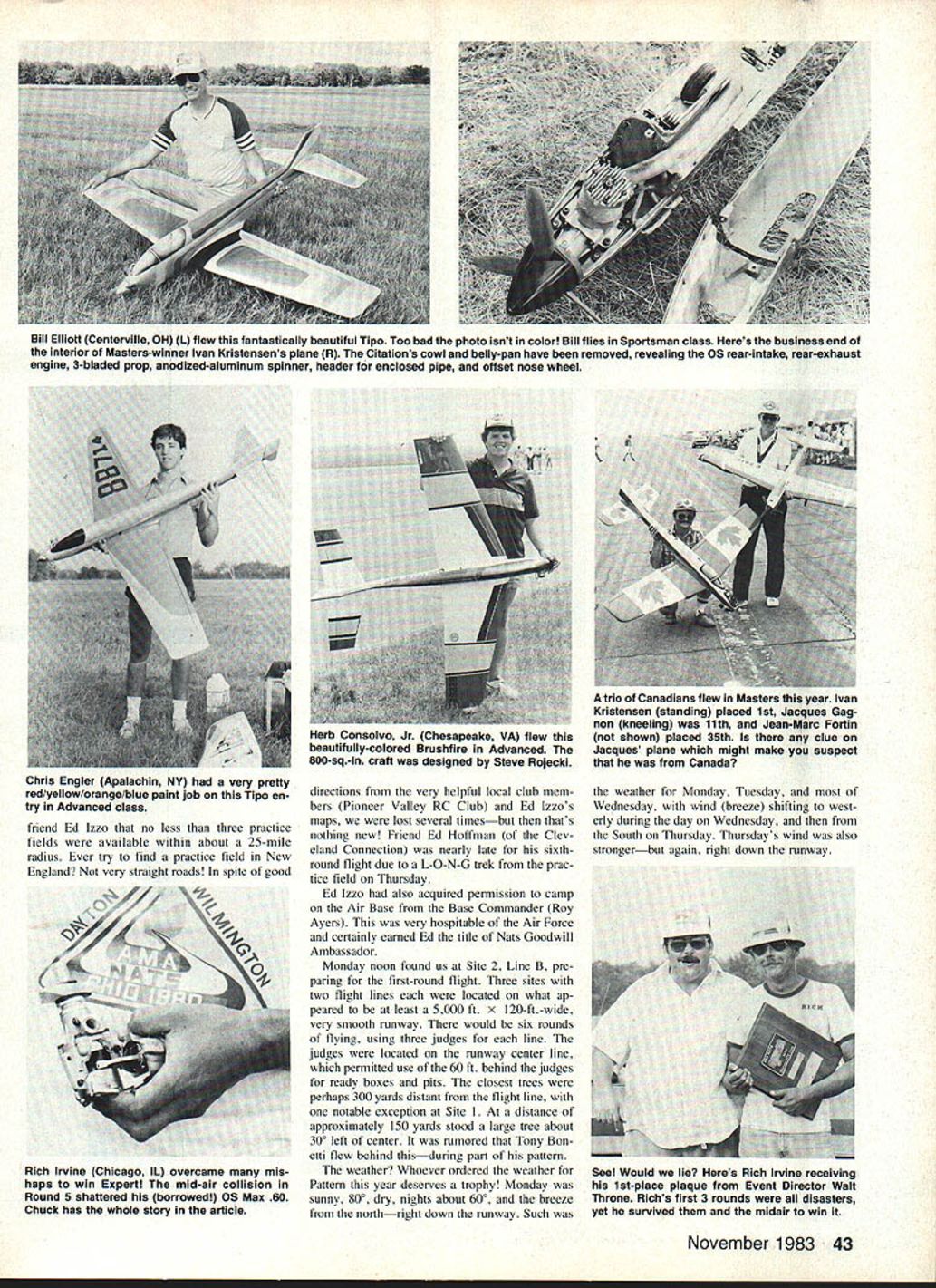
- Thirty-six judges and officials, plus many volunteers and score tabulators, worked throughout the week to run the contest.
Site layout and facilities
- Flying took place on what appeared to be at least a 5,000 ft. x 120 ft. very smooth runway, with three sites and two flight lines each.
- Six rounds of flying were scheduled, using three judges per line. Judges were positioned on the runway center line, leaving about 60 ft. behind them for ready boxes and pits.
- Trees were generally about 300 yards away from the flight line, with one notable exception: at one site a large tree stood about 150 yards left of center. Rumor had it a competitor once flew behind this tree during part of his pattern.
Weather
Whoever ordered the weather for Pattern deserves a trophy. Monday through most of Wednesday were sunny, about 80°F by day and 60°F at night, with a breeze right down the runway. The wind shifted to westerly during Wednesday and to southerly on Thursday; Thursday's wind was stronger but still aligned with the runway.
Flying, interference, and incidents
- Flying started promptly at noon on Monday. Partway through the first round at Site 3, several crashes occurred (reports said seven) on frequency 72.160. The interference was suspected to come from a concrete plant dispatcher's transmitter operating on that frequency. The Host club and Nats officials had warned of potential problems on other frequencies but apparently not 72.160.
- One aircraft impacted the runway center line between judges at Site 1 and observers at Site 2, a frightening moment that fortunately did not result in judges being struck.
Scoring and results posting
- Unofficial flight scores were posted quickly at each site; some competitors barely returned to the pits before seeing their posted scores.
- Official scores were processed at headquarters (Quality Inn) about five miles away. Score sheets had to be rechecked and entered, so official round-to-round standings were typically available about a day later. Entering some 300 score sheets nightly was a big task for Headquarters personnel.
- Mike Jenkins (Louisville, KY) and his score-calculation software were noted as a superior, field-capable solution used at the Masters Tournament; such systems can provide immediate, accurate results on the flight line.
Judging
- Judging has improved over the years but remained the area needing the most work. Most USPJA judges were capable, experienced, and hard-working, but a few inexperienced judges created wide point spreads on individual maneuvers (some as large as 4–6 points), leading to controversy among competitors.
Class highlights
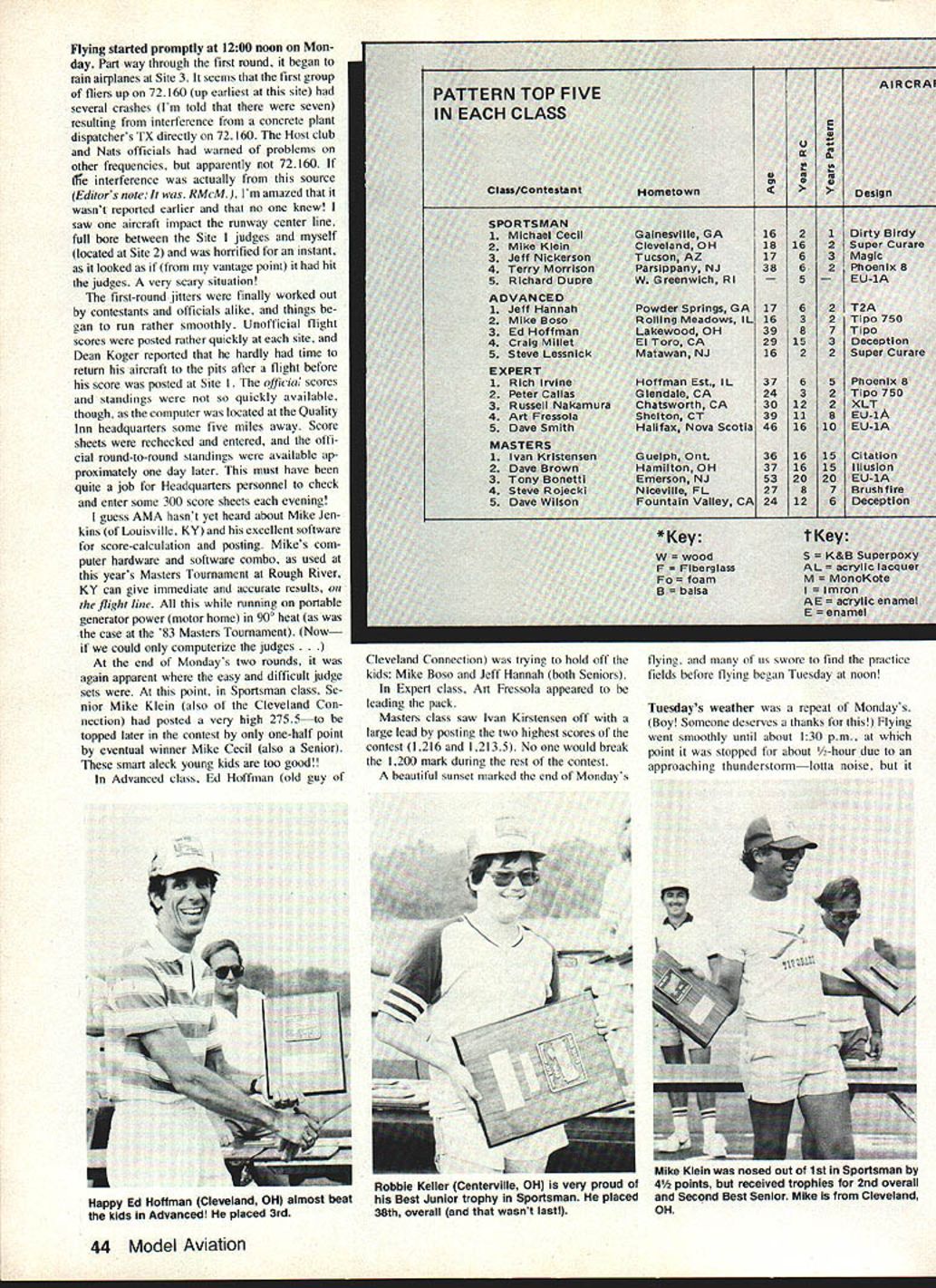
- Sportsman: Senior Mike Klein posted an early high of 275.5, later topped by eventual winner Mike Cecil by only one-half point.
- Advanced: Ed Hoffman (Cleveland Connection) was contending with Seniors Mike Boso and Jeff Hannah.
- Expert: Art Fressola appeared to be leading the pack in the early rounds.
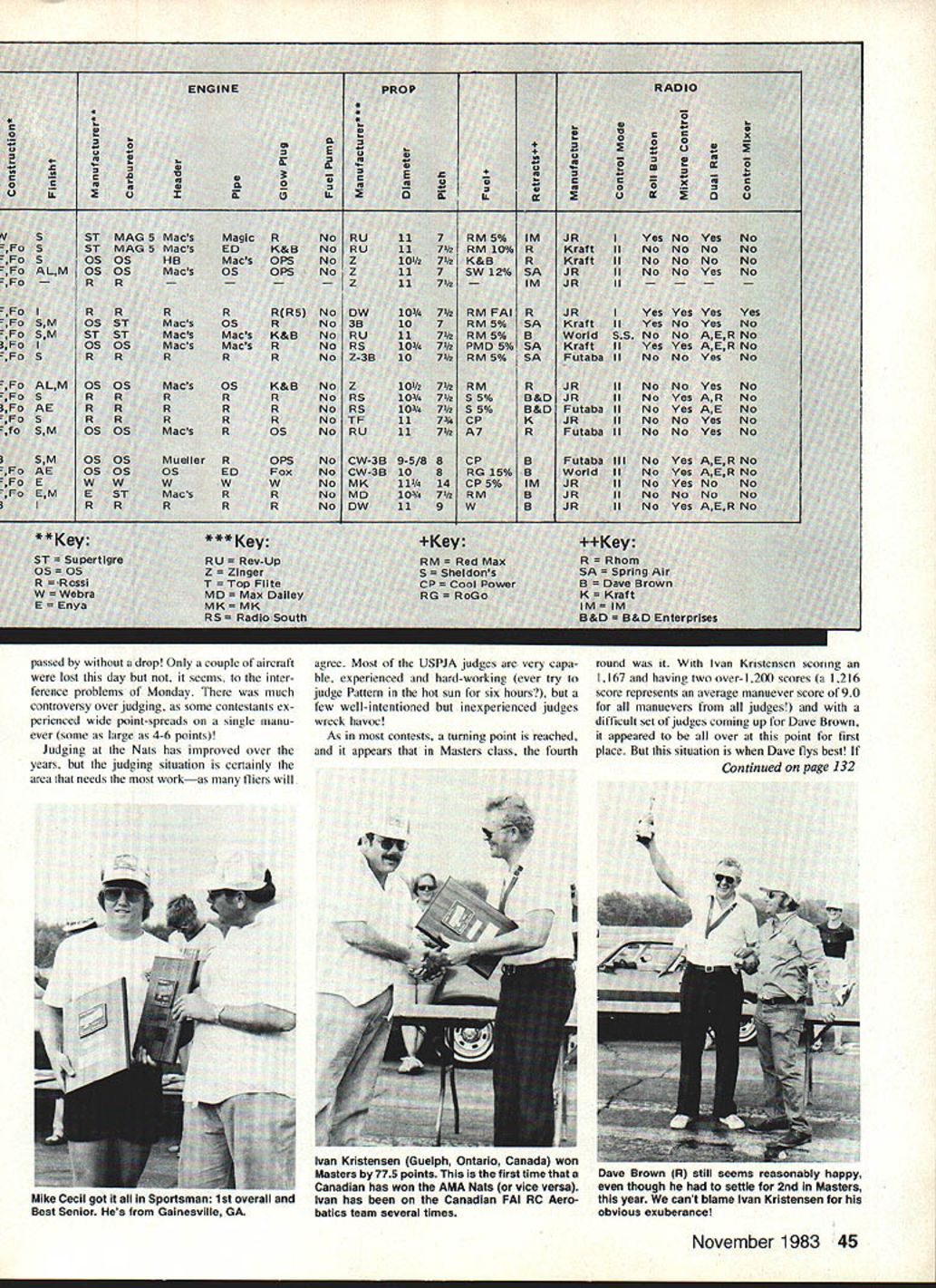
- Masters: Ivan Kristensen opened with two of the highest scores of the contest (1,216 and 1,213.5). No one else managed to break the 1,200 mark during the remainder of the contest.
Conclusion and thanks
In summary, Westover Air Force Base was one of the finest Nats Pattern sites in years: a superb runway, excellent local hospitality from the Pioneer Valley RC Club, permission to camp from Base Commander Colonel Roy Ayers, and the hard work of Pattern Director Walt Throne and his many volunteers. District I V.P. Ed Izzo was especially helpful and visible throughout the event. This combination of site, weather, and organization made the 1983 Pattern event a memorable Nationals experience.
Transcribed from original scans by AI. Minor OCR errors may remain.

