
AMA Nats 1983: RC Pylon Racing
Art Arro
Overview
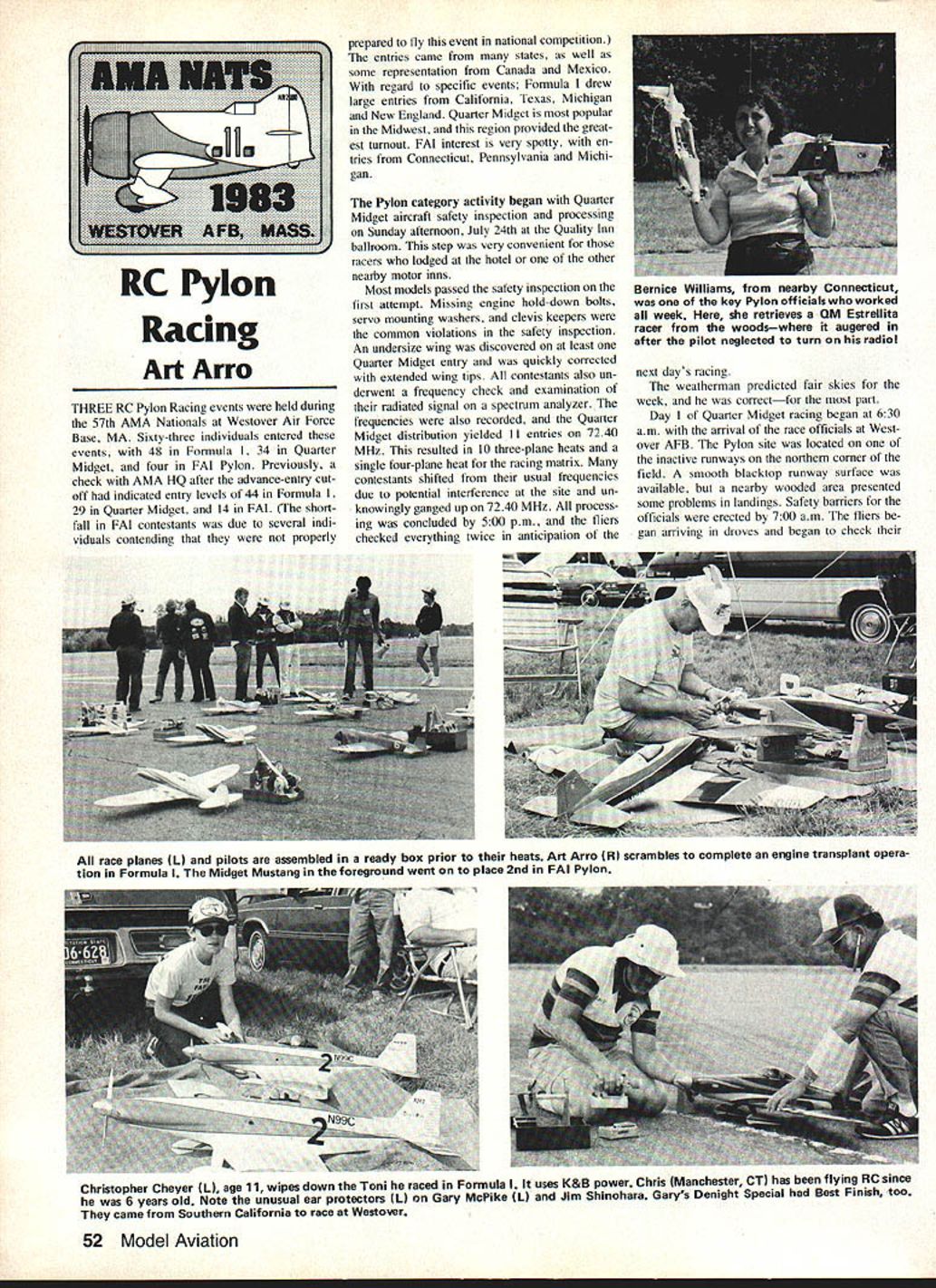
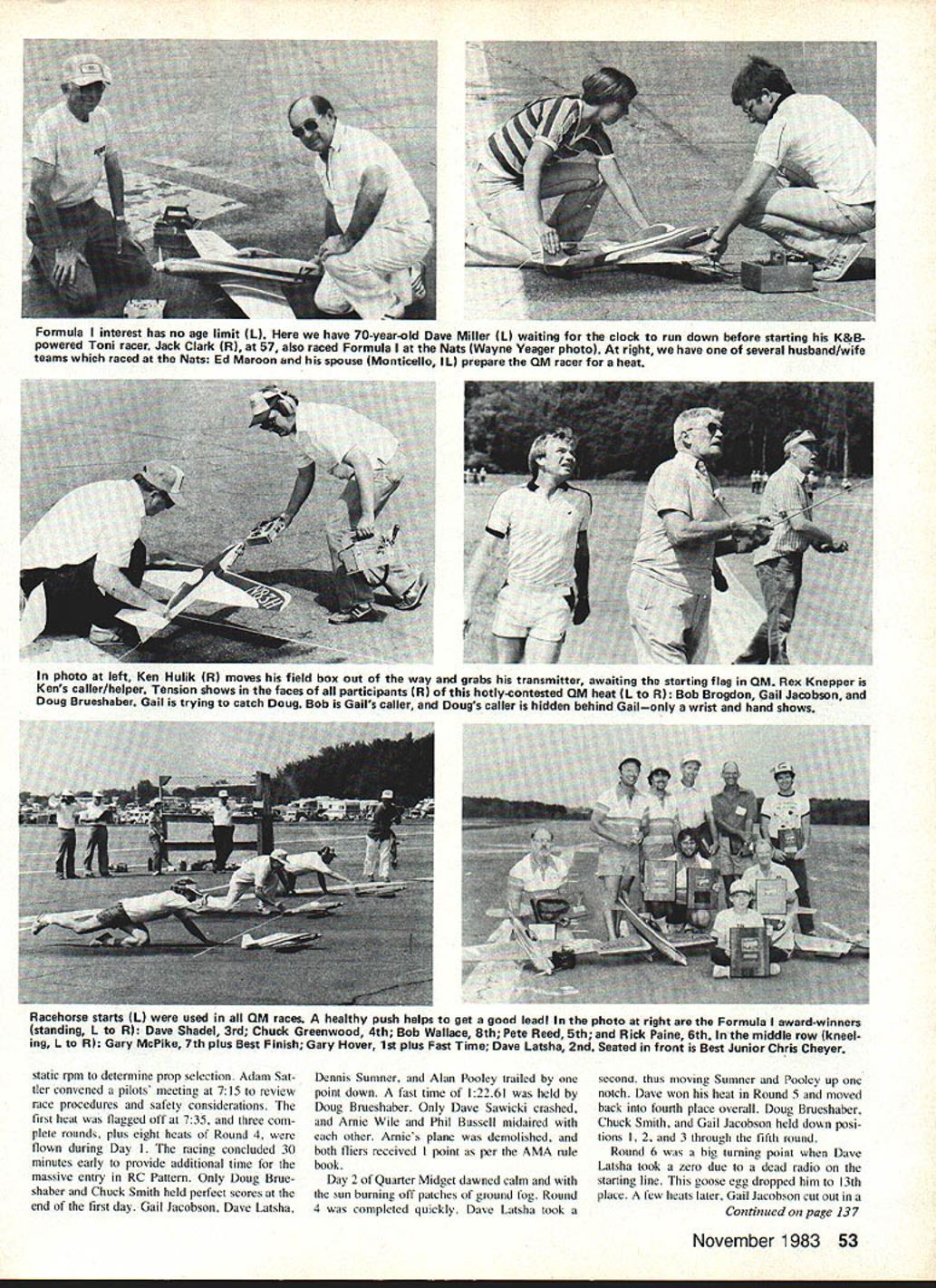
Three RC Pylon Racing events were held during the 57th AMA Nationals at Westover Air Force Base, MA. Sixty-three individuals entered these events:
- Formula I: 48 entries
- Quarter Midget: 34 entries
- FAI Pylon: 4 entries
Advance-entry checks had indicated 44 in Formula I, 29 in Quarter Midget, and 14 in FAI; the shortfall in FAI was due to several contestants deciding they were not properly prepared for national competition. Entrants came from many U.S. states and from Canada and Mexico. Formula I drew large entries from California, Texas, Michigan and New England. Quarter Midget was strongest in the Midwest, while FAI interest was spotty (entries from Connecticut, Pennsylvania and Michigan).
Processing and Safety Checks
Pylon activity began with Quarter Midget aircraft safety inspection and processing on Sunday afternoon, July 24, in the Quality Inn ballroom — convenient for racers staying at that hotel or nearby motor inns. Most models passed inspection on the first attempt. Common violations included missing engine hold-down bolts, missing servo-mounting washers, and missing clevis keepers. An undersize wing was discovered on at least one Quarter Midget entry and was corrected with extended wing tips.
All contestants underwent frequency checks and examination of their radiated signal on a spectrum analyzer; frequencies were recorded. Quarter Midget distribution yielded 11 entries on 72.40 MHz, producing ten three-plane heats and one four-plane heat. Many contestants had shifted from their usual frequencies because of potential interference and unknowingly concentrated on 72.40 MHz. Processing concluded by 5:00 p.m.
Quarter Midget
Site and conditions
The Pylon site was on an inactive runway in the northern corner of Westover AFB. The blacktop runway surface was smooth, but nearby woods made some landings difficult. Safety barriers for officials were erected by 7:00 a.m. Pilots checked static rpm to determine prop selection and assembled for racing.
Day 1 (Heat rounds 1–4)
- Pilots' meeting called by Adam Sattler at 7:15 a.m.; first heat flagged off at 7:35 a.m.
- Three complete rounds plus eight heats of Round 4 were flown.
- Racing ended 30 minutes early to provide time for the large RC Pattern entry.
- At the end of Day 1, only Doug Brueshaber and Chuck Smith held perfect scores. Gail Jacobson, Dave Latsha, Dennis Sumner, and Alan Pooley trailed by one point.
- Fast time: Doug Brueshaber — 1:22.61.
- Incidents: Dave Sawicki crashed; Arnie Wile and Phil Bussell mid‑aired with each other (Arnie's plane was demolished). Both fliers received 1 point per AMA rules.
Day 2 (Round 4–6)
- Day dawned calm with ground fog burning off.
- Round 4 completed quickly. Dave Latsha placed second in a heat and later won a Round 5 heat, moving back into fourth overall.
- Doug Brueshaber, Chuck Smith, and Gail Jacobson held top positions through Round 5.
- A turning point came in Round 6 when Dave Latsha recorded a zero due to a dead radio on the starting line, dropping him to 13th overall.
- Later in the day Gail Jacobson experienced engine cutouts during a blistering race with Doug Brueshaber, moving her down to eighth at one point.
- Racing concluded at 11:30 a.m. with one heat of Round 6 remaining.
Day 3 (Rounds 6–Final)
- Calm, cool, sunny weather continued.
- Chuck Smith won the last heat of Round 6 with his Nelson‑powered Folkerts and was tied with Doug Brueshaber in points; at that point Doug and Chuck were the only two with perfect scores.
- Round 7 saw Rex Knepper and Gail Jacobson win respective heats and challenge the top four. Matt Smith, in fifth, took a zero and fell to thirteenth.
- In the final round Dennis Sumner moved into second overall after Chuck Smith crashed his Folkerts. Doug Brueshaber won a two‑plane heat against David Layman and retained his perfect score and fast time.
- Heat points separated place winners down to fourth; one flyoff was required to determine fifth and sixth. Gail Jacobson and Bob LaBrash were paired for that flyoff; Jacobson pulled off the course due to radio interference.
- Quarter Midget racing completed by 10:30 a.m.
Engine teardown, controversy and resolution
An engine teardown and inspection was called for all award place‑winners. Two well‑known control‑line fliers performed the inspections. One engine was found to be oversize in displacement; another was borderline depending on measurement technique. Quarter Midget rules specify stock production engines; there was no evidence of reworking in inspected engines.
The oversize engine was attributed to Doug Brueshaber, which initially removed him from first place and the Fast Time award. Doug protested and air‑shipped the engine to the manufacturer for confirmation. The manufacturer found the engine within specifications but noted variances in bore and stroke measurements made at the contest. The manufacturer also noted discrepancies in the AMA rule book concerning displacement specification for various events. With these facts, Nats officials reversed the oversize ruling and declared Doug Brueshaber the Quarter Midget winner of the 57th AMA Nationals. A second First Place award had been presented earlier; the situation dampened the event but was resolved.
Formula I
Processing and Best Finish
Formula I processing went smoothly with 48 entries — a perfect 12‑heat matrix of four‑plane races. Static judging to determine starting positions was performed immediately after processing. AMA rules allow two models per entrant; nearly 100 Formula I models presented a striking sight. Best Finish model went to Gary McPike for his Denight Special; this earned him the privilege of taking off first in every heat.
Day 1 (Start and course change)
- Heat racing began Thursday, July 28 at 7:35 a.m. The day was partly sunny; wind increased around 9:00 a.m., creating tailwind takeoffs.
- Sixteen zero‑point scores were recorded in the first round. Adam Sattler reversed the course layout to address this, which required relocating safety barriers and took about an hour.
- During the break, pilots voted to surrender the Saturday morning time slot to RC Scale and to race extended hours on Friday — the "Westover Marathon."
Two complete rounds plus three additional heats were completed Thursday morning. First place was shared between Dave Shadel, Gary Hover, and John McDermott with perfect scores; Shadel held the fast time at 1:17.06.
Rounds 4–8 and the Westover Marathon
- The Marathon resumed early Friday with Round 3 heat 4 at 7:30 a.m.; eight heats later Round 4 was over.
- After some crashes (McDermott dropped to 13th after a crash) and strong competition, only Dave Shadel and Gary Hover held perfect scores at one point.
- The Samurai Racing Team adapted quickly to the warm, humid New England weather. Dave Shadel posted a 1:15.65 in Round 5; Gary Hover bettered that with a 1:14.88 in Round 6.
- That point saw many of the top slots occupied by Samurai team pilots.
- In Round 8, Dave Shadel leaned the needle setting to extract more power, but the engine went slightly lean and sagged. His caller called a cut at the scatter point; Pete Reed crossed first in that heat, dropping Shadel one point to second overall.
- Gary Hover won his race and clinched the Formula I title for the 57th AMA Nationals.
Flyoffs and placings
Three flyoffs were required to determine 2nd–3rd, 5th–6th and 7th–8th places. Notable results:
- Second place flyoff: Dave Latsha vs. Dave Shadel. Latsha got airborne quickly while Shadel's plane failed to become airborne properly; Latsha's engine later went sour and he struggled to remain aloft but finished, setting a new slow‑time of 2:58 and taking second place overall.
- Fifth place flyoff: Pete Reed won when Rick Paine cut out.
- Seventh place flyoff: Gary McPike defeated Bob Wallace with a 1:46.81 after Wallace blew a plug and idled.
FAI Pylon was flown immediately after Formula I on the same course layout. Formula I pilots volunteered to relieve workers who had labored through the week; 70 heats of Formula I were completed that day.
FAI Pylon
- The four FAI entries assembled at the starter's line at 5:30 p.m. with no‑tie fuel and callers. Five rounds of two‑plane heats were scheduled.
- A frequency conflict on 72.32 MHz led Pete Reed to neglect to turn on his receiver in the first heat, resulting in the crash of his special P‑51‑type FAI racer. Art Arro finished 10 laps and won that heat.
- Bob Wallace and Dave Latsha flew together; Bob won a good race.
- Art Arro and Dave Latsha flew in Round 2; Art almost couldn't start because of a pinched fuel line but got running in the last seconds without an optimal needle setting and lost to Dave.
After the scheduled heats, Bob Wallace emerged as the FAI winner with a perfect 20‑point score. Art Arro was second with 18 points after losing to Dave in tight races. Dave Latsha had a single zero and finished third overall but recorded the Fast Time of 1:33.18. Pete Reed placed fourth; his award was a poor consolation for losing his aircraft, engine and radio system.
Conclusions and observations
- Quarter Midget proved fast and furious — a departure from the original intent of the event — but it has a strong following in the Midwest and growing interest in the South. The Nelson .15 engine dominated Quarter Midget in 1983, with eight of the Top Ten using it. The 0‑240 diameter carburetor was widely used, though many prefer venturi and crankcase pressure; rules proposals have been submitted to address these preferences.
- Formula I showed the Samurai Racing Team (dominant in Southern California) could perform strongly in New England conditions. The Samurais took four of seven Formula I award places, plus Fast Time and Best Finish. The Super Tigre X‑40 remained the most popular Formula I engine, with a few K&B engines also competitive. Popular airframes were the Denight Special and Toni, followed by the Polocat, Pitts Pellett, and Midget Mustang. Doug Brueshaber’s Formula I Shark was a notable new model.
- FAI Pylon demonstrated that racing engines can be made to run reliably without nitro; races were fast and interesting. Mandatory mufflers reduced exhaust noise enough that ear protection on the starting line was unnecessary; most noise came from high prop‑tip speeds. Low FAI entry numbers limited broader conclusions about special modifications.
Overall, the pylon events at the 57th AMA Nationals offered strong competition, mechanical and radio dramas, and memorable performances across classes.
Transcribed from original scans by AI. Minor OCR errors may remain.

