
AMA Nats 1983: RC Scale
Bob & Dolly Wischer
This was a recovery year for RC Scale at the Chicopee Nats. After the disappointment of only 32 entries in 1982, the event rebounded to an encouraging total of 91 aircraft in all classes at Westover Air Force Base. Giant Scale showed the greatest increase, with 35 entrants. Precision (FAI) Scale also recovered from just two flying in 1982 to nine participants actually making flights; some expected FAI modelers were absent because a team-selection event was scheduled two weeks later.
Entries, quality, and accidents
- The overall quality of both models and flying showed a pronounced upgrade. Accidents, once common and entertaining to onlookers, were fewer and more widely spaced.
- Many contestants flew high-quality flights; however, static documentation remained a weakness for some entrants (especially in Giant and Sportsman classes), preventing otherwise fine-flying models from placing highly.
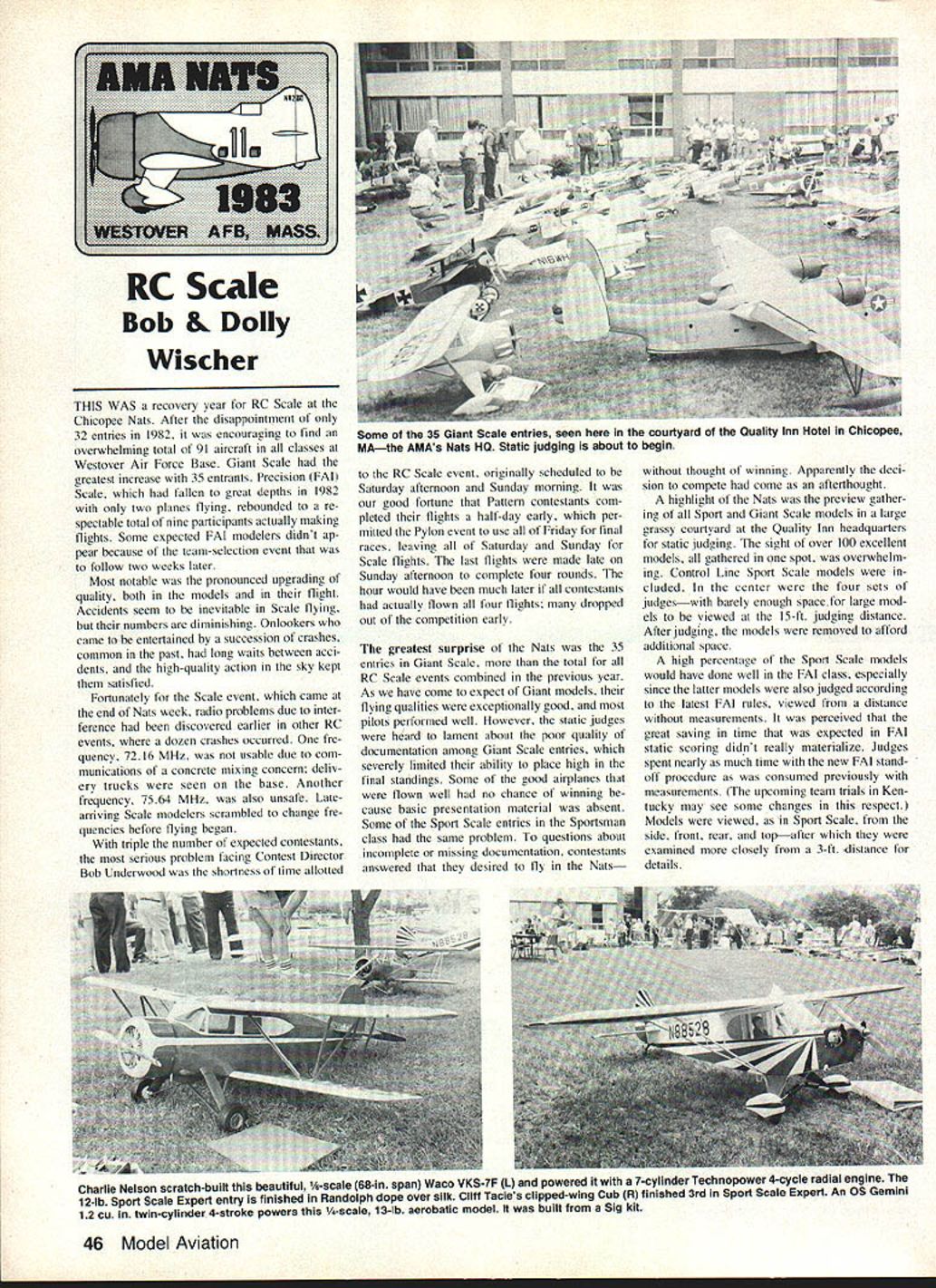
- A highlight before flying was the static preview of Sport and Giant Scale models in a large grassy courtyard at the Quality Inn headquarters—over 100 excellent models gathered for judging. Control-line Sport Scale models were included and judges viewed large models at a 15-ft judging distance.
Radio interference and scheduling
- Radio interference discovered earlier in the week caused a dozen crashes in other RC events. Frequency 72.16 MHz proved unusable due to communications from a concrete-mixing concern; 75.64 MHz was also unsafe. Late-arriving Scale modelers scrambled to change frequencies before flying began.
- With triple the number of expected contestants, time was tight. Originally scheduled for Saturday afternoon and Sunday morning, the event benefited from Pattern contestants finishing a half-day early and Pylon using Friday for final races. Four rounds were completed late Sunday afternoon; many contestants, however, did not fly all four rounds.
Static judging and FAI changes
- FAI (Precision) Scale used the new FAI stand-off static judging procedure (viewed from distance without measurements). The anticipated time savings did not fully materialize—judges often spent nearly as much time as with the old measurement-based system. Models were viewed side, front, rear, and top, then examined more closely from about 3 ft for details.
- At the Nats, the best-flying models generally also had high static scores. In Giant and FAI classes the winners combined strong static and flight scores. Sport Scale Expert winners were near the top in static; an exception was a ducted-fan A4D that overcame a 5-point static deficit to win Sportsman.
Winners and notable aircraft
- FAI (Precision) Scale:
- Winner: Cliff Tacie — Spezio Tu-Ho (won by a 13-point margin)
- 2nd: Bob Wischer — Piel Beryl
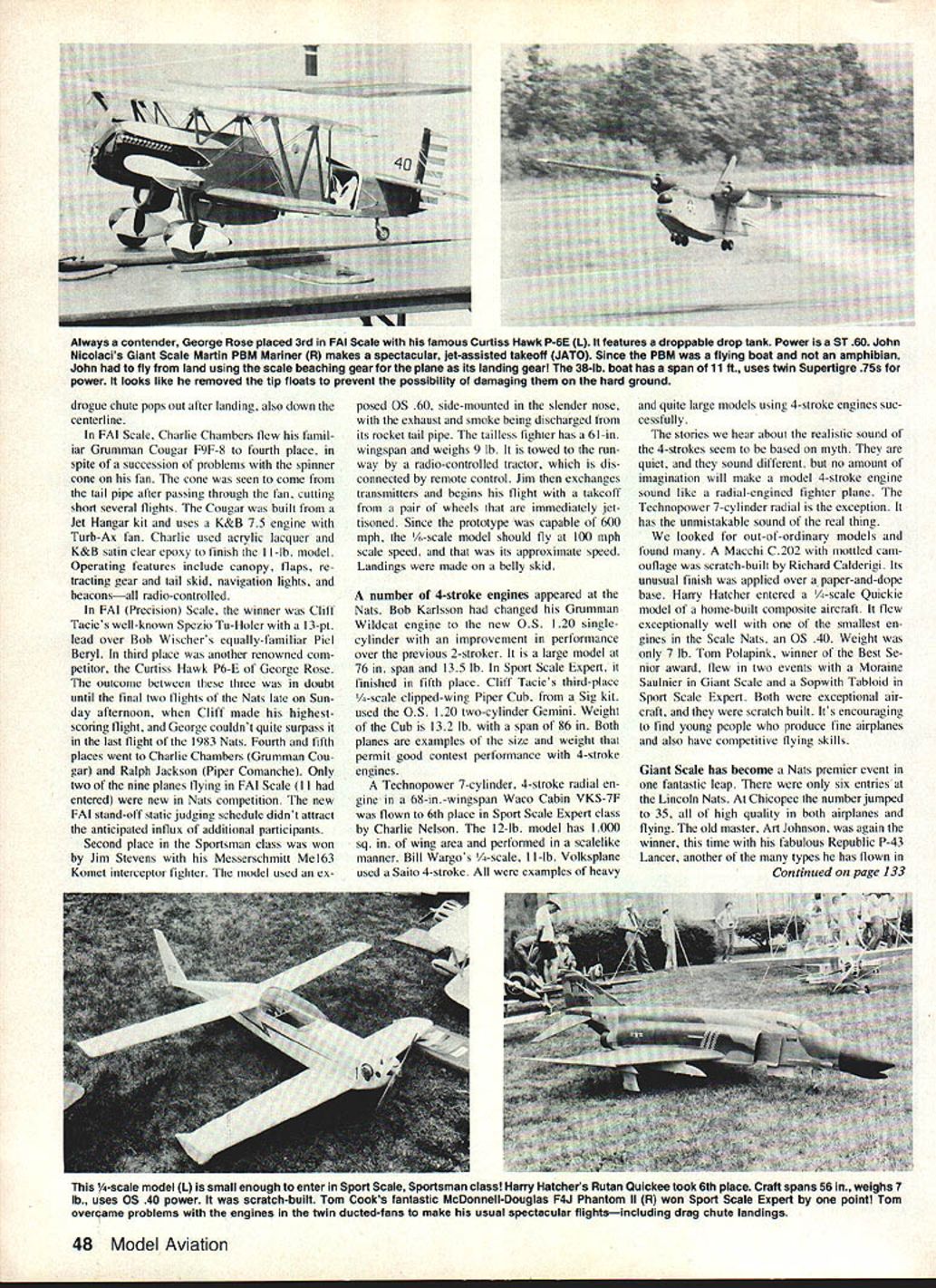
- 3rd: George Rose — Curtiss Hawk P-6E
- 4th: Charlie Chambers — Grumman Cougar (F9F-8)
- 5th: Ralph Jackson — Piper Comanche
- Note: Eleven entered; nine flew. Only two of the nine were new to Nats competition.
- Sport Scale (Sportsman):
- 1st: Bob Fiorenze — A4D Skyhawk (ducted-fan). Notable for extreme low passes, upright and inverted, close to the runway.
- 2nd: Jim Stevens — Messerschmitt Me 163 Komet (1/6-scale tailless interceptor, towed to runway by RC tractor, takes off from jettisoned wheels, lands on belly skid). The model used an exposed O.S. .60 in the nose with rocket-like exhaust and smoke.
- Sport Scale (Expert):
- 1st: Tom Cook — McDonnell-Douglas F4J Phantom II (twin ducted-fan). Also awarded the Flight Achievement trophy. Tom overcame engine problems—one flight completed on one engine and still scored highly due to excellent realism and flying qualities.
- Giant Scale:
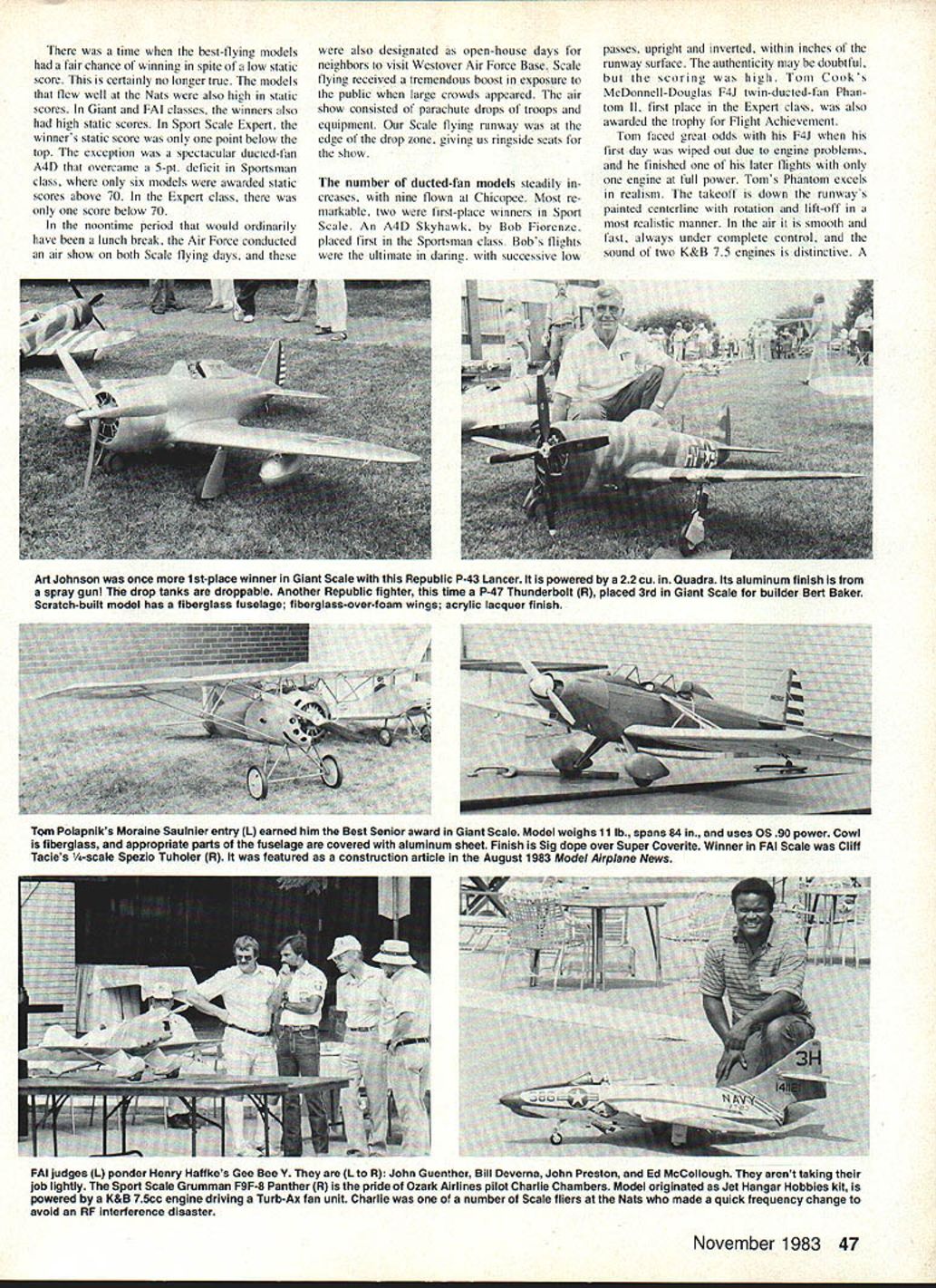
- 1st: Art Johnson — Republic P-43 Lancer (featured in Model Builder magazine)
- 2nd: Pete Reed — Brisighella-designed Starduster Too (used Shereshaw Bantam 2-stroke 2.6 cu. in.)
- 3rd: Bert Baker — Republic Thunderbolt (scratch-built; Rossi .90 engine; foam-core wing, molded fiberglass fuselage)
- Largest entries: Norm Rosenstock’s Aeronca LC (1/3 scale, 10‑ft span, 43 lb, Kawasaki 4 hp) and John Nicolaci’s Martin Mariner (11‑ft span, twin Super Tigre .75 engines, 38 lb; beaching gear for runway ops). The Mariner displayed JATO pods on the fuselage sides (used despite AMA rules prohibiting gaseous boost).
Engines and powerplants
- Ducted-fan models were increasingly common (nine at Chicopee); two ducted-fans won first places (Sportsman and Expert).
- Four-stroke engines were well represented:
- Bob Karlsson converted his Grumman Wildcat to an O.S. 1.20 single-cylinder four-stroke with improved performance (76 in. span, 13.5 lb), placing 5th in Sport Scale Expert.
- Cliff Tacie’s 1/4-scale clipped-wing Piper Cub used an O.S. 1.20 two-cylinder Gemini (13.2 lb, 86 in. span), finishing 3rd in Sport Scale Expert.
- Charlie Nelson flew a Technopower 7-cylinder four-stroke radial in a 68-in span Waco VKS-7F (about 12 lb) to 6th place in Sport Scale Expert.
- Bill Wargo’s 1/4-scale Volksplane (11 lb) used a Saito four-stroke.
- Although four-strokes are quieter and sound different, most do not convincingly mimic the sound of a radial fighter—Technopower’s 7-cylinder radial is an exception with a realistic radial sound.
Notable scratch-built models and young builders
- Richard Calderici: scratch-built Macchi C.202 with mottled camouflage over a paper-and-dope base.
- Harry Hatcher: 1/4-scale Quickie home-built composite flown exceptionally well with an O.S. .40 and a weight of only 7 lb.
- Tom Polapink: Best Senior award winner; flew a Morane Saulnier in Giant Scale and a Sopwith Tabloid in Sport Scale Expert—both scratch-built.
- The presence of young builders producing fine airplanes and demonstrating competitive flying skills was encouraging.
Judging, operations, weather, and organizers
- Judging system: For fairness, all models in a class were scored by the same set of judges—three judges for each AMA class (Sportsman, Expert, Giant) and four for FAI. Four rounds were flown with four sets of flight judges at two sites (each with two lines) so all flyers who completed four rounds had equal exposure to each set of judges.
- Flight line coordinators Ron Hesselbrock and Dave Brown maintained a steady flow; contestants were ready for their turns.
- Weather was generally good for the week. Scale flying experienced some gustiness and wind shifts that may have affected a few scores; there were some downwind landings.
- During midday on both Scale flying days the Air Force held an air show and base open house; large crowds provided tremendous public exposure for Scale flying. The Scale runway was at the edge of the parachute drop zone, giving competitors ringside seats.
- Event direction and staffing: Bob Underwood directed all Scale events (starting with Indoor). His daughters Ann and Cathy tabulated scores across Indoor Scale, Free Flight Scale, and RC Scale. Rae Underwood sold AMA souvenirs—an all-hands, family effort.
- The local hosting effort by the Pioneer Valley RC Club was exceptional. Club members assisted in all phases, including unloading AMA equipment and providing manpower throughout the week. The event had the flavor of an old-time, family-hosted Nats.
Looking ahead
The Chicopee Nats restored much enthusiasm for RC Scale. With the strong local support and improved participation and quality, the Scale community looks forward to the next national meet—on to Reno in 1984.
Transcribed from original scans by AI. Minor OCR errors may remain.

