
RC Soaring
Gerald Ziegenfuse
This year's Nats certainly was a historical event. It set attendance records for a modern-day Nats, and the RC Soaring events were no exception. We had 89 entrants in the Unlimited class, 85 in the Two‑Meter class, and 76 in the Modified Standard class—for a total of 250. These events were the 1st, 2nd, and 4th most-entered. (The figures include only those who actually flew.)
We expected a large attendance in the Soaring events, as there is much soaring activity on the East Coast. We had initially forecast a turnout of approximately 150 entrants, but when the first envelope of entry copies came from AMA HQ, it contained 155. (Editor: The author was assistant director of the Soaring events.) Right off, frequencies 72.24 and 72.40 were filled, with each having several standbys. The exceptionally large entry was tolerable only by use of the newer frequencies. Many people changed over when they found that their favorite frequencies were filled.
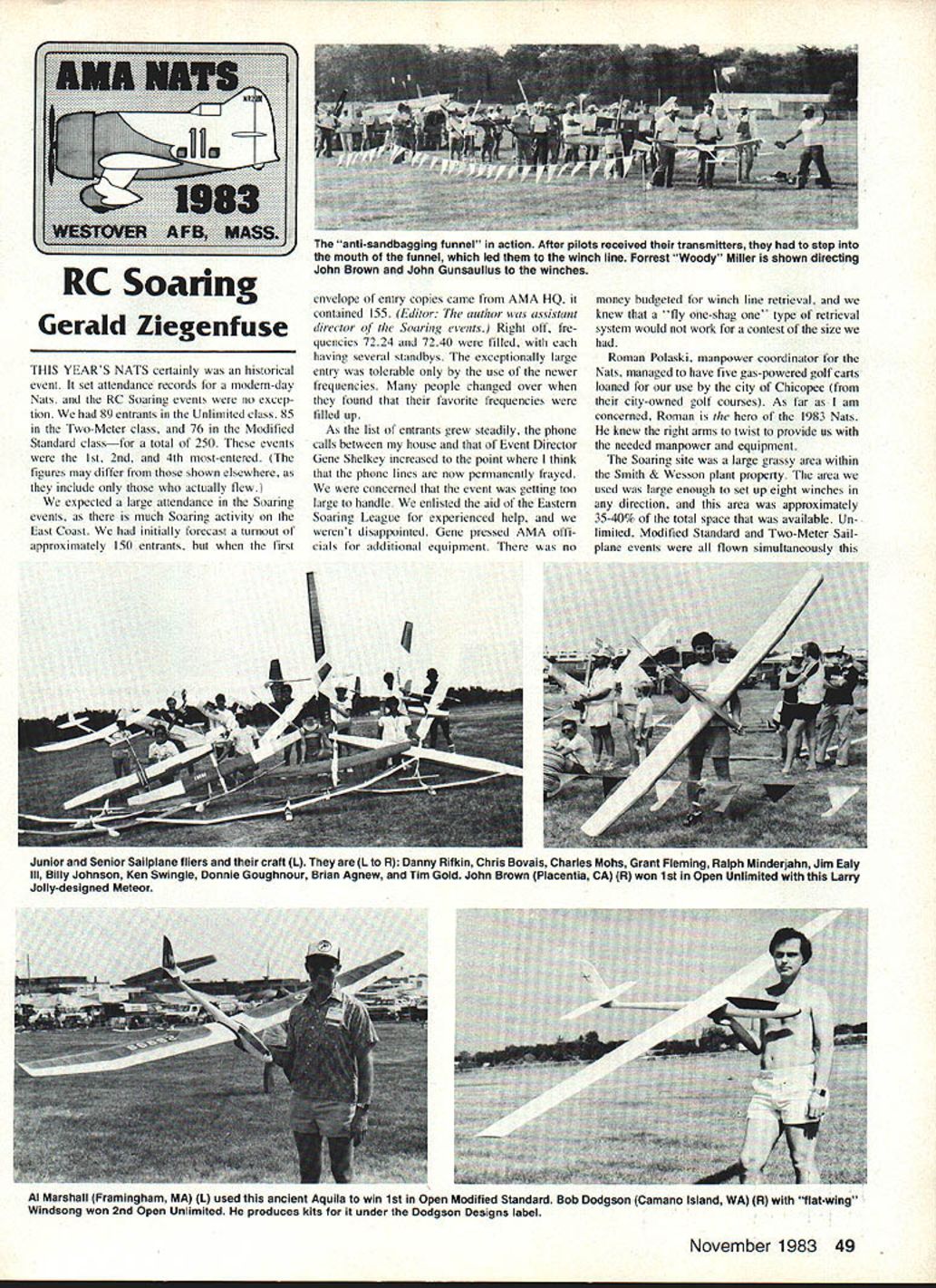
As the list of entrants grew steadily, phone calls between my house and that of Event Director Gene Shelkey increased to the point where I think the phone lines are now permanently frayed. We were concerned that the event was getting too large to handle. We enlisted the aid of the Eastern Soaring League for experienced help, and we weren't disappointed. Gene pressed AMA officials for additional equipment. There was no money budgeted for winch line retrieval, and we knew that a "fly one‑shag one" type of retrieval system would not work for a contest of this size.
Roman Polaski, manpower coordinator for the Nats, managed to have five gas-powered golf carts loaned for our use by the city of Chicopee (from their city-owned golf courses). As far as I am concerned, Roman is the hero of the 1983 Nats. He knew the right arms to twist to provide us with the needed manpower and equipment.
The soaring site was a large grassy area within the Smith & Wesson plant property. The area we used was large enough to set up eight winches in any direction, and this area was approximately 35–40% of the total space that was available. Unlimited, Modified Standard, and Two‑Meter sailplane events were all flown simultaneously this year.
Class rules
- Two‑Meter: aircraft wingspan no more than two meters (78 3/4 in.), no limit on the number of controls.
- Modified Standard: wingspan not exceeding 100 in., no limit on the number of controls.
- Unlimited: no wingspan or control limitations.
Wednesday, July 27
We tried a 7:00 a.m. start; setup problems prevented getting the first flight off until shortly after 8:00 a.m. Weather was great—light, variable winds generally out of the northwest, temperature in the low 90s. Lift plentiful. With 250 entrants putting flights into the three‑hour time span, I knew we had a chance to preside over the greatest disaster in Nats history. Three rounds were completed shortly after 5:00 p.m. We had flown 750 flights in a little over nine hours—a tribute to contestant cooperation and a lot of hard work by volunteer workers.
Day One standings:
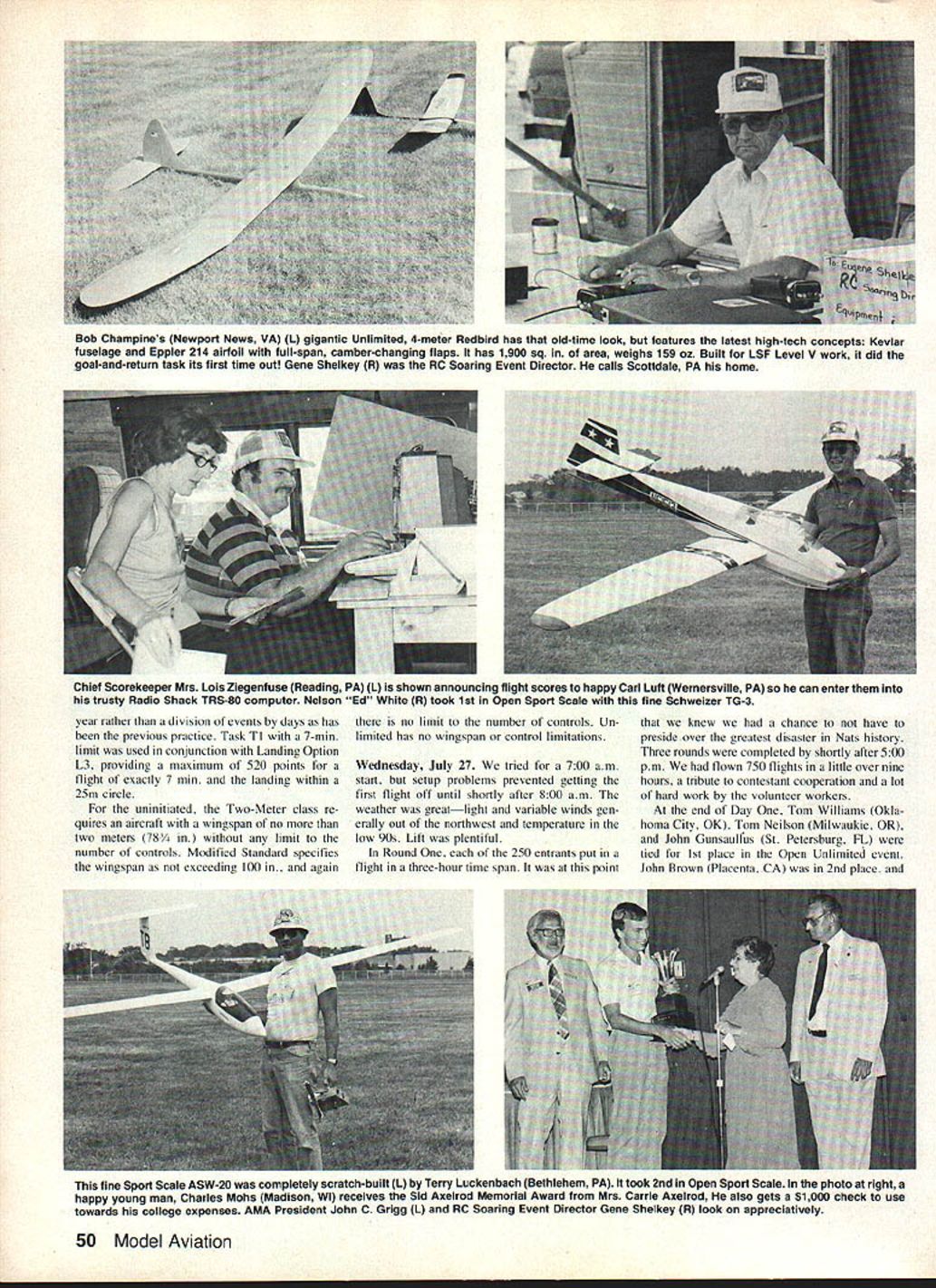
- Open Unlimited: tied for 1st — Tom Williams (Oklahoma City, OK), Tom Neilson (Milwaukie, OR), John Gunsaullus (St. Petersburg, FL). 2nd — John Brown (Placentia, CA). 3rd — Michael Hoeffler (Northboro, MA).
- Open Standard: 1st — Martin McCartney (Braintree, MA). 2nd — Alan Marshall (Framingham, MA). 3rd — Anthony Matyi (Hamilton Sq., NJ).
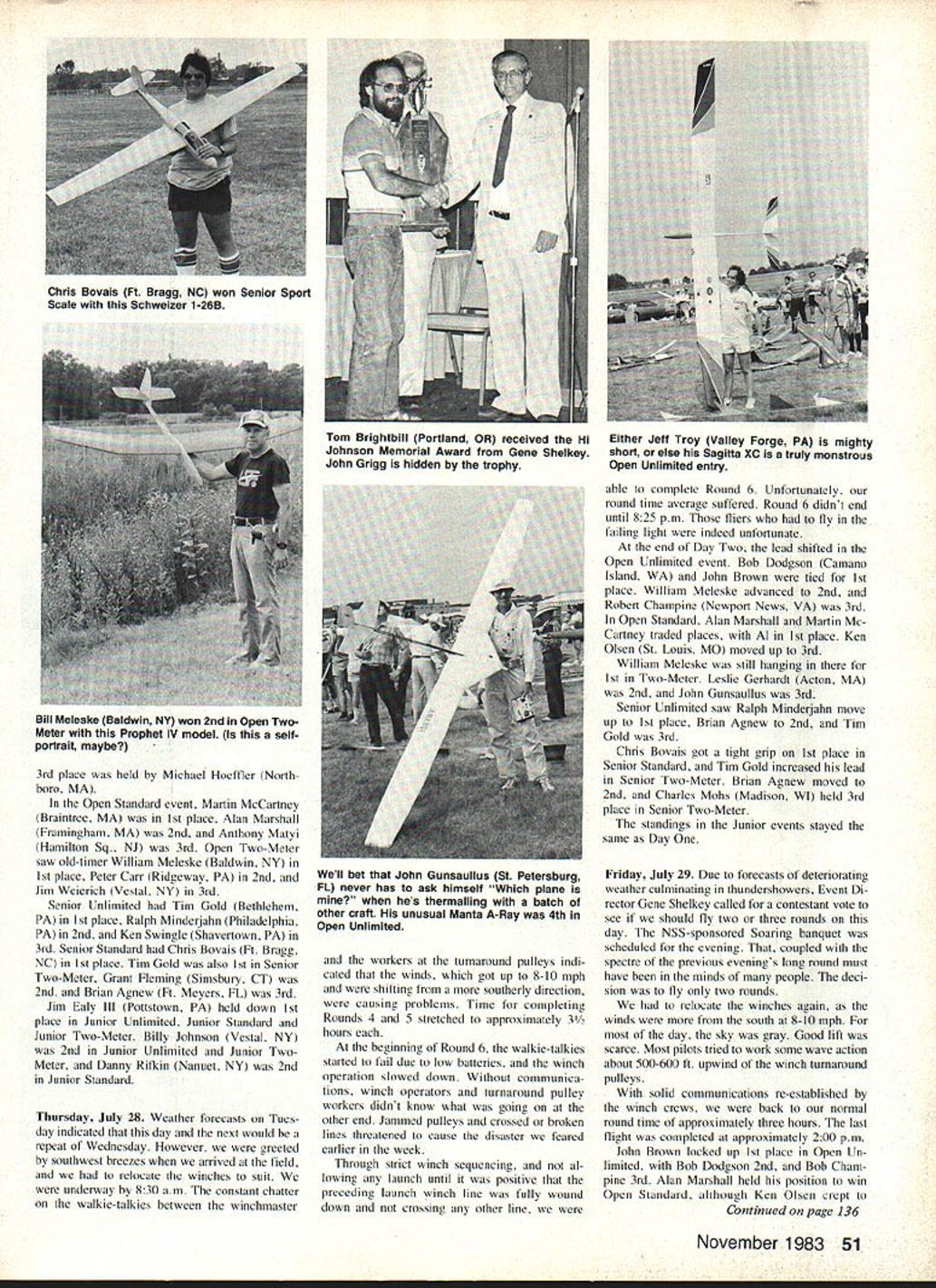
- Open Two‑Meter: 1st — William Meleske (Baldwin, NY). 2nd — Peter Carr (Ridgeway, PA). 3rd — Jim Weirich (Vestal, NY).
- Senior Unlimited: 1st — Tim Gold (Bethlehem, PA). 2nd — Ralph Minderjahn (Philadelphia, PA). 3rd — Ken Swingle (Shavertown, PA).
- Senior Standard: 1st — Chris Bovais (Ft. Bragg, NC).
- Senior Two‑Meter: 1st — Tim Gold. 2nd — Grant Fleming (Simsbury, CT). 3rd — Brian Agnew (Ft. Myers, FL).
- Junior Unlimited: 1st — Jim Ealy III (Pottstown, PA). 2nd — Billy Johnson (Vestal, NY).
- Junior Standard: 1st — Jim Ealy III. 2nd — Danny Rifkin (Nanuet, NY).
- Junior Two‑Meter: 1st — Jim Ealy III. 2nd — Billy Johnson (Vestal, NY).
Thursday, July 28
Weather forecasts on Tuesday indicated this day and the next would be a repeat of Wednesday. However, we were greeted by southwest breezes when we arrived at the field and had to relocate the winches to suit. We were underway by 8:30 a.m. The constant chatter on the walkie‑talkies between the winchmaster and the workers at the turnaround pulleys indicated that winds—8–10 mph and shifting from a more southerly direction—were causing problems. Time for completing Rounds 4 and 5 stretched to approximately 3½ hours each.
At the beginning of Round 6, walkie‑talkie transmissions started to fail due to low batteries, and winch operation slowed. Without communications, winch operators and turnaround pulley workers didn't know what was going on at the other end. Jammed pulleys and crossed or broken lines threatened the disaster we feared earlier in the week.
Through strict winch sequencing, and by not allowing any launch until it was positive that the preceding launch winch line was fully wound down and not crossing any other line, we were able to complete Round 6. Unfortunately, our round time average suffered. Round 6 didn't end until 8:25 p.m. Those fliers who had to fly in the failing light were indeed unfortunate.
At the end of Day Two, standings shifted:
- Open Unlimited: Bob Dodgson (Camano Island, WA) and John Brown tied for 1st. William Meleske advanced to 2nd, and Robert Champine (Newport News, VA) was 3rd.
- Open Standard: Alan Marshall moved to 1st, Martin McCartney to 2nd, and Ken Olsen (St. Louis, MO) to 3rd.
- Open Two‑Meter: William Meleske remained 1st, Leslie Gerhardt (Acton, MA) 2nd, John Gunsaullus 3rd.
- Senior Unlimited: Ralph Minderjahn moved up to 1st, Brian Agnew to 2nd, Tim Gold to 3rd.
- Senior Standard: Chris Bovais held 1st.
- Senior Two‑Meter: Tim Gold increased his lead, Brian Agnew was 2nd, Charles Mohs (Madison, WI) 3rd.
- Junior events: standings remained the same as Day One.
Friday, July 29
Due to forecasts of deteriorating weather culminating in thundershowers, Event Director Gene Shelkey called for a contestant vote to see if we should fly two or three rounds that day. The NSS‑sponsored Soaring banquet was scheduled for the evening; that, coupled with the specter of the previous evening's long round, influenced the decision to fly only two rounds.
We had to relocate the winches again as winds were from the south at 8–10 mph. For most of the day the sky was gray and good lift was scarce. Most pilots tried to work some wave action about 500–600 ft. upwind of the winch turnaround pulleys. With solid communications re‑established by the winch crews, we were back to our normal round time of approximately three hours. The last flight was completed at approximately 2:00 p.m.
Final results and highlights:
- Open Unlimited: John Brown locked up 1st place. Bob Dodgson 2nd. Robert Champine 3rd.
- Open Standard: Alan Marshall won Open Standard. Ken Olsen finished a close 2nd, within 10 points of Al. Martin McCartney took 3rd, just 10 points behind Ken.
- Open Two‑Meter: John Gunsaullus outdid William Meleske by one point to take 1st place. Leslie Gerhardt finished 3rd.
- Senior Unlimited: Ralph Minderjahn 1st, Brian Agnew 2nd, Tim Gold 3rd.
- Senior Standard: Chris Bovais 1st.
- Senior Two‑Meter: Tim Gold 1st, Brian Agnew 2nd, Charles Mohs 3rd.
- Junior classes: Jim Ealy III won all three junior classes.
The NSS‑sponsored Soaring Awards Banquet was held Friday evening at the Quality Inn, Nats HQ. Distinguished guests included Mr. and Mrs. John Grigg, Mr. and Mrs. Carl Goldberg, Mr. and Mrs. Walt Good, and Mrs. Carrie Axelrod. An excellent buffet was served and the awards were distributed.
- The Hi Johnson Trophy for the highest total score went to Tom Brightbill of Portland, Oregon.
- Mrs. Carrie Axelrod presented the Sid Axelrod Memorial Trophy for the best overall Junior or Senior performance to Charles Mohs. This award was based upon innovation, construction, and flight points—with emphasis on innovation, as this was considered one of Sid's strongest points.
Saturday, July 30 — RC Sport Scale Sailplane
The RC Sport Scale Sailplane event was held this day. Compared to the fast pace of the other soaring events, this was a relaxed, easy‑going affair. Each of the eight scale sailplanes was flown separately, affording minimum pilot distraction and maximum spectator enjoyment. The flight task was three rounds of 3½‑minute duration, with a 20‑point landing bonus if the pilot landed within a 100‑ft. diameter landing circle.
- Richard Bonnell of St. Petersburg, FL flew his 21‑lb. Richard LS‑1. If winches had tongues, they would have been hanging out on this craft after each launch of his V‑scale aircraft.
- Scale judges Jeff Troy, Robert Schow, and Carl Luft awarded the highest static score to Terry Luckenbach's scratch‑built ASW‑20 (Terry is from Bethlehem, PA).
- Nelson "Ed" Whyte of Alto, MI flew his beautifully flown Schweizer TG‑3 to first place in the Open category. Terry Luckenbach was 2nd, and Gene Shelkey of Scottdale, PA was 3rd with his Schweitzer 233. Gene, the RC Soaring event director, spent this day relaxing from the pre‑contest tension.
Observations and recommendations
With perfect 20‑20 hindsight, we can now look back and see where we could have improved this competition. Overall, I think the NSS and the Soaring community gained greater respect from the AMA and Nats officials for their handling of this admittedly too-large competition. However, the concept of the Nationals, at least as far as RC Soaring events are concerned, should be changed:
- It is not possible to accommodate everyone who may want to enter. Limiting the number of persons per individual frequency is a must.
- Limiting the total number of entrants must also be considered. Had we allowed everyone who wanted to use 72.400 MHz to enter, we would have spent six hours just to get each of those individuals one flight—33 people requested that frequency.
- A competition of this size requires many experienced workers. We were assisted by many persons who stepped up to operate winches, retrieve lines, and work in the transmitter impound. Without these people we couldn't have made it.
Thanks to all who helped. To list the names of everyone who helped make this competition a success would take several more pages—and we would probably miss someone!
Additional thanks from me to Bill Meleske, who somehow found time to take the pictures that accompany this article.
Transcribed from original scans by AI. Minor OCR errors may remain.

