
AMA Nats: CL Combat
Memorable
The previous Nats held in Lincoln in 1979 and 1982 were good—but not especially memorable. Combat had good matches, but that was about all. The 1982 Nats will be remembered, though, as the one where the lights were turned off by an errant Slow Combat model. The fly-away model, trailing its control lines, flew around some power lines located near the site and caused a transformer to blow in a spectacular fashion. A professional photographer caught the action, and the photo was on display in the AMA HQ tent along with many other neat photos available to the contestants.
Celebrity Fun-Fly
The Celebrity Fun-Fly featured Burt Rutan (designer of the around-the-world Voyager plane) flying against Hazel Sig-Hester using a couple of her models that may be kitted in the future. It was one-to-one until the rest of the AMA officials and Duke Fox joined in, turning it into the biggest free-for-all since the 1971 Nats where California challenged the world. Vince "Head-On-Pass" Mankowski and Duke Fox put on the best show, with the winner being the one with the slightly faster engine.
Ringside, Sunglasses and Camp
Duke Fox spent the entire six days camped at ringside watching matches and repairing engines. It was also a time of zany one-upmanship as the sunglasses crowd tried to outdo each other. Winners in the high-tech sunglasses department were Steve Kott and Chuck Rudner, who had mirrored glasses that changed color but apparently worked very well—although they cost around $165 a pair.
Trends in Models and Competition
In general, the move in models was toward lower technology, with many designs featuring external controls, uncored foam wings with simple hole cutouts for weight savings, and some of the simplest pacifier fuel tank compartments yet seen. There are more people with better-performing planes that are well trimmed, too. There were fewer "easy" matches for the pro fliers because of the trend toward equity in performance, and several of the top guns were put out early.
Contest Management and Communication
Contest management was very good this year with Judy Curtis as Event Director and a large group of enthusiasts, including her husband Paul, Rick and Jerri Fetters, and pit boss Sheila Cranfill—plus many excellent judges. Radio headsets were used for instant communication between the circle marshal and the judges. This innovation probably saved a bunch of models, as the announcement of a kill could be communicated rapidly to the fliers.
Radio communication also helped during a couple of high-speed fly-aways, since the chase crew could be directed to the models and people in an adjacent soccer field could be warned of an incoming model. Perhaps an official two-wheeled chase vehicle, as used in the Free Flight events, would be handy.
Entries, Jury System and Close Calls
Problems were few, considering the number of contestants. This was the biggest Nats Combat turnout in quite a while—about 52 entries in Open Fast Combat, roughly double last year's count. The jury system was used to settle disputes and seemed to work well; it was really only needed in FAI Combat, where the rules are complex and open to interpretation.
One longstanding issue at the Nationals is what to do about matches that are too close to call. There was one double kill in Fast Combat where both parties thought they had the "first kill," but the judges couldn't determine who did it first. The winner was determined by who got in the air first, since the two fliers had equal numbers of cuts. There is no firm policy stating whether such matches should be reflown or decided by officials, which causes problems—especially when close matches involve midair collisions and contestants may not have backup planes.
Engines and Equipment
Although Fox engines claimed most of the top places, other marques were seen on the field and in the winner's circle. Cipolla was favored by several contestants because of its light weight, and several Super Tiger .36s were running fine, although the Super Tiger X-40 conversions didn't make an appearance. Jim Jack and Alan DeVeuve used Hoffelt .36Rs for the Top Speed event and some of their matches, but the blazing speeds didn't get either of them past the fifth round. Jim Jack and Alan DeVeuve are listed as from San Diego and Dallas, respectively.
Slow Combat and the Transformer Incident
As mentioned earlier, the most significant thing about Slow Combat, other than Jerry Sabin taking the top spot and ruining a Texas sweep, was the spectacular fly-away and transformer explosion. The power lines that ran up and down the road swayed wildly, sending trees and stricken spectators scrambling into the open areas. Combat had the prime location for spectators, too, since it was adjacent to the main road coming into the airport—many spectators thought that Combat was the Nationals.
No photo of the Slow Combat winners was included because someone in the picture wore a T-shirt emblazoned with inappropriate comments on the front.
This was the first time that FAI Combat was run at the Nats.
Fuel and Engine Tuning
Most contestants used the 10% nitro/castor-oil combination mandated by the new rules, even though the diameter of the engine venturi was still unrestricted. Many people simply lowered the heads on their engines a few thousandths of an inch to increase compression and made do with familiar equipment—such as many clones of the Force and the Rush Puppy.
The practice-session fuel was pretty lousy and caused a lot of blown plugs and poor engine set-ups. Howard Rush sent his model up richer than usual, and it held a good—although ragged-sounding—needle. A different batch of official fuel was used on Wednesday and worked better, although when mechanics missed the needle setting it was usually on the lean side. Each contestant received a small container with the official fuel mix; judges had more fuel available in case a plane's fuel bladder broke.
Notable Matches and Results
Don Canfall had lost a close match to Jerry Sabin in Slow Combat the previous day, so he was extra-determined to put Howard Rush away in the final—which he did.
Top finishers in both Slow and FAI Combat were mostly the usual predictable people, with only Sabin (taking Slow) and Pete Plunkett (sixth place in FAI) being exceptions. Many will remember Larry Hill, who used a large Racing pilot to add about 10 mph to any plane; Pete Plunkett has the ability to add a similar amount of speed through the turns.
VA Combat
VA Combat was a barrel-roll of laughs. Thursday featured very high winds that made fast-energy Fast Combat models difficult—some VA models couldn't get through the wind to complete even one lap. The level-flying rules were relaxed in hopes of getting in some decent matches. When two models met in the wind it resembled a pair of 200-mph Fast Combat blimps turning and making head-on passes—both models effectively went into stealth mode, since neither pilot would make the other model on the flyby.
Top VA Combat finishers:
- 1st: Jerry Sabin (Griffith, IL)
- 2nd: Darren Hult (Oklahoma City, OK)
- 3rd: Al Jorgensen (Fargo, ND)
- 4th: Mike Olson (Fargo, ND)
- 5th: Jeff Johnson (formerly of Fargo, now Wichita, KS)
Notably, the Texans—generally the best windy-weather pilots—were shut out of the top five.
Fast Combat and Seniors
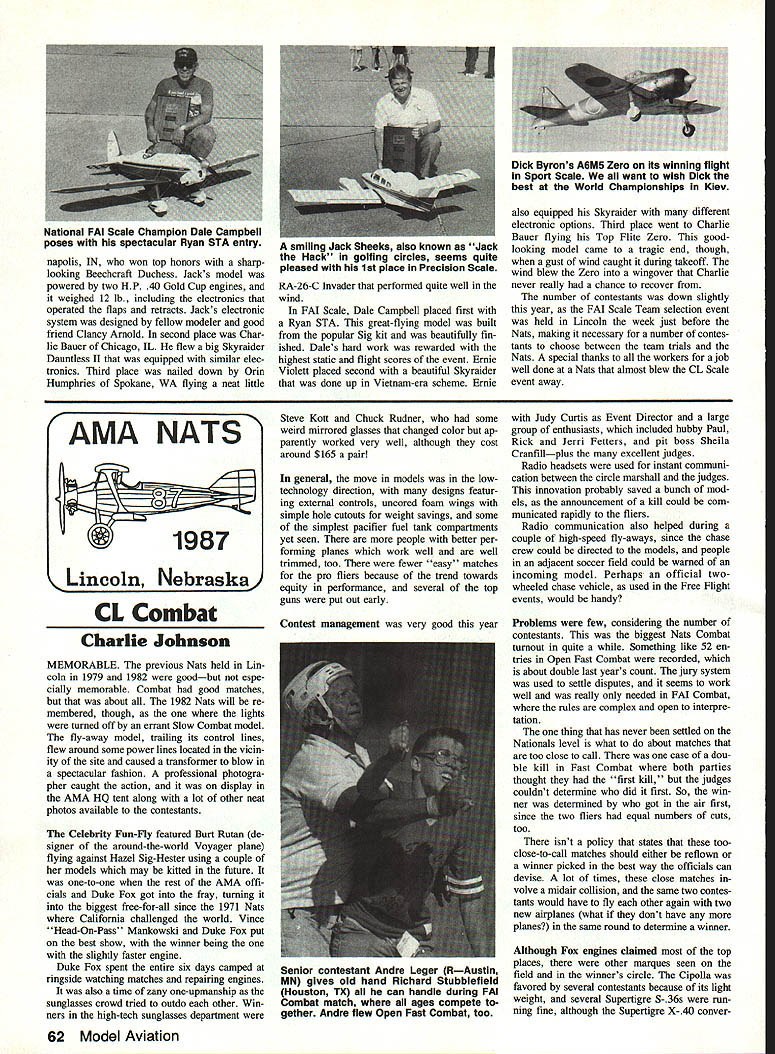
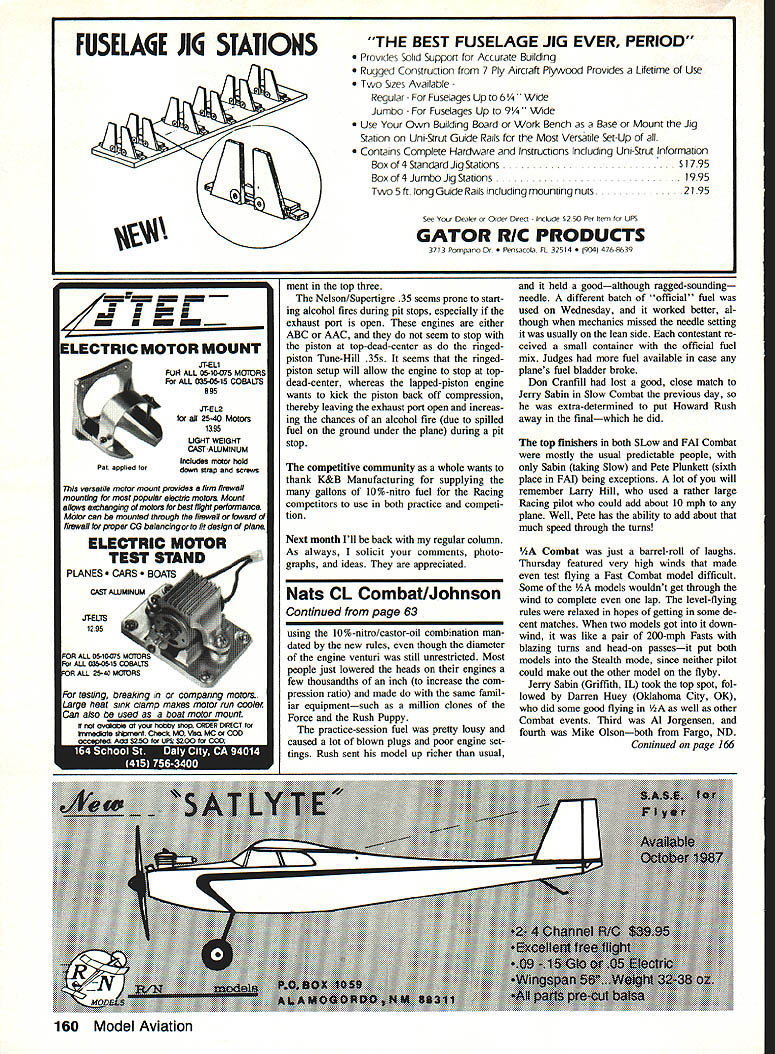
Fast Combat was the premier Combat event at the Nationals, featuring 52 Open entrants and around six to eight in the Junior and Senior categories. The outstanding Senior winner was Greg Wojtecki (Chicago, IL), who also won Senior Slow Combat. He used a Cipolla .36-powered Bosta to devastate the competition. This plane/engine combination weighed a mere 16 oz. ready to fly and was used to put away the Minor brothers as well as Andre Leger, who would go on to fly Open Fast Combat.
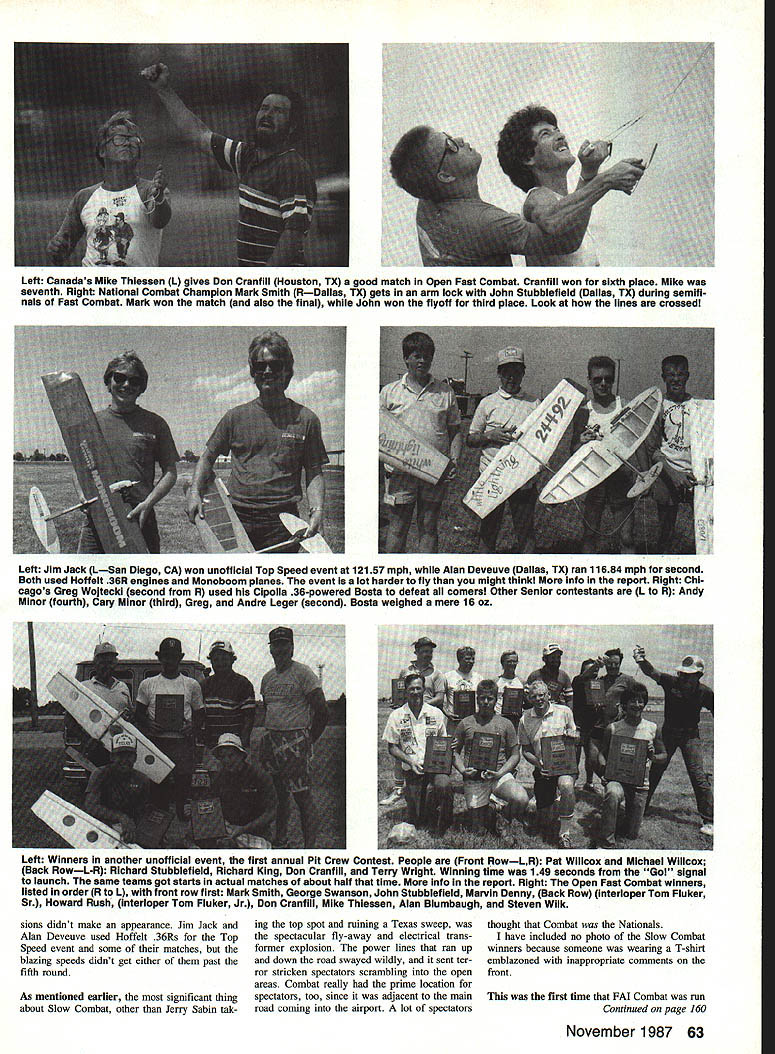
Combat is very family oriented, with many family teams competing. Congratulations to Mark Smith (Dallas, TX), who took this year's National Championship in Open Fast Combat.
Top Speed Event
Mike Hoffelt put up $50 for top speed of the meet. Results:
- Jim Jack (San Diego, CA) — 121.57 mph (Hoffelt .36R in a Monoboom)
- Alan DeVeuve (Dallas, TX) — 116.84 mph (Hoffelt .36R in a Monoboom)
- Bob Mears (Lubbock, TX) — Fox-powered foamie
This event is much harder than it looks—the height pole separates real times from dream times and separates pilots who can fly low and steady from those who can't. Howard Rush did turn 124 mph, but the speed was disallowed because the engine had to remain in the airplane for the full seven laps.
Pit-Crew "Go" Contest
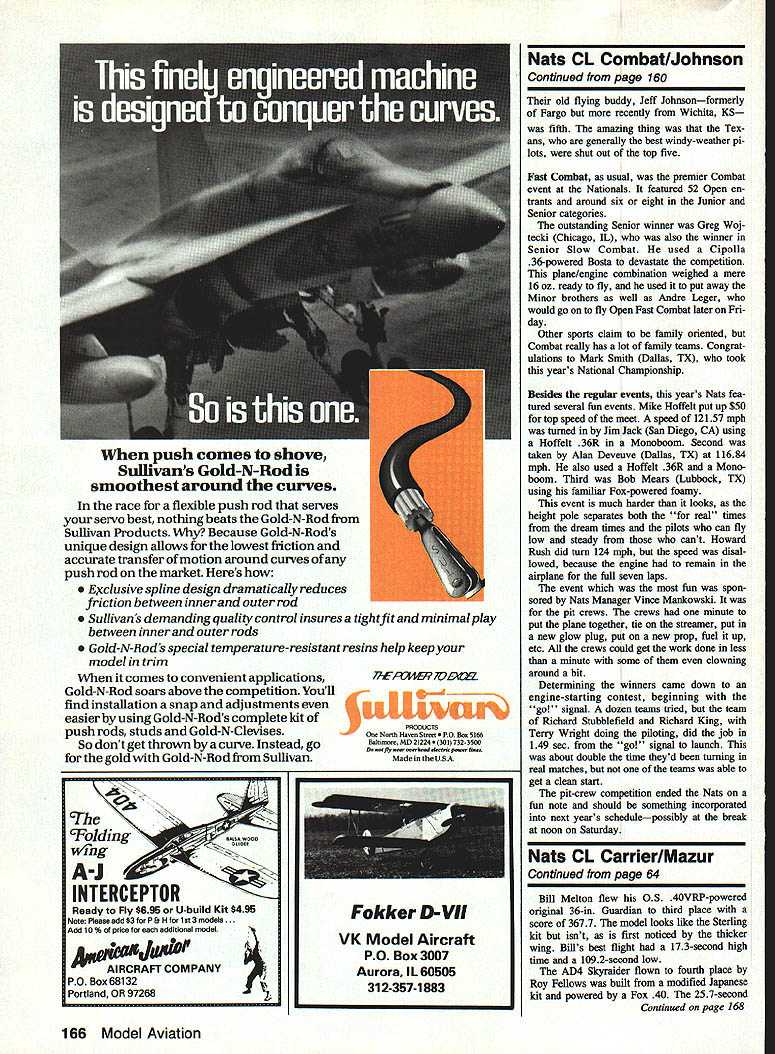
The most fun event was sponsored by Nats Manager Vince Mankowski: the "Go" for the pit crews. Crews had one member to put the plane together, tie on the streamer, install a new glow plug, put on a new prop, fuel it up, etc. All the crews could get the work done in less than a minute, with some even clowning around.
Determining the winners came down to engine-starting contests, beginning with the "go!" signal. A dozen teams tried; the team of Richard Stubblefield and Richard King, with Jerry Wright piloting, did the job in 1.49 seconds from the "go!" signal to launch. This was about double what they'd been turning in practice, but none of the other teams were able to get a clean start.
The pit-crew competition ended the Nats on a fun note and should be incorporated into next year's schedule—possibly at the break at noon on Saturday.
Transcribed from original scans by AI. Minor OCR errors may remain.

