
AMA Nats: CL Combat
By Charlie Johnson
Event overview
Once again the Combat fliers got prime real estate at the National Combat Championships. While other events were held in other parts of the region, Combat enjoyed the greatest exposure to spectators with an excellent flying site near the AMA Nats headquarters and concessions. There was ample practice area for dozens of circles, although very few fliers practiced much because of the intense heat and humidity.
Weather and conditions
Temperatures were generally in the high eighties, with several days well into the 90°F range and very high humidity. It wasn't as bad as two years ago in Lake Charles when record temperatures were set, but the heat took about 10–15 mph off top speeds. That actually made for better matches, although it was hard on engines and contestant endurance. Except for a few raindrops on one day, temperature and humidity were the only detracting factors; wind remained at a very low level and only caused a couple of interesting landings. It wasn't a factor like last year, when some models couldn't even penetrate the upwind side of the circle.
Officials and organization
Pat Willcox served as Event Director and was ably assisted by:
- Norm McFadden and Chris Shearer — circle marshals
- Doris Willcox and Sheila Cranfill — pit operations and scoring
- Gayle Foster — chief judge
For the first time in recent memory, non-Combat judges were used to score the matches. Even without Combat-specific experience, they did a very good job and seemed to get the calls right, as evidenced by very few complaints. The reputation of some of the big names in Combat didn't seem to buy any extra calls from the judges.
Competitors and turnout
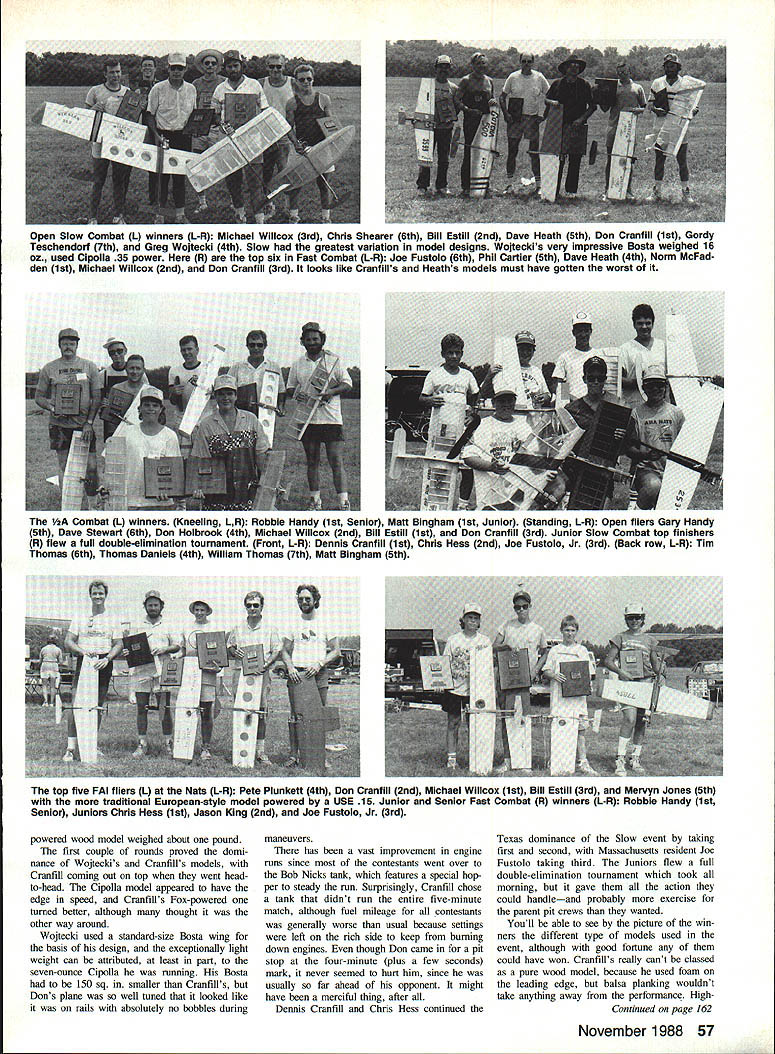
The timing of the Nationals—just before the departure of the FAI team for Kiev—reduced the total number of contestants and excluded several previous Combat champions, including Dick Stubblefield and Bladder Grabber winner Steve Kott. Many expected that with the top fliers absent others would rise up, but of the 12 top-three spots in the four Combat events, 11 were taken by the Melrose Park contingent: Michael Willcox, Don Cranfill, and Bill Estill. Only Norm McFadden prevented a complete sweep by taking first in Fast Combat.
Slow Combat
Slow Combat attracted the largest entry: 34 in Open and seven or eight in Junior; no Seniors were entered. This event showed the greatest variation in model design, with a large percentage using Fox engines. Notable entries included a very spectacular wood model flown by Don Cranfill and a powered wood model from Wojtecki that weighed about one pound and used a seven-ounce Cipolla engine.
The first rounds highlighted the dominance of Wojtecki's and Cranfill's models, with Cranfill prevailing when they met head-to-head. Wojtecki used a standard-size Bosta wing as the basis of his design; the exceptionally light weight of his model was due in part to the small Cipolla engine. Wojtecki's Bosta was about 150 sq. in. smaller than Cranfill's, but Don's plane was so well tuned it flew like it was on rails with no bobbles during maneuvers.
Engine runs improved markedly since many contestants adopted the Bob Nicks fuel tank, which features a special pumper to steady the run. Surprisingly, Cranfill chose a tank that didn't run the entire five-minute match; fuel mileage was generally worse than usual because settings were left on the rich side to avoid burning engines. Even though Don made a pit stop at about the four-minute mark, it didn't seem to hurt him because he was usually far ahead of his opponent.
Don Cranfill and Chris Hess continued the Texas dominance of the Slow event by taking first and second, with Massachusetts resident Joe Fustolo placing third. The Juniors flew a full double-elimination tournament that occupied the entire morning and gave the youngsters plenty of action (and plenty of exercise for the parent pit crews).
You'll be able to see from pictures of the winners the different types of models used in the event. Cranfill's model can't be classed as a pure wood model—he used foam on the leading edge—but balsa planking wouldn't have detracted from its performance.
Fast Combat
Fast Combat eliminations began on Friday. The only thought among many entrants was to keep the Texans from sweeping all events. Norm McFadden spoiled that plan by taking first in Fast Combat with the fastest and most spectacular model of the meet—the familiar orange-and-white "Creamsicle." Norm disposed of each opponent decisively and lost only to Michael Willcox when the glow plug element blew out on the ground, causing a very rich engine run that Willcox capitalized on. With just a plug change (and the needle valve unchanged), McFadden returned to the circle and won the rematch, making that earlier loss his only defeat in the full double-elimination contest.
There were many outstanding matches that kept spectators on the edges of their seats and contestants near exhaustion. After the first two rounds, Cranfill, Willcox, McFadden, and Holbrook were the only fliers still "clean"; many others sat at 1–1 heading into the third round held Saturday morning.
FAI influence was noticeable in flying style, with many matches featuring a lot of cuts. Michael Willcox even scored four cuts in one of his late matches—the most anyone scored in FAI Combat—although the fully taped streamers held together better in Fast than in FAI. Fast Combat was aggressively contested both days and produced several memorable offensive battles.
One of the most notable Slow matches (for contrast) was a dazzling four-minute and thirty-second run-and-hide after Don Cranfill took two quick cuts from Ray Richardson; Ray tried every trick to get back at Don but couldn't.
Summary and observations
Despite the lighter turnout this year, the Combat events were as exciting as any in recent memory. The site was satisfactory, and the officials were well organized, efficient, and fair. At the annual MACA (Model Aircraft Combat Association) meeting held at the Nats, attendees discussed possible improvements for Combat. The only things that could have made this Nats better would have been higher contestant turnout and lower temperatures.
Congratulations to the three fliers from Houston for their outstanding flying, and especially to Norm McFadden, who refused the crumbs and took the main course back to Seattle.
Transcribed from original scans by AI. Minor OCR errors may remain.

