
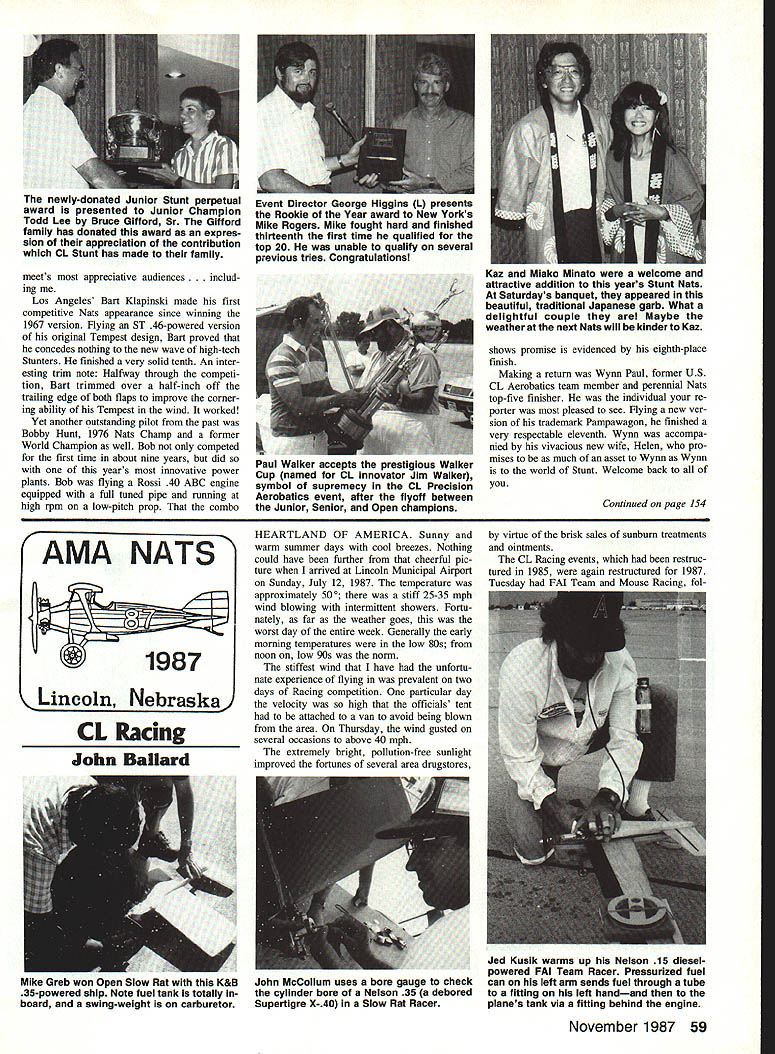
AMA NATS: CL Racing
By John Ballard
Location and weather
Heartland of America. Sunny and warm summer days with cool breezes — nothing could have been further from that cheerful picture when I arrived at Lincoln Municipal Airport on Sunday, July 12, 1987. The temperature was approximately 50°F; there was a stiff 25–35 mph wind blowing with intermittent showers. Fortunately, as far as the weather goes, this was the worst day of the entire week. Generally the early morning temperatures were in the low 80s; from noon on, low 90s was the norm.
The stiffest wind I have had the unfortunate experience of flying in was prevalent on two days of racing competition. On one particular day the velocity was so high that the officials' tent had to be attached to a van to avoid being blown from the area. On Thursday the wind gusted on several occasions above 40 mph.
The extremely bright, pollution-free sunlight improved the fortunes of several area drugstores by virtue of brisk sales of sunburn treatments and ointments.
Schedule and format
The CL Racing events, restructured in 1985, were restructured again for 1987:
- Tuesday: FAI Team and Mouse Racing
- Wednesday: Jr./Sr./Open Scale Racing and Slow Rat Racing
- Thursday: (left three full travel days for contestants to return home)
Running two fast-paced premier events a day put strain on pilots, pit men, and officials alike. Each day’s competition typically ran from 9:00 a.m. until almost 7:00 p.m.
Racing site and preparations
AMA Control Line officials selected an excellent racing site in roughly the same proximity as the site used for the Lincoln 1979 Nats. The two racing circles were extremely smooth. Unfortunately, tar spacers had dried out after years of exterior exposure and a fair amount of tar disintegrated, leaving approximately half-inch gaping cracks in some areas.
Special thanks to Racing Director John McCollum and the crew from the local club, Sky Knights of Lincoln, who assisted in making the circles. Art Johnson spent considerable time taping large cracks in the landing/takeoff areas to prevent smaller Mouse and Scale racers from stumbling.
F/M Team Racing
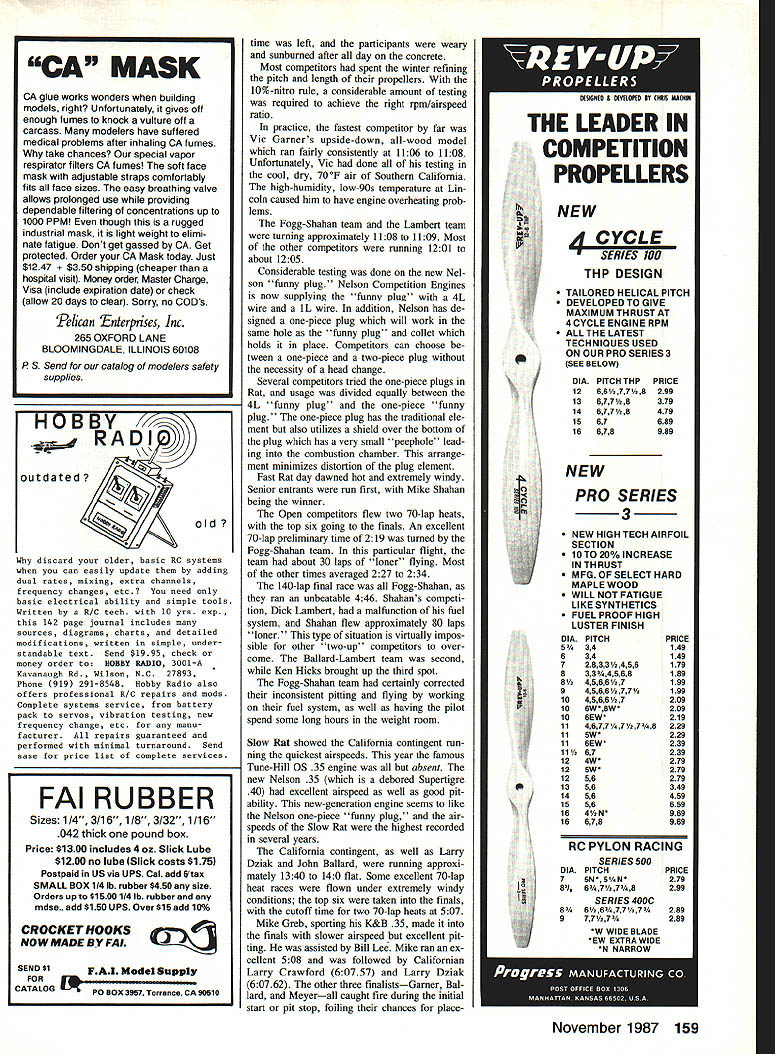
Five teams came out Monday and practiced during the evening hours. Their equipment was processed early Tuesday morning, and several excellent heat races were flown. Most competitors were capable of getting enough RPMs per tank, but consistent engine runs were a problem.
The Knopp/McCollum team took it all with a lackluster 10:12 time, followed by Jed Kusik and Mike Greb. During the showers in the final race, Kusik's pilot slipped on the rain-slick concrete and shortened the final race for the other two competitors, who completed 165 and 160 laps, respectively.
Mouse Racing
This event was predictably filled with surprises. The Juniors and Seniors did well fighting the stiff 20 mph breezes, and the Open final saw two competitors negotiating windy takeoffs.
- Junior Mouse: Todd Lee (Topeka, KS) won with a final of 6:36, followed by Arnie Olson (Fargo, ND) and Mark Williams.
- Senior Mouse: Todd Ballard was first with a time identical to the Junior winner (6:36). Jane Johnson was second, and Randy Rich was third.
- Open Mouse (11 competitors, stiff afternoon breeze): Vic Garner won with 5:10, followed by Donald Gutscher (6:28) and Knopp/McCollum (6:38).
Scale Racing
Many competitors spent much of Monday tuning and practicing for the official event on Wednesday. The stiff afternoon wind made landing and takeoff practice difficult with these lightweight machines. Airspeeds were 15.02 to 16.06 for seven laps.
Several competitors spent many hours trying various propeller types to generate desired RPM and loading. It has become impossible to merely use a tachometer on these engines to interpolate speeds. Even minor model modifications in propeller thickness, length, or pitch must be thoroughly checked in various weather conditions to obtain maximum speed.
Engines seen included the Nelson .15, the new-style Rossi .15, and one or two heavily modified Cox .15s.
On Wednesday, hot and sunny, Racing Director John McCollum brought all competitors together for a detailed talk concerning whipping, high flying, etc. To improve communications between judges and pilots in the center, John used two loudspeakers connected to a PA system located just outside the pilots' circle. These speakers worked well, as the decibel level of more powerful engines made it impossible to hear either the pit man or judges at distance during racing events.
John indicated his preferences for running the events and a compromise was agreed upon: take the top six from the preliminary heats, selected by combining both 70-lap heat times.
- Junior/Senior Scale Race: Mike Shaha turned a respectable 6:31, followed by Todd Ballard and Randy Rich.
- Open Scale: Competitors faced a stiff, gusty 25 mph wind. Preliminary heats were excellent. The cutoff showed the top six at 3:08 (6:16 combined) for the two 70-lap races.
The final 140-lap Open race matched the top qualifiers Dick Lambert and Larry Dziak, both flying Little Quickies. Lambert’s was powered by a long-stack Nelson .15; Dziak’s used a late-model Rossi .15. On the initial start Larry beat Dick out of the pit. After both planes were in the air they were nearly equal; neither seemed able to pass the other. Larry’s first pit stop was excellent, whereas Dick’s was extremely slow — later attributed to the battery heater being set too low on his Go-Bee Fireplug. Halfway through the 140-lap race, it looked as if Larry had a comfortable lead, but then gremlins struck: Dick had another bad pit and fell farther behind, while Larry’s engine began to run poorly. Larry came in for a short stop and richened the needle to no avail; the engine refused to pick up except for the first few laps after the last two pit stops. The final result was a win for Lambert by two laps; Dziak finished second.
Rat Race
Practice for the premier Racing event was confined to Monday and Tuesday, and with Scale Racing taking the entire morning and afternoon on Wednesday, not much practice time remained. Participants were weary and sunburned after a full day on the concrete.
Most competitors had spent the winter refining propeller pitch and length. With the 10% nitro rule, considerable testing was required to achieve the right RPM/airspeed combinations.
In practice the fastest competitor was Vic Garner's upside-down, all-wood model which ran fairly consistently at 11:06 to 11:08. Unfortunately Vic had done all his testing in the cool, dry 70°F air of Southern California; the high humidity and low-90s temperatures at Lincoln caused overheating problems.
The Fogg-Shahan team and the Lambert team were turning approximately 11:08 to 11:09. Most of the other competitors were running 12:01 to about 12:05.
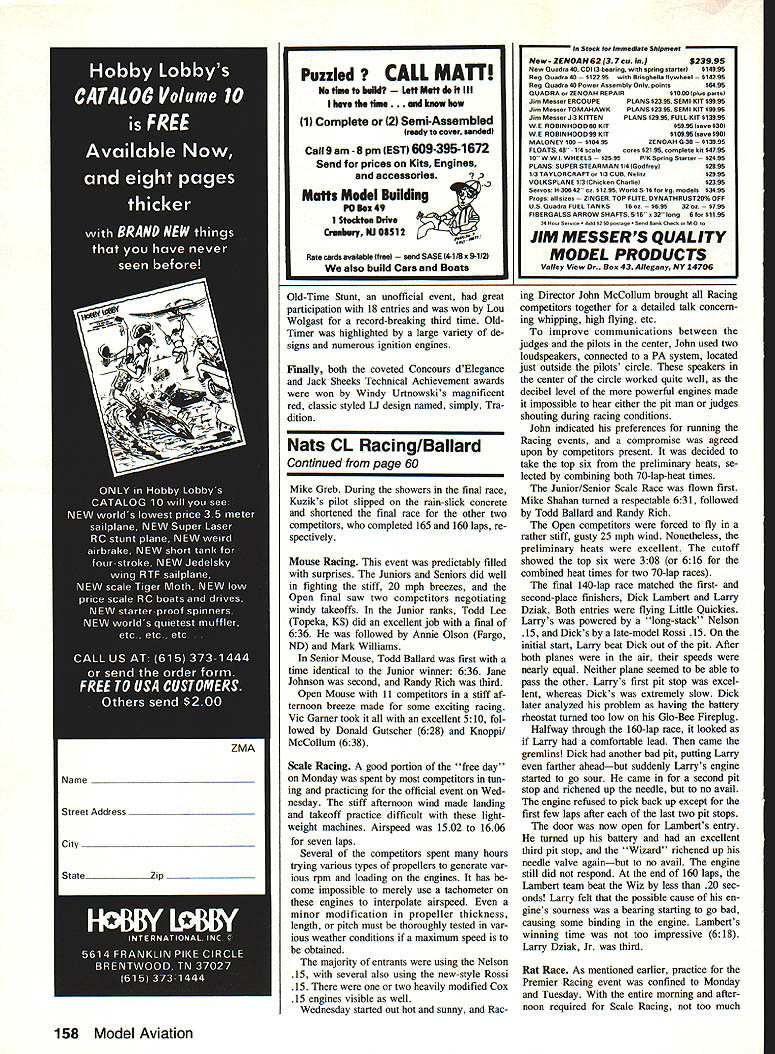
Considerable testing was done on the new Nelson "funny plug." Nelson Competition Engines is now supplying the "funny plug" with a 4L wire and a 1L wire. In addition, Nelson has designed a one-piece plug that will work with the same hole as the two-piece "funny plug" and a collet which holds it in place. Competitors can choose between a one-piece and a two-piece plug without changing the head.
Several competitors tried the one-piece plugs in Rat, and usage was divided equally between the two styles. The one-piece plug has the traditional element but also utilizes a shield over the bottom of the plug with a very small "peephole" leading into the combustion chamber; this arrangement minimizes distortion of the plug element.
Fast Rat day dawned hot and extremely windy. Senior entrants were run first, with Mike Shahan the winner.
Open competitors flew two 70-lap heats, with the top six going to the finals. An excellent 70-lap preliminary time of 2:19 was turned by the Fogg-Shahan team; in that flight the team had about 30 laps of "loner" flying. Most other times averaged 2:27 to 2:34.
The 140-lap final was all Fogg-Shahan; they ran an unbeatable 4:46. Shahan’s main competition, Dick Lambert, had a fuel system malfunction, and Shahan flew approximately 80 laps "lone." The Ballard-Lambert team was second, while Ken Hicks placed third. The Fogg-Shahan team had corrected inconsistent pitting and flying by working on their fuel system and having the pilot spend long hours in the weight room.
Slow Rat
The California contingent ran the quickest airspeeds. The famous Tune-Hill .03 was still mostly absent. The new Nelson .35 (a debored Super Tigre .40) had excellent airspeed and good pit ability. This new-generation engine seems to prefer the Nelson one-piece "funny plug," and Slow Rat airspeeds were the highest recorded in several years.
Top competitors, including the California contingent as well as Larry Dziak and John Ballard, were running approximately 13:40 to 14:10 flat. Some excellent 70-lap heat races were flown under extremely windy conditions; the top six advanced to the finals, with the cutoff time for two 70-lap heats at 5:07.
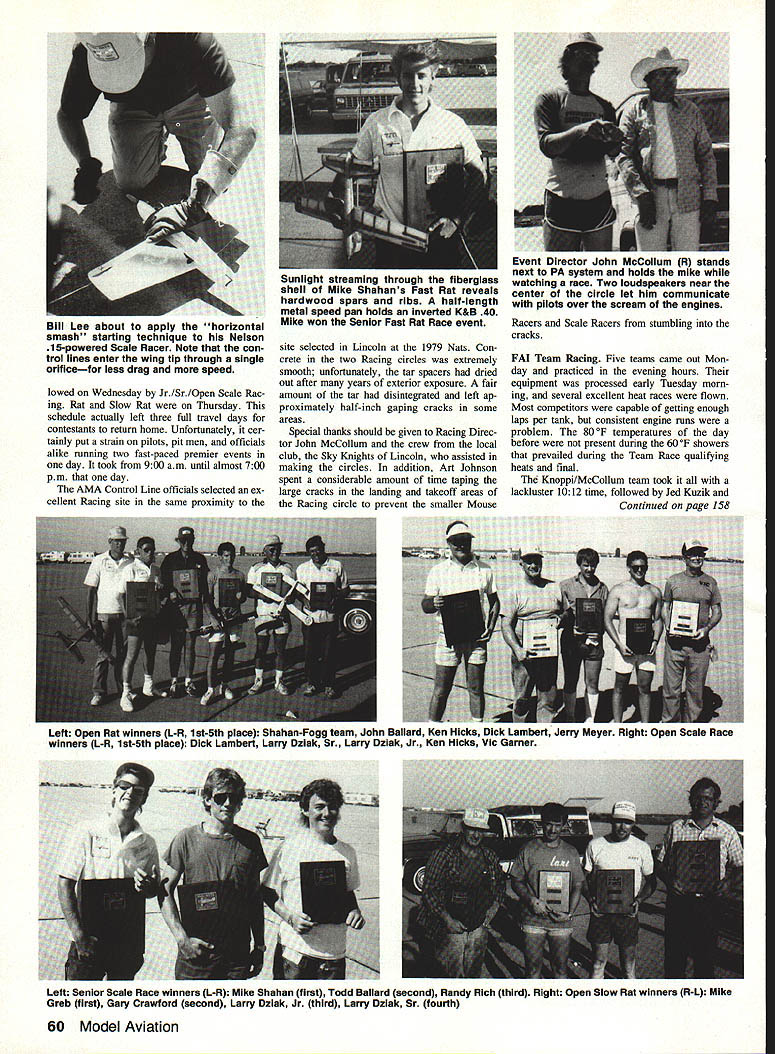
Mike Greb, sporting his K&B .35, made the finals with slower airspeed but excellent pitting, assisted by Bill Lee. Mike ran an excellent 5:08 and was followed by California’s Larry Crawford (6:07.57) and Larry Dziak (6:07.62). The other three finalists — Garner, Ballard, and Meyer — all caught fire during the initial start or a pit stop, fouling their carburetors for placement in the top three.
The Nelson/Supertigre .35 seems prone to starting alcohol fires during pit stops, especially if the exhaust port is open. These engines are either ABC or AAC and do not seem to stop with the piston at top-dead-center as do the ringed-piston Tune-Hill .35s. The ringed-piston setup will allow the engine to stop at top-dead-center, whereas the lapped-piston engine tends to kick the piston back off compression, leaving the exhaust port open and increasing the chances of an alcohol fire (due to spilled fuel on the ground under the plane) during a pit stop.
Equipment and thanks
- Engines seen and used: Nelson .15, Rossi .15, modified Cox .15, Nelson .35 (debored Super Tigre .40), K&B .35, occasional Tune-Hill .03.
- Props: extensive testing of prop thickness, length, and pitch was common to find correct RPM/airspeed in variable weather.
- Plugs: Nelson "funny plug" (two-piece) and the new one-piece version were both in use.
The competitive community thanks K&B Manufacturing for supplying many gallons of 10%-nitro fuel for the racing competitors to use in both practice and competition.
Closing
Next month I'll be back with my regular column. As always, I solicit your comments, photographs, and ideas — they are appreciated.
Transcribed from original scans by AI. Minor OCR errors may remain.

