
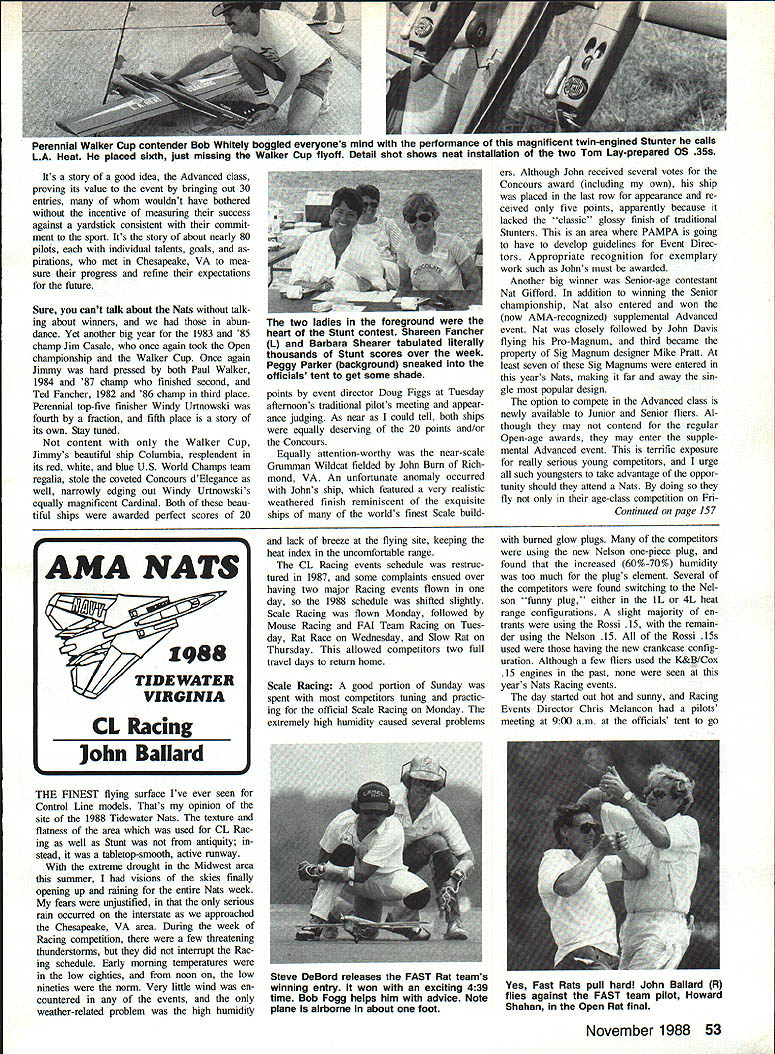
AMA Nats: CL Racing
THE FINEST flying surface I've ever seen for Control Line models. That's my opinion of the site of the 1988 Tidewater Nats. The texture and flatness of the area used for CL Racing as well as Stunt was tabletop-smooth, an active runway ideal for competition.
After the extreme drought in the Midwest during the summer, I had visions of skies finally opening up and raining for the entire Nats week. My fears were unjustified: the only serious rain occurred on the interstate as we approached the Chesapeake, VA, area. During the week of Racing competition there were a few threatening thunderstorms, but they did not interrupt the Racing schedule. Early morning temperatures were in the low eighties, and from noon on the low nineties were the norm. Very little wind was encountered in any of the events. The only weather-related problem was the high humidity and lack of breeze at the flying site, which kept the heat index in the uncomfortable range.
In 1987 the CL Racing event schedule was restructured and some complaints arose over having two major Racing events flown the same day. For 1988 the schedule was shifted slightly to give competitors more reasonable travel time:
- Monday: Scale Racing
- Tuesday: Mouse Racing and FAI Team Racing
- Wednesday: Rat Race (Open Rat)
- Thursday: Slow Rat
This allowed competitors two full travel days to return home.
Scale Racing
A good portion of Sunday was spent tuning and practicing for the official Scale Racing on Monday. The extremely high humidity caused several problems with burned glow plugs. Many competitors were using the new Nelson one-piece plug and found that 60%–70% humidity was too much for that plug's element. Several competitors switched to the Nelson two-piece ("funny") plug, either in the IL or .4L or .15 range configurations.
A slight majority of entrants were using the Rossi .15, with the remainder using the Nelson .15. All of the Rossi .15s used were those with the new crankcase configuration. Although a few fliers had used the K&B/Cox .15 engines in the past, none were seen at this year's Racing events.
Qualifying heats used the best time from two 10-lap qualifying heats to choose finalists. This year's qualifying was better than 1987: the fastest qualifying time was 2:48, and the cutoff for the final was 3:00 flat. Six competitors made the final. Larry Dziak, after glow-plug troubles, switched from the one-piece Nelson plug to the two-piece IL configuration and put in an excellent performance.
Final results (top six):
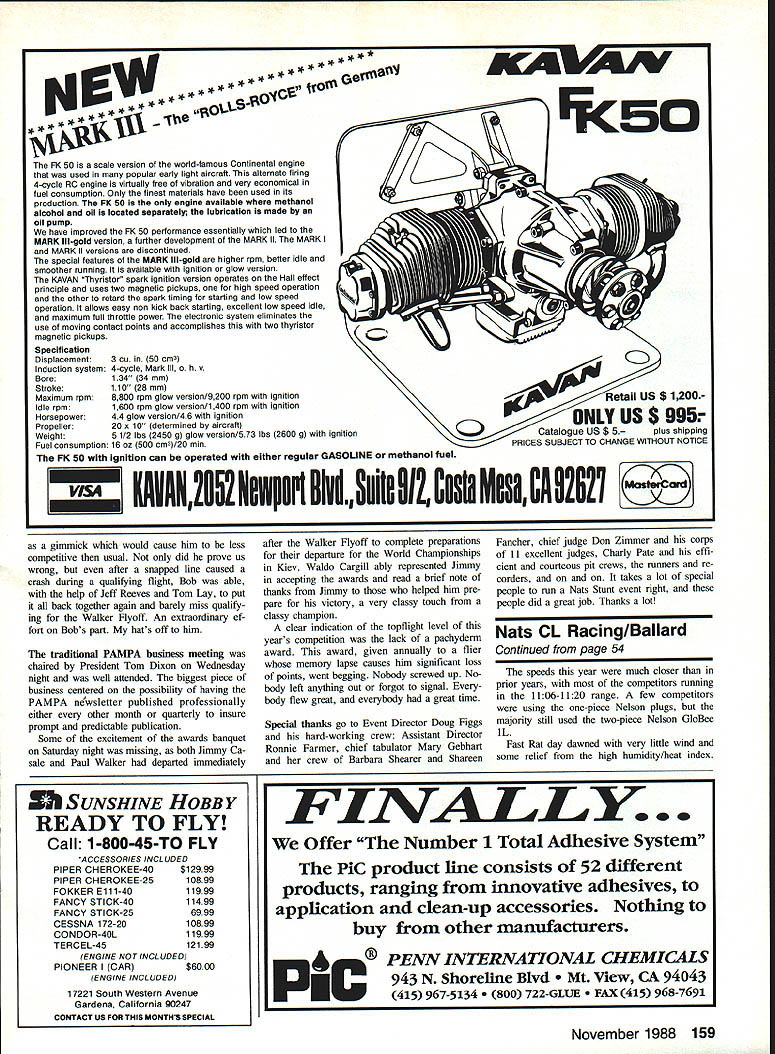
- Larry Dziak — 5:41
- Dick Lambert — 5:51
- John Ballard — 5:52
- Bob Fogg — 6:09
- Bill Bischoff — (placement noted as fifth)
- (sixth place not specified)
For context, Open times at the 1987 Nats were over the 6:00-minute mark, with the winner at 6:18; this year's times represent a clear improvement.
There was exciting two-up racing in both Junior and Senior Scale. Junior was won by Daniel Schurzember. Senior Scale was won by Mike Schahan with a respectable 6:18, followed by Todd Ballard in second.
Team Racing (FAI Team Racing)
Tuesday saw a meager entry level in FAI Team Racing, as many entrants were preparing to leave for the CL World Championships. The Kelley/Parant team from Canada entered with world-class equipment and turned a respectable 8:35 in the final that included a prop change. Mike Grieb placed second at 9:22, followed by Glen Vansant in third.
Mouse Racing
Mouse Racing traditionally produces excitement, often due to strong wind conditions. This year the winds were light, and Junior/Senior entries flew with fewer mishaps than many Open entrants. Jane Johnson recorded an excellent time to win Junior/Senior Mouse. Open Mouse attracted more than double the entries of some other events.
There were a few minor disasters among Open fliers and one notable pit incident with the Ballard team when an engine backfired during a pit stop and the pilot had to fight the backward-taxiing plane for a full lap before it was stopped.
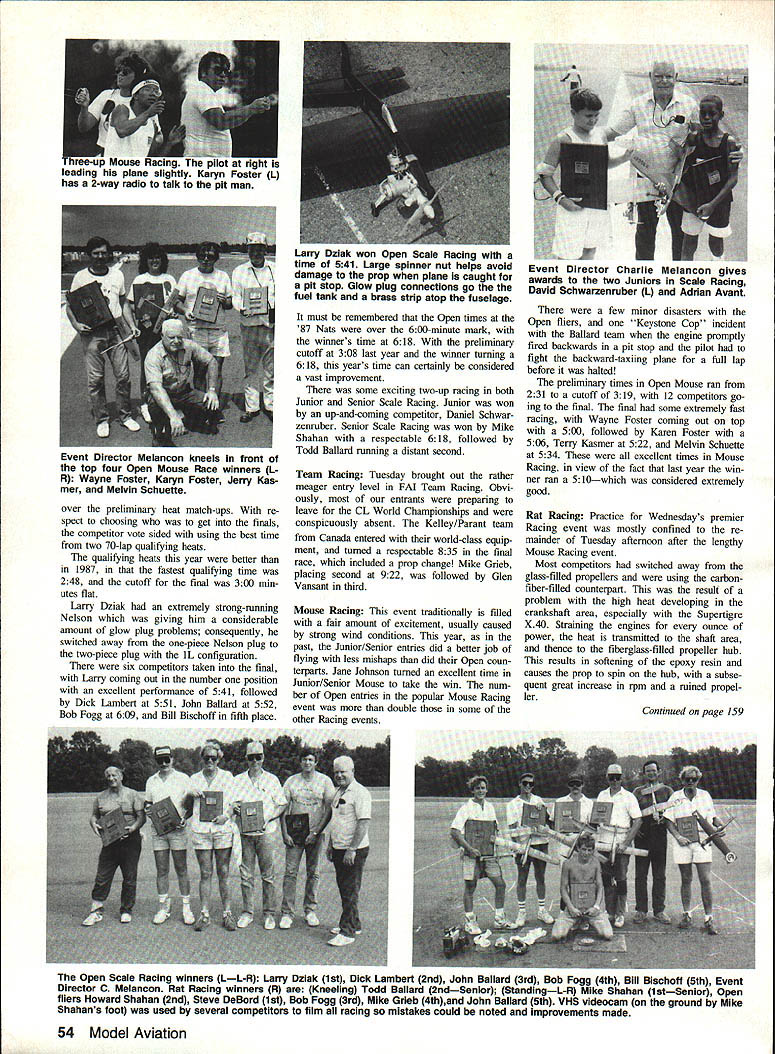
Preliminary Open Mouse times ranged from 2:31 to a cutoff of 3:19; 12 competitors advanced to the final. Final top results:
- Wayne Foster — 5:00
- Karen Foster — 5:06
- Terry Kaser — 5:22
- Melvin Schuette — 5:34
These were excellent times; last year’s best had been 5:10, which had been considered very good.
Rat Racing (Open Rat)
Practice for Wednesday's premier event continued into Tuesday afternoon after the lengthy Mouse Racing event. Many contestants switched from glass-filled propellers to carbon-fiber-filled props because heat developing in the crankshaft area—especially with the Super Tigre X.40—was softening the epoxy resin in fiberglass-filled prop hubs, causing props to slip and be ruined.
At the early morning pilots' meeting it was decided that the best of the two qualifying times would be taken, with eight fliers advancing to the final.
The 70-lap qualifying races produced Bob Fogg as low-time qualifier with 2:10. The cutoff was 2:28.77. Sixth- and seventh-place qualifiers had times of 2:28.33 and 2:28.49 respectively; many competitors fell in the 2:15–2:20 range.
This year’s final featured no "loner" flying and some excellent two-up racing. Howard Shahan flew three entries and John Ballard flew five. Steve DeBord, the newest member of the Fogg-Shahan FAST Team, won with a superb 4:39. Final top six:
- Steve DeBord — 4:39
- Howard Shahan — 4:44
- Bob Fogg — 4:47
- Mike Grieb — 4:52
- John Ballard — 4:53
- Dick Lambert — 5:01
These times were considerably better than last year; the previous National Champ's winning 4:46 would have placed third this year. Teams such as Ballard/Lambert and Ballard/Griner had only slight pitting problems, but a few extra seconds in the pits made sizable differences in final placings.
Larry Dziak suffered a series of unusual equipment failures, blowing several good engines and thus was not a serious factor in the Rat competition.
Senior Rat was run first on Rat day, with Mike Shahan taking first with a very good 5:10, followed by Todd Ballard at 7:08.
Slow Rat
Thursday featured the 300-sq.-in. profile racers with high-performance .35 engines. Virtually the only engine used was the Nelson-prepared Super Tigre X.35 in either ABC or AAC piston/liner configurations. A couple of K&B .35s performed well but were not on the level of the X.35.
Over the past year additional performance was found with the Super Tigre X.35 by using an OS drum rotor (or small modifications to the drum disc), which could yield a 400–600 rpm increase. Modifications to the cylinder head and props further improved performance.
As a precaution after many pit fires in 1987, Halon fire extinguishers were present in pits; naturally, with an extinguisher in every pit there were no fires this year.
Competitors reported speeds in the 12.70–13.50 range for the new-generation Super Tigre X.35. Slow Rat practice mostly found times in the 14.50–15.00 range. The entry level of this event has been limited by the high-tech equipment and preparation required; all entrants elected to run a 140-lap final with three pit stops.
The 140-lap final produced excellent two-up racing. John Ballard won with a time of 5:34, followed closely by Vic Garner, Larry Dziak, and Joe Armstead.
Foxberg and Formula 21 Racing
Two unofficial but exciting events were held at the Tidewater Nats.
- Foxberg Racing: Run on Wednesday after the Open Rat finals. Rules required a Fox .35 Stunt engine, contest-supplied fuel, and a specific profile kit aircraft. Organized by the Sky Lancers of Washington, D.C., the event was exceptionally well run. Multiple manufacturers sponsored prizes, and the registration desk maintained two-way radio contact with the circle marshal to keep three-up heats flowing continuously.
- Formula 21 Scale Racing: This was especially exciting to observe. Models must be profile representations of actual full-scale racers (Thompson, Bendix, Pulitzer, Goodyear, etc.), have a scale finish with a contrasting canopy and racing numbers, and meet AMA Slow Rat dimensional rules (minimum fuselage length 24 in., minimum wing area 300 sq. in., minimum thickness 1 in.). Control lines were .015 x 60 ft., braided cable. Competitors used Picco and Rossi .21 engines, with the Rossi .21 race engine most prominent. Speeds appeared in the 170+ ft/sec range even on the 10%-nitro fuel supplied. With many entries, mostly from the East Coast, these models are on par with the best and would be a strong candidate for addition to the AMA official event schedule. Their speeds support a three-up format for pilots and pit crews of average ability.
Acknowledgements
The competitive Racing community thanks K&B Manufacturing for supplying many gallons of 10%-nitro fuel used by participants in all Racing events (except Mouse) for both practice and competition.
Transcribed from original scans by AI. Minor OCR errors may remain.

