
AMA Nats: CL Scale
By Dick Perry
Overview
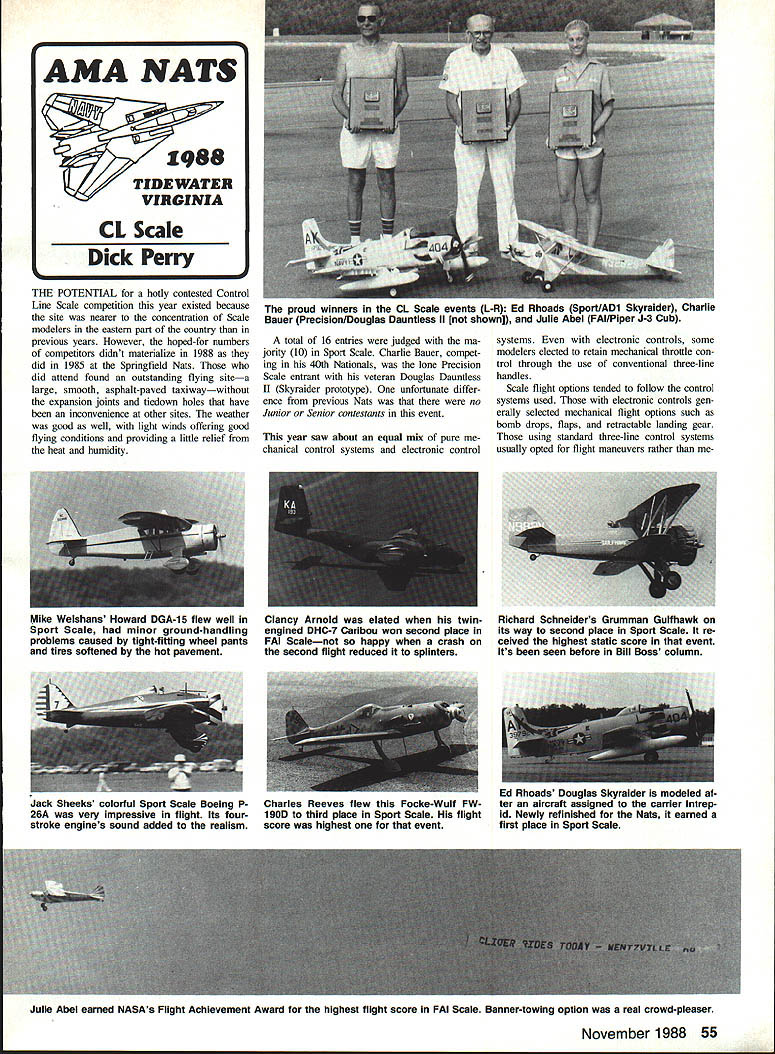
The Control Line Scale competition at the Nationals attracted fewer competitors in 1988 than the peak attendance in 1985, in part because the site was closer to the concentration of Scale modelers in the eastern U.S. Those who attended found an outstanding flying site: a large, smooth, asphalt taxiway without the expansion joints and tiedown holes that have plagued other venues. Weather was favorable, with light winds and comfortable flying conditions.
A total of 16 entries were judged, with the majority (10) in Sport Scale. There were no Junior or Senior contestants in this event. Charlie Bauer, competing in his 40th Nationals, was the lone Precision Scale entrant with his veteran Douglas Dauntless II (Skyraider prototype).
Entries and control systems
- Control systems: about an equal mix of pure mechanical three-line systems and electronic controls.
- Some modelers using electronic servos retained mechanical throttle control via conventional three-line handles.
- Flight-option choices tended to follow control systems:
- Electronic-control pilots often selected mechanical options (bomb drops, flaps, retracts).
- Three-line pilots usually selected flight-maneuver options, producing a variety of flying displays.
- Nearly all entrants chose touch-and-go throttle control; the options that best improved flight scores were those producing realistic, smooth performance.
Sport Scale
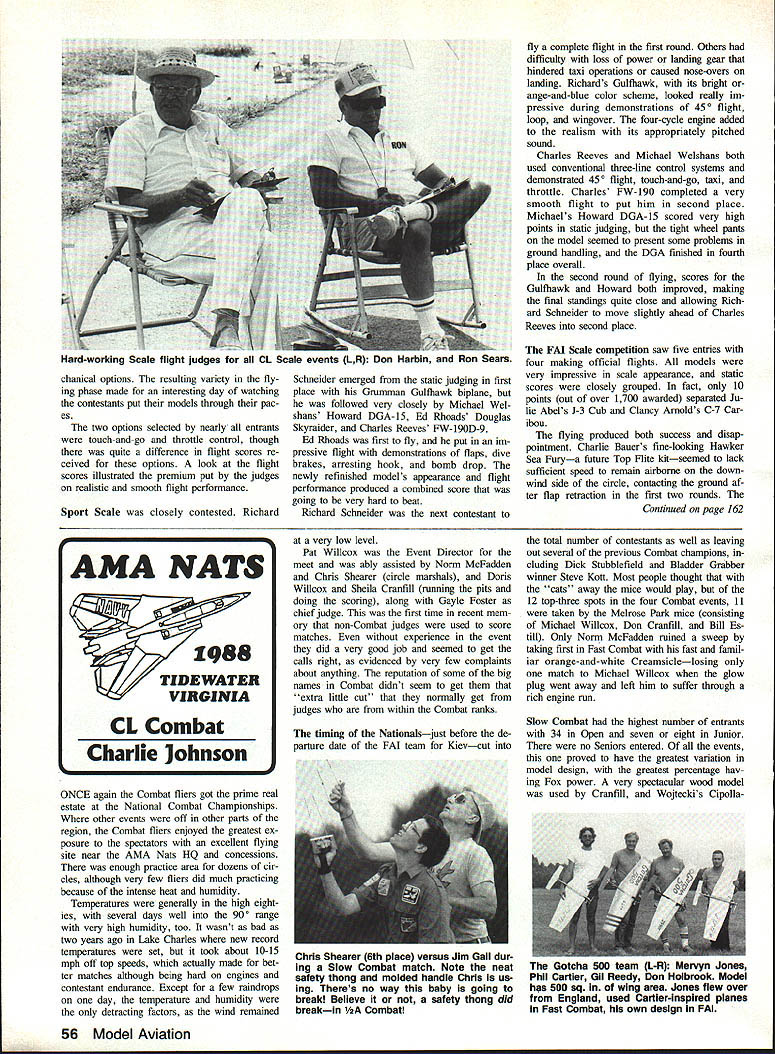
Sport Scale was closely contested. Static judging initially placed Richard Schneider first with his Grumman Gulfhawk biplane, followed by Michael Welshans’ Howard DGA-15 and Ed Rhoads’ Douglas Skyraider. Charles Reeves’ Focke-Wulf FW-190D-9 completed very smooth flights and finished high in the standings.
Highlights and problems:
- Ed Rhoads’ first flight included impressive demonstrations of flaps, dive brakes, an arresting hook, and a bomb drop.
- Newly refinished models that combined good appearance and flight performance scored particularly well.
- Some entrants suffered mechanical problems: loss of power, landing gear issues, and nose-overs on landing.
- Schneider’s Gulfhawk, in a bright orange-and-blue scheme and powered by a four-cycle engine, attracted attention for its realistic sound and appearance.
- Reeves and Welshans both flew conventional three-line control systems and demonstrated touch-and-go taxi throttle work. Reeves’ FW-190 flew very smoothly; Welshans’ DGA-15 scored well in static judging but had ground-handling problems due to tight wheel pants and soft tires on hot pavement.
Final Sport Scale placings:
- Richard Schneider — Grumman Gulfhawk biplane
- Charles Reeves — Focke-Wulf FW-190D-9
- Ed Rhoads — Douglas Skyraider
- Michael Welshans — Howard DGA-15
FAI Scale
Five entries were received in FAI Scale; four made official flights. All models were impressive in scale appearance, and static scores were closely grouped—only 10 points (out of over 1,700) separated Julie Abel’s J-3 Cub and Clancy Arnold’s C-7 Caribou.
Notable performances and incidents:
- Julie Abel earned the National Association of Scale Aeromodeling (NASA) Flight Achievement Award for the highest flight score in FAI Scale. Her scratch-built Piper J-3 Cub (modeled after Hazel Sig’s full-scale plane) had the best static score and the top flight score. Her options included banner tow and drop, 45° flight, touch-and-go, and throttle. The banner-tow was a crowd-pleaser.
- Clancy Arnold’s C-7 Caribou was the only multiengine model in CL Scale; it featured retracts, flaps, and working cargo doors. Arnold’s first-round flight secured him second-place honors, but the model did not finish its second flight. A probable outboard wing failure a few laps into the second flight—likely caused by a hard landing in the first round—resulted in a crash that totally destroyed the model.
- Dale Campbell flew his Ryan STA to third place; the large model (based on the Sig kit) used leaflet-drop options and looked impressive in flight.
- Charlie Bauer’s Hawker Sea Fury looked fine but appeared to lack sufficient speed to remain airborne on the downwind side of the circle. After flap retraction, it contacted the ground in the first two rounds. Bauer’s third-round flight also ended prematurely but after he had completed enough laps to register an official flight.
Organizers, judges, and scorers
- Category Director: Bert Dungan
- Flight judges: Ron Sears and Don Heron
- Static judges: Bert Dungan, Don Heron, Dave Platt, Steve Sanger, Norm Rosenstock, Skip Mast
- Scorekeeper: Shirley Sheeks
Their combined efforts made the CL Scale events possible and smoothly run.
Transcribed from original scans by AI. Minor OCR errors may remain.

