
AMA NATS 1988 — Tidewater, Virginia: FF Outdoor Scale
By Larry Kruse
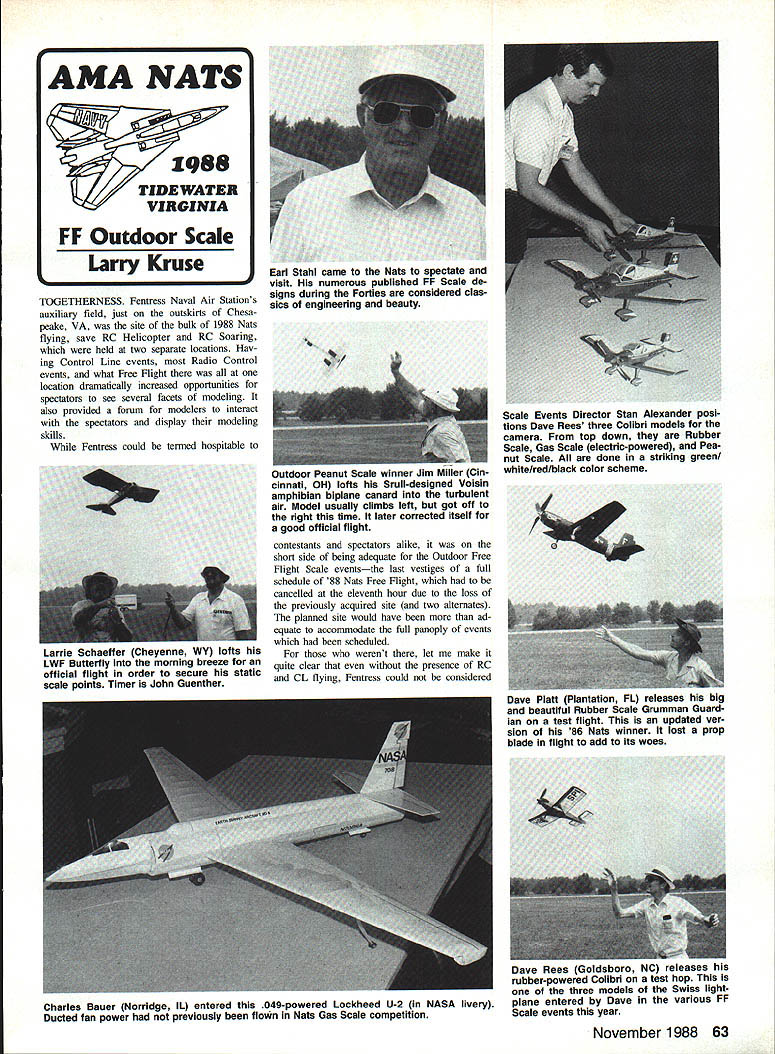
Fentress Naval Air Station's auxiliary field, just on the outskirts of Chesapeake, VA, was the site of the bulk of the 1988 Nats flying, except for RC Helicopter and RC Soaring, which were held at two separate locations. Having Control Line events, most Radio Control events, and the remaining Free Flight all at one location dramatically increased opportunities for spectators to see several facets of modeling. It also provided a forum for modelers to interact with spectators and display their modeling skills.
While Fentress was hospitable to contestants and spectators alike, it was marginally adequate for the Outdoor Free Flight Scale events—the last vestiges of a full schedule of '88 Nats Free Flight, which had to be cancelled at the eleventh hour due to the loss of the previously acquired site (and two alternates). The planned site would have been more than adequate to accommodate the full panoply of events which had been scheduled.
Despite the shortcomings, competition in three events—Gas Scale, Rubber Scale, and Peanut—was quite good, though the number of contestants would have been greater at a larger site.
Gas Scale
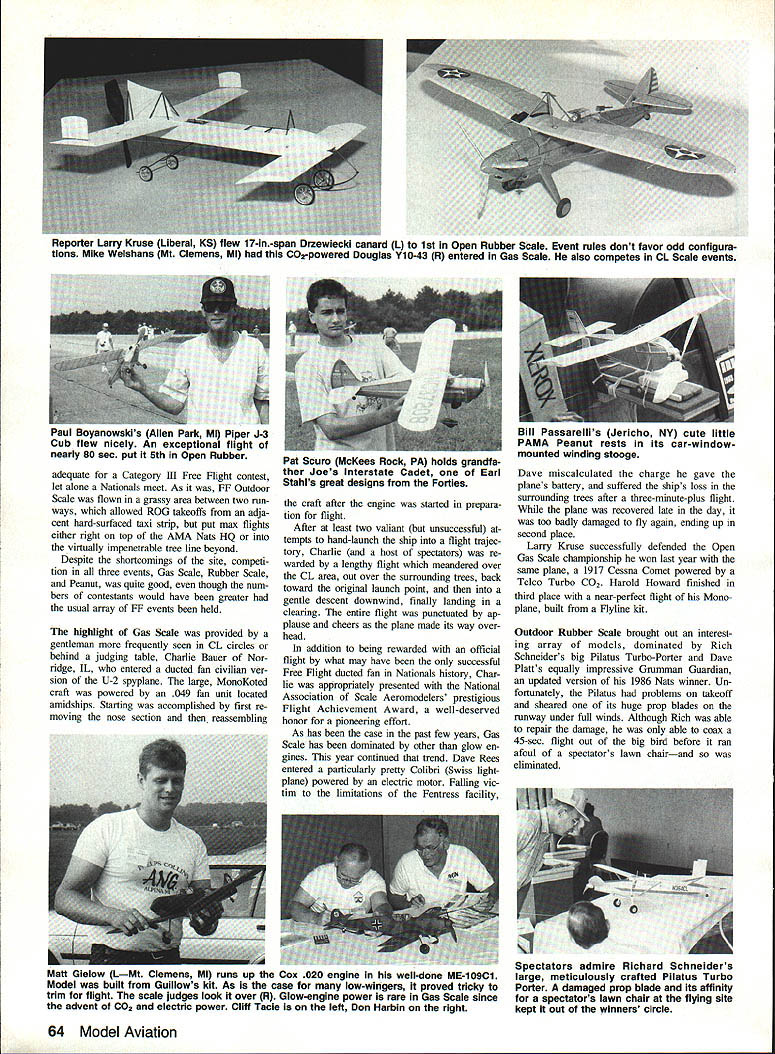
Gas Scale provided the highlight of the Free Flight Scale competition. Charlie Bauer (Norridge, IL) entered an .049-powered Lockheed U-2 in NASA livery — a ducted-fan ship. Starting the engine required removing the nose section, starting the engine, and reassembling the craft. After at least two valiant but unsuccessful hand-launch attempts, Charlie finally produced a lengthy flight that meandered over the CL area, out over surrounding trees, returned toward the original launch point, and, after a gentle downwind descent, landed safely. The flight was punctuated by applause and cheers. In addition to receiving an official flight, Charlie was presented the National Association of Scale Aeromodelers' prestigious Flight Achievement Award — a well-deserved honor for a pioneering effort. It may have been the most successful Free Flight ducted-fan flight in Nationals history.
As has been the case the past few years, Gas Scale dominated the glow-engine events this year. Dave Rees entered a particularly pretty Colibri (a Swiss lightplane) powered by an electric motor. Miscalculating the battery charge for the Fentress facility, he lost the plane in the surrounding trees after a three-minute-plus flight. The craft was recovered late in the day but too badly damaged to fly again, leaving Dave in second place.
Larry Kruse successfully defended the Open Gas Scale championship he won last year with the same plane, a 1917 Cessna Comet powered by a Telco Turbo CO2. Harold Howard finished third with a near-perfect flight of his monoplane, built from a Flyline kit.
Outdoor Rubber Scale
Outdoor Rubber Scale brought out an interesting array of models, dominated early by Rich Schneider's big Pilatus Turbo-Porter and Dave Platt's equally impressive Grumman Guardian, an updated version of his 1986 Nats winner. Unfortunately, the Pilatus experienced a takeoff problem and sheared one of its huge prop blades on the runway under full winds. Although Schneider repaired the damage, he managed only a 45-second flight before the model was fatally ensnared by a spectator's lawn chair and was eliminated.
Platt's Guardian also suffered prop problems. The WWII replica threw a blade on a test flight and it shattered on impact. Dave repaired the damage, but the model was badly out of trim—particularly in the glide—and sustained irreparable damage during subsequent test flights. Having suffered similar setbacks two years in a row in his quest to repeat the 1986 win, Dave said he will be rethinking his approach to Rubber Scale for next year's building season.
The battle for first place centered around another Colibri entered by Dave Rees and a Drzewiecki tandem-winged canard flown by Larry Kruse. The Colibri amassed 90 scale points compared to the canard's 87.5, but failed to exceed the 70-second barrier on any official flight, finishing with a total of 151.48. Kruse's canard caught rising air on its last flight and finished with a 157.57 despite turbulence from the nearby tree line.
Third place went to Bill Passarelli's consistent-flying Fike, while Jim Miller finished a close fourth flying a Santos Dumont 14-bis, a sister ship to the one he flew indoors.
Peanut Scale
Peanut Scale featured a contest between Jim Miller's Voisin biplane and another Voisin flown by Larry Kruse. The Don Sprull design is difficult to beat when built well and flown in good trim. Miller's static score of 128.25 points versus Kruse's 121.50 proved decisive; both had very close flight scores, 66.3 to 67.4, respectively.
Dave Rees took third place flying the same Peanut Colibri he had used indoors. The little low-winger was a very pretty subject in the air and a crowd favorite when flown by one of the East Coast's best modelers.
Bill Passarelli finished fourth with an interesting and promising PAMA design, a French ultralight in full-scale form. It appears easy to construct and fly; I hope Bill can be persuaded to publish the design to share it with others.
Camaraderie and Guests
While competitive on an event-by-event basis, the overall spirit of Outdoor Scale was epitomized by Dave Platt. True to his British heritage and the notion that Free Flight is the most civilized of model competitions, Dave called a halt to contest proceedings at 11:00 a.m., set a table with linen and crystal on the flight line, and provided a champagne brunch (nonalcoholic) for selected guests. The repast was repeated at tea-time for the judges and officials, and a jolly good time was had by all. Thank you, Dave, for reminding us that camaraderie is more important than competition.
The contest was also highlighted by the presence of Earl Stahl, the grand old man of Free Flight Rubber Scale, who came to watch and visit with contestants and spectators. We owe a large debt of gratitude to Earl and others like him who pointed the way and set high standards for us to emulate. It's gratifying to know he still maintains an active interest in the sport in which he inspired so many of us to begin.
In closing, I would be remiss not to thank all of the judges, timers, and statistics officials, whose efforts made the difference between merely holding a contest and achieving a success.
Nats Outdoor Scale / Kruse
A bunch of people flying airplanes. I must apologize for being so busy flying and attempting to take the needed photos for this report that I did not get all of your names. Because of that failure I hesitate to name anyone for fear of offending those I might miss—but you know who you are, and be assured that your work was most appreciated.
Special thanks to:
- John Guenther
- Stan Alexander
- Ann Underwood
They helped things run smoothly, even in the midst of the one seemingly obligatory site change. We all look forward to next year and the resumption of a full slate of Free Flight events, among which Free Flight Scale will still remain our favorite.
Transcribed from original scans by AI. Minor OCR errors may remain.

