
AMA Nats: FF Power
Larry Kruse
ANY FREE FLIGHT CONTEST is dependent upon three components—quality contestants, adequate siting, and acceptable weather. A Nationals contest, in particular, depends on a healthy representation of each of those elements.
It is safe to say that at this year's Lincoln Nats the contestants were there, both in quality and quantity, as over 850 FF event entries were tabulated—302 of them in Power.
The second component, adequate siting, deserves some expanded commentary, however. From conversations with numerous contestants, the mental image that the Nats FF site that brought them to Lincoln was not borne out by what they found. Situated some 17 miles west and south of Lincoln, near the village of Denton, the site was on high ground overlooking rolling hills to the north and east.
Positioned up against barbed wire fences on two sides, the launch line commanded a view of the retrieval area, which was a series of undulations with tall grass and few trees. Several deep washes or gullies traversed the bases of these hills. Unfortunately, this fact was not readily apparent from a distance—only when you got up on them while chasing a model. You could not cross them with a motorbike or three-wheeled ATV, so a lot of the chasing had to be done on foot.
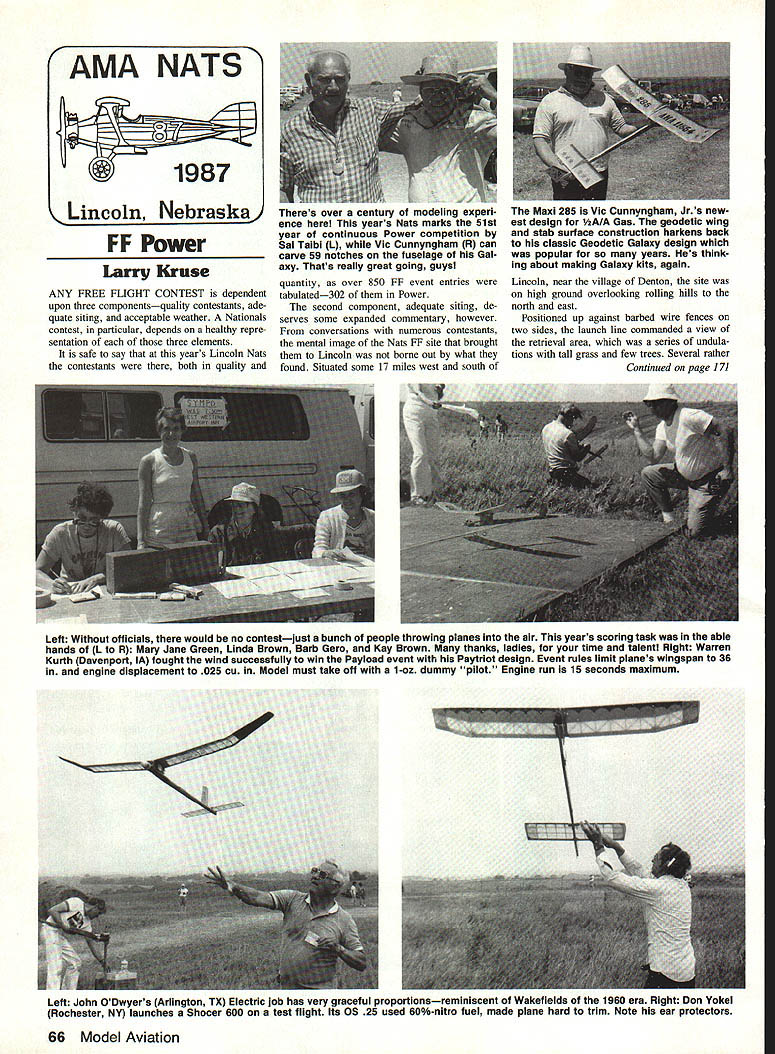
Several rather dedicated people took on the chores that made the event possible. Without officials there would be no contest—just a bunch of people throwing planes into the air. Scoring and tasking were in able hands: Mary Jane Green, Linda Brown, Barb Gero, and Kay Brown. Thanks, ladies, for your time and talent.
Nats FF Power / Continued from page 66
As one wag put it, "Flying is all downhill, here." Followed to its logical conclusion, that comment suggested that retrieval was all uphill. And so it was.
In all fairness to the site-selection officials, the location would probably have been preferable to the tall corn of Mead—if only the weather would have cooperated! It did not. Showing no deference whatsoever to the needs of the FF fraternity, the winds of Nebraska blew almost unrelentingly throughout the week, only to intensify as the Nats drew to a close.
Outdoor FF began on Tuesday of Nats week with C Gas and Payload fliers being greeted by rain in the morning hours as one of the two major weather fronts encountered during the week moved through eastern Nebraska. By afternoon, flights were possible as the sun came out.
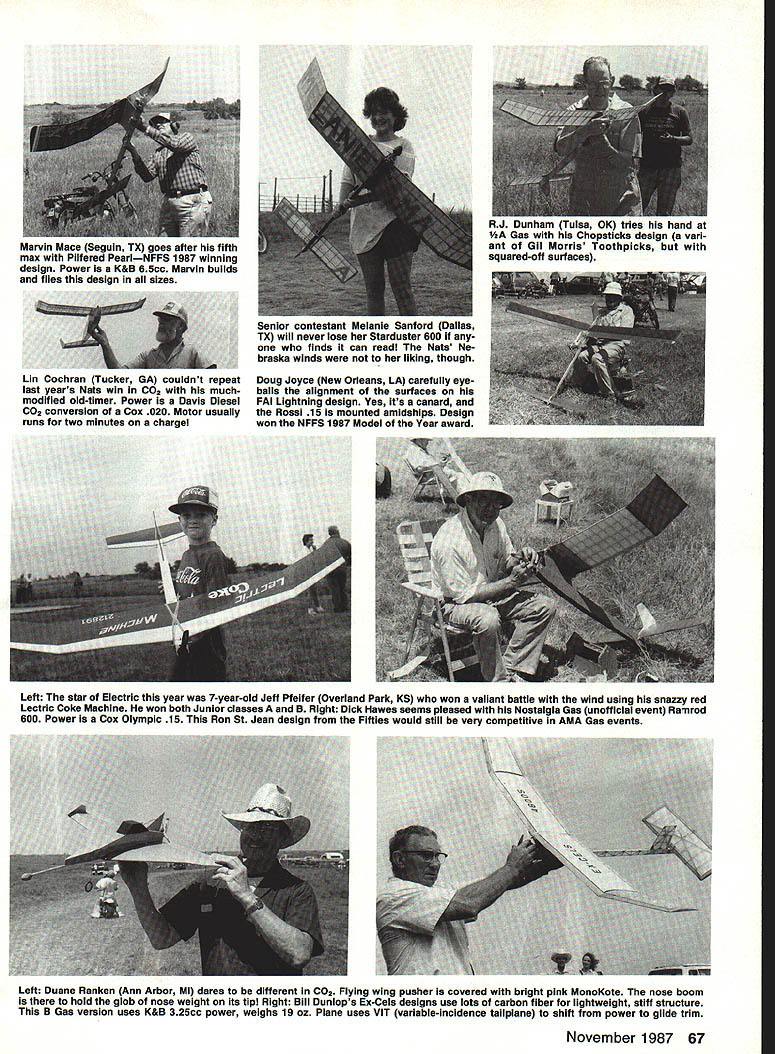
Marvin Mace and his Pilfered Pearl entourage led the way into the flyoffs in Open C Gas and never looked back. Gil Morris' Matchsticks could not keep pace with Mace and fell to second, followed by Bill Dunlop, who was still trying to sort out trim combinations on his new carbon fiber Ex-Cels. Only one Senior, Melanie Anderson, chose to put up a flight in C, and so was content to watch the youthful competition.
Despite the southerly breezes, Warren Kurth's Murphy-designed Patriot maxed out in Open Payload, while other ships were being blown off-pattern and, in some cases, into the ground. Dave Platt was particularly surprised when his DT malfunctioned at the moment of ROG launch, and various pieces of his nicely done original design took to the air individually in the strong breeze. Bill Hale and Bob Nichols managed adequate ROGs to end up second and third, but neither was able to get his power pattern "on step" due to the wind. David Brown and Melanie Sanford were the two Senior representatives and finished in that order with abbreviated efforts.
Payload's heavier brother, Cargo, brought out its usual contingent of the goofy and the sublime (models, not fliers!) on Wednesday, the only day free of excessive wind.
For those not familiar with Cargo, it is both an entertaining and challenging event. The idea is to lift as much weight as possible using a model having a wingspan of no more than 48 in., a total engine displacement of no more than .025 cu. in., a 20-sec. engine run, and a minimum flight duration of 40 sec. Scoring is done on the basis of total weight lifted during the three best flights of 12 attempts, all of which must be ROG (rise-off-ground). As one might expect, there is a great deal of cheering heard, and body English applied, as each ship is released.
Bob Nichols was the winner of Open Cargo with his Bull Moose II, followed by Duane Renken, who fought engine problems throughout the day. Lin Cochran entered a ship that looked like it was right out of Star Wars, but he, too, had engine problems. Arnie Wile had different problems. The engine on his Old-Timer-looking Cargo entry ran well, but he could only record flights that fell within a hairbreadth (on the wrong side) of 40 sec. In a repeat of his Payload performance, David Brown won Senior Cargo.
Keith Fulmer liked Wednesday. A noted indoor flier from Indiana, Keith showed his prowess outdoors by setting a new National Record of 17 min., 50 sec. in Open 1/2A Gas with his diminutive, all-red Satellite 250. At a weight of six ounces, the ship had a spectacular climb. Even on its four-second flyoff engine runs it got unbelievably high, rotating 360 degrees along its vertical axis to level out into the wind as the engine quit. Durand Weiler was second, recording a 637-sec. total. Jim Summersett, who ran his string to 579 sec. before bowing out, was in third place.
Both Juniors and Seniors were present in 1/2A, and all flew representative flights. Troy Chamberlain headed up the Junior list, followed by Kenny Wice and Jeanette Yokel. Senior belonged to the Gagliano brothers, Matt and Charles, but Melanie Anderson let Charles know that she was around, challenging him for second.
D Gas and FAI were flown on Thursday as the wind shifted determinately to the south/southwest, where it remained for the rest of the week.
Young Glenn Anderson showed a lot of class and grit in winning FAI with an excellent 801, considering the conditions. During one launch critically near the end of a round, Glenn's engine inadvertently quit at about three seconds, and the plane came down under the 20-sec. minimum. Glenn had less than three minutes to retrieve the plane, run back to the official's tent, refuel, restart the engine, and get the ship into the air to avoid dropping the round. It was quite a performance and earned a well-deserved max for the young man. Second was NFFS honoree Doug Joyce with his screaming, mid-engined canard. Third was taken by Carl Bogart, whose flights were abbreviated by the windy conditions.
The event of the "big 'uns," D Gas, had a surprising turnout of 15 entrants. The old master, Sal Taibi, followed his usual practice of flying as early as possible and looked to be in the lead most of the way, flying four straight maxes. Marvin Mace was chasing him, but both were overtaken and passed by Jim Summersett, whose high-climbing Pearl seemed to be able to punch a hole right up through the turbulence and find lift every time. Jim ended up with a very respectable total of 600 sec., and looked like he could continue all day, if need be. There was no need, however, as Sal apparently elected to forego additional flights because of the wind and difficult chase conditions.
In A Gas, 68 contestants had expressed their intent to fly by pre-registering. In a scenario that would be repeated in each remaining event throughout the week, only 18 contestants elected to fly. Surprisingly, all three Juniors who entered flew. Little Jeanette Yokel soundly trounced the boys by recording a total of 268 sec., which would have put her fifth in Open class! The wind was such a factor that Troy Chamberlain and Kenny Wice only put up one flight apiece and finished in that order. David Brown was the only Senior to fly of the five entered.
In Open A Gas, Durand Weiler was the only flier to reach the flyoff stage, and so won handily against Jim Summersett and Ed Schakenburg, who both maxed twice but dropped their third flights as wind velocity increased.
CO2 suffered as well; however, 10 of 15 contestants did put up flights. Bob Nichols won the Open category after George Perryman's plane blew out of the timer's range of vision at 89 sec. on its second flight. George maintained it was still going, which is why he said he had been unable to find it by the end of Nats week. Arnie Wile's "sang-tank" approach to CO2 brought him third place.
Senior David Brown had a tiny little entry which penetrated the wind well enough to win for him. In Junior, Kenny Wice stayed aloft a total of 95 sec. for first place. Someone suggested that scoring should have been modified to make CO2 a distance event rather than a timed event (George Perryman might have been the one who made that suggestion).
Power came to a conclusion of sorts on Saturday as wind and weather conditions persisted. B Gas was pretty much a repeat of the previous day's experience in A, as only 10 of a registered 43 contestants decided to brave the elements once more. Senior Jan Langelius's Shocer probably handled the wind as well as any ship could, recording one max and narrowly missing a second at 235 sec. To her credit, Melanie Sanford also put up a flight, but it appeared that her Starduster 600 was damaged as it blew downwind upon landing.
In Open B it was Jim Summersett again, this time with a Satellite that appeared to go off-pattern and nosed in only a split second before the engine cut on an early flight. Jim proved just as persistent in the wind, though, as he could be seen putting the pieces back together so that he could finish with a three-flight total of 347 sec. That Pearl man, Marvin Mace, was right there with him at 338 sec., and Charles Polansky's Pearl came in at 329. Interestingly enough, Charles has introduced two of his sons-in-law, John Kucera and Richard Haas, into FF, and both have turned out to be real competitors.
Electric-powered Free Flight continues to show some growth, albeit slowly, and was the final event on the Power schedule. Junior Jeff Pfeifer was the bit of Electric as he determinedly put up good flights in winning both A (six-cell) and B (eight-cell) classes with his red-and-white Lectric Coke Machine. Dressed in red and white to match his model, the seven-year-old lad gave it everything he had as he heaved his large model into the air against the buffeting gale. Two other Juniors, Danny Ackerman and Kenny Wice, also put up flights, but little Jeff stole the charisma award.
In Open, Don Hughes and Bob Nichols were first and second, respectively, in A and B Electric. Third in A was captured by John O'Dwyer flying a beautifully proportioned model that looked like a Sixties Wakefield design. Third in B was taken by Duane Renken to close out the scoring in Power.
Objectively assessing advances in the sport and new trends was impossible since the winds prevented the full spectrum of competition from emerging in most classes. Those FF'ers who chose to compete should be applauded for their courage. Those who elected not to risk their planes and equipment should be given credit for being judicious. For most, it was a frustrating week with little reward and no closure. Whether or not the site would have been considered adequate under better conditions remains a question which will probably never be answered.
In the months to follow, as we collectively and individually sift through our thoughts about our doings at Lincoln, I'm sure that most of us will both hope and believe that next year things are bound to be better.
I said in the first paragraph that there were three components needed for a good Free Flight contest. There is actually a fourth. That fourth and most important component is always a "given" at the Nats. It is the group of officials who run the show, that hardworking cadre of Category Managers, Category Directors, Event Directors, scorekeepers, timers, and sundry other volunteer helpers who spend long hours hearing our complaints—and fleeting moments hearing our "thank yous." To Dr. Sandy Frank, Linda Brown, and all of their crew goes a big chunk of appreciation for all of their time and effort spent on our behalf. We know how much each of you does for each of us. Thanks for everything.
Transcribed from original scans by AI. Minor OCR errors may remain.

