
AMA Nats: General
John Worth
Overview — It was a scorcher
Almost anywhere in the country it's very hot in July, and the AMA National Model Airplane Championships are typically high-temperature affairs. The 1988 event at Tidewater, Virginia, was hotter than usual. Nationals are often rated hottest when held at Lake Charles, LA, but this year the Virginia Nats earned a reputation as an all-time pressure cooker.
Despite the heat, winds were mostly light and variable and flying generally did not suffer. The only significant interruption was a several-hour shutdown one day of the RC Soaring events when a thunderstorm passed through that site, which was located many miles from the other activities. Thunderstorms threatened throughout Nats week, and there had been heavy rains the week before that hampered setup operations. A monster storm hit the night the Nats ended, but during the scheduled flying week the storms largely stayed out of the way.
Just under 1,000 contestants registered, accompanied by about 200 mechanics and roughly 300 officials.
Outdoor Free Flight cancellation
A major element was missing: Outdoor Free Flight (other than FF Scale) had to be canceled just two weeks before the Nats. The mile-square farm site that had been promised was no longer available. The owner, who had agreed the year before to clear the field after harvesting an early crop, chose instead to plant soybeans that would not be harvested until after the Nats.
The decision was economic. Much of the country suffered severe drought, but East Coast farms had good conditions; crop prices (beans, corn, etc.) had skyrocketed. It was simply too lucrative to leave a large field idle for a week. Even if AMA had offered compensation, mid‑summer 1988 prices would have made it prohibitive (tens of thousands of dollars). No suitable alternative site was found within a reasonable distance of the other Nats activities.
Effects on other events and site juggling
- RC Soaring originally planned to share the farmer's field with Free Flight. When that field became unavailable, Soaring was relocated to a smaller but adequate full‑scale soaring airstrip about 30 miles from the main Nats sites.
- Helicopter events were impacted as well. Pre‑Nats rains ruined the proposed grass surface at the alternative soaring site, forcing a last-minute move to what was available.
- The Fentress Auxiliary Landing Field hosted most events but was farther away than ideal. A closer site had potential radio interference from another RC site, so it couldn't be used.
The week before the Nats felt like musical chairs with sites moving around. Volunteer workers put in tremendous individual effort to get all sites (except Outdoor Free Flight) ready by the official start. Once the contest began, the site problems subsided, and most events ran smoothly. The remaining challenge was accommodating the heavy RC contestant load; excellent cooperation between RC Pattern and Pylon directors helped minimize complaints.
Headquarters, indoor flying, and logistics
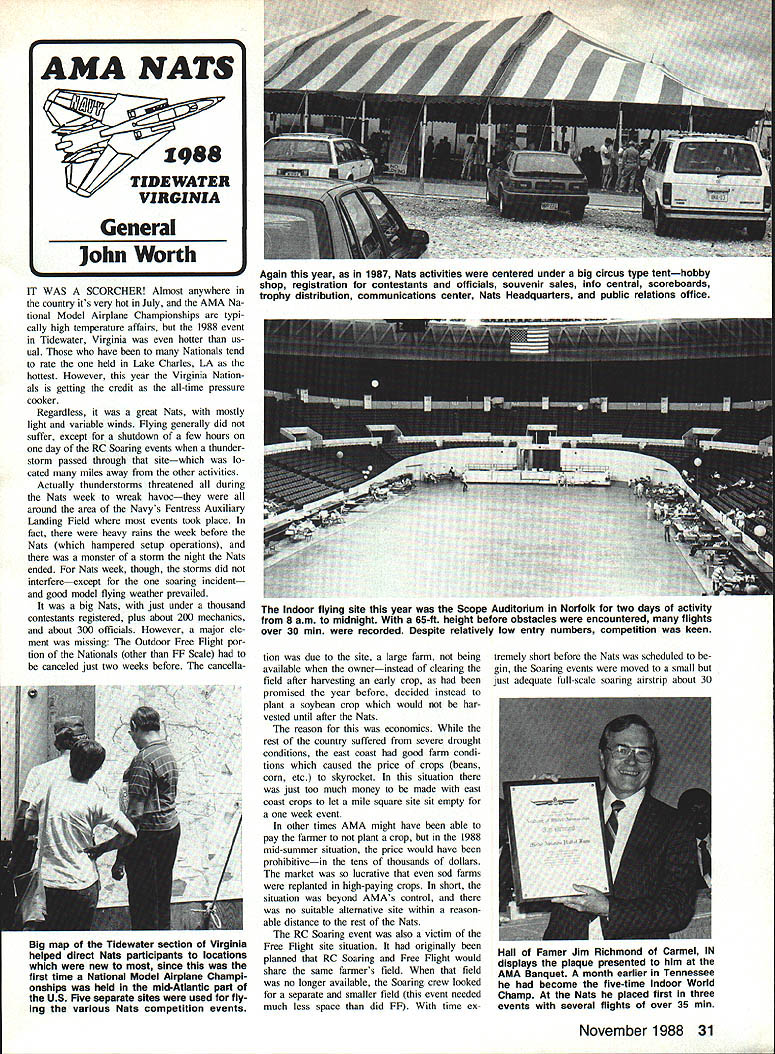
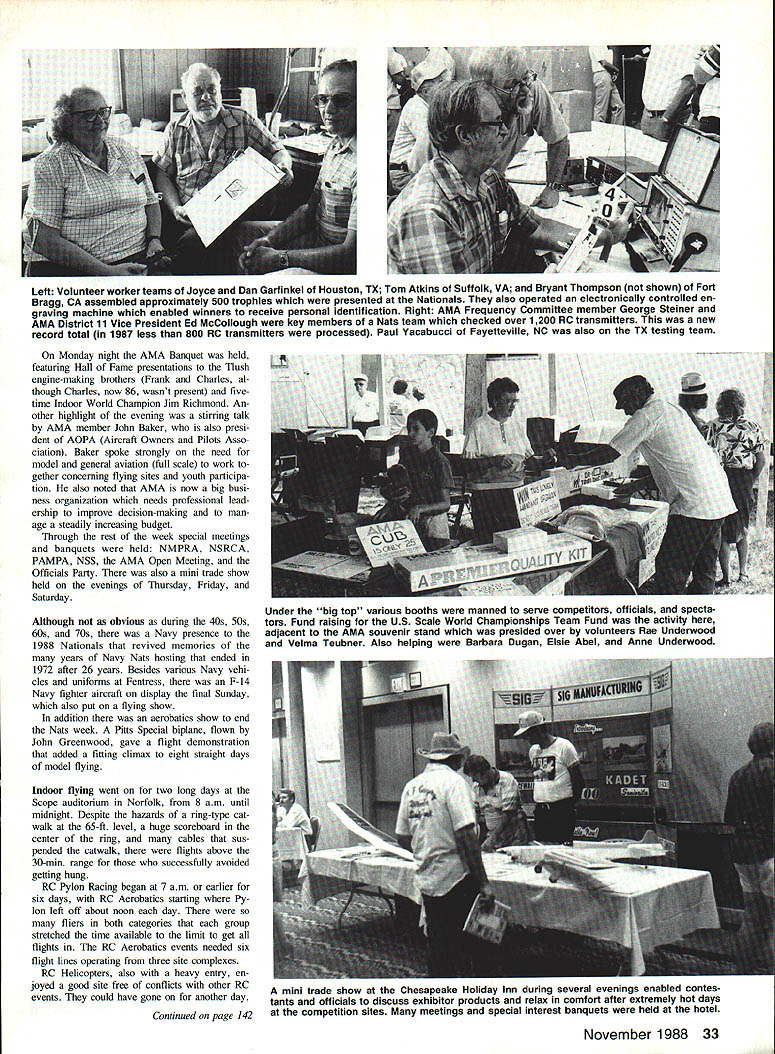
Nats headquarters operated under a large circus‑style tent housing the hobby shop, registration, officials, souvenir sales, info center, scoreboards, trophy distribution, and communications. A big map of the Tidewater section of Virginia directed participants to the five separate sites used for competition events.
Indoor flying was held at the Scope Auditorium in Norfolk for two long days (8 a.m. to midnight). The hall offered about 65 ft. of height before obstacles, but a ring‑type catwalk, a central scoreboard, and supporting cables presented hazards. Still, several competitors recorded flights over 30 minutes.
Events and schedules
- RC Pylon Racing: began as early as 7 a.m. for six days.
- RC Aerobatics: typically started around noon after Pylon, often needing up to six flights in some categories; tight schedules forced some adjustments.
- RC Helicopters: heavy entry and a good site; competitors could have used another day.
- RC Scale: provided the grand finale, flying four rounds over two days. A fifth round was possible, but heat and fatigue led to a noon finish on the last Sunday.
- Control Line: enjoyed good sites, with grass areas for Combat and smooth runways for Precision Aerobatics and Racing. Speed and Carrier had separate adequate locations.
Most events benefited from good weather, adequate sites, and capable personnel.
Nostalgia Night, notable people, and historic models
Nostalgia Night on the opening Sunday featured stories from "old timers," movies, and displays of Old‑Timer models from the AMA Museum. Notable attendees included:
- Frank Thulsh (five‑time Indoor World Champion)
- Leo Weiss
- Leon Shulman
- Mike Granieri
- Woody Blanchard
- Norm Rosenstock
- Dave Brown
- Don Lowe
- John Worth
- Johnny Clemens
- Carl Schnaedig
- Jim Richmond (Hall of Famer)
Famous models on display included:
- Elbert J. Weathers' original Pacificcoaster
- Dave Ritchie's replica of the K/G‑1
- Carl Price's Twin Pusher
- A Jim Walker Fireball
- A Miss America by Carl Schnaedig
- A replica Korda Wakefield model
- A replica of Maxwell Bassett's Miss Philly II
- A deBolt Live Wire by Norm Rosenstock
Banquets, meetings, and speakers
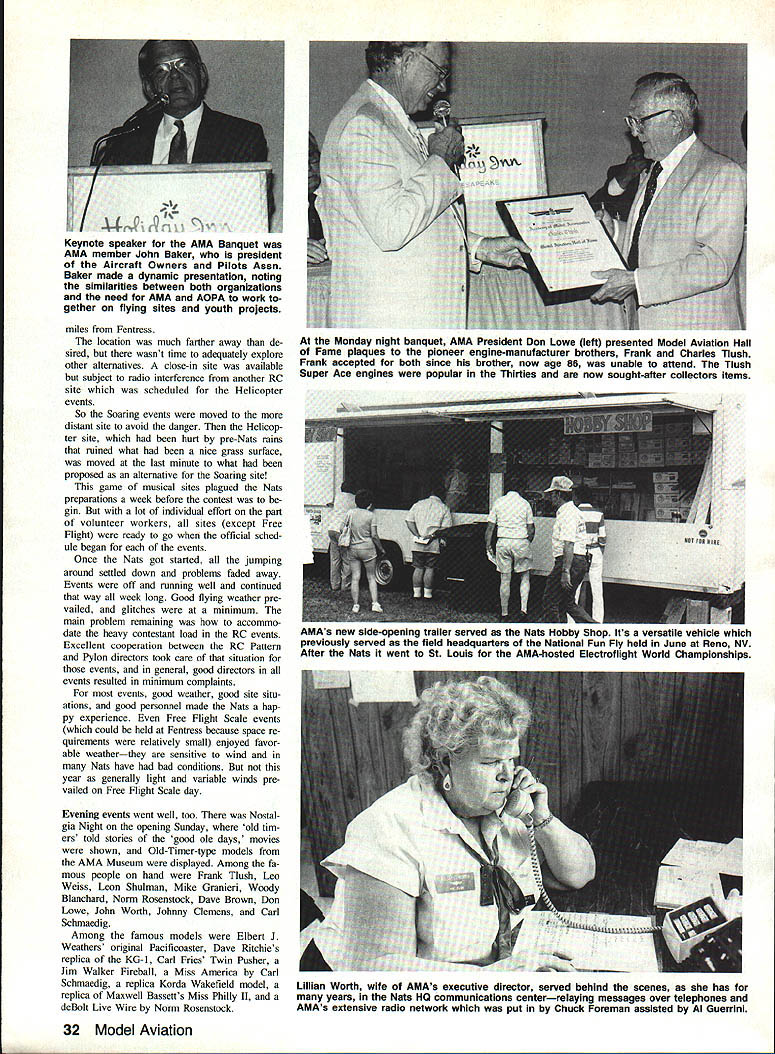
The AMA Banquet on Monday night featured Hall of Fame presentations to the Thulsh engine‑making brothers (Frank and Charles; Charles, then 86, was not present) and to Jim Richmond. John Baker, AMA member and president of AOPA, gave a stirring talk urging collaboration between model and full‑scale aviation on flying sites and youth participation. He also noted AMA's increasing scale and the need for professional leadership to manage growing budgets.
Other gatherings during the week included meetings and banquets for NMPRA, NSRCA, PAMPA, NSS, the AMA Open Meeting, and an Officials Party. A mini trade show ran on the Thursday, Friday, and Saturday evenings.
Navy presence and full‑scale demonstrations
Although not as prominent as in earlier decades, there was a notable Navy presence at the 1988 Nationals, recalling the long history of Navy‑hosted Nats that ended in 1972. Navy vehicles and uniforms were on display at Fentress, and an F‑14 Navy fighter was exhibited on the final Sunday and performed a flying demonstration. The week concluded with an aerobatics show by John Greenwood in a Pitts Special biplane.
Volunteers and local clubs — the workforce behind the Nats
The only financially feasible way to hold a Nats is to rely on local AMA‑chartered clubs for manpower. Four Tidewater area clubs provided major support before, during, and after the event:
- Norfolk Aeromodelers
- Tidewater Model Soaring Society
- Tidewater RC Incorporated
- Tidewater Whirlybirds
About 300 AMA member volunteers in total worked to make the Nats a success. A special Facilities Crew of out‑of‑staters put in enormous hours to ensure every event had equipment and supplies. This group included:
- Bob and Janet Landry
- Paul and Peg Viverito
- Gary Atta
- Dick Pettit
- Jim Buchanan (Underhill, Vermont)
Tragically, Jim Buchanan passed away one evening in the middle of Nats week at the Fentress airfield facilities staging area. He was remembered as someone who went quietly and happily while doing what he enjoyed—working with friends.
Two Tidewater leaders received special mention for their long months of effort and on‑site leadership:
- Mike Ingalls (Chesapeake, Virginia)
- Greg Kozlowski
Closing and sites under consideration
All in all it was a fine Nats aside from the Outdoor Free Flight cancellation. Several potential sites were being explored for the next year: Tacoma, Washington; Ames, Iowa; and Muncie, Indiana. The AMA Executive Council was expected to decide at its October meeting in Reston, VA.
The annual miracle of the National Championships is a blur of hundreds of faces and names. The many volunteers, clubs, and individuals who made the 1988 Tidewater Nats possible deserve the gratitude of the entire modeling community.
Transcribed from original scans by AI. Minor OCR errors may remain.

