
CL Aerobatics AMA NATS LINCOLN '79
Wynn Paul
"HAIL, Hail, the gang's all here!" You bet they were: four World Champions, eight former National Champions. Overheard many times during the week was the exclamation, "This has got to be the greatest stunt contest ever held." It may well have been just that.
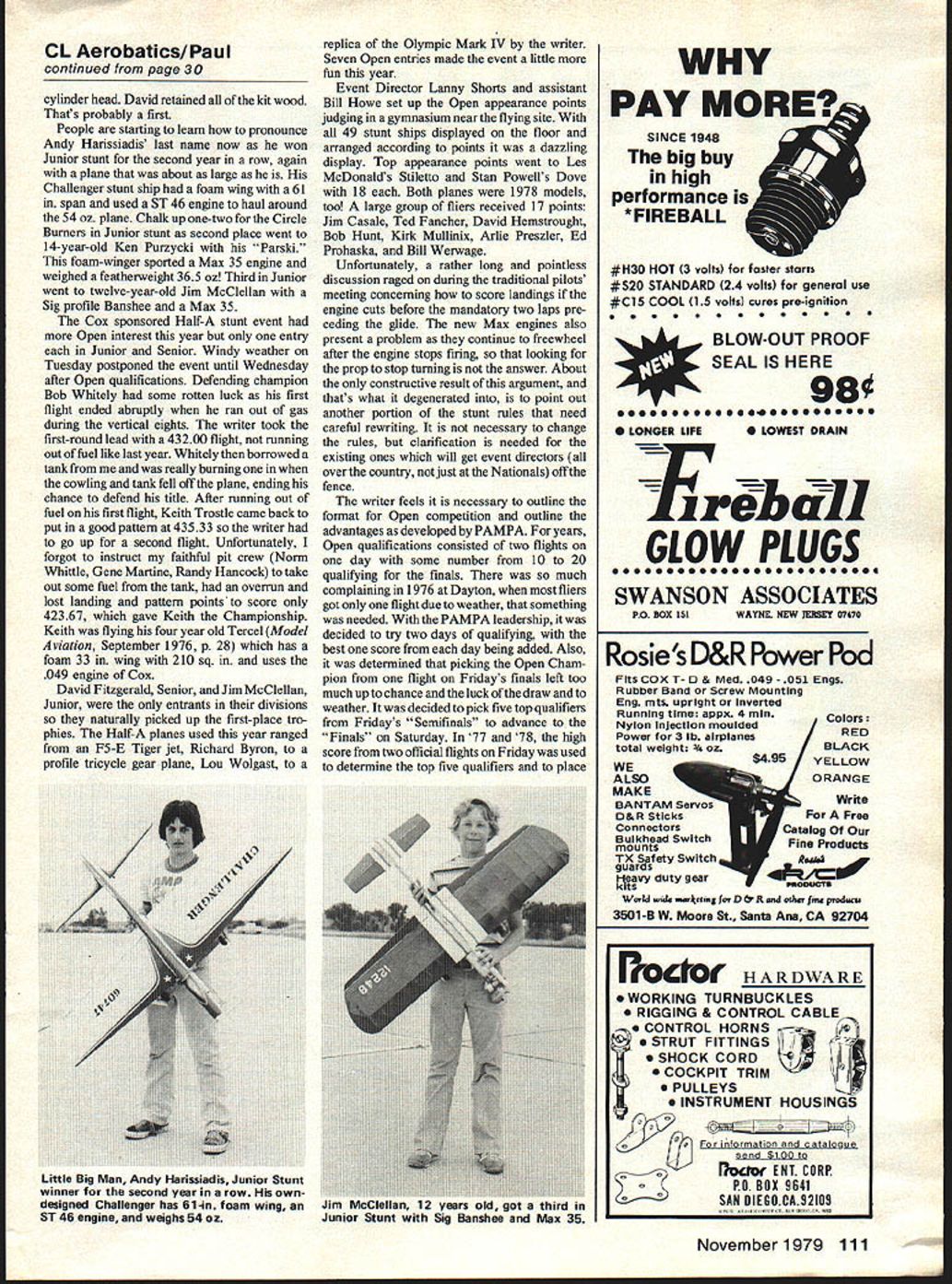
When the wind finally calmed down at about 2:00 a.m. Sunday morning, the "Old Bear" from Irving, Texas, Bob Gieseke, had the Walker Cup sitting in his motel room for the fifth time. Bob won this Nationals to add to his titles in 1966, 1968, 1974 and 1975.
Stunt fliers had been hearing for months that Lincoln would be hot and windy. This prophecy proved true for the 49 Open fliers that turned out for the PAMPA revised format. Except for Wednesday's qualifying and Friday's semifinals, which were near-perfect flying days, the rest of the competition days were windy; Saturday's finals were flown in near-gale winds.
Junior and Senior Divisions
The Junior-Senior fliers did not enjoy good weather as 10–15 mph winds prevailed on Tuesday, the first day of competition. The turnout was a resounding disappointment—three juniors and six seniors—so both age divisions were flown on the same circle.
David Fitzgerald, 17 years old, continued his dominance of the Senior division as he won for the third year in a row. His string of national victories goes back one year farther, as he won the Junior Championship in 1976. Again flying a Sig Super Chipmunk, hastily constructed in 10 days' time after totaling his old Chip, David experienced some engine troubles on Sunday and Monday with his Max 35. He performed the customary procedure for a balky Max: he removed the bad engine and started over with another one, going merrily on his way with outstanding flying on a somewhat windy day.
His closest competition again came from Kevin Capitanelli, flying a new plane with a Max 40 FSR. However, Kevin's high score of 450.50 was too far off David's blazing 473.75. According to Arlie Preszler's evaluation of David, "He had a dynamite flight even though the engine leaned out after the horizontal round eights." Another Garden State Circle Burner, Andy Blank from Verona, New Jersey, finished in third place in his first Nats appearance.
Fitzgerald's plane had only a few modifications from the stock Sig kit. He moved the gear blocks back to rest against the wing spar, made the top block a continuous piece from nose to tail without the cutout for the cockpit—"The large cutout for the canopy is a weak spot in the design," said the Champ. He also ran the engine motor bearers all the way out to the front of the cowl for added strength. He was using the now-standard "Rabe engine shroud" on his Max 35 engine; this consists of a piece of thin stock wired around the cylinder head with holes cut fore and aft to circulate air around the back of the cylinder head. David retained all kit wood.
People are starting to learn to pronounce Andy Harissiades' last name. He won Junior stunt for the second year in a row, again flying the large Challenger stunt ship with a foam wing (61" span), using an ST 46 engine; the ship weighed around 54 oz.
Chalk up a one-two for Circle Burners in Junior stunt. Second place went to 14-year-old Ken Purzycki, Parsippany; his foam-winger sported a Max 35 engine and weighed a featherweight 36½ oz. Third Junior went to twelve-year-old Jim McClellan, flying a Sig profile Banshee with a Max 35.
Cox Half-A Stunt
The Cox-sponsored Half-A stunt event had more Open interest this year but only one entry each in Junior and Senior. Windy weather on Tuesday postponed the event until Wednesday after Open qualifications.
Defending champion Bob Whitely had some rotten luck as his first flight ended abruptly when he ran out of gas during the vertical eights. The writer took the first-round lead with a 432.00 flight, not running out of fuel like last year. Whitely then borrowed a tank from me and was really burning one in the cowling when the tank fell off the plane, ending his chance to defend his title.
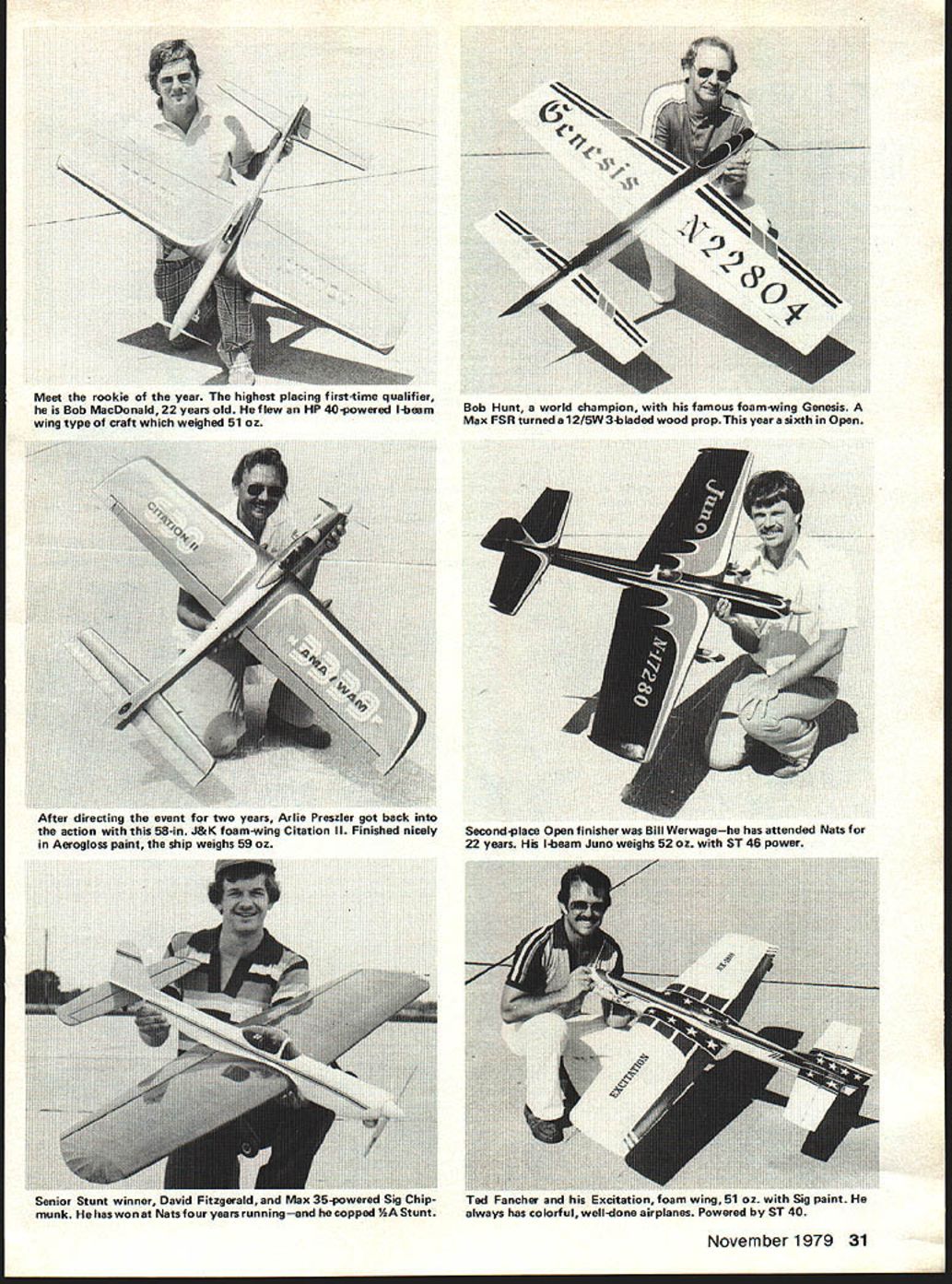
After running out of fuel on his first flight, Keith Trostle came back to put in a good pattern at 435.33 so the writer had to go up for a second flight. Unfortunately, I forgot to instruct my faithful pit crew (Norm Whittle, Gene Martine, Randy Hancock) to take out some fuel from the tank, had an overrun and lost landing and pattern points to score only 423.67, which gave Keith the Championship. Keith was flying his four-year-old Tercel (Model Aviation, September 1976, p. 28), which has a foam 33 in. wing with 210 sq. in. and uses the .049 Cox engine.
David Fitzgerald (Senior) and Jim McClellan (Junior) were the only entrants in their divisions so they naturally picked up the first-place trophies. The Half-A planes used this year ranged from an FS-E Tiger jet (Richard Byron) to a profile tricycle-gear plane (Lou Wolgast) to a replica of the Olympic Mark IV by the writer. Seven Open entries made the event a little more fun this year.
Appearance Judging and the Pilots' Meeting
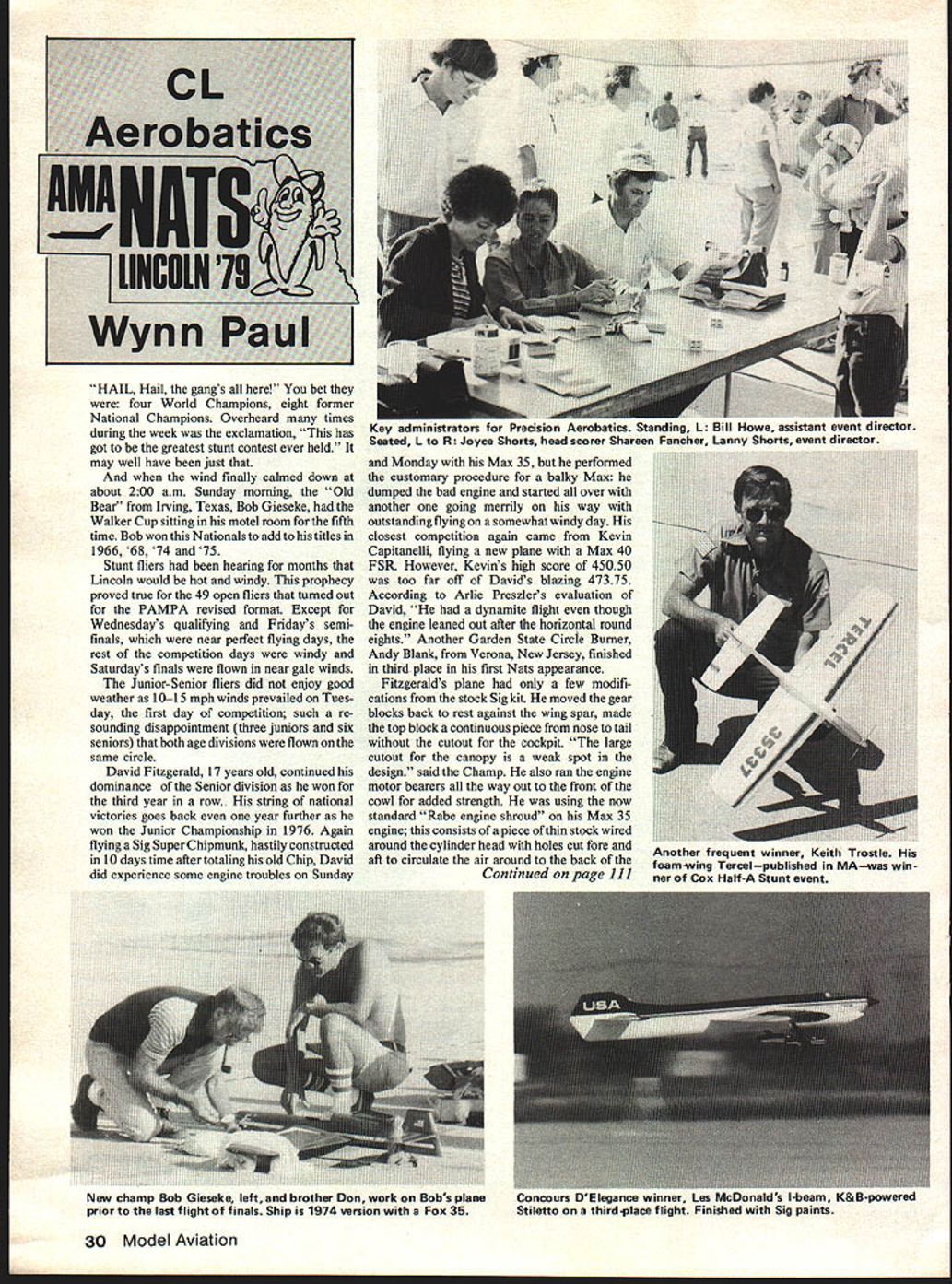
Event Director Lanny Shorts and assistant Bill Howe set up the Open appearance-points judging in a gymnasium near the flying site. With all 49 stunt ships displayed on the floor and arranged according to points it was a dazzling display.
Top appearance points went to:
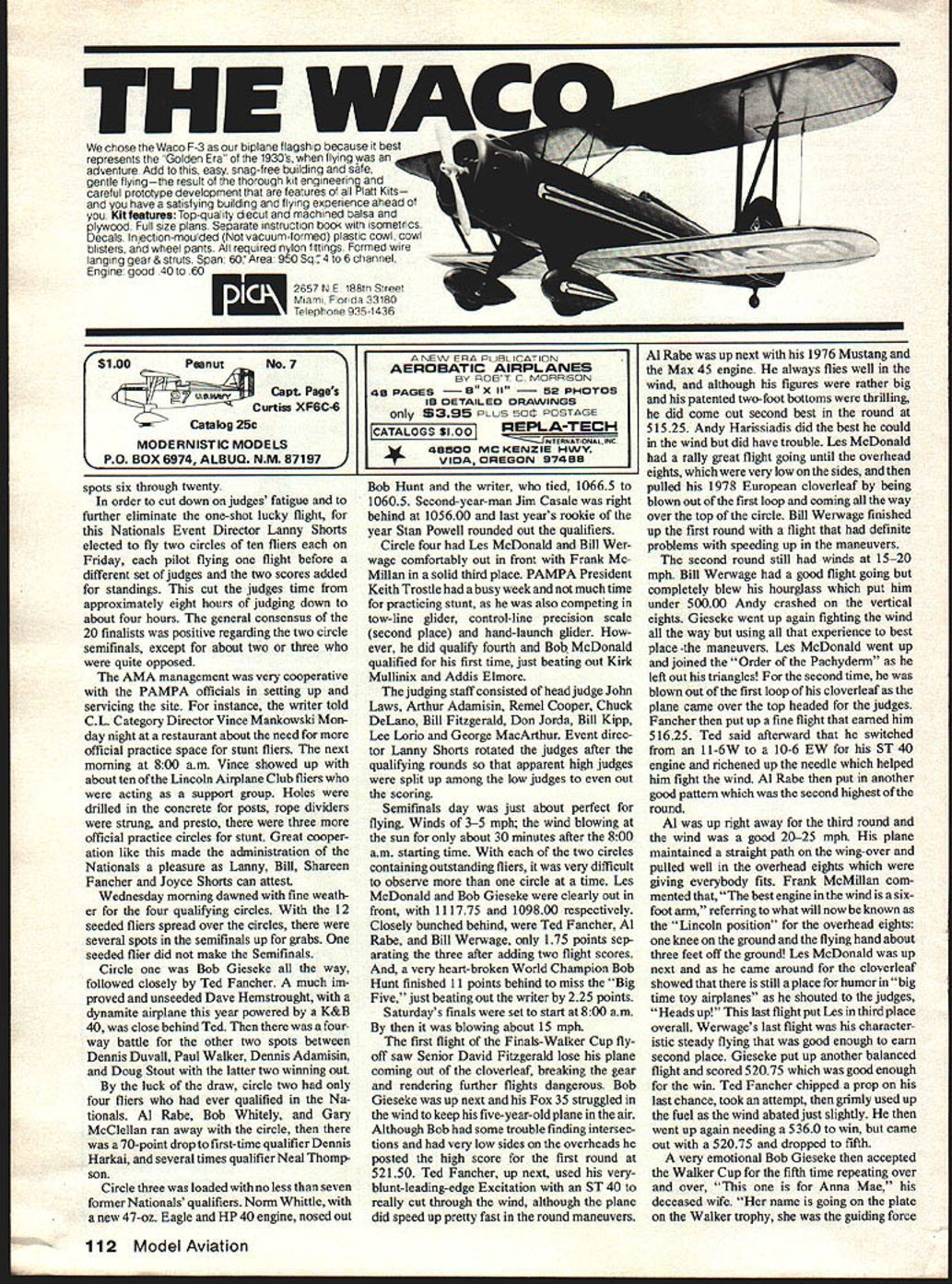
- Les McDonald's Stiletto — 18
- Stan Powell's Dove — 18
A large group of fliers received 17 points: Jim Casale, Ted Fancher, Dave Hemstrough, Bob Hunt, Kirk Mullinix, Arlie Preszler, Ed Prohaska, and Bill Werwage.
A rather long and pointless discussion raged on during the traditional pilots' meeting concerning how to score landings if the engine cuts before the mandatory two laps preceding the glide. The new Max engines also present a problem as they continue to freewheel after the engine stops firing, so that looking for the prop to stop turning is not the answer. About the only constructive result of this argument was to point out another portion of the stunt rules that needs careful rewriting. It is not necessary to change the rules, but clarification is needed for existing ones which will get event directors (all over the country, not just at the Nationals) off the fence.
PAMPA Format and Open Competition
The writer feels it is necessary to outline the format for Open competition and the advantages as developed by PAMPA. For years, Open qualifications consisted of two flights on one day with some number from 10 to 20 qualifying for the finals. There was so much complaining in 1976 at Dayton, when most fliers got only one flight due to weather, that something was needed.
Under PAMPA leadership, it was decided to try two days of qualifying, with the best one score from each day being added. Also, it was determined that picking the Open Champion from one flight on Friday's finals left too much up to chance and weather. It was decided to pick five top qualifiers from Friday's "Semifinals" to advance to the "Finals" on Saturday. In 1977 and 1978, the high score from two official flights on Friday was used to determine the top five qualifiers and to place spots six through twenty.
In order to cut down on judges' fatigue and to further eliminate a one-shot lucky flight, for this Nationals Event Director Lanny Shorts elected to fly two circles of ten fliers each on Friday, each pilot flying one flight before a different set of judges and the two scores added for standings. This cut the judges' time from approximately eight hours of judging down to about four hours. The general consensus of the 20 finalists was positive regarding the two-circle semifinals, except for about two or three who were quite opposed.
The AMA management was very cooperative with the PAMPA officials in setting up and servicing the site. For instance, the writer told C.L. Category Director Vince Mankowski Monday night at a restaurant about the need for more official practice space for stunt fliers. The next morning at 8:00 a.m. Vince showed up with about ten Lincoln Airplane Club fliers who acted as a support group. Holes were drilled in the concrete for posts, rope dividers were strung, and presto—there were three more official practice circles for stunt. Great cooperation like this made the administration of the Nationals a pleasure, as Lanny, Bill, Shareen Fancher and Joyce Shorts can attest.
Qualifying Circles
Wednesday morning dawned with fine weather for the four qualifying circles. With the 12 seeded fliers spread over the circles, there were several spots in the semifinals up for grabs. One seeded flier did not make the semifinals.
Circle one:
- Bob Gieseke all the way, followed closely by Ted Fancher.
- A much-improved and unseeded Dave Hemstrough, with a dynamite airplane this year powered by a K&B 40, was close behind Ted.
- A four-way battle for the other two spots between Dennis Duvall, Paul Walker, Dennis Adamsin, and Doug Stout resulted in Adamsin and Stout winning out.
Circle two:
- Al Rabe, Bob Whitely, and Gary McClellan ran away with the circle.
- There was then a 70-point drop to first-time qualifier Dennis Harkai, and several-times qualifier Neal Thompson.
Circle three:
- Norm Whittle, with a new 47-oz. Eagle and HP 40 engine, nosed out Bob Hunt and the writer, who tied 1066.5 to 1060.5.
- Jim Casale was right behind at 1056.00 and last year's rookie of the year Stan Powell rounded out the qualifiers.
Circle four:
- Les McDonald and Bill Werwage were comfortably out in front with Frank McMillan in solid third place.
- PAMPA President Keith Trostle had a busy week (also competing in tow-line glider, control-line precision scale—second place—and hand-launch glider) but qualified fourth.
- Bob McDonald qualified for his first time, just beating out Kirk Mullinix and Addis Elmore.
Judges and Semifinals
The judging staff consisted of:
- Head judge John Laws
- Arthur Adamsin
- Remel Cooper
- Chuck DeLano
- Bill Fitzgerald
- Don Jorda
- Bill Kipp
- Lee Lorio
- George MacArthur
Event director Lanny Shorts rotated the judges after the qualifying rounds so that apparent high judges were split up among the low judges to even out the scoring.
Semifinals day was just about perfect for flying: winds of 3–5 mph and the wind blowing at the sun for only about 30 minutes after the 8:00 a.m. starting time. With each of the two circles containing outstanding fliers, it was very difficult to observe more than one circle at a time. Les McDonald and Bob Gieseke were clearly out in front, with 1117.75 and 1098.00 respectively. Closely bunched behind were Ted Fancher, Al Rabe, and Bill Werwage—only 17.5 points separating the three after adding two flight scores. World Champion Bob Hunt finished 11 points behind to miss the "Big Five," just beating out the writer by 0.25 points.
Finals
Saturday's finals were set to start at 8:00 a.m. By then it was blowing about 15 mph.
First round:
- Senior David Fitzgerald lost his plane coming out of the cloverleaf, breaking the gear and rendering further flights dangerous.
- Bob Gieseke was up next; his Fox 35 struggled in the wind but he posted the high score for the first round at 521.50 despite trouble finding intersections and very low sides on the overheads.
- Ted Fancher used his very blunt-leading-edge Excitation with an ST 40 to cut through the wind, although the plane did speed up in the round maneuvers.
- Al Rabe, with his 1976 Mustang and Max 45 engine, flew well in the wind and posted 515.25.
- Andy Harissiades did the best he could in the wind but had trouble.
- Les McDonald had a great flight going until the overhead eights, which were very low on the sides; he was blown out of the first loop of the cloverleaf and the plane came over the top of the circle.
- Bill Werwage finished the first round with a flight that had problems with speeding up in the maneuvers.
Second round:
- Winds remained at 15–20 mph.
- Bill Werwage completely blew his hourglass, putting him under 500.00, and he crashed on the vertical eights.
- Gieseke fought the wind and used his experience to best place the maneuvers.
- Les McDonald again was blown out of the first loop of his cloverleaf and hit the ground.
- Fancher put up a fine final that earned him 516.25; he later said he switched from an 11-6 to a 10-6W prop for his ST 40 engine and credited the extra power for helping him fight the wind.
- Al Rabe put in another high pattern, the second-highest of the round.
Third round:
- Winds increased to a good 20–25 mph.
- Al Rabe's plane maintained a straight path on the wing-over and pulled well in the overhead eights, which were giving everybody fits.
- Frank McMillan commented, "The best engine in the wind is the six-foot arm," referring to what became known as the "Lincoln position" for the overhead eights—one knee on the ground and the flying hand about three feet off the ground.
- Les McDonald, in a humorous moment as he came around for the cloverleaf, shouted to the judges, "Heads up!" His last flight put him in third place overall.
- Werwage's last flight was steady and good enough to earn him second place overall.
- Gieseke put up another balanced flight and scored 520.75, which was good enough for the win.
- Ted Fancher chipped a prop on a last chance, used up the remaining air as the wind abated slightly, went up again but could not improve his score and dropped to fifth.
A very emotional Bob Gieseke accepted the Walker Cup for the fifth time, repeating over and over, "This one's for Anna Mae," his deceased wife. Her name is going on the plate on the Walker trophy; "She was the guiding force behind me all the way and this one's for her."
Bob was flying his 1974 plane, having crashed a new foam-winged Nobler in the spring. This plane has a wing from his 1968 plane that won the Nationals in 1968, 1974 and 1979. The wing is 51 inches in span and the entire plane was refinished in the spring after losing the foam-wing plane. Silkspan was applied and the plane weighs in at 43 oz., using the old standard Fox 35 and a Rev-Up 10-6W.
Bill Werwage finished second with his three-year-old Juno, an I-beam wing plane with an extensively reworked ST 46 engine. Of the five finalists only Ted Fancher had a new airplane, and he was the only finalist with a foam wing.
Engines and Equipment
The range of engines used this year was extensive:
- Fox 35 — Bob Gieseke (the only Fox 35 used in the top 20)
- ST 46 — eight in the top 20 (including 2nd, 7th, and 9th places)
- K&B 40 (series 75) — several, used by Powell, Hemstrough and Les McDonald who kept swapping parts and engines; Les ended up using a Grish 10-6 three-blade prop
- HP 40 — two in the top 20
- Max 45 FSR — two in the top 20
- Max 40 FSR — two in the top 20
- Max 35 — one in the top 20
- ST 40 — one in the top 20
All this suggests to the average stunt flier that there are a number of good engines that can be used successfully for stunt, and in a number of displacements.
PAMPA Banquet
The sixth annual PAMPA banquet was held Saturday night with 73 people in attendance. PAMPA president Keith Trostle presided and showed those assembled the Precision Aerobatics Jim Walker World Cup, emblematic of the World Team Championship and won by the U.S.A. ever since its inception in 1966. Event Director Lanny Shorts and assistant Bill Howe were applauded for their fine work all week.
The PAMPA Concours D'Elegance "Most Beautiful Stunt Plane," as voted by the pilots, was won this year by Les McDonald for his 1978 version of the famous Stiletto. The awards for Half-A Stunt, Junior, Senior and Open Stunt were presented to the recipients, and as is now the custom, the final presentation was the Walker Trophy to the 1979 National Champion Bob Gieseke.
Transcribed from original scans by AI. Minor OCR errors may remain.

