
AMA Nats Lincoln '79: CL Combat
Charlie Johnson
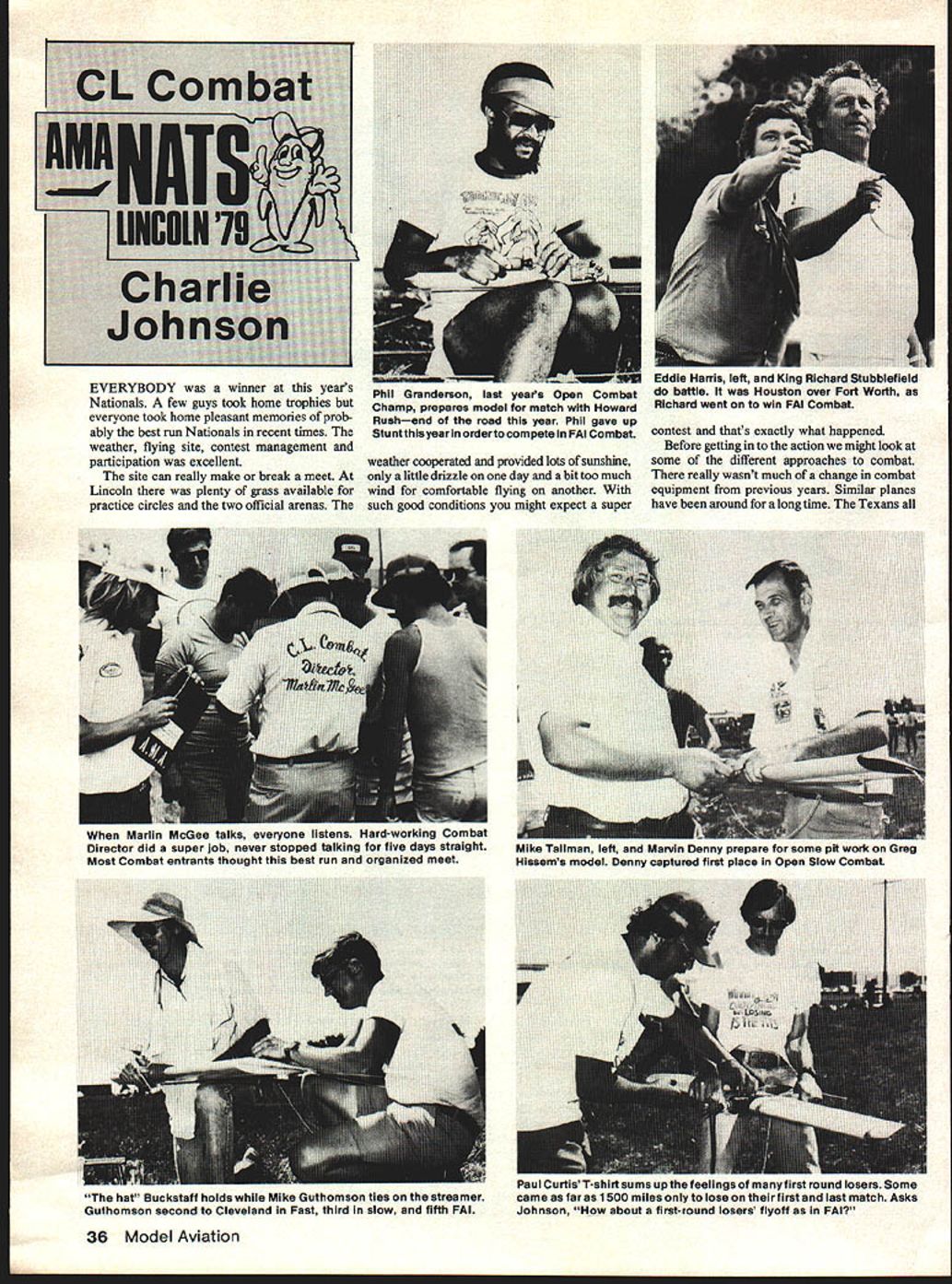
EVERYBODY was a winner at this year's Nationals. A few guys took home trophies but everyone took home pleasant memories of probably the best run Nationals in recent times. The weather, flying site, contest management and participation were excellent.
The site can really make or break a meet. At Lincoln there was plenty of grass available for practice circles and the two official arenas. The weather cooperated and provided lots of sunshine, only a little drizzle one day and a bit too much wind for comfortable flying on another. With such good conditions you might expect a super contest and that's exactly what happened.
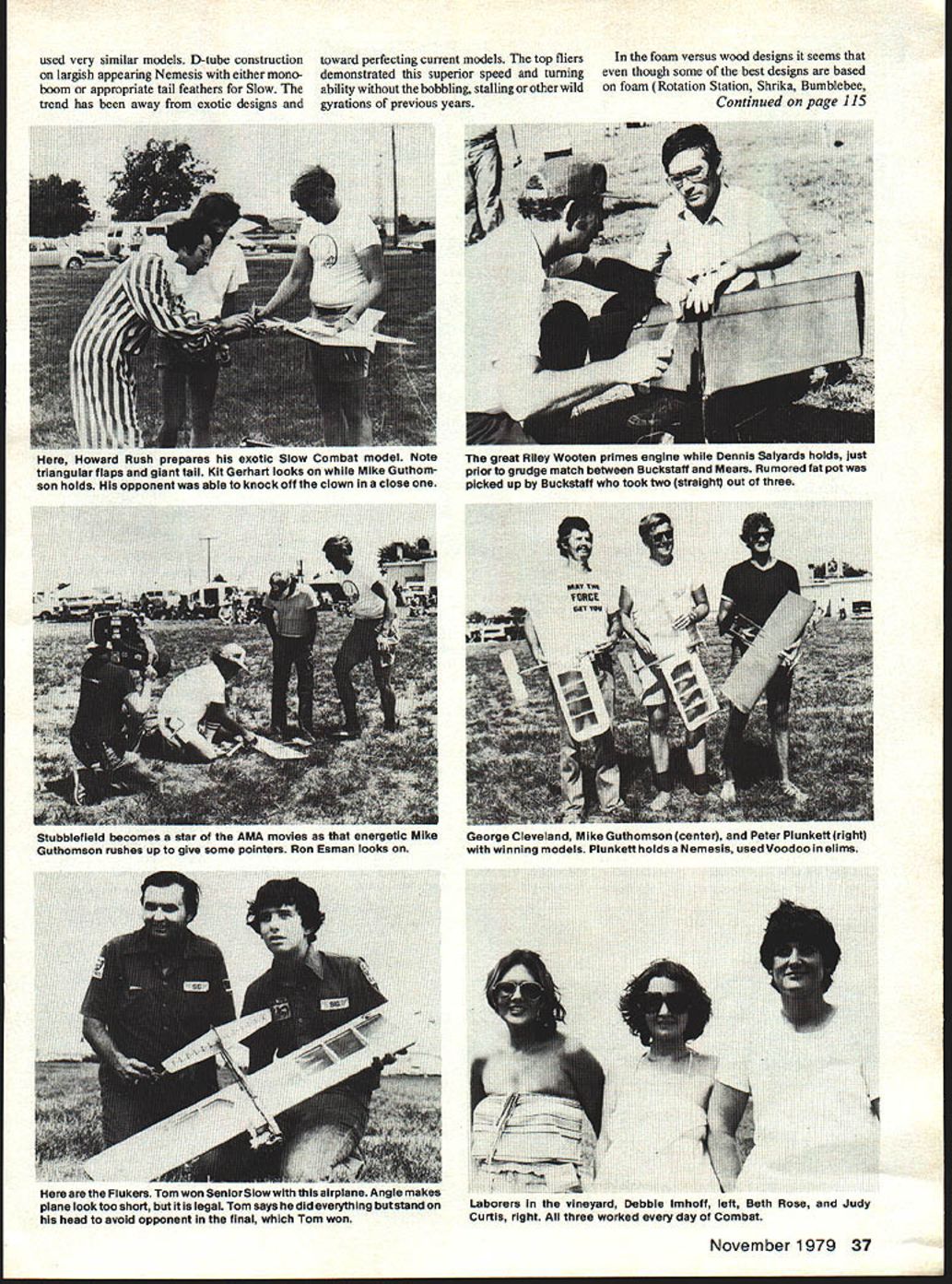
Before getting into the action we might look at some of the different approaches to combat. There really wasn't much of a change in combat equipment from previous years. Similar planes have been around for a long time. D-tube construction on largish-appearing Nemesis designs with either monobooms or appropriate tail feathers for Slow remains common. The trend has been away from exotic designs and toward perfecting current models. The top fliers demonstrated superior speed and turning ability without the bobbling, stalling or other wild gyrations of previous years.
In the foam versus wood designs it seems that even though some of the best designs are based on foam (Rotation Station, Shrika, Bumblebee, etc.), it was all wood in the winner's circle. Could be, if the Texans had used foam, it would have been the other way around.
The engine battle was a lopsided victory for Fox. Duke's motors took everything in sight, the notable exception being Mike Guthomson using a Tigre to place second in Open Fast Combat. Gary Fentress campaigned a Rossi in FAI and was the only non-Fox. The Fox 15 is becoming even more dominant in FAI since the engine is readily available, has plenty of parts, good fuel mileage and rarely blows. The motor generally was not thought of as being the ultimate powerhouse like a Rossi— that is, until this year. Stubblefield's Fox on 50% (the usual diet) was every bit as strong as the Rossi 15 used by Howard Rush burning 40%. A few other engines were tried in FAI including a very hard-charging Cox 15 tuned by Ron Young of Cox Manufacturing. Supertigre X-15s were also in the fray and ran very well. In fact, a TWA 36 turned out to be the real sleeper of the meet.
Engines in all classes were cranking out a lot of power and we know what happens sooner or later. This year it wasn't a shaft-blowing contest so much as who could hole a piston the best. The kerpow of a blown shaft was replaced by the sagging-popping sound of an engine turning its liner blue and ventilating the crankcase through the piston.
What made this Nationals so outstanding was the level of proficiency of the pilots. Piloting skills have really improved dramatically, especially in FAI Combat. Fast Combat found a high percentage of kills, too many mid-airs in Slow, and some world-class flying in FAI. There seemed to be two schools of thought in Fast Combat: one was that the faster you got it over with, the less chance there was for a mid-air or your opponent getting a shot at you. Howard Rush believed this strategy and proceeded to get the fastest kill of the meet.
The other theory goes something like this: let the guy fly around long enough and he'll beat himself, either by hitting the ground or flying in front of you. This worked to a lot of people's advantage whether intentional or not. John Jo (the Brasher killer) did a number on Howard Rush during eliminations that Howard would soon forget.
You can read the full results of who won what in the Competition News section. I'd like to comment on some of the more outstanding matches. Tom Fluker pulled out a tight one in Senior Slow Combat against David Owen. David really dominated the match and Tom did some excellent defensive work in winning the title. The big upset was found in Open Slow where Marvin Denny knocked off Richard Stubblefield for the win. Marvin said he'd been flying at the Nationals for 23 years and never taken a first in combat! Stubblefield was understandably disappointed since a win in Slow would have been the first jewel in the triple crown of Slow–Fast–FAI. Richard's comment was that second place didn't feel any better than fifth. When you're as good as Stubblefield you only want first.
Everyone was amused by Howard Rush (complete with clown suit) flying his Trick Streak in Slow. The picture that appears elsewhere can explain the fins and tail on this plane. Howard could best explain the aerodynamic advantages to this design. No one could explain Howard.
Stubblefield got his first win the next day in FAI Combat by trouncing all who dared combat him. The Texas team of Stubblefield–Buckstaff–Guthomson–Cleveland (George is an honorary Texan) took four of the six top spots. Their equipment is straightforward as is their flying technique: stay up for four minutes and get lots of cuts—nothing to it. The new down-time rules make it unwise to check out the turf too often if you want to win. The razzle-dazzle techniques work great if your opponent follows your fake.
Equipment-wise in FAI it was a Fox day and 50% in the tank. Airplanes are around 360 squares and 13 ounces. A lot of Taipan 7-4s were in evidence as well as about every prop made in the 7-4 to 7-5 range. A couple people used 7-5½ fiberglass Goodyear props, and these went well in level flight but didn't win any races. One of the best motors I saw was a Cox 15 tuned by Ron Young. Phil Granderson was using it in one of his planes and it ran very strong on only 20% nitro; it really needed 50% to do the job.
Open Fast has always been the big 'gun' of the Nationals. Everything else is just a warmup to the big one. The Texans had fleets of their fine models as did many of the other top groups. Rush had 35s in place of his Rossi 15 in his foam ships (had adapter plates). Foxes were everywhere. Les Pardue used a TWA 36 which turned out to be a real sleeper by out-powering everything. Duke Fox had a little look-see at this motor built by Glen Dye. The motor was sidelined with string from a streamer that wound up between the front bearing and drive washer (K&B 40-type front end). Joe Ambrose also used one of these motors with good success. You get good power and better dependability than a Fox but with a higher sticker price. Les also used a Kustom Kraftsman needle assembly coupled with a copper tubing fuel regulator à la Phil Granderson. The setup produced the broadest needle range short of a real regulator.
The first round really took its toll this year. Burch, Stubblefield, Buckstaff, Imhoff, Fentress, Segal, Curtis and many more became instant spectators. Marlin McGee was overjoyed because he now had lots of spare judges to fill in for his regular fine staff. The two schools of combat strategy I mentioned earlier clashed head-to-head in the third round. Colonel Rush was fresh from some quick kills and in this match he met John Jo, a person who likes to let you beat yourself (with a little help). Howard took two quick cuts off John but was faked into the ground following Jo through some Wilken's wiggles. While Rush checked out the landscape Jo accumulated enough airtime to win the match.
The same thing almost happened to Mike Guthomson when he faced John Jo. John usually starts his own engine so the Texans weren't really in a hurry to get going. Only this time Pat Wilcox rushed out at the last second and started Jo's engine, thus getting him into the air first. Mike took too much on line but dropped the sinker on John.
With Buckstaff and Stubblefield out in the first round, it looked dim for a Texas victory but Cleveland and Guthomson hammered their way to the finals with Cleveland's Fox overpowering Guthomson's Tigre. On their way to victory here's who the winners flew:
- Cleveland (Shaw, Baldus, Salyards, Pardue, Plunkett, Guthomson)
- Guthomson (Bye, Herd, Hissem, John Jo, Rogers; lost to Cleveland)
- Plunkett (Stubblefield, Tallman, Gutscher, Jaden; lost to Cleveland, beat Rogers for 3rd)
The end of Fast Combat was not quite the end of the excitement. Sherwood Buckstaff won a two-out-of-three match against Bob Mears for a cash prize reportedly in the dirt column. Looks like quite a rivalry between the West Texas folks and Houston-area fliers. Rumors spread of a special $5,000 match between the old master Riley Wooten and the Wizard Sherwood Buckstaff.
Much of the credit for this very successful meet must go to Combat Director Marlin McGee. Excellent job of organization and judging. Among many of the devoted officials in attendance were:
- Gayle McGee
- Rhonda and her father Rand Rozelle
- Judy Curtis
- Debbie Imhoff
- Beth Rose
- and many more who gave their time and energy to make something special of the Nationals.
A job well done, thanks.
Transcribed from original scans by AI. Minor OCR errors may remain.

